
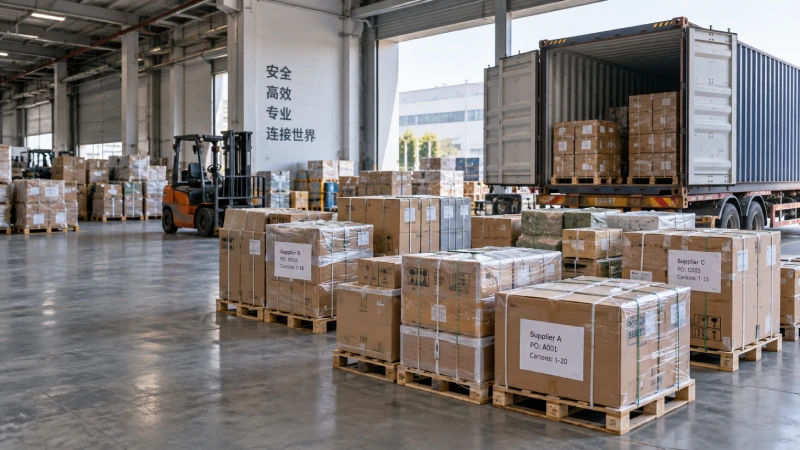
Buying from Alibaba is only the first part of getting goods from China to Kenya. Once you have selected a supplier, confirmed the product and agreed on the order, you still need to decide who will collect the cargo in China, whether different orders should be consolidated, which shipping method fits the shipment, what documents must be prepared, and how the goods will be cleared and delivered in Kenya.
This is where many first-time importers run into problems.
A supplier may give you a shipping price, but that price is difficult to evaluate unless you know the Incoterm, final packed dimensions, destination in Kenya, customs scope and what is excluded from the quotation. If you are buying from several Alibaba suppliers, the decision becomes more important because shipping each order separately may create unnecessary handling and coordination.
This guide focuses specifically on shipping Alibaba goods from China to Kenya after supplier selection. It does not cover how to find an Alibaba supplier, negotiate an MOQ or make payment. Instead, it explains the logistics decisions you need to make before the goods leave China.
Data Note: Freight rates, carrier schedules and import procedures can change. This guide focuses on shipment planning rather than publishing fixed freight rates. Product-specific Kenyan requirements should always be checked against the actual HS classification and current regulator guidance before shipment.
Quick Answer: How Do You Ship Alibaba Goods from China to Kenya?
After placing an Alibaba order, first confirm the Incoterm, supplier address, final packed carton dimensions, gross weight, cargo value, ready date and final destination in Kenya.
You can then compare three possible shipping arrangements:
- shipping organized by the Alibaba supplier;
- Alibaba.com Logistics, where available for the particular order;
- an independent freight forwarder coordinating the shipment from China.
For EXW orders or purchases from several Chinese suppliers, using one freight forwarder to coordinate pickup and consolidation can simplify the logistics chain.
Depending on the shipment size and urgency, the cargo may move by express courier, air freight, sea freight LCL or FCL.
Before shipping, also confirm Kenyan import requirements. Goods subject to Kenya’s PVoC program generally need the applicable conformity process before export. Kenya also applies Certificate of Origin requirements to imported consignments, subject to official exceptions and provisional measures. For applicable containerized cargo destined for Kenyan ports, KRA’s Advance Cargo Declaration system requires an ACD reference before loading.
The important point is simple:
Do not let the supplier ship simply because the goods are ready. Make sure the logistics scope and Kenya-side compliance requirements are clear first.
For a broader comparison of shipping methods, routes, costs and transit planning, see Shipping from China to Kenya.
Your Alibaba Order Is Ready: What Happens Next?
Alibaba connects the buyer and supplier, but the physical shipment still moves through a normal international freight process.
For a typical commercial shipment, the logistics chain looks like this:
Alibaba supplier → China pickup or warehouse delivery → consolidation if required → export handling → international freight → Kenya customs clearance → inland delivery
How much of this chain your supplier handles depends on the sales term and shipping arrangement.
There are usually three possibilities.
The Supplier Arranges the Shipment
The Alibaba supplier may provide a freight quotation together with the product order.
This can be convenient when you have:
- one supplier;
- a relatively straightforward shipment;
- small sample or courier cargo;
- no need to combine cargo from other factories.
But “the supplier can ship to Kenya” does not tell you enough.
You still need to know:
- What is the Incoterm?
- Is the shipment express, air freight, LCL or FCL?
- Where does the quoted service end?
- Are China origin charges included?
- Are Kenya destination charges included?
- Who coordinates customs clearance?
- Are duties and taxes included or excluded?
- Does the price include delivery to Nairobi or only arrival in Mombasa?
- Who is responsible for PVoC, CoC or other product approvals?
- Is cargo insurance included?
A cheap-looking supplier freight quote can become expensive if important destination costs are outside the original price.
Alibaba.com Logistics Is Used
Alibaba.com also operates logistics services for eligible orders and destinations. Alibaba describes its logistics offering as a way to connect buyers with logistics services and shipment visibility.
However, eligibility and service availability depend on the individual order. Check what is actually available for your transaction rather than assuming every Alibaba purchase includes an Alibaba-operated logistics option.
You Appoint Your Own Freight Forwarder
The third option is to separate product purchasing from freight management.
In this structure:
- you buy the goods from the Alibaba supplier;
- you provide the supplier information to your freight forwarder;
- the forwarder coordinates collection or warehouse delivery in China;
- different supplier orders can be consolidated if required;
- the forwarder arranges the selected international freight method;
- Kenya-side customs and delivery arrangements are coordinated according to the agreed scope.
This is particularly useful when several Alibaba suppliers are involved because the international shipment can be planned around the combined cargo, rather than treating every supplier order as a separate shipment.
Alibaba Supplier Shipping vs an Independent Freight Forwarder
There is no universal rule that says supplier shipping is always more expensive or that an independent freight forwarder is always cheaper.
The right question is:
Are you comparing the same logistics service?
A supplier may quote only transport from a Chinese port to Mombasa, while another forwarder may quote factory pickup, warehouse handling, consolidation, ocean freight and inland delivery.
Those prices should not be compared as if they are identical.
| Situation | Supplier-Arranged Shipping | Independent Freight Forwarder |
|---|---|---|
| One small supplier | Can be convenient | Useful for an independent comparison |
| Several suppliers | Coordination may be fragmented | Can centralize pickup and consolidation |
| EXW order | Buyer must arrange more origin logistics | Forwarder can coordinate supplier pickup |
| FOB order | Supplier handles the agreed FOB-side obligations | Buyer controls the main international freight |
| Small urgent shipment | Supplier courier option may work | Forwarder can compare express or air options |
| Door delivery | Scope needs careful confirmation | Scope still needs careful confirmation |
| Regulated cargo | Compliance must still be checked | Compliance must still be checked |
Compare the Full Shipping Scope, Not Just the Number
When comparing two Alibaba shipping quotations, confirm that both quotes use the same:
- supplier pickup point;
- Incoterm;
- number of cartons;
- total gross weight;
- dimensions or total CBM;
- freight method;
- destination;
- customs-clearance scope;
- duty and tax treatment;
- inland delivery scope;
- insurance basis.
For example, these are not equivalent:
EXW Foshan → Nairobi door
and
FOB Shenzhen → Mombasa port
The first quote starts much earlier in the supply chain and ends much later.
A lower freight number does not automatically mean a lower total landed logistics cost.
Compare My Shipping Setup
If you already have a supplier quotation, compare it against the actual Incoterm, cargo dimensions and Kenyan destination rather than comparing freight prices in isolation.
Check the Incoterm Before Comparing Alibaba Shipping Quotes
Two of the most common terms buyers encounter when purchasing goods from Chinese suppliers are EXW and FOB.
The difference matters because it determines where the supplier’s delivery responsibility ends and where the buyer’s logistics responsibility starts.
EXW: Your Logistics Responsibility Starts Earlier
Under EXW, the seller makes the goods available at the agreed location, often the supplier’s factory or warehouse.
Under the formal Incoterms framework, EXW places the main collection and transport responsibility on the buyer after the goods have been made available. ICC also notes that EXW can create practical difficulties in international transactions.
In a China-to-Kenya shipment, an EXW arrangement may therefore require coordination of:
- pickup from the supplier;
- factory loading arrangements;
- transport to the export warehouse or terminal;
- China export procedures;
- international freight;
- destination processing.
This is why the factory location matters.
An EXW supplier in Guangzhou and an EXW supplier in Yiwu do not have the same China-side logistics cost, even if their international freight eventually leaves through the same general route.
FOB: Confirm the Named Port and Actual Handover Point
With FOB, the seller has more responsibility on the export side, including export clearance, before delivery occurs onboard the vessel at the agreed port.
If an Alibaba quotation says:
FOB Shenzhen
you should still confirm:
- which port or terminal is intended;
- when the cargo will be ready;
- what documents the supplier provides;
- whether there are any additional costs before the agreed FOB handover.
There is also an important detail for containerized freight.
ICC guidance indicates that FCA may be a more appropriate rule for containerized cargo when the seller hands the goods to the carrier at a terminal before the container is actually loaded onboard the vessel, whereas FOB formally sets delivery onboard the ship.
For an importer, the practical lesson is not to argue over Incoterms terminology with every Alibaba supplier.
Instead, confirm the actual handover point:
Where exactly does the supplier’s responsibility end, and where does your freight arrangement start?
That answer is more useful for comparing logistics costs.
Get the Right Cargo Details from Your Alibaba Supplier
A freight quotation is only as reliable as the shipment information used to calculate it.
One of the most common mistakes when shipping Alibaba goods to Kenya is requesting freight rates using the product dimensions shown on the Alibaba listing.
Those dimensions may describe the individual product rather than the final export carton.
Freight planning needs the packed shipment.
Before asking for a freight quote, request:
- product description;
- total product quantity;
- number of cartons, crates or pallets;
- dimensions of each carton or package;
- total gross weight;
- total CBM, if available;
- commercial value;
- supplier pickup address;
- Incoterm;
- expected cargo-ready date;
- packaging type;
- final destination in Kenya.
Also disclose whether the cargo contains:
- lithium batteries;
- standalone batteries;
- liquids;
- chemicals;
- aerosols;
- magnets;
- engines or equipment containing fluids;
- other potentially dangerous goods.
For machinery or unusually large cargo, send the dimensions and weight of each individual package rather than only the shipment total.
Why Packed Dimensions Matter
Consider a machine whose Alibaba product page lists dimensions of:
70 × 50 × 90 cm
After export packing, however, the supplier may place it in a crate measuring:
85 × 65 × 110 cm
The second measurement is what matters to the freight calculation.
For air freight, dimensions can affect chargeable weight.
For LCL, packing dimensions affect CBM.
For FCL, they affect container planning.
For oversized cargo, they may determine whether standard container loading is possible at all.
Whenever possible, request the supplier’s final packing list or final packed dimensions before confirming the shipping arrangement.
Shipping from One Supplier vs Multiple Alibaba Suppliers
One of the biggest advantages of planning Alibaba logistics separately from the purchase itself is the ability to coordinate several Chinese suppliers.
If you are buying from only one supplier, the process may be simple:
Supplier → pickup or forwarder warehouse → export → Kenya
If you are buying from three or four suppliers, you may instead use a consolidation process.
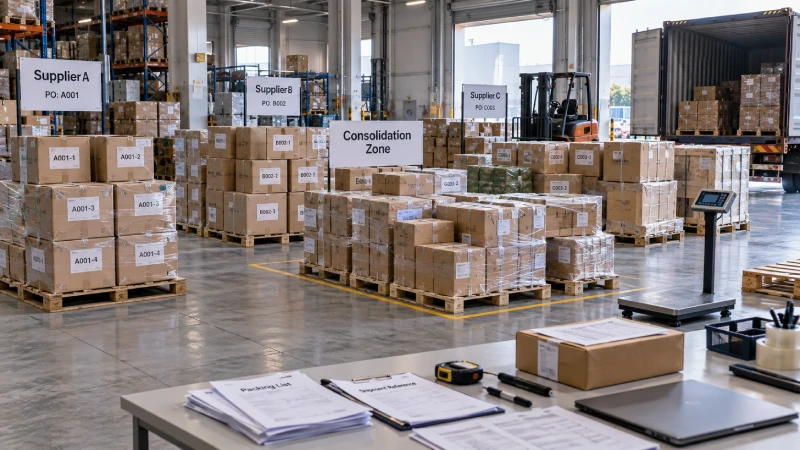
How Multiple-Supplier Consolidation Works
Imagine you buy:
- lighting products from a supplier in Guangzhou;
- furniture from a supplier in Foshan;
- accessories from a supplier in Shenzhen.
Instead of asking each supplier to arrange separate international freight to Kenya, the goods can potentially be delivered or collected into one agreed China warehouse.
The process may look like this:
- Create a supplier list.
- Give the forwarder each supplier’s address and contact information.
- Assign a PO or shipment reference to each supplier.
- Confirm when each order will be ready.
- Arrange warehouse delivery or pickup.
- Record the cartons received from each supplier.
- Check visible package condition and shipment marks.
- Confirm final dimensions and weights.
- Consolidate the cargo.
- Arrange the international shipment.
This can simplify international freight coordination because one shipment plan is created after the different orders have been brought together.
However, consolidation should not automatically be assumed to save money.
The calculation still depends on:
- supplier locations;
- domestic China trucking;
- warehouse handling;
- storage time;
- cargo volume;
- final freight method.
A forwarder should compare the actual shipment rather than claiming that consolidation is always cheaper.
Warehouse Receiving Is Not the Same as Product Inspection
This distinction is important.
A consolidation warehouse may be able to check operational details such as:
- number of cartons received;
- external carton condition;
- shipping marks;
- package dimensions;
- gross weight.
That does not automatically mean the products inside have undergone quality inspection.
If you require:
- quantity verification inside cartons;
- product testing;
- functional inspection;
- specification checking;
- pre-shipment quality control;
that work should be arranged separately and defined clearly before the supplier releases the cargo.
Pro Tip: Give each supplier a clear warehouse shipping mark before dispatch, for example: Buyer Name / PO Number / Supplier Code / Carton 1 of 10. This makes mixed-supplier cargo much easier to identify and reconcile.
Plan My Consolidated Shipment
If you are buying from several Alibaba suppliers, prepare the supplier addresses, cargo-ready dates and estimated carton information before deciding whether to ship separately or consolidate in China.
Express, Air, LCL or FCL: Which Method Fits an Alibaba Order?
The best shipping method cannot be selected simply because you purchased through Alibaba.
It depends on the actual cargo.
| Shipment Situation | Method Usually Worth Checking First |
|---|---|
| Samples or very small urgent orders | Express |
| Commercial cargo where speed matters | Air freight |
| Moderate-volume cargo that does not fill a container | LCL sea freight |
| Large-volume or container-scale cargo | FCL sea freight |
Express Freight
International express courier services can work well for:
- samples;
- replacement parts;
- urgent small orders;
- smaller, straightforward parcels.
Convenience is the main advantage.
However, once cargo becomes larger or heavier, compare courier pricing with conventional air freight rather than assuming express remains the best option.
Air Freight
Air freight is commonly considered for commercial shipments that need to move faster than sea freight.
It can be suitable for:
- higher-value goods;
- urgent replenishment;
- electronics;
- spare parts;
- relatively compact commercial shipments.
For air cargo, chargeable weight matters. A lightweight but bulky shipment can therefore cost more than its actual scale weight suggests.
This is another reason to obtain final carton dimensions from the Alibaba supplier.
LCL Sea Freight
LCL, or Less than Container Load, is useful when the cargo is suitable for sea freight but does not justify booking an entire container.
It is particularly relevant for Alibaba buyers who:
- purchase from several suppliers;
- are moving wholesale quantities;
- have several cubic meters of cargo;
- can accept a longer transport cycle than air freight.
The cargo shares container space with other shipments.
LCL costs should not be judged only by an advertised “per CBM” number because the total shipment may also involve China origin handling, consolidation, documentation and Kenya destination charges.
FCL Sea Freight
FCL becomes relevant when the cargo reaches container-scale volume or when operational control makes a dedicated container preferable.
Depending on the cargo, options may include different container sizes and equipment types.
The decision should be based on:
- packed cargo volume;
- package dimensions;
- cargo weight;
- loading feasibility;
- value;
- risk of handling;
- LCL versus FCL total cost.
For a detailed country-level comparison of sea, air, express and other options, use our Shipping from China to Kenya guide rather than trying to choose a mode from Alibaba’s product page alone.
Kenya Compliance to Check Before Your Alibaba Supplier Ships
This is one of the most important parts of the process.
A supplier telling you that the cargo is ready does not necessarily mean the goods are ready to enter Kenya.
Some compliance steps need to be addressed before export.
Check Whether PVoC and a Certificate of Conformity Apply
The Kenya Bureau of Standards operates the Pre-Export Verification of Conformity (PVoC) program.
KEBS explains that PVoC is performed in the exporting country to determine whether covered products meet applicable Kenyan technical regulations and mandatory standards. KEBS also states that importers should ensure their suppliers understand Kenya’s import quality requirements and that goods subject to the PVoC program obtain the required Certificate of Conformity through appointed agents.
For an Alibaba order, this means compliance should be discussed before the supplier ships.
Do not assume:
“The supplier exports to Africa, so they know Kenya requirements.”
Instead, confirm:
- the exact product;
- proposed HS classification;
- whether the product is subject to PVoC;
- whether another Kenyan regulator is involved;
- what testing or documentation is needed;
- who will coordinate the conformity process;
- whether the required certificate will be available before shipment.
KEBS currently lists China within its PVoC contractor allocation. Because agency allocations and procedures can change, verify the current KEBS list for the actual shipment rather than relying on an old supplier contact.
Confirm the Certificate of Origin
Kenya’s Certificate of Origin requirement is another item that should not be left until cargo arrival.
KRA states that the mandatory COO requirement took effect on July 1, 2025, with full enforcement from October 1, 2025, while also listing specific exceptions and provisional alternatives for exceptional cases.
For a normal commercial Alibaba shipment, ask early:
- Who is the exporting party?
- Can the required Certificate of Origin be arranged?
- Does the invoice identify the exporter correctly?
- Are the commercial documents consistent?
Do not assume an Alibaba order confirmation substitutes for customs documentation.
The commercial purchase record and the documents required for physical import clearance serve different purposes.
Check the Advance Cargo Declaration Requirement for Containerized Sea Cargo
KRA announced that its Advance Cargo Declaration (ACD) platform for containerized cargo destined for Kenyan ports went live on August 3, 2026.
According to KRA, the shipper or exporter must obtain an ACD reference code at the port of loading before applicable containerized cargo is loaded. The platform requires documents including:
- draft Bill of Lading;
- commercial invoice;
- freight invoice;
- export declaration.
The resulting reference code must then appear on the Bill of Lading before the shipment proceeds to Kenya.
For an Alibaba importer, the operational lesson is important:
Your invoice, export documents and freight booking should not be treated as separate tasks that will somehow be corrected after departure.
They need to be coordinated before loading.
Operational Warning: Do not ask an Alibaba supplier to “ship first and send the documents later” when regulatory or pre-loading documentation is required. Missing or inconsistent documentation can create problems that are far harder to fix once the cargo is already moving.
Product-Specific Regulation Still Needs Separate Checking
PVoC is not the only possible requirement.
Depending on the goods, additional Kenyan regulators or permits may apply.
Examples that should trigger further review include:
- food and agricultural products;
- medical products;
- chemicals;
- cosmetics;
- electrical products;
- telecommunications equipment;
- vehicles;
- batteries;
- controlled or restricted goods.
The correct approach is to start with the exact product and HS classification, then verify the current requirement.
Do not rely on a supplier’s statement that:
“Other customers shipped this product before.”
A supplier’s previous shipment to another country does not confirm Kenyan compliance.
Documents Needed for an Alibaba Shipment to Kenya
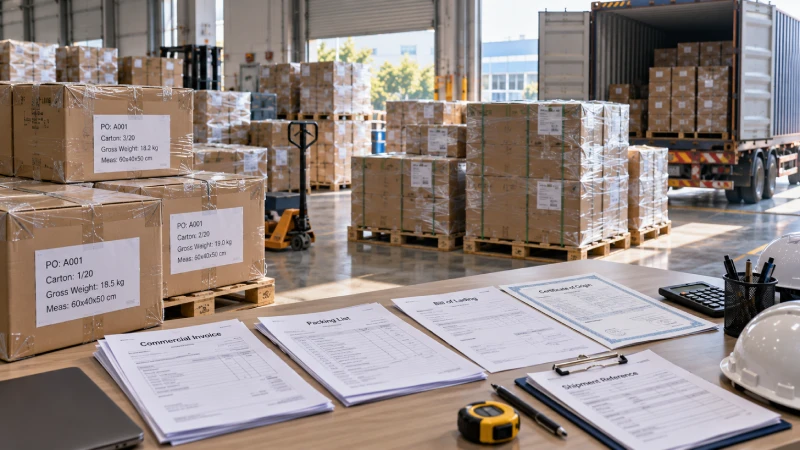
For customs and compliance purposes, your Alibaba purchase eventually has to become a proper international trade documentation set.
KRA’s import guidance lists documents including the commercial invoice, packing list, Bill of Lading or Air Waybill, Certificate of Origin and, for regulated goods, a Certificate of Conformity. Permits or licences may also be required for restricted goods.
A practical document matrix looks like this:
| Document / Information | Usually Comes From | Main Purpose |
|---|---|---|
| Commercial invoice | Supplier or exporter | Product description, value and transaction information |
| Packing list | Supplier | Cartons, weights, packing and quantities |
| HS classification information | Importer or clearing agent using product data | Customs and regulatory assessment |
| Bill of Lading | Carrier or forwarder | Sea transport document |
| Air Waybill | Airline or forwarder | Air transport document |
| Certificate of Origin | Appropriate export-side issuing process | Evidence of origin |
| CoC, where applicable | PVoC conformity process | KEBS compliance |
| Freight invoice | Carrier or forwarder | Freight cost and documentation support |
| Export declaration | China export process | Export and ACD documentation |
| Product-specific permit | Relevant importer or regulator process | Controlled goods where applicable |
Make the Commercial Invoice Specific
Avoid vague product descriptions such as:
- accessories;
- goods;
- parts;
- equipment;
- samples.
Use a commercially meaningful description that accurately identifies the product.
This helps with:
- HS classification;
- customs review;
- regulatory review;
- document consistency.
The commercial invoice, packing list and shipping documents should also agree on basic information such as package count, product description and shipment parties.
Do Not Let the Supplier Decide the HS Code Alone
The supplier can provide product information and may suggest an HS code based on its export experience.
But Kenya’s tariff classification should be checked against the actual goods and Kenyan customs requirements.
The same broad marketing description can cover products with different classifications.
Incorrect HS classification can affect:
- import duty;
- VAT or other taxes;
- permits;
- standards requirements;
- customs declaration;
- clearance risk.
For that reason, provide sufficient technical product information to the Kenya clearing side before the goods arrive.
What Happens After Alibaba Goods Reach Kenya?
The next stage depends on whether the cargo arrives by sea, air or courier and what destination you agreed in the freight contract.
For commercial imports, KRA’s import guidance says imported goods such as machinery and general merchandise require engagement of a licensed customs clearing agent. The clearing agent processes the import declaration and coordinates the customs procedure using the import documents provided by the importer.
A simplified sea-freight process may look like this:
Vessel arrival → cargo and manifest processing → customs and regulatory processing → duties, taxes and applicable approvals → cargo release → inland movement
The exact procedure depends on the cargo and declaration.
Sea Freight Through Mombasa
For most conventional sea freight to Kenya, Mombasa is the country’s key container gateway.
Kenya Ports Authority describes the Port of Mombasa as a major gateway serving Kenya and the wider East African hinterland, with dedicated container-terminal infrastructure.
If your business is in Mombasa, your inland requirement may be relatively straightforward after clearance.
If your warehouse is in Nairobi, however, “shipping to Kenya” is still not a sufficiently precise destination.
You need to determine how the cargo will move inland.
Mombasa vs Nairobi ICD
Kenya Ports Authority operates the Nairobi Inland Container Depot, which is linked directly with Mombasa by rail.
KPA states that imports can move from Mombasa to its inland depots under Through Bill of Lading arrangements, and that Nairobi ICD is connected to Mombasa by rail services. The facility handles both containerized and loose cargo.
This means a Nairobi-based importer should ask more than:
“How much is shipping from Alibaba to Kenya?”
A useful quotation request should specify the destination, for example:
- Mombasa;
- Nairobi ICD;
- Nairobi commercial warehouse;
- final door address in Nairobi;
- another Kenyan city.
Those are different logistics scopes.
Final Delivery After Customs Release
Once the shipment is released, inland transport may be arranged to:
- warehouse;
- wholesale shop;
- factory;
- project site;
- distribution centre;
- another Kenyan city.
For heavier or unusual cargo, delivery planning should include:
- truck type;
- unloading equipment;
- access restrictions;
- forklift or crane requirements;
- site opening hours.
Do not wait until the container or truck arrives at the destination before discovering that there is no equipment available to unload the cargo.
Port, DAP, DDP or Door Delivery: Know What the Quote Actually Includes
Terms such as door-to-door can sound simple but may describe different commercial scopes.
Always ask what the quote specifically includes.
| Arrangement | Question to Ask |
|---|---|
| Port or airport service | Who handles Kenya clearance and delivery after arrival? |
| DAP | Who completes import formalities and pays duties and taxes? |
| DDP | Who legally performs the import obligations and what costs are included? |
| Door delivery | Does “door” include customs and taxes or only delivery after clearance? |
DAP
Under DAP, the seller or service provider arranges transport to the agreed destination, but import clearance and import duties generally remain the buyer’s responsibility under the Incoterms structure.
The actual agreement should still identify the named place clearly.
“Kenya DAP” is too vague.
“Nairobi, Kenya” is better, but the precise delivery location is better still.
DDP
DDP transfers much more responsibility to the seller under Incoterms, including import-side obligations.
That makes it attractive to buyers who want a simple delivered price, but it also means the operational and legal setup needs to be realistic.
For Kenya, do not accept a DDP promise without understanding:
- who handles import clearance;
- whose importer information is used;
- whether the product is permitted;
- whether PVoC or other certificates are required;
- how duties and taxes are handled;
- whether local destination charges are included;
- whether delivery is to an actual commercial address.
A forwarding company should not promise DDP feasibility for every Alibaba product before checking these points.
Check Door-to-Door Feasibility
Provide the product, value, packing details, supplier location and final Kenyan delivery city before deciding whether port, DAP, DDP or another door-to-door arrangement is appropriate.
Common Alibaba Shipping Mistakes That Create Extra Cost
The freight method itself is often not what causes problems.
The problems usually start earlier, from incomplete information or unclear responsibilities.
1. Comparing Only the Shipping Price
A USD figure is meaningless without its scope.
Compare:
- origin;
- destination;
- Incoterm;
- mode;
- local charges;
- customs scope;
- inland delivery.
2. Getting a Freight Quote Before Final Packing
Supplier estimates may change after production.
If your cargo becomes larger after packing, the final freight calculation can change too.
Request packed dimensions.
3. Shipping Before Checking Kenya Compliance
PVoC, product permits, COO and other documentation should be checked while the cargo is still in China, not after it arrives in Kenya.
4. Assuming Alibaba Automatically Handles the Freight
The goods may be purchased through Alibaba while the freight is arranged by:
- the supplier;
- Alibaba.com Logistics, where available;
- an independent freight forwarder.
Know which party you are actually dealing with.
5. Letting Every Supplier Ship Separately
If you have several Chinese suppliers, compare separate shipments against consolidation before finalizing bookings.
Do not consolidate automatically, but do evaluate it.
6. Comparing EXW and FOB Prices as If They Are the Same
An EXW quote starts at a different responsibility point from an FOB quote.
Normalize the service scope before deciding which is cheaper.
7. Using Vague Invoice Descriptions
Descriptions such as “parts” or “accessories” can create unnecessary classification questions.
Describe the real goods accurately.
8. Invoice and Packing List Do Not Match
Quantities, packages and product details should be internally consistent.
Document discrepancies are easier to correct before departure.
9. Contacting the Kenya Clearing Side Too Late
For a commercial shipment, customs planning should not start only after the vessel or aircraft arrives.
Your clearing side may need documents and product information in advance.
10. Forgetting the Final Inland Destination
Mombasa, Nairobi ICD and Nairobi door delivery are different scopes.
Tell the forwarder where you actually need the cargo.
11. Assuming DDP Solves Every Import Responsibility
A DDP label does not make product regulations disappear.
The shipment still has to comply with Kenyan import rules.
12. Failing to Declare Special Cargo
If your Alibaba order contains:
- batteries;
- liquids;
- chemicals;
- aerosols;
- magnets;
- dangerous goods;
- oversized equipment;
tell the forwarder at the quotation stage.
The correct shipping method, documentation, carrier acceptance and packing requirements may be different.
What to Send Before Requesting a Shipping Quote
If your Alibaba order is already in production or nearly ready, you can speed up the logistics process by preparing the following information.
Supplier Information
- supplier name;
- supplier city;
- pickup address;
- supplier contact;
- EXW, FOB or other Incoterm;
- one supplier or multiple suppliers.
Cargo Information
- product name;
- quantity;
- number of cartons or pallets;
- dimensions of each package;
- total gross weight;
- total CBM if known;
- cargo value;
- cargo-ready date.
Special Cargo Information
Tell the forwarder whether the goods contain:
- batteries;
- chemicals;
- liquids;
- magnets;
- engines;
- pressure containers;
- dangerous materials;
- unusually large or heavy packages.
Kenya Destination
Specify whether you need:
- Mombasa;
- Nairobi ICD;
- Nairobi warehouse or door;
- another Kenyan destination.
Service Requirement
Indicate whether you need help with:
- China supplier pickup;
- several-supplier consolidation;
- express shipping;
- air freight;
- LCL;
- FCL;
- export handling;
- document coordination;
- Kenya customs coordination;
- inland delivery.
The more precise this information is, the easier it becomes to compare realistic shipping options.
Send Cargo Details
For an Alibaba shipment, send the supplier location, Incoterm, product, number of packages, packed dimensions, gross weight, cargo value and Kenyan destination. If several suppliers are involved, include each supplier separately.
Final Checklist Before an Alibaba Order Leaves China
Before approving shipment, work through this checklist.
Cargo
- Supplier has confirmed production is complete.
- Final carton count is available.
- Final packed dimensions are available.
- Gross weight is confirmed.
- Special or dangerous cargo has been disclosed.
Commercial Terms
- Incoterm is confirmed.
- Named pickup or delivery point is clear.
- Supplier shipping and forwarder quotations use comparable scopes.
- International freight mode is confirmed.
- Insurance requirements have been considered.
Documents
- Commercial invoice is accurate.
- Packing list matches the cargo.
- Product description is specific.
- HS classification has been reviewed for Kenya.
- Certificate of Origin arrangements are confirmed.
- Bill of Lading or Air Waybill information will be checked before final issuance.
Compliance
- PVoC applicability has been checked.
- CoC is being arranged where required.
- Product-specific permits have been checked.
- ACD arrangements are confirmed for applicable containerized cargo.
- Kenya clearing agent has the necessary shipment information.
Destination
- Mombasa vs Nairobi vs final door is clearly defined.
- Customs-clearance responsibility is clear.
- Import duties and tax responsibility is clear.
- Final inland delivery scope is agreed.
- Unloading arrangements have been checked for heavy cargo.
If several of these questions are unanswered, the cargo may not yet be ready to ship even if the supplier says production is complete.
FAQ
Can my Alibaba supplier ship directly to Kenya?
Yes. Some suppliers can arrange international freight, and Alibaba.com Logistics may also be available for eligible orders. You can also appoint an independent freight forwarder. Before accepting any option, confirm the Incoterm, shipping mode, final destination and which origin and Kenya-side charges are included.
Is it better to use my Alibaba supplier’s shipping agent or my own freight forwarder?
Neither option is automatically better. Supplier-arranged freight can be convenient for one straightforward order, while an independent forwarder may be useful for multiple suppliers, consolidation or comparing different freight methods. Compare both on the same cargo details, Incoterm and destination.
Can I combine goods from several Alibaba suppliers before shipping to Kenya?
Yes. Different supplier orders can potentially be collected or delivered to one warehouse in China and consolidated before international shipping. Whether this is economical depends on supplier locations, China-side transport, warehouse handling and the final shipment size.
What information should I ask my Alibaba supplier for before arranging shipping?
Request the final carton count, packed carton dimensions, total gross weight, total CBM if available, product description, commercial value, pickup address, Incoterm and cargo-ready date. Special cargo such as batteries, chemicals or liquids should also be disclosed.
Do Alibaba goods need PVoC or a Certificate of Conformity for Kenya?
It depends on the product. Goods covered by Kenya's PVoC program should follow the applicable conformity process before export and obtain the required CoC where applicable. Check the exact product and current KEBS requirements before shipping.
Does an Alibaba order need a Certificate of Origin for Kenya?
Kenya applies a Certificate of Origin requirement to imported consignments, subject to official exceptions and provisional measures. For a normal commercial shipment, confirm the COO arrangement before the goods leave China.
Can Alibaba goods be delivered directly to Nairobi?
Yes. Sea cargo commonly enters through Mombasa, after which the shipment can move inland according to the booked arrangement, including routes involving Nairobi ICD or final delivery in Nairobi. Specify the actual Nairobi destination when requesting shipping.
