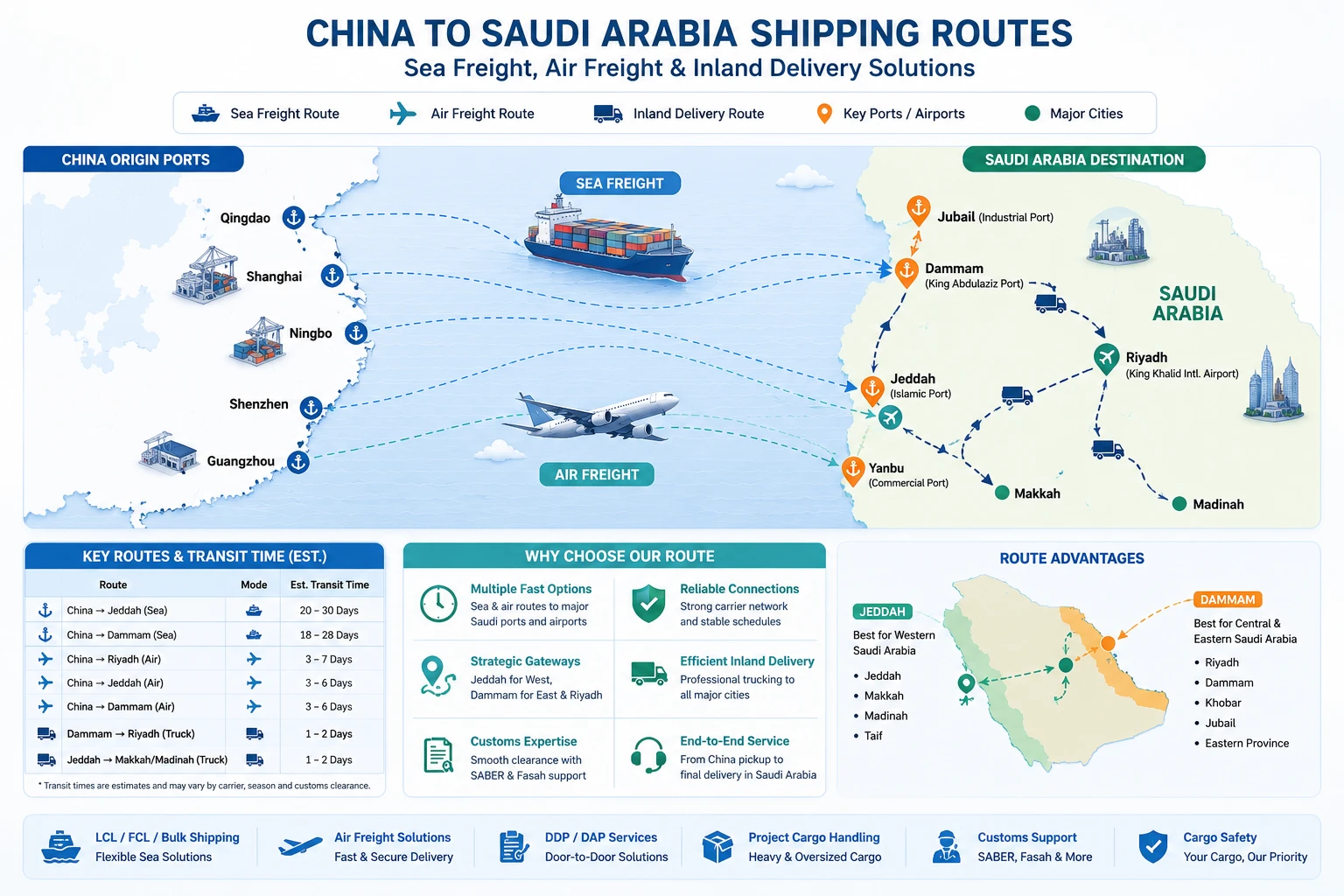

Ship from China to Saudi Arabia: Freight Cost, Transit Time & Customs Guide
Shipping Snapshot: China → Saudi Arabia (October 2025)
As of October 2025, China–KSA freight remains active on both Jeddah (JED) and Dammam (DMM) lanes. Spot ocean pricing has firmed versus late summer, while air is stable-to-soft for bulk brackets. Express remains route- and fuel-surcharge dependent.
Latest snapshot (indicative)
| Mode | Indicative Rate (USD) | Average Transit Time |
|---|---|---|
| LCL Sea Freight | $50–$110 / CBM (some offers ≈$25/CBM) | 22–35 days (port-to-port) |
| FCL 20GP | $1,400–$2,000 / container | 20–30 days |
| FCL 40HQ | $1,900–$2,600 / container | 20–30 days |
| Air Freight (100–1000+ kg) | $4.0–$6.5 / kg | 3–6 days (airport-to-airport) |
| Express Courier | ~$6–$12 / kg | 2–5 days (door-to-door) |
| Indicative only. Final all-in quotes depend on origin port, carrier, season, HS code, and whether destination & inland delivery are included. | ||
Market insights (Oct ’25)
-
Ocean: Rates stabilized after late-summer softness; expect mild peak-season firming on JED/DMM lanes.
-
Air: Space available, but electronics/apparel lanes can tighten ahead of Q4—bulk brackets (≥1000 kg) price best.
-
Express: Fuel surcharges updated monthly; check carrier tools for exacts (DHL SA 2025 guide).
Freight Cost from China to Saudi Arabia
Shipping costs involve much more than just the freight rate. When importing from China into Saudi Arabia, you’ll need to factor in export handling, international transport, destination charges, clearance, taxes, insurance, and possibly inland delivery. A clear cost-breakdown helps avoid nasty surprises.
🔍 Cost Components Breakdown
-
Origin / Export Charges — Supplier pickup, packaging, export customs, documentation in China.
-
International Freight — Sea, air, express rates (based on route, cargo type, volume/weight).
-
Destination / Import Charges — Port handling, unloading, customs brokerage, local trucking.
-
Customs Duty & VAT — Duty (often on CIF value) + VAT in Saudi Arabia.
-
Insurance & Special Handling — Valuable goods, perishables, dangerous goods escalate cost.
-
Inland Delivery & Final Mile — From port/airport in Saudi to buyer’s warehouse/distribution centre.
📊 Example Cost Scenarios (Indicative, October 2025)
| Cargo Type | Shipping Mode | Route Example | Estimated Cost (USD) | Transit Time |
|---|---|---|---|---|
| 1 CBM / 200 kg electronics | LCL Sea Freight | Shenzhen → Jeddah | $25 – $50 / CBM | 22 – 35 days |
| 20′ GP standard load | FCL Sea Freight | Shanghai → Dammam | $1,950 / 20GP | ≈ 20 – 30 days |
| 40′ HQ full container | FCL Sea Freight | Ningbo → Jeddah | $2,350 / 40HQ | ≈ 20 – 30 days |
| 500 kg garments | Air Freight | Guangzhou → Riyadh | $4.0 – $6.5 / kg | 3 – 6 days |
| 50 kg urgent samples | Express Courier | Shenzhen → Dammam | ≈ $6 – $12 / kg | 2 – 5 days |
| Indicative only — actual rates vary by origin port, carrier, cargo type, season (Ramadan/Hajj), and whether destination handling and inland delivery are included. | ||||
⚠️ Cost-Saving Tips & Common Pitfalls
-
Consolidate multiple small shipments into one container to reduce per-unit cost for LCL/air.
-
Verify all-in quotes: ask forwarder to specify if destination handling, customs, and inland delivery are included.
-
Beware “too cheap” quotes: extremely low CBM/ton rates may exclude key fees (port surcharges, docs, inspections).
-
Plan by cargo type: fragile, high-value or regulated goods cost more (insurance/special handling).
-
Watch seasons: Just before major religious holidays (e.g., Hajj, Ramadan), or product restocking peaks — carrier/space surcharges may apply.
-
Currency / tax shifts: Saudi VAT or new customs rules can change landed cost quickly — always verify current duty + VAT for your HS code.
Import Tax & Duties in Saudi Arabia
Importing goods from China into the Kingdom of Saudi Arabia (KSA) requires full compliance with tax, duty and regulatory rules. Below is a detailed guide as of October 2025.
🔹 Standard Customs Duty Structure
- Duties are calculated based on the CIF value (Cost + Insurance + Freight).
- Typical rates for many consumer and industrial goods are 5 % to 12 % of CIF.
- Some sensitive or protected-industry goods face higher duty rates: up to 25 % in certain cases.
- Example: From 16 July 2024, specific electrical equipment and apparatus had duty increased from 5 % to 15 %.
🔹 Value-Added Tax (VAT) on Imports
- The standard VAT rate in Saudi Arabia is 15 % (for most goods and services) since 1 July 2020.
- All imported goods (unless specially exempted) are subject to this 15 % VAT, regardless of whether customs duty applies.VAT is applied on the customs value + any customs duty.
🔹 Required Documents & Regulatory Items
- Commercial Invoice: with clear product description, HS codes, unit price, total value.
- Packing List: dimensions, gross/net weights, packaging type.
- Bill of Lading (B/L) or Air Waybill (AWB).
- Certificate of Origin (CO): may be required for preferential duty or free-trade treaties.
- Regulatory Certificates: Certain goods must comply with KSA standards via Saudi Standards, Metrology and Quality Organization (SASO) or other authorities.
- Import permit / license: For regulated goods — electronics, telecoms, medical devices, chemicals, lithium batteries etc.
⚠️ Practical Tips & Avoiding Pitfalls
- HS Codes accuracy matters: Misclassification can lead to wrong duty rate, delays or fines.
- Check product-specific duty changes: E.g., electrical goods whose duty rose to 15 % as of July 2024. (see above)
- Preferential / exemption regimes: Some goods may qualify for lower duty or 0 % within GCC / free zones — confirm with forwarder/customs.
- Advance cost estimation: When quoting landed cost to buyer, include duty + VAT + clearance / local handling.
- Keep documentation for audits: Saudi authorities require accurate, verifiable documents — both for customs & VAT compliance. Recent VAT regulations also tighten refund/credit requirements.
| HS Code / Category | Product Description | Customs Duty Rate | Notes |
|---|---|---|---|
| 8504 / 8536 (Electrical switches, plugs, connectors) | Switches, fuses, surge protectors, plugs & junction boxes | 15 % | Increased from 5% to 15% effective 16 July 2024 |
| General consumer / industrial goods | Non-sensitive consumer or industrial items | 5% – 12% | Most typical items imported into KSA |
| Basic food / agricultural items | Staple foods, bulk agricultural raw materials | 5% or duty-free | Some goods exempt when local production low |
| Clothing / textiles (non-luxury) | Standard garments, textiles | ≈ 5% | Examples show this typical band |
| Luxury / high-end consumer goods | Luxury furniture, high-end electronics, designer goods | Up to 25% | Used for protected or luxury categories |
| These are sample rates. Duty for your specific goods depends on HS code, origin, trade agreements & Saudi tariff schedule. Use ZATCA Integrated Tariff search for precise figure. | |||
Shipping Time from China to Saudi Arabia
Transit times between China and Saudi Arabia vary significantly depending on shipping mode, route, consolidation, customs clearance, and final delivery. Here’s an updated guide for October 2025.
| Shipping Mode | Average Transit Time | Notes |
|---|---|---|
| FCL Sea Freight (port-to-port) | 20–30 days | Direct sailings from major ports. |
| LCL Sea Freight (port-to-port) | 25–38 days | Includes consolidation/de-consolidation time. |
| Air Freight (airport-to-airport) | 3–7 days | Dependent on route, customs clearance. |
| Express Courier (door-to-door) | 2–5 days | Small parcels, premium service. |
| Door-to-Door Services | Sea: 28–40 days Air: 7–12 days |
Inclusive of last-mile delivery. |
| Times are indicative. Final in-transit time depends on origin port, route, service quality, and last-mile delivery. Always confirm per-shipment schedule. | ||
🔹 Key Factors That Affect Shipping Time
-
Port of Origin & Destination: Larger Chinese ports (Shanghai, Ningbo, Shenzhen) tend to have more direct sailings. Saudi ports like Jeddah can get congested during peak weeks.
-
Service Type & Routing: Direct vessels/air routes are faster; transshipment or multi-leg routings add time.
-
Customs Clearance & Documentation: Missing or incorrect paperwork is a frequent cause of delay at both sides.
-
Seasonality & Holidays: Peak import seasons, religious holidays, or high volume retail periods (pre-Hajj, pre-Ramadan, Q4) can slow down loading, sailing, clearance.
-
Cargo Type & Consolidation: LCL shipments, or those with unusual size/weight/dangerous goods, tend to move slower.
-
Last-Mile Delivery: Inland trucking in Saudi Arabia (especially remote areas) adds time; logistics in Riyadh vs coastal airports differ.
✅ Best Options by Business Priority
-
Fastest — Express Courier (2-5 days) for urgent small parcels.
-
Most Reliable — Air Freight (3-7 days) for time-sensitive shipments with manageable cost/volume.
-
Best Value — FCL Sea Freight (20-30 days) for bulk, non-urgent shipments.
⚠️ Pro Tip
Always build in a buffer of 5–10 days during peak seasons or for LCL shipments. Ask your freight forwarder for route-specific average in-transit time (not just ideal).
Door-to-Door Shipping (DDP vs DAP) to Saudi Arabia
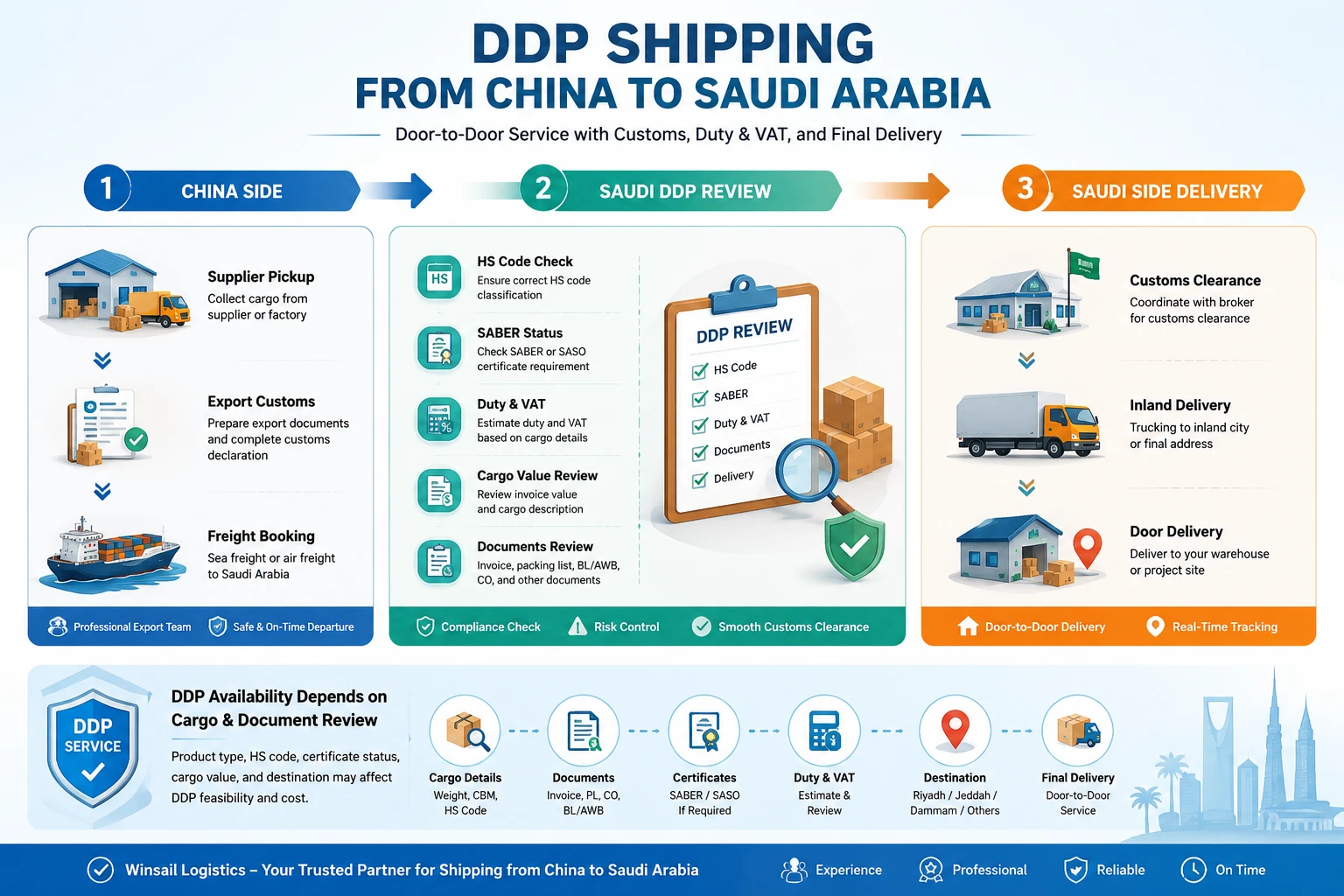
For many importers into Saudi Arabia, the most straightforward logistics option is door-to-door shipping — meaning pickup at the Chinese factory/warehouse, international movement, customs clearance in Saudi Arabia, and last-mile delivery to your warehouse or site.
| Term | Seller Responsibility | Buyer Responsibility | Best For |
|---|---|---|---|
| DDP (Delivered Duty Paid) | Pickup in China, export customs, freight, Saudi duties & VAT, import clearance, final delivery | Receive goods at agreed location | Buyers who want full convenience and predictable cost |
| DAP (Delivered at Place) | Pickup in China, export customs, freight to agreed place in Saudi | Saudi import clearance, duties & VAT, local last-mile delivery | Experienced importers with local customs/broker setup |
| Confirm all fees & responsibilities in writing. A clear quote should specify “to warehouse / to factory / to port gate / excluding duties” etc. | |||
✅ Why This Matters
-
Clarity of cost and risk: Knowing which party handles duties, clearance and delivery avoids hidden charges or delays.
-
Simplified logistics: DDP takes most responsibility off the buyer; DAP gives more control but also more tasks.
-
Compliance & documentation: Under DDP, you rely heavily on your forwarder’s local network in Saudi; under DAP, you must ensure correct customs brokerage in-country.
⚠️ Pro Tips & Considerations
-
Ensure your contract clearly states which place of delivery is included (warehouse, factory yard, port gate) to avoid ambiguity.
-
Under DDP, check that your logistics partner is capable of Saudi import clearance & tax payment, especially for regulated goods. ([turn0search1]…)
-
Under DAP, buyer should have or arrange for a licensed customs broker in Saudi Arabia ahead of arrival to avoid delays.
-
Compare all-in quotes: For each quote ask “Does this include duties, VAT, customs, last-mile delivery to Riyadh/Jeddah/Dammam?”
-
For high-value/sensitive cargo, ensure insurance covers door-to-door risks, not just port-to-port.
Sea Freight from China to Saudi Arabia
Sea freight is the most common and cost-efficient option for moving cargo between China and Saudi Arabia. With regular sailings from major Chinese ports — Shanghai, Ningbo, Shenzhen, Qingdao and Guangzhou — to Jeddah Islamic Port and King Abdulaziz Port (Dammam), importers can choose between Full Container Load (FCL) and Less than Container Load (LCL) depending on cargo volume and urgency.
🔹 FCL vs LCL: Which to Choose?
| Shipping Type | Volume & Weight | Cost Structure | Avg. Transit Time | Best For |
|---|---|---|---|---|
| FCL (Full Container Load) | 20 GP ≈ 28 CBM / 25 t · 40 HQ ≈ 68 CBM / 28 t | Fixed cost per container | 20 – 30 days | High-volume shipments, machinery, bulk goods |
| LCL (Less than Container Load) | 1 – 15 CBM typical | Charged per CBM (min. 1 CBM) | 25 – 38 days | Small / medium shipments, mixed cargo |
🔹 Indicative Sea Freight Rates (October 2025)
| Route | 20′ GP | 40′ HQ | LCL / CBM | Est. Transit |
|---|---|---|---|---|
| Shanghai → Jeddah | $1,450 – $1,900 | $2,200 – $2,700 | $55 – $100 / CBM | 22 – 30 days |
| Ningbo → Dammam | $1,500 – $1,950 | $2,250 – $2,850 | $60 – $110 / CBM | 25 – 35 days |
| Shenzhen → Jeddah | $1,600 – $2,000 | $2,400 – $2,950 | $65 – $120 / CBM | 25 – 35 days |
| Rates are indicative only. Final cost depends on carrier, season, origin port, and whether destination charges are included. | ||||
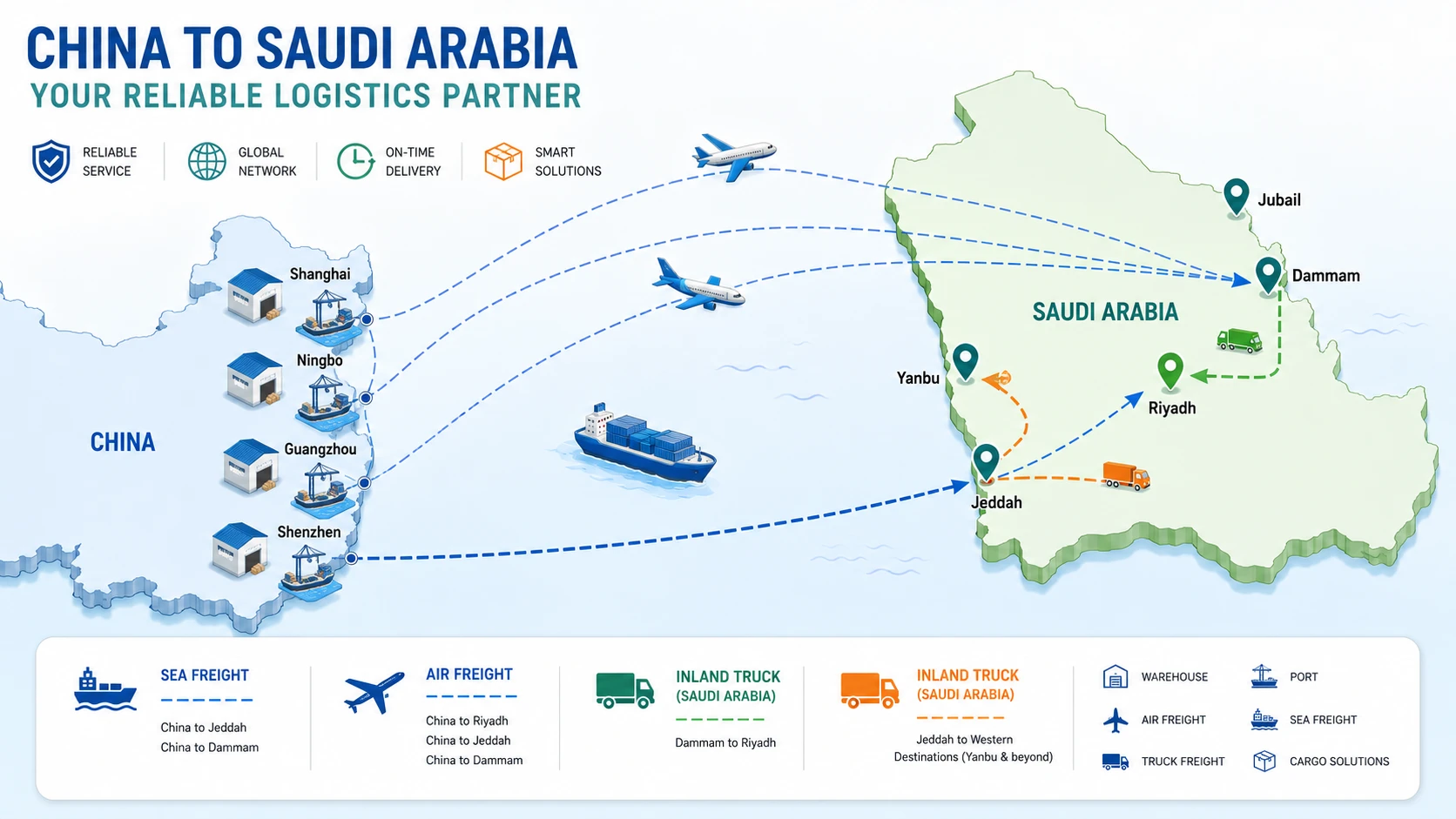
🔹 Recommended Port Pairs
- China Origins → Shanghai (CNSHA), Ningbo (CNNGB), Shenzhen (CNSZX), Guangzhou (CNCAN)
- Saudi Destinations → Jeddah Islamic Port (AEJED) – West Coast | King Abdulaziz Port (Dammam) – East Coast
- For Riyadh or central Saudi deliveries, Dammam + inland rail/truck is often faster.
⚠️ Practical Tips for Sea Freight
- Plan ahead for Ramadan / Hajj / Q4 peak season — space and sailing frequency tighten quickly.
- Consolidate LCL cargo to avoid over-minimum charges and multiple D/O fees.
- Check D/O + DTHC fees (Jeddah / Dammam often billed separately by terminal operator).
- Use moisture-proof packaging for electronics, machinery and wood products due to high humidity in transit.
- Request “all-in” quotes with clearly stated origin + destination charges to compare forwarders accurately.
Air Freight from China to Saudi Arabia
For time-sensitive, high-value, or small-volume shipments, air freight from China to Saudi Arabia is the fastest and most reliable option.
Regular flights operate between major Chinese air hubs — Guangzhou (CAN), Shanghai Pudong (PVG), Shenzhen (SZX), and Beijing (PEK) — and Saudi Arabia’s Riyadh (RUH), Jeddah (JED), and Dammam (DMM) airports.
As of October 2025, commercial air cargo space has normalized post-peak season, though rates remain higher than pre-2020 averages due to persistent fuel surcharges and capacity controls.
🔹 Air Freight Service Options
| Service Type | Typical Rate (USD/kg) | Transit Time | Best For |
|---|---|---|---|
| Standard Air Freight | $4.5 – $6.5 / kg | 3 – 7 days | General cargo, regular replenishment |
| Priority / Express | $6.5 – $9.0 / kg | 2 – 5 days | Urgent, fashion, electronics |
| Economy Air Freight | $3.8 – $5.0 / kg | 6 – 10 days | Bulk, cost-sensitive shipments |
| Door-to-Door (DDP) | $7.0 – $12 / kg (all-in) | 7 – 12 days | SMEs needing full service |
🔹 Key Routes & Airlines
| Route | Airlines | Transit Type | Est. Duration |
|---|---|---|---|
| Guangzhou → Riyadh | Saudia Cargo, China Southern | Direct | 3 – 5 days |
| Shanghai → Jeddah | Saudia Cargo, Emirates SkyCargo, SF Airlines | Direct / 1-stop | 4 – 6 days |
| Shenzhen → Dammam | Emirates, Qatar Cargo | 1-stop via DXB/BAH | 5 – 8 days |
| Beijing → Riyadh | Saudia Cargo, Etihad | 1-stop | 4 – 7 days |
| Rates are indicative averages (Oct 2025). Confirm with carrier or forwarder for precise schedule and volumetric pricing. | |||
🔹 Volume Weight Calculation (Chargeable Weight)
Most air freight rates are based on the chargeable weight, calculated as either:
How to Calculate Chargeable Weight:
Chargeable Weight (kg) = the greater of Gross Weight or Volumetric Weight
Volumetric Weight (kg) = (Length × Width × Height) ÷ 6000
Example:
A box measuring 100 × 80 × 60 cm = 480,000 cm³ ÷ 6000 = 80 kg.
If the actual weight is 60 kg, you’ll be charged for 80 kg (the higher value).
Express Shipping from China to Saudi Arabia
For samples, e-commerce parcels, or urgent small cargo, express courier shipping is the fastest way to move goods from China to Saudi Arabia.
Global couriers like DHL, FedEx, UPS, and Aramex provide reliable door-to-door delivery, handling pickup, export paperwork, customs clearance, and final delivery within 2–7 days depending on service type and destination city.
Express shipping costs are based on chargeable weight (the greater of actual or volumetric weight), and often include fuel surcharges, remote area fees, and customs clearance handling.
🔹 Typical Express Delivery Times (as of Oct 2025)
| Courier | Transit Time | Coverage | Notes |
|---|---|---|---|
| DHL Express | 3 – 5 days | Riyadh, Jeddah, Dammam, Khobar | Fastest, reliable customs clearance |
| FedEx International Priority | 4 – 6 days | Nationwide | Strong on east coast; slightly lower cost |
| UPS Worldwide Expedited | 5 – 7 days | Industrial zones, business addresses | Stable, predictable B2B service |
| Aramex Express | 5 – 8 days | Full GCC coverage | Economical and strong local presence |
🔹 Indicative Price Reference (Door-to-Door, Oct 2025)
| Weight Bracket | DHL | FedEx | UPS | Aramex |
|---|---|---|---|---|
| 0 – 5 kg | $45 – $70 | $40 – $65 | $38 – $60 | $30 – $55 |
| 5 – 10 kg | $8.0 – $10.0 / kg | $7.5 – $9.5 / kg | $7.0 – $9.0 / kg | $6.0 – $8.5 / kg |
| 10 – 20 kg | $6.5 – $8.5 / kg | $6.0 – $8.0 / kg | $5.8 – $7.8 / kg | $5.0 – $7.5 / kg |
| 20 – 50 kg | $6.0 – $7.5 / kg | $5.5 – $7.0 / kg | $5.3 – $6.8 / kg | $4.5 – $6.5 / kg |
| 50 kg + | Custom quotation required — rates vary by pickup city and volume | |||
| Rates are average estimates. Check each courier’s calculator or your forwarder’s account for live quotes and surcharges. | ||||
🔹 Why Choose Express Shipping
✅ Fastest option available — direct pickup and customs clearance handled by courier.
✅ All-inclusive pricing — includes export declaration, fuel, and clearance support.
✅ Ideal for samples, prototypes, urgent documents, or online store fulfillment.
✅ End-to-end tracking via courier’s website or API integration.
⚠️ Key Considerations
-
Declare correct product value: undervaluing can lead to customs holds.
-
Avoid prohibited items such as batteries (unless UN-certified), liquids, powders, or high-value electronics without documentation.
-
Check “Remote Area Surcharge (RAS)”: applies to smaller towns beyond Riyadh, Jeddah, or Dammam.
-
Use commercial invoice + packing list with clear HS codes to speed up clearance.
-
For multiple parcels, consider consolidated express (bulk DHL/FedEx via freight forwarder) — 20–40 % cheaper for same transit time.
Key Ports & Airports: China ↔ Saudi Arabia
Efficient shipping between China and Saudi Arabia relies on well-connected seaports and airports.
Choosing the right port pair or air hub can shorten transit times, reduce costs, and simplify customs handling.
Below is an overview of the most commonly used gateways for sea freight and air freight between the two countries.
🔹 Major Seaports in China (Export Origins)
| Port | Port Code | Strengths | Routes to KSA |
|---|---|---|---|
| Shanghai Port | CNSHA | Largest port with global routes | Direct to Jeddah, Dammam |
| Ningbo-Zhoushan Port | CNNGB | High throughput, stable schedules | To Dammam (King Abdulaziz Port) |
| Shenzhen (Yantian) Port | CNSZX | Ideal for South China electronics | Via Singapore or Colombo to Jeddah/Dammam |
| Guangzhou (Nansha) Port | CNCAN | Serves Pearl River Delta exporters | Transshipment to Red Sea routes |
| Qingdao Port | CNTAO | Main North China gateway | To Dammam; longer route but cost-effective |
🔹 Major Seaports in Saudi Arabia (Import Destinations)
| Port | Port Code | Location | Description |
|---|---|---|---|
| Jeddah Islamic Port | SAJED | Red Sea (West Coast) | Handles ~65% of KSA imports; ideal for western & central regions |
| King Abdulaziz Port (Dammam) | SADMM | Arabian Gulf (East Coast) | Main port for Riyadh and Eastern industrial zones |
| Yanbu Industrial Port | SAYBI | Red Sea | Specialized in petrochemicals & bulk cargo |
| Jubail Commercial Port | SAJUB | Arabian Gulf | Focus on oil, gas, heavy industry exports |
🔹 Major Airports — China ↔ Saudi Arabia
| Country | Airport | Code | Description |
|---|---|---|---|
| China | Shanghai Pudong (PVG) | PVG | Main air cargo hub with direct flights to JED/RUH |
| China | Guangzhou Baiyun (CAN) | CAN | High capacity for electronics, e-commerce |
| China | Shenzhen Bao’an (SZX) | SZX | Strong for express and high-tech shipments |
| Saudi Arabia | King Khalid Intl (Riyadh) | RUH | Largest cargo airport in KSA |
| Saudi Arabia | King Abdulaziz Intl (Jeddah) | JED | Main gateway for western KSA |
| Saudi Arabia | King Fahd Intl (Dammam) | DMM | Ideal for Eastern Province industrial deliveries |
🔹 Choosing the Right Port or Airport
✅ For Western KSA (Jeddah / Mecca / Medina):
→ Ship via Jeddah Islamic Port or JED airport for fastest clearance.
✅ For Central & Eastern KSA (Riyadh / Dammam):
→ Use King Abdulaziz Port (Dammam) for sea freight or RUH / DMM for air freight.
✅ For Heavy Equipment or Bulk Goods:
→ Prefer Yanbu or Jubail (specialized ports for industrial shipments).
✅ For High-Value or Time-Sensitive Cargo:
→ Ship from PVG / CAN / SZX → RUH / JED, depending on region and airline options.
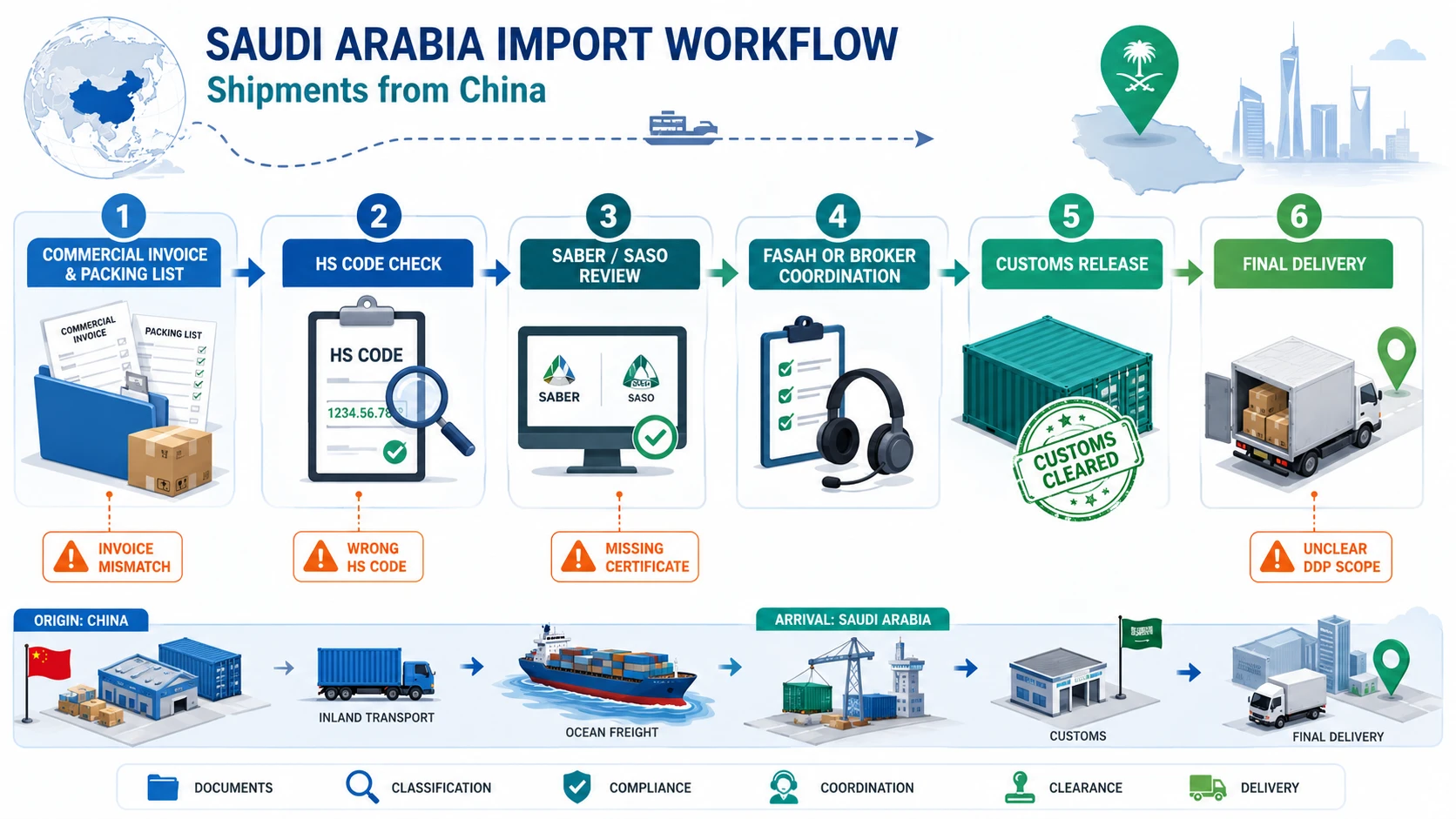
How to Ship from China to Saudi Arabia: 6 Steps
Shipping from China to Saudi Arabia involves multiple parties — supplier, freight forwarder, carrier, and customs — but with a clear plan, the process is smooth and predictable.
Here’s a simplified 6-step guide showing exactly how importers and exporters can move goods efficiently while staying compliant with Saudi regulations.
Step 1: Confirm Product & Documentation
Before shipping, ensure all paperwork and compliance requirements are in order.
-
Confirm the HS code and corresponding duty rate in Saudi Arabia (ZATCA tariff search).
-
Ensure the product meets SASO / SABER certification if applicable (for electronics, machinery, building materials, etc.).
-
Prepare core documents:
-
Commercial Invoice
-
Packing List
-
Certificate of Origin (CO)
-
Export Declaration (in China)
-
Any required inspection / test reports
-
Pro Tip: For e-commerce or samples under $270 USD, simplified invoices may be accepted by courier services.
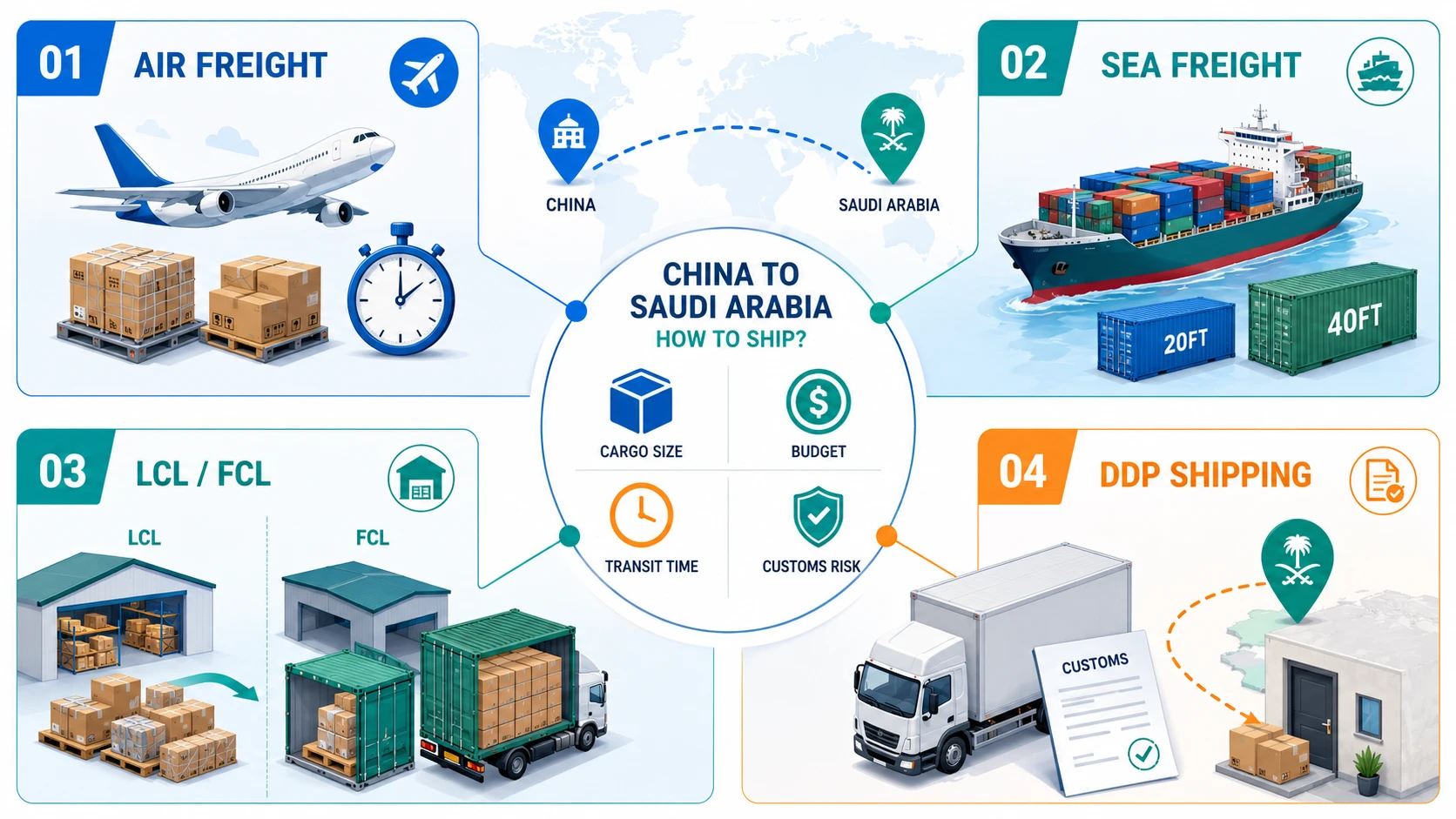
Step 2: Choose the Right Shipping Method
Select a mode based on budget, urgency, and shipment size:
| Shipment Type | Recommended Mode | Transit Time | Typical Use |
|---|---|---|---|
| Small parcels (1–50 kg) | Express (DHL/FedEx/UPS/Aramex) | 3–7 days | Samples, e-commerce, documents |
| Mid-size cargo (100–500 kg) | Air Freight | 4–8 days | Electronics, perishable goods |
| Bulk / containers | Sea Freight (FCL / LCL) | 20–35 days | Machinery, furniture, large orders |
| High-value or turnkey | Door-to-Door (DDP) | 7–40 days | SMEs without local import agent |
Pro Tip: During Ramadan or Hajj season, book earlier — carrier space becomes limited.
Step 3: Arrange Pickup & Export in China
-
Your forwarder or supplier will arrange pickup from factory or warehouse.
-
Export customs declaration is submitted to China Customs (using your supplier’s export license).
-
Goods are transported to the port or airport — e.g., Shanghai (PVG / CNSHA), Shenzhen (SZX / CNSZX), or Ningbo (CNNGB).
-
Export documentation (invoice, packing list, declaration) must match the shipping bill.
Important: Any mismatch between invoice and packing list can delay Chinese export clearance.
Step 4: International Transport
-
For sea freight, cargo is loaded onto vessel and sails to Jeddah or Dammam.
-
For air freight, the flight departs via direct or 1-stop route to RUH, JED, or DMM.
-
For express courier, goods move through integrated courier networks (DHL / FedEx / UPS / Aramex).
-
Transit updates and tracking numbers should be shared with consignee.
Typical duration:
Sea: 20–35 days • Air: 3–8 days • Express: 2–5 days
Step 5: Customs Clearance in Saudi Arabia
Customs clearance is conducted under ZATCA (Zakat, Tax and Customs Authority).
-
Present commercial invoice, HS code, packing list, CO, and import license (if required).
-
Pay customs duties (5–12%) and VAT (15%).
-
For restricted goods, submit SABER/SASO certificates.
-
Clearance typically takes 1–3 days if documents are complete.
Pro Tip: Use a local broker or forwarder familiar with Saudi systems to avoid penalties or storage fees.
Step 6: Final Delivery to Buyer
Once cleared, the shipment is released to the consignee or forwarder for last-mile delivery:
-
Sea freight: from Jeddah/Dammam port to Riyadh, Mecca, Medina, etc.
-
Air freight: from RUH/JED/DMM airports directly to end warehouse.
-
Express courier: automatic door-to-door delivery.
Transit inside KSA:
-
Dammam → Riyadh: ~1 day by truck
-
Jeddah → Riyadh: ~2 days
-
Jeddah → Mecca: ~6 hours
Real Shipping Examples: China → Saudi Arabia
Alibaba & Shipping from China to Saudi Arabia
Many Saudi Arabia importers source products directly through Alibaba.com, one of the world’s largest B2B trading platforms. While Alibaba makes it easy to connect with Chinese suppliers, shipping arrangements can often be confusing.
🔹 Does Alibaba Include Shipping?
Not always. Some suppliers offer FOB (Free on Board) or CIF (Cost, Insurance, Freight) terms that cover part of the shipping process, but most do not provide full door-to-door delivery to the Saudi Arabia. Buyers are often responsible for arranging international freight, customs clearance, and last-mile delivery.
🔹 Common Issues Saudi Arabia Buyers Face
- Unexpected high shipping charges quoted by suppliers.
- Limited visibility on transit time or carrier selection.
- Lack of customs support once the cargo arrives at Jebel Ali or Abu Dhabi.
- Small parcels being routed through expensive courier services by default.
🔹 Best Practice for Alibaba Orders
- Confirm Incoterms with your supplier (EXW, FOB, CIF).
- Request dimensions and weight of the cargo before choosing sea/air/express.
- Work with a trusted freight forwarder to manage the China-to-Saudi Arabia leg, including customs and delivery.
- Consolidate multiple Alibaba orders into one shipment to lower costs.
🔹 How We Help
As a professional freight forwarder, we provide:
- Consolidation services for multiple Alibaba suppliers.
- Transparent shipping quotes from China to Saudi Arabia.
- Full customs clearance and VAT support in Saudi Arabia.
- Door-to-door delivery for both bulk shipments and small parcels.
👉 This ensures that Alibaba sourcing + reliable shipping works seamlessly for your Saudi Arabia business.
FAQs
The lowest-cost option for most products is sea freight (LCL or FCL).
-
LCL (Less than Container Load) is economical for 1–15 CBM shipments, but slower.
-
FCL (Full Container Load) becomes more cost-effective once your cargo exceeds ~15 CBM.
-
DDP sea freight can also be a good deal if you lack an import license — your forwarder pays duties and VAT on your behalf.
Tip: Always request quotes from at least two forwarders — small differences in destination handling fees (D/O, THC) can affect the total cost by 10–15 %.
Yes — via DDP (Delivered Duty Paid) or courier/air DDP services. Your freight forwarder acts as the importer of record in Saudi Arabia and clears goods under their brokerage license.
This is common for:
-
E-commerce sellers testing market demand
-
SMEs without Saudi registration
-
Sample or trial orders
For regular B2B shipments or large volumes, it’s best to register a local entity or partner with a licensed Saudi importer.
Not all goods require certification.
-
Mandatory: Electrical appliances, lighting, construction materials, toys, and electronics.
-
Optional or exempt: Non-electrical spare parts, basic packaging materials, textiles.
-
You can check product status at saber.sa.
Without valid SASO/SABER documents, your cargo cannot clear customs in KSA.
Work with your supplier early — many Chinese factories already have SASO-ready product certificates.
Typically 1–3 working days once the shipment arrives and documents are complete.
Delays occur when:
-
HS codes are misclassified
-
SASO/SABER certificate is missing
-
Invoice values don’t match the packing list
-
Payment of duties or VAT is delayed
Using a local customs broker or a forwarder with a ZATCA e-clearance account speeds up the process significantly.
After customs release, your forwarder can deliver via:
-
Domestic trucking: Dammam → Riyadh (~1 day), Jeddah → Riyadh (~2 days).
-
Express courier: Aramex, SMSA, or DHL local delivery for parcels < 100 kg.
-
Distribution center hand-off: Common for retail or B2B importers in Riyadh.
For temperature-sensitive or high-value goods, request GPS-tracked trucks or bonded warehousing.
-
Destination handling fees (DTHC / D/O) charged by terminal or shipping agent.
-
Storage / demurrage fees if customs clearance takes too long.
-
Remote-area delivery surcharges for outlying cities.
-
Document correction fees when invoice or manifest data differ.
To avoid surprises, always ask your forwarder for a “fully landed” quote detailing all destination costs.
-
Sea freight: Use carrier websites (COSCO, MSC, Maersk) with the Bill of Lading number.
-
Air freight: Track using the Air Waybill (AWB) number on airline or cargo portals.
-
Express courier: Use DHL/FedEx/UPS/Aramex tracking pages or APIs for real-time updates.
-
DDP shipments: Ask your forwarder for milestone updates (pickup → export → on board → customs → delivery).
Total Landed Cost = Product Value + Freight + Insurance + Duties + VAT + Destination Charges.
-
Duty ≈ 5 – 12 % of CIF
-
VAT = 15 % applied on (CIF + Duty)
-
Include handling, documentation, and trucking if applicable.
Always use the CIF value (Cost + Insurance + Freight) for duty calculations.
Yes — through consolidation (LCL or Air Consolidation).Your forwarder collects cargo from multiple suppliers into one master shipment.
Advantages:
-
Lower per-CBM rate
-
Fewer customs entries
-
Simplified import paperwork
Ensure all supplier invoices list the same consignee and HS code category to prevent clearance issues.
They are restricted but not totally banned.
-
Lithium batteries: Require MSDS + UN 38.3 test report; air shipment must use “Cargo Aircraft Only.”
-
Liquids or gels: Need clear composition sheet and product safety label.
-
Cosmetics / skincare: Must be pre-registered in Saudi FDA (Weqaya) system.
When in doubt, send product MSDS to your forwarder to verify compliance before shipping.