
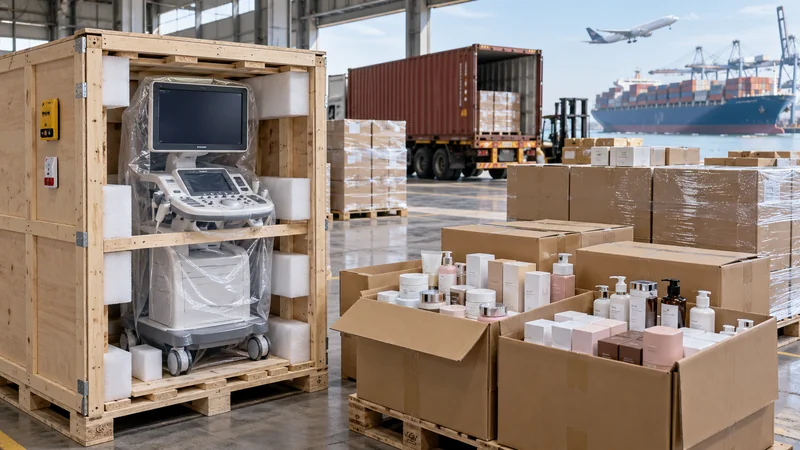
Medical equipment and cosmetics are not ordinary general cargo from a compliance perspective. Before freight is booked from China to Nigeria, the Nigerian regulatory pathway for the exact product should be identified.
This matters because medical devices/equipment and cosmetics follow different compliance paths, even though both can fall within NAFDAC oversight.
A diagnostic monitor, hospital machine or laboratory device should not be handled as if it were a cosmetic product. Likewise, skin care, hair care, makeup and personal-care products should not be treated as “medical cargo” simply because NAFDAC is involved.
For importers planning shipping from China to Nigeria, the practical sequence is:
- Identify the exact product and intended use.
- Confirm whether NAFDAC registration or another permit route applies.
- Check whether SON or SONCAP requirements overlap.
- Determine whether the cargo is ordinary, temperature-controlled or dangerous goods.
- Prepare the Nigerian import and clearance documents.
- Only then select the freight method and book shipment from China.
NAFDAC’s current medical-device guidance states that medical devices, including IVDs, generally cannot be imported, distributed or used in Nigeria unless registered under the applicable regulatory framework. Its current medical-device guideline took effect on April 10, 2025 and has a review date in 2030. NAFDAC: Guidelines for Registration of Medical Devices Including IVDs and Related Products
Important: Product classification, registration requirements and permit routes depend on the exact product. Winsail Logistics can coordinate freight originating from China and help identify shipping-document and handling requirements, but it cannot guarantee NAFDAC registration, SON approval or Nigerian customs release.
First Identify Which Product Category You Are Importing
The first mistake to avoid is describing the shipment too broadly.
“Medical equipment” and “beauty products” are not precise enough for regulatory or freight planning. The importer and Chinese manufacturer should identify exactly what the product is, what it does, how it is marketed and how it will be used.
Medical Equipment and Medical Devices
This category may include products such as:
- diagnostic equipment;
- patient-monitoring devices;
- imaging equipment or components;
- laboratory devices;
- in-vitro diagnostic equipment;
- hospital equipment;
- medical consumables;
- device accessories;
- electrically powered treatment or monitoring equipment.
The intended use matters. A product designed to diagnose, monitor, prevent or support treatment of a medical condition may be regulated differently from a general electronic product with similar hardware.
Cosmetics and Personal-Care Products
Cosmetic shipments may include:
- skin-care products;
- creams and lotions;
- serums;
- makeup;
- hair-care products;
- shampoos and conditioners;
- personal-care liquids;
- perfumes or fragrance products;
- private-label and OEM cosmetics.
Ingredients, presentation and claims can affect the regulatory and transport pathway.
For example, describing a product as a “skin cream” is different from claiming that it treats a medical condition. Likewise, a beauty device promoted purely for appearance may require different classification analysis from equipment promoted for diagnosis or treatment.
Simple Classification Decision Tree
Step 1 — What is the intended use?
If the product is intended for diagnosis, monitoring, treatment or another medical purpose, screen it as a possible medical device.
If it is mainly applied to the body for cleansing, beautifying, grooming or appearance-related purposes, screen it under the cosmetic pathway.
Step 2 — What claims appear on the packaging and marketing materials?
Review labels, manuals, websites and sales brochures.
Step 3 — Does the product contain batteries, liquids, aerosols or flammable ingredients?
This affects transportation even if it does not change NAFDAC registration status.
Step 4 — What Nigerian regulator or conformity route applies?
Confirm NAFDAC requirements and separately screen SON/SONCAP where relevant.
NAFDAC Requirements for Imported Medical Devices
Medical-device import planning should begin before the goods leave the Chinese factory.
NAFDAC’s current guidance covers medical devices, including IVDs and related products, and requires applications to follow the applicable NAFDAC registration process. Current guidance also refers to technical documentation, device classification, conformity information and product dossiers for relevant device classes. NAFDAC: Guidelines for Registration of Medical Devices Including IVDs and Related Products
For an importer, the main planning areas include:
- the Nigerian applicant or authorized party;
- exact product and model identification;
- device classification;
- manufacturer information;
- power of attorney or other authorization where applicable;
- technical and conformity documentation;
- labeling and instructions for use;
- product dossier requirements for applicable classes;
- registration status;
- import permits where applicable;
- port-clearance documentation.
The Chinese supplier therefore needs to provide more than a commercial invoice.
Depending on the device, the Nigerian applicant may need documentation concerning the manufacturer, product specifications, safety and performance, conformity, labeling and technical characteristics.
For higher-risk or more technically complex products, documentation requirements can become substantially more detailed.
A CE certificate, ISO certificate or other overseas approval may help support a regulatory file, but it does not automatically replace Nigerian requirements.
Pro Tip: Do not book commercial medical-device stock solely because the Chinese manufacturer provides CE, FDA, ISO or similar documentation. Confirm the Nigerian pathway for the exact product first.
Medical Equipment May Also Require SON Screening
One of the most important compliance points for medical-equipment importers is that NAFDAC involvement does not automatically mean SON can be ignored.
The Standards Organisation of Nigeria currently states that SONCAP exemptions include “medicals, other than equipment and machines.” Its SONCAP scope uses the same distinction. SON: What Products Are Exempted from the SONCAP Scheme?
That wording is important.
It means a medical product should not automatically be considered SONCAP-exempt simply because it is associated with healthcare.
| Question | NAFDAC | SON / SONCAP |
|---|---|---|
| Is the product regulated as a medical device? | Key regulator question | Not sufficient by itself |
| Is the product registered with NAFDAC? | May be required | Does not automatically create SON exemption |
| Is it medical equipment or a machine? | Relevant | SON screening may still be necessary |
| Does a conformity route apply? | Product-specific | Product-specific |
| Can shipment be booked before checking both? | Not recommended | Not recommended |
For example, an imported medical machine may need NAFDAC screening while also requiring analysis of its SON/SONCAP treatment.
SON states that Product Certificates and SONCAP Certificates are required for SONCAP-regulated goods, while certain machinery, project-specific items and other categories may instead qualify for specific import-permit treatment subject to SON approval. SONCAP FAQ
The practical rule is:
NAFDAC status ≠ automatic SON exemption.
Before shipment, confirm the treatment of the exact equipment rather than relying on a general description such as “hospital equipment.”
NAFDAC Requirements for Cosmetics Imported into Nigeria
Cosmetics follow their own regulatory pathway.
NAFDAC publishes specific guidance for imported cosmetics and states that covered cosmetic products are subject to registration requirements before normal commercial importation, sale and distribution in Nigeria. NAFDAC: Guidelines for Registration of Imported Cosmetics in Nigeria
The importer should normally prepare around:
- Nigerian applicant details;
- manufacturer information;
- authorization from the overseas manufacturer where applicable;
- exact product and brand name;
- formulation or composition information;
- labeling;
- product registration;
- supporting manufacturer documentation;
- port clearance.
For OEM and private-label projects, this should be considered before mass production.
Changing the brand name, formula, package, manufacturer or product presentation after the registration file has been prepared can create additional regulatory work.
This is particularly important when a Nigerian buyer is sourcing from a Chinese OEM factory. The commercial order and the regulatory documentation should describe the same product.
Samples for Registration Are Different from Commercial Stock
Importers often ask whether they can ship samples before completing commercial registration.
For medical devices, there is an important distinction between registration/evaluation samples and normal commercial inventory.
Nigeria’s Medical Device and Related Products Regulations allow NAFDAC to issue permits for samples in specified situations such as registration, performance evaluation, research, emergency use and certain other authorized purposes. Current NAFDAC medical-device guidance also provides for import permits for registration samples after the relevant documentation has been screened. NAFDAC: Medical Device and Related Products Regulations 2024
That does not mean an importer can simply label commercial stock as “samples.”
The permit conditions and quantities matter.
A small medical-device sample shipment for registration or testing should therefore be arranged according to the specific NAFDAC authorization rather than shipped as ordinary commercial inventory.
Do not automatically apply the same medical-device sample procedure to cosmetics. The applicable NAFDAC route should be confirmed separately for each product category.
What Happens During Port Clearance?
Registration does not eliminate the need for shipment-level clearance.
NAFDAC’s published port-clearance guidance for cosmetics and medical devices lists shipment documentation including items such as:
- commercial invoice;
- packing list;
- Form M;
- PAAR;
- Bill of Lading or Air Waybill;
- Single Goods Declaration;
- evidence of valid NAFDAC product registration;
- manufacturer Certificate of Analysis where applicable;
- other authorization or supporting documents required for the shipment.
For products from China, the published guidance also refers to a Clean Report of Inspection and Analysis where applicable. NAFDAC: Guidelines for Clearing Cosmetics and Medical Devices
Nigeria Customs separately lists registered Form M and regulatory certificates among the documents supporting the PAAR process. Nigeria Customs Service
This is why regulatory preparation should happen before departure from China.
Discovering after arrival that a product name, model, registration record or commercial invoice is inconsistent can lead to delays that are much more expensive than fixing the documentation before shipping.
Air vs Sea Freight for Medical Equipment
The best method depends on equipment size, value, urgency, sensitivity and project schedule.
| Medical cargo | Air freight | Sea freight | Main concern |
|---|---|---|---|
| Compact diagnostic device | Strong option | Possible | value, handling, registration |
| High-value monitoring equipment | Strong option | Possible | shock, security, insurance |
| Large medical machine | Expensive | Strong option | crate, dimensions, unloading |
| Hospital project equipment | Selected urgent items | Strong option | shipment coordination |
| Temperature-sensitive device/reagent | Possible with suitable solution | Possible if validated | temperature specification |
When Air Freight Works Well
Air freight is often suitable for:
- compact diagnostic equipment;
- high-value devices;
- urgent hospital requirements;
- replacement equipment or parts;
- project cargo with a critical deadline;
- suitable temperature-sensitive shipments.
Air freight reduces transit exposure but does not remove the need for proper packing.
A sensitive diagnostic instrument can still be damaged by vibration, impact, incorrect orientation or poor ground handling.
When Sea Freight Works Well
Sea freight is usually more practical for:
- large medical machines;
- bulky hospital equipment;
- project shipments;
- examination tables or furniture-like equipment;
- palletized regular inventory;
- multiple machines shipped together.
For heavy equipment, planning should include the final Nigerian delivery site.
Check:
- crate dimensions;
- gross weight;
- center of gravity;
- lifting points;
- forklift access;
- crane requirements;
- unloading access;
- doorway or elevator restrictions;
- installation schedule.
The cheapest ocean rate is not useful if the destination cannot unload the equipment safely.
Before choosing air or sea, provide the exact model, packing dimensions, gross weight, value, battery information, handling requirements and destination in Nigeria.
Winsail Logistics can then evaluate suitable freight options for cargo originating in China.
Air vs Sea Freight for Cosmetics
Cosmetics often move differently from medical machines because the main issues are volume, product formulation, leakage and possible dangerous-goods classification.
Air Freight
Air freight may suit:
- product-launch inventory;
- urgent replenishment;
- registration or evaluation samples where authorized;
- small high-value cosmetic orders;
- limited initial batches.
However, the forwarder needs to know what is inside the product.
Terms such as “beauty products” or “cosmetics” are not enough to determine air acceptance.
Sea Freight
Sea freight is normally more economical for regular commercial inventory such as:
- cartons of skin-care products;
- shampoo;
- makeup;
- creams;
- private-label product lines;
- larger wholesale shipments.
Before booking either mode, review whether the cargo contains:
- alcohol;
- aerosols;
- pressurized containers;
- flammable solvents;
- batteries;
- other ingredients creating transport restrictions.
Cosmetics Can Also Be Dangerous Goods
NAFDAC registration and dangerous-goods classification answer different questions.
NAFDAC addresses product regulation in Nigeria.
Dangerous-goods rules address whether and how the cargo can be transported safely.
Some cosmetics may become dangerous goods because of:
- high alcohol content;
- flammable liquids;
- flammable solvents;
- aerosol propellants;
- pressurized containers.
Many cosmetics are not dangerous goods.
The correct classification depends on the actual formulation, physical properties and packaging.
DG-Screening Checklist
Before booking potentially hazardous cosmetics from China, provide:
- full product name;
- composition information;
- Safety Data Sheet where applicable;
- flash point if relevant;
- aerosol status;
- alcohol or solvent information;
- package size;
- inner and outer packaging configuration;
- total quantity.
For air freight, dangerous goods must comply with the applicable air-transport requirements. IATA’s 67th Edition Dangerous Goods Regulations took effect on January 1, 2026. IATA: Significant Changes to the 67th Edition DGR
For sea freight, the IMDG Code incorporating Amendment 42-24 became mandatory from January 1, 2026. IMO: Shipping Rules in Force from January 1, 2026
Carrier acceptance still has to be confirmed. A technically classifiable DG product is not automatically accepted by every airline, shipping line, route or consolidation service.

Temperature-Sensitive Medical and Cosmetic Cargo
Not every medical device and not every cosmetic shipment needs temperature control.
Start with the manufacturer’s documented storage specification.
Ask the supplier:
- What temperature range is required?
- What is the permitted excursion range?
- How long can the cargo remain outside the preferred range?
- Is continuous temperature logging required?
- Is validated passive packaging available?
- Is active temperature control required?
- Is refrigerated transport actually necessary?
- What humidity limits apply?
For some devices, reagents, IVD products or components, temperature can be critical.
For cosmetics, excessive heat can affect products such as creams, emulsions and certain formulations, but that does not automatically mean they require refrigerated transport.
There is an important difference between:
“Protect from excessive heat”
and
“Maintain continuously at 2–8°C.”
Do not upgrade or downgrade handling conditions without the manufacturer’s technical specification.
If passive temperature-controlled packaging is used, its validated duration should cover the realistic transport chain—not merely the airport-to-airport flight time.
Medical Equipment Packing
Medical equipment often needs more engineering attention than ordinary commercial cargo.
Protect Against Shock and Vibration
Use cushioning designed for the equipment’s actual weight.
Heavy devices can crush weak foam and become effectively unprotected.
For sensitive equipment, the Chinese manufacturer should identify acceptable shock and vibration limits where available.
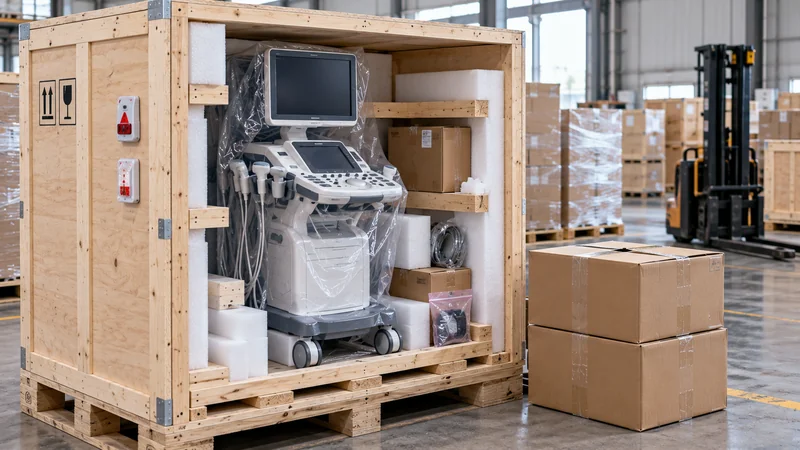
Use Export-Grade Crates When Appropriate
Large or sensitive machines may require:
- export wooden crates;
- reinforced bases;
- internal blocking and bracing;
- moisture protection;
- corrosion protection;
- forklift entry;
- lifting points.
Wood packaging used for international trade should meet applicable phytosanitary requirements where required.
Protect Electronics and Sensitive Components
Depending on the device, consider:
- anti-static protection;
- moisture barriers;
- desiccants;
- sealed accessory packages;
- cable and probe protection;
- removable-component separation.
Add Handling Indicators Where Useful
Tilt indicators and shock indicators can support handling control and help identify possible incidents.
They are monitoring tools—not substitutes for proper packaging.
Track Serial Numbers
For valuable medical machines, maintain a packing record showing:
- model;
- serial number;
- crate number;
- accessories;
- quantity;
- gross weight.
This helps with customs, delivery, inventory control and claims if equipment is lost or damaged.
Cosmetics Packing
Cosmetic cargo has different vulnerabilities.
Prevent Leakage
Liquid products should have secure closures and suitable inner containment.
Where necessary, use:
- sealed caps;
- shrink seals;
- individual bags;
- absorbent material;
- leak-resistant secondary packaging.
Separate Glass Containers
Glass bottles and jars should use appropriate dividers or cushioning.
Avoid large void spaces inside cartons.
Control Carton Strength
Cartons for sea freight may experience stacking pressure and humidity.
Export cartons should be suitable for the total product weight and expected transport environment.
Keep Batch Identification Visible
Do not mix batches without clear records.
The commercial and warehouse documentation should allow identification of:
- product;
- batch or lot;
- quantity;
- carton range where necessary.
Use DG Packaging When Required
If the product is classified as dangerous goods, normal retail packaging may not be sufficient for international transportation.
The transport configuration must follow the applicable dangerous-goods rules and carrier requirements.
Product Description and Claims Must Be Consistent
One of the simplest ways to reduce avoidable customs and regulatory problems is to keep product information consistent across the entire shipment.
Compare:
- commercial invoice;
- packing list;
- product label;
- NAFDAC registration;
- manufacturer documents;
- model number;
- intended use;
- technical dossier;
- marketing material.
Avoid vague invoice descriptions such as:
- “beauty items”;
- “health products”;
- “medical equipment”;
- “machine”;
- “cosmetics accessories.”
Instead, describe the actual product accurately.
For example:
“Digital patient vital-sign monitor, Model XX-200”
is more useful than:
“medical equipment.”
Likewise:
“Facial moisturizing cream, 50 ml jars”
is more useful than:
“beauty items.”
Do not invent descriptions solely to obtain a lower freight rate or avoid regulation. Misdescription can create customs, carrier and dangerous-goods problems.
Medical vs Cosmetic Regulatory Path
| Planning area | Medical equipment/devices | Cosmetics |
|---|---|---|
| Product classification | Intended medical purpose is critical | Product type, formulation and claims matter |
| Main NAFDAC pathway | Medical-device registration/permit framework | Cosmetic registration framework |
| Nigerian applicant | Required according to applicable process | Required according to applicable process |
| Manufacturer documents | Technical/conformity documentation may be substantial | Manufacturer, product and formulation documentation |
| SON screening | Particularly important for equipment/machines | Product-specific screening |
| Transport hazard | Batteries, dry ice or other components may matter | Alcohol, aerosols and solvents may matter |
| Samples | Special permit routes may apply | Confirm cosmetic-specific route |
| Commercial stock | Do not treat as registration samples | Registration/clearance should be confirmed |
| Port clearance | NAFDAC + Customs documentation | NAFDAC + Customs documentation |
NAFDAC vs SON Responsibility
A useful way to think about the process is that different authorities answer different questions.
NAFDAC: Is this regulated healthcare or cosmetic product properly authorized under the applicable Nigerian framework?
SON/SONCAP: Does an applicable standards/conformity assessment requirement cover the imported product?
Nigeria Customs: Are the import declaration, regulatory documents, valuation and customs-clearance requirements satisfied?
Carrier: Can the cargo be transported under the proposed mode, route and packaging?
Passing one of those checks does not automatically satisfy all the others.
Costs Beyond Freight
Importers should avoid comparing suppliers or forwarders using freight price alone.
Medical-Equipment Costs May Include
- NAFDAC registration and compliance work;
- SON/SONCAP-related certification where applicable;
- export crating;
- special handling;
- temperature control;
- dangerous-goods handling where relevant;
- cargo insurance;
- origin handling;
- destination handling;
- customs duty and taxes;
- Nigerian regulatory processing;
- inspection;
- inland delivery;
- crane, forklift or rigging services;
- installation-site delivery.
Cosmetic Costs May Include
- NAFDAC registration;
- labeling changes;
- inspection or testing where applicable;
- dangerous-goods documentation;
- DG freight surcharge;
- special packaging;
- destination clearance;
- customs duty and taxes;
- warehousing;
- final distribution delivery.
A low factory price can quickly become an expensive import if the product is produced before its Nigerian compliance pathway is confirmed.
Compliance and Document Checklist
Medical Equipment
Before shipment, check:
- exact product name;
- exact model;
- manufacturer;
- intended use;
- HS-code review;
- NAFDAC registration or permit status;
- device classification where applicable;
- SON/SONCAP screening;
- commercial invoice;
- packing list;
- serial-number list where applicable;
- Form M;
- PAAR preparation;
- Bill of Lading or Air Waybill;
- battery information;
- temperature requirements;
- handling requirements;
- destination unloading requirements.
Cosmetics
Check:
- exact product name;
- brand;
- manufacturer;
- ingredients or composition information;
- NAFDAC status;
- label consistency;
- batch/lot information;
- HS-code review;
- commercial invoice;
- packing list;
- Form M;
- PAAR preparation;
- liquid or aerosol status;
- alcohol or solvent content;
- SDS where transport hazard may exist;
- dangerous-goods classification where relevant.
Packaging and Handling Checklist
Medical Cargo
- shock protection;
- vibration protection;
- anti-static protection where required;
- humidity protection;
- export crate where appropriate;
- serial-number tracking;
- accessory inventory;
- shock indicator if useful;
- tilt indicator if useful;
- lifting/forklift instructions;
- temperature monitoring if required.
Cosmetics
- leak-proof closure;
- secondary liquid containment;
- strong export cartons;
- glass protection;
- batch separation;
- heat-exposure planning;
- pallet protection;
- DG packaging where required.
Cargo Information Needed Before Freight Planning
The more precise the cargo information, the more accurately the freight and compliance risks can be screened.
For Medical Equipment
Send:
- product name;
- manufacturer;
- brand;
- model;
- intended use;
- quantity;
- unit value;
- serial numbers if available;
- package count;
- dimensions;
- gross weight;
- batteries or battery specifications;
- temperature range;
- shock/tilt restrictions;
- NAFDAC registration status;
- SON/SONCAP status if already checked;
- delivery city in Nigeria.
For Cosmetics
Send:
- exact product type;
- brand;
- manufacturer;
- formulation or ingredient information where relevant;
- SDS where available;
- liquid, cream, powder or aerosol status;
- alcohol/flammable content;
- package size;
- cartons;
- dimensions;
- gross weight;
- batch information;
- NAFDAC registration status;
- destination in Nigeria.
Review Product Compliance Before Production or Shipping
For regulated cargo, the best time to identify a problem is before mass production—not after the container reaches Lagos.
This is especially important for:
- Chinese OEM cosmetic projects;
- private-label brands;
- newly sourced medical devices;
- equipment with multiple models;
- products being imported into Nigeria for the first time;
- products with medical or therapeutic claims;
- aerosols and alcohol-based cosmetics;
- temperature-sensitive products.
Before freight is booked, align the Chinese supplier, Nigerian importer, regulatory adviser where required and freight forwarder around the same product information.
FAQ
Does medical equipment need NAFDAC registration in Nigeria?
Many products falling within Nigeria's medical-device framework require NAFDAC registration before normal commercial importation, distribution or use. The exact treatment depends on the product, device classification and intended use.
Does medical equipment also need SONCAP?
It may require SON screening. SON's current SONCAP information exempts “medicals, other than equipment and machines,” so medical equipment and machines should not automatically be treated as exempt. The exact product should be checked before shipment.
Can medical samples be shipped before commercial registration?
Potentially, but not as ordinary unrestricted commercial stock. NAFDAC regulations provide permit routes for medical-device samples for specified purposes such as registration, evaluation and research, subject to the applicable conditions.
Do cosmetics need NAFDAC registration before import?
For normal commercial importation and sale, imported cosmetics fall under NAFDAC's product-registration framework. The exact product and current registration route should be confirmed before commercial shipment.
Can cosmetics ship by air from China to Nigeria?
Yes, many cosmetics can ship by air, but alcohol content, flammable solvents, aerosols and other regulated materials must be screened first. Dangerous-goods documentation, packaging and airline acceptance may be required.
Are all cosmetics dangerous goods?
No. Dangerous-goods status depends on the actual formulation, physical properties and packaging. Potential triggers include flammable alcohol or solvents, aerosol propellants and pressurized containers.
How should diagnostic equipment be packed?
Packing should reflect the equipment's value and sensitivity. Depending on the device, use suitable cushioning, moisture protection, anti-static protection and an export-grade crate, with serial-number tracking and special handling controls where needed.
Can Winsail obtain or guarantee NAFDAC registration?
No. Winsail Logistics can support freight planning, cargo handling and shipping-document coordination for shipments originating from China, but NAFDAC registration, SON approval and Nigerian customs decisions remain subject to the relevant Nigerian authorities.
Final Planning Advice
Shipping medical equipment or cosmetics from China to Nigeria is much easier when compliance and logistics are planned as one process.
Do not begin with:
“How much is the freight?”
Begin with:
“What exactly is the product, how is it regulated, and what conditions must be satisfied before it leaves China?”
For medical equipment, confirm the device classification, NAFDAC pathway and possible SON overlap.
For cosmetics, confirm registration, labeling and product formulation, then screen for temperature sensitivity and dangerous-goods characteristics.
After those questions are resolved, the freight decision becomes much clearer.
Air freight may be appropriate for compact, valuable or urgent cargo. Sea freight may be more practical for large medical equipment or regular commercial cosmetic inventory. Temperature control should only be used when justified by the product specification, while dangerous-goods handling must follow the actual transport classification.
Most importantly, keep the product name, model, intended use, labels, regulatory documents, invoice and shipping documents consistent.
For a shipment originating in China, prepare the product details before requesting freight planning.
For medical equipment, send the exact product/model, intended use, dimensions, weight, battery information, temperature requirements and current NAFDAC/SON status.
For cosmetics, send the product type, cartons, weight, formulation or SDS where relevant, liquid/aerosol status, alcohol or flammable content and NAFDAC status.
This allows the freight route, packing requirements and transport restrictions to be checked before the cargo leaves China.
Regulatory note: Nigerian product-registration, port-clearance, SON/SONCAP and customs procedures can change. Product-specific confirmation should be completed before each commercial shipment. This guide is for freight and compliance planning and is not a guarantee of regulatory approval or customs clearance.
Reviewed for logistics and compliance planning against current published NAFDAC, SON, Nigeria Customs, IATA and IMO information as of October 2026.
