

Tanzania import duty and VAT on Chinese goods depend on the product’s HS classification, customs value, and applicable tax rules. Tanzania generally follows the East African Community (EAC) Common External Tariff for import duty, while standard-rated imports into Mainland Tanzania attract 18% VAT on a statutory taxable value that includes applicable customs duty and other import charges. To estimate your taxes, confirm the tariff line, customs value, applicable levies, exemptions, and importer responsibilities before shipment.
Import Tax Data Note — Reviewed October 25, 2026
This guide uses publicly available EAC and Tanzanian legislation reviewed in October 2026. Rates, exemptions, and assessments depend on the goods and applicable import date. The calculations are illustrative, not official TRA assessments. Product-specific treatment should be confirmed with a licensed Tanzanian clearing agent before shipping.
For an overview of transportation arrangements, see our shipping from China to Tanzania guide.
What Taxes Apply to Goods Imported from China into Tanzania?
Goods imported into Mainland Tanzania may attract import duty, value added tax (VAT), and additional statutory levies. The amount depends on the product, its customs classification, the legally determined customs value, and any exemptions or special measures.
Import Duty Under the EAC Common External Tariff
Tanzania belongs to the East African Community Customs Union. Imports originating outside the EAC, including ordinary Chinese-origin goods, generally fall under the EAC Common External Tariff (CET).
The EAC introduced a four-band tariff structure in July 2022:
| Main CET Band | General Tariff Category |
|---|---|
| 0% | Certain raw materials and capital goods |
| 10% | Certain intermediate goods |
| 25% | Certain intermediate and finished goods |
| 35% | Certain finished goods protected under the CET framework |
These are structural tariff bands, not guaranteed rates for individual products. Sensitive goods may attract higher rates, specific duties, or other measures. Tanzania may also apply approved stays of application and duty-remission arrangements.
The correct duty rate must therefore be established using the applicable HS tariff line and legal measures in force on the relevant date.
Import VAT and Other Statutory Charges
For taxable imports into Mainland Tanzania, the standard VAT rate is 18%, subject to applicable exemptions or zero-rating provisions.
Importers may also need to account for:
- Railway Development Levy (RDL): Generally imposed on covered imports, subject to statutory exemptions.
- Customs Processing Fee (CPF): Charged according to the applicable cargo category and regulations.
- Excise Duty: Applies to specified excisable products.
- Industrial Development Levy (IDL): Applies to products listed in the relevant statutory schedule.
These charges should not be confused with freight, terminal handling, customs brokerage, storage, or inland delivery expenses.
How to Find the Correct Tanzania Import Duty Rate by HS Code
The Harmonized System (HS) code is the starting point for identifying the applicable import-duty treatment.
Two products that appear similar commercially can fall under different tariff lines because of their materials, functions, specifications, or technical characteristics.
Identify Your Product’s HS Classification
Start with an accurate product description rather than relying only on the supplier’s invoice name.
For example, the description “electrical equipment” is insufficient for reliable classification. Customs may need to know the equipment’s function, electrical specifications, construction, and whether it is a complete machine or a component.
The international HS system provides a common six-digit classification foundation. National or regional tariff schedules may contain additional subdivisions that determine the applicable import treatment.
China’s export declaration code should not automatically be treated as the final Tanzanian import tariff line.
Check the EAC CET and Current Tariff Measures
Use the applicable EAC customs tariff framework and subsequent official tariff measures to identify the correct treatment.
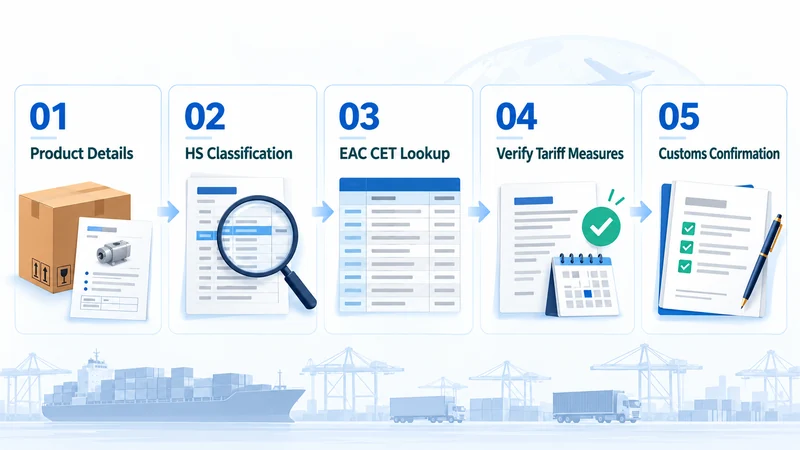
| Step | What to Check | Expected Result |
|---|---|---|
| 1. Product details | Function, materials, specifications, and condition | Accurate commercial description |
| 2. HS classification | Relevant chapter, heading, subheading, and legal notes | Candidate tariff line |
| 3. EAC CET | Duty treatment for the complete tariff line | Starting duty rate |
| 4. Applicable measures | EAC Gazette amendments, Tanzania-specific measures, and effective dates | Rate applicable to the import |
| 5. Relief eligibility | Approved exemptions or duty remission | Adjusted treatment, if eligible |
| 6. Local confirmation | Classification and supporting documents reviewed by a licensed clearing agent | Documented tax estimate |
The Tanzania Trade Portal can assist with product and procedure searches. However, some publicly accessible tariff documents are older editions, so they should not be used without checking later EAC measures.
Confirm the Rate Before Shipping
Ask the Tanzanian clearing agent to confirm:
- The complete HS tariff line.
- The commodity description supporting that classification.
- The applicable import-duty rate or specific-duty formula.
- Any additional levies or exemptions.
- The legal measure and effective date used.
Where classification remains uncertain, consider whether a formal advance ruling is appropriate under the available customs procedures.
Pro Tip — Do Not Copy a Supplier’s HS Code Without Verification
A Chinese supplier’s HS code is a useful starting point, but Tanzania may use different tariff subdivisions or classification interpretations. Confirm the destination tariff line before committing to a purchase budget.
For the documentation and customs-entry process, see our customs clearance in Tanzania guide.
How Does Tanzania Determine the Customs Value of Imported Goods?
Import duty is usually calculated from the customs value accepted under the applicable valuation rules, rather than simply the amount appearing on the supplier’s invoice.
Customs Value and the CIF Concept
For many ordinary commercial imports, a practical starting point is the cost, insurance, and freight (CIF) value.
Simplified customs-value starting formula:
Customs Value ≈ Goods Value + International Freight + Insurance + Required Valuation Adjustments
Consider a hypothetical shipment:
| Component | Value (USD) |
|---|---|
| Goods value | $10,000 |
| International freight | $900 |
| Insurance | $100 |
| Illustrative CIF value | $11,000 |
This calculation assumes that no additional adjustments are required and that the stated freight and insurance amounts correspond to the legally relevant valuation point.
Under the East African Community Customs Management Act, transaction value is generally the primary valuation method when its legal requirements are satisfied.
Customs may examine additional payments, assists, royalties, relationships between buyer and seller, and other relevant circumstances. If transaction value cannot be accepted, other prescribed valuation methods may apply.
How EXW, FOB and CIF Affect the Calculation
The supplier’s quoted Incoterm helps identify which costs are already included in the commercial price.
| Quotation Basis | What the Buyer Should Check |
|---|---|
| EXW | Factory price plus relevant origin costs, freight, insurance, and required adjustments |
| FOB | Goods value and separately documented freight and insurance |
| CIF | Whether freight and insurance are included to the specified destination and whether other valuation adjustments apply |
Changing an invoice from FOB to CIF does not, by itself, reduce customs duty. The legally correct customs value must still be established.
If goods are invoiced in USD or CNY, confirm the applicable customs exchange rate and conversion rules. A commercial bank’s exchange rate may not be the rate used for customs assessment.
How to Calculate Import Duty, VAT and Total Import Taxes in Tanzania
The calculation should be completed in stages because the taxes and levies do not necessarily share the same base.
Step 1 — Establish the Customs Value
Start with the customs value determined under the relevant customs valuation rules.
For a straightforward shipment, this may correspond to CIF after all required additions and adjustments.
Step 2 — Calculate Import Duty and Applicable Levies
For an ad valorem tariff line:
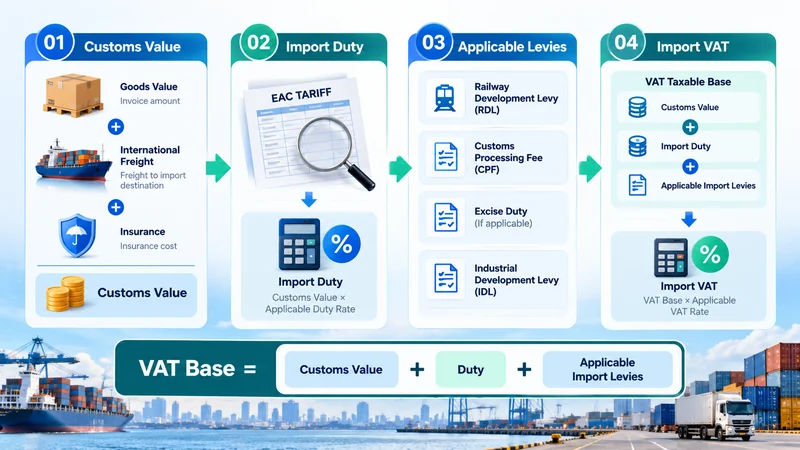
Import Duty = Customs Value × Verified Applicable Duty Rate
Specific or compound tariffs require the calculation method prescribed for the product.
Other applicable levies must be calculated separately using their respective statutory bases.
Step 3 — Determine the VAT Taxable Base
Under Section 9 of Tanzania’s Value Added Tax Act, Cap. 148, the taxable import value incorporates the customs value, customs duty payable, and other applicable taxes, levies, fees, or fiscal charges payable on importation.
For a simplified standard-rated import:
VAT Taxable Base = Customs Value + Import Duty + Other Applicable Statutory Import Charges
Import VAT = VAT Taxable Base × Applicable VAT Rate
This is why calculating VAT on CIF alone can underestimate the tax payable.
Step 4 — Example of a Tanzania Import Tax Calculation
The following is a hypothetical commercial dry-cargo shipment entered for home consumption in Mainland Tanzania under conditions assumed to be applicable in October 2026.
Assumptions:
- Customs value is accepted at $11,000.
- The illustrated import-duty amount of $2,200 is an arbitrary teaching figure, not a verified HS-code duty rate.
- The goods are standard-rated for VAT.
- RDL and the ordinary dry-cargo CPF apply without exemption.
- Excise duty and IDL are assumed not to apply.
| Calculation Item | Method | Amount (USD) |
|---|---|---|
| Goods value (FOB) | Assumed invoice value | $10,000.00 |
| International freight | Assumed | $900.00 |
| Insurance | Assumed | $100.00 |
| Customs value | $10,000 + $900 + $100 | $11,000.00 |
| Import duty | Hypothetical assessed amount | $2,200.00 |
| Railway Development Levy | 2% × $11,000 | $220.00 |
| Customs Processing Fee | 1% × $10,000 FOB | $100.00 |
| Excise duty / IDL | Assumed not applicable | $0.00 |
| VAT taxable base | $11,000 + $2,200 + $220 + $100 | $13,520.00 |
| Import VAT | 18% × $13,520 | $2,433.60 |
| Total illustrative import taxes and levies | Duty + RDL + CPF + VAT | $4,953.60 |
Important: This is not a tax estimate for a specific product. It uses an invented duty amount and assumes that all specified charges apply. It also excludes exemptions, additional valuation adjustments, customs currency conversion, and any statutory rounding.
The RDL illustration uses the generally applicable 2% rate following the 2024 amendment. The CPF illustration uses the 1% FOB rate for covered dry cargo introduced on July 1, 2026. The 18% standard Mainland VAT rate applies to the assumed taxable import.
A real calculation requires the product’s complete tariff line and the rules applicable to its import declaration.
The $4,953.60 result also excludes shipping-related destination expenses, brokerage, storage, and inland transportation.
For those costs, consult our shipping cost from China to Tanzania guide.
Check Duties for My Cargo
Need to estimate duties and VAT before placing an order?
Send Winsail Logistics your product description, proposed HS code, invoice value, Incoterm, and planned destination. We can help organize the information needed for a preliminary duty review and coordinate the relevant shipment arrangements. Final tax treatment must be confirmed through the appropriate customs procedures.
Additional Import Levies, Excise Duty and Possible Exemptions
Import duty and VAT are not necessarily the only statutory charges on an import declaration.
Railway Development Levy and Customs Processing Fee
Railway Development Levy (RDL)
Tanzania’s Finance Act 2024 increased the general Railway Development Levy rate from 1.5% to 2% of the relevant CIF value. The 2% framework remained reflected in tax references reviewed in October 2026, subject to statutory exemptions and subsequent applicable measures.
Importers should not use an older 1.5% figure without checking the legislation relevant to their declaration.
Customs Processing Fee (CPF)
The Tanzania Revenue Authority (Customs Processing Fee) Regulations, 2026, effective July 1, 2026, specify a CPF of 1% of FOB value for covered dry cargo.
Petroleum products have a different charging arrangement. The regulations also identify exempt categories.
See the official Customs Processing Fee Regulations, 2026.
Excise Duty and Industrial Development Levy
Excise duty applies only where goods fall within the relevant excise legislation.
Product type, condition, technical characteristics, and legally defined tax bases can affect the assessment. Certain vehicles, for example, may have excise calculations linked to characteristics beyond the basic customs-duty classification.
The Industrial Development Levy (IDL) applies to specified goods under Tanzania’s imports-control legislation, including relevant amendments.
Neither charge should be added to every import calculation automatically.
| Charge | Typical Calculation Basis | Verification Needed |
|---|---|---|
| Import duty | Customs value or specific tariff basis | Full HS tariff line |
| VAT | Statutory taxable import value | Applicable VAT treatment |
| RDL | Relevant CIF/customs-value basis | Current rate and exemptions |
| CPF | Cargo-category-specific basis | Current regulations and exempt categories |
| Excise duty | Product-specific statutory base | Applicable excise schedule |
| IDL | Product-specific statutory base | Listed tariff lines and current legislation |
When Are Tax Exemptions or Reductions Available?
Relief may be available for qualifying products, importers, approved projects, or manufacturing arrangements.
However, distinguish between:
- Zero customs duty: No import duty under the applicable tariff treatment.
- VAT exemption or zero-rating: Separate treatment determined by VAT legislation.
- Duty remission: Relief subject to specified eligibility and conditions.
- VAT input-tax credit: Potential recovery by an eligible registered taxpayer, not necessarily a reduction in tax payable at import.
An exemption may require approval, supporting documents, or compliance with a defined validity period.
Pro Tip — Zero Customs Duty Does Not Automatically Mean Zero VAT
A product may attract no customs duty but remain subject to import VAT or another statutory charge. Always check each tax independently before treating an import as tax-free.
Who Is Responsible for Declaring and Paying Import Taxes?
Knowing the estimated tax amount is only part of the process. Importers must also establish who is legally responsible for customs declarations and payments.
Importer of Record and Licensed Clearing Agent
Commercial import clearance in Tanzania generally involves an authorised, licensed Clearing and Forwarding Agent (CFA).
Customs documentation is processed through the Tanzania Customs Integrated System (TANCIS).
The importer remains responsible for providing accurate product descriptions, transaction values, supporting information, and relevant authorisations under the applicable legal arrangements.
A freight forwarder coordinating the shipment is not automatically the legal Importer of Record.
Import Duty Responsibility Under FOB, CIF, DAP and DDP
| Incoterm | Import Clearance | Import Duties and VAT |
|---|---|---|
| FOB | Generally buyer | Generally buyer |
| CIF | Generally buyer | Generally buyer |
| DAP | Generally buyer | Generally buyer |
| DDP | Seller under the agreed rule | Seller under the agreed rule |
These are general responsibility allocations under Incoterms 2020. The contract, named place, and legal feasibility of the import arrangement must also be considered.
Under CIF, the seller arranges the agreed freight and insurance, but the buyer generally remains responsible for Tanzanian import clearance and taxes.
Under DAP, transportation to the named destination does not automatically include import-duty payment.
DDP requires the seller to take responsibility for import clearance and applicable duties and taxes. The parties must confirm that this can be performed legally in Tanzania before agreeing to DDP terms.
Door-to-door delivery is therefore not necessarily DDP.
For more detail, read our DDP shipping from China to Tanzania guide.
Documents Needed to Estimate Import Duty and VAT
A reliable estimate requires enough evidence to support both classification and valuation.
Before requesting a calculation, prepare the following documents and information:
- Commercial invoice or proforma invoice: Product description, quantities, currency, unit values, and total price.
- Technical specifications: Materials, functions, model numbers, and relevant product characteristics.
- Proposed HS code: Provided by the supplier, if available, for independent verification.
- Packing list: Package quantities, gross and net weights, and shipment details.
- Freight and insurance information: Quoted or actual amounts, including the applicable Incoterm.
- Bill of lading or air waybill: When available.
- Importer details: Legal identity, taxpayer information, and clearing-agent authorisation, as applicable.
- Relief or approval documents: Any valid exemption, remission, or relevant product-specific authorisation.
For mixed shipments, provide a separate product and value breakdown for each distinct commodity.
Missing technical specifications, inconsistent invoices, or unsupported valuation figures can make an early estimate unreliable.
How to Verify Tanzania Import Tax Changes Before Shipping
Tariff treatment and national fiscal measures can change between the original purchase quotation and the customs declaration.
A rate found on a website several months earlier may not remain applicable at the time of import.
Follow the Official Verification Sequence
Use this sequence before confirming a purchasing budget:
- Classify the goods. Establish the complete EAC tariff line using accurate product specifications.
- Check tariff amendments. Review the applicable EAC CET and subsequent Gazette measures, including Tanzania-specific provisions.
- Verify national taxes. Check current VAT, levy, fee, excise, and IDL legislation.
- Confirm relief eligibility. Review any exemption or remission and its effective period.
- Establish the customs value. Reconcile invoice, freight, insurance, and legally required adjustments.
- Obtain local confirmation. Ask the licensed Tanzanian clearing agent to confirm the tax calculation against the expected declaration date.
Record the relevant law, tariff line, source date, assumptions, and any outstanding classification questions.
Recheck the Estimate Before Customs Declaration
The estimate should be reviewed again if the goods change, invoice values are revised, a different import date applies, or an exemption expires.
Once TRA assesses the shipment, compare the actual assessment with the pre-shipment estimate and retain supporting documents.
This helps importers distinguish genuine regulatory changes from mistakes in the original estimate.
Check Duties for My Cargo
If you are sourcing goods in China, completing a duty review before dispatch can help identify missing information and clarify your tax budget.
Provide your cargo description, specifications, invoice, proposed HS code, and intended destination. Winsail Logistics can assist with shipment planning and coordinating the information required for an appropriate customs-duty review.
Import Tax Disclaimer
This guide provides general information and illustrative calculations, not an official customs assessment or legal or tax advice. Final classification, valuation, exemptions, and liabilities depend on applicable law and decisions of the competent authorities. Winsail Logistics assists with shipment planning and customs-clearance coordination within its confirmed service scope and does not issue binding customs or tax rulings.
FAQ
Can I use the HS code provided by my Chinese supplier to calculate Tanzania import duty?
You can use it as a starting point, but it should not be treated as the final Tanzanian classification. The relevant EAC tariff line, legal notes, and current national measures must be checked. If the imported product differs from the supplier’s description, the proposed code may be incorrect.
If my machinery has zero import duty, do I still pay VAT?
Possibly. Customs-duty relief and VAT treatment are separate legal questions. Machinery attracting zero import duty may still be subject to standard import VAT or other applicable charges. Any exemption or special treatment must be confirmed against the product, importer, and relevant legal provisions.
Is Tanzania import VAT calculated on the invoice or CIF value?
Neither is necessarily the complete VAT base. For Mainland taxable imports, the VAT calculation starts with the legally determined customs value and also includes customs duty and other applicable import taxes, levies, or fees as prescribed by law. Applying VAT only to the supplier’s invoice can underestimate the amount payable.
Can a VAT-registered Tanzanian importer recover import VAT?
Eligible VAT-registered businesses may be able to claim import VAT as input tax when the goods are acquired for qualifying taxable activities. Recovery depends on legal conditions, valid supporting documents, and any restrictions on input-tax credits. Payment of VAT at import does not automatically guarantee a full refund or credit.
Do small parcels and courier shipments have different tax rules?
Courier shipments may follow different operational declaration procedures, but they are not automatically exempt from import duty or VAT. Any simplified treatment, applicable threshold, or statutory exemption must be verified for the actual goods and import arrangement. Courier delivery to an address does not itself determine whether duties are included in the price.
Do the same VAT rules apply when goods enter through Zanzibar?
Not necessarily. Zanzibar has distinct VAT legislation and administrative arrangements. The applicable treatment depends on where the goods are imported and used, as well as any subsequent movement between Zanzibar and Mainland Tanzania. A Mainland VAT estimate should not automatically be applied to a Zanzibar shipment.
Can import duties change after I receive a CIF or DDP quotation?
Yes. Tariff amendments, valuation adjustments, revised HS classification, or changes in relief eligibility may affect the final tax liability. A CIF quotation does not normally include import taxes. Under DDP, responsibility is allocated under the agreed contract, but the seller must have a legally workable clearance arrangement and a clearly defined scope.
