

The total landed cost from China to Tanzania includes the purchase price of goods, China origin charges, international freight, insurance, destination handling, applicable import duties and taxes, and delivery to your specified location. To calculate it accurately, start with the supplier’s Incoterm, identify all additional charges, verify the customs assessment, and divide attributable costs by the number of saleable units. This gives importers a more reliable purchasing budget than a freight quotation alone.
Data Note — October 23, 2026: This guide uses official customs, tariff, and port documentation available at the review date. All monetary amounts in the worked example are hypothetical, not Winsail Logistics quotations or official tax assessments. Actual import duties, VAT treatment, port fees, and exchange rates must be confirmed for your specific goods and shipment. The calculation framework focuses on goods imported into Mainland Tanzania for domestic use; Zanzibar and transit shipments may require different treatment.
What Is the Total Landed Cost of Imported Goods?
When importing products from China, the supplier’s invoice and the international shipping quotation are only two parts of your purchasing budget.
Total landed cost is the full cost attributable to acquiring goods and bringing them to a defined destination, such as your warehouse in Dar es Salaam, Arusha, or Dodoma.
For example, an importer purchasing machinery from a Chinese manufacturer may receive an FOB quotation that excludes ocean freight. After arrival at Dar es Salaam, the shipment may also incur import taxes, terminal charges, customs clearance expenses, and inland transportation.
The real purchasing cost becomes clear only when those expenses are combined.
Freight Cost vs Customs Value vs Total Landed Cost
These three figures serve different purposes.
| Cost measure | What it represents | Main use |
|---|---|---|
| Freight cost | Transportation and related services covered by a specific shipping quotation | Comparing logistics options |
| Customs value | The value established under applicable customs valuation rules for calculating import charges | Customs assessment |
| Total landed cost | The complete attributable acquisition and delivery cost | Purchasing budgets, inventory valuation, and pricing |
A freight quote covering only transport to Dar es Salaam cannot establish what it will cost to receive goods at an inland warehouse.
Similarly, a customs value is not necessarily the same as the final landed cost. Destination handling, brokerage, and inland delivery may increase the buyer’s commercial costs without automatically becoming part of the customs value.
For transport options and route planning, see our shipping from China to Tanzania guide.
Set the Cost Boundary Before You Calculate
A reliable calculation needs four pieces of information:
- Purchase terms: EXW, FOB, CIF, DAP, or another agreed Incoterm.
- Origin: The supplier’s factory or agreed delivery point in China.
- Destination: The Tanzanian port, terminal, warehouse, or final receiving address.
- Import responsibility: The party acting as importer of record and paying applicable customs charges.
If one calculation stops at Dar es Salaam Port while another includes delivery to a warehouse in Arusha, their totals are not directly comparable.
Your worksheet should therefore state exactly where the calculation begins and ends.
EXW vs FOB vs CIF vs DAP: How Incoterms Change Your Landed Cost
The Incoterm determines which transport costs and responsibilities normally belong to the seller and which belong to the buyer.
This is important because adding a cost already included in the supplier’s price will overstate your landed cost. Omitting a buyer-paid expense will understate it.
Under ICC Incoterms® 2020, the main differences are:
| Incoterm | Normally included in the seller’s responsibility | Additional costs the buyer should budget |
|---|---|---|
| EXW — Ex Works | Making goods available at the named place | Loading arrangements, pickup, export arrangements, international freight, insurance if purchased, import clearance, taxes, destination handling, and delivery |
| FOB — Free on Board | Delivery on board the vessel at the named Chinese loading port, including applicable export formalities | Main freight, insurance if purchased, destination handling, import clearance, taxes, and inland delivery |
| CIF — Cost, Insurance and Freight | Goods, contracted maritime freight, and contractual insurance to the named destination port | Applicable destination charges, customs clearance, import taxes, and inland delivery |
| DAP — Delivered at Place | Transport to the named destination, ready for unloading | Import clearance, applicable duties and taxes, and unloading responsibilities under the contract |
This matrix summarizes the standard rules; the exact named place, sales contract, and services purchased must also be checked. Consult the ICC Incoterms rules for the official definitions.
EXW: Include Collection and Export-Side Expenses
Under EXW, the supplier makes the goods available at the agreed location, often the factory.
The buyer may need to arrange collection, loading responsibilities, domestic transportation, export formalities, and international shipping.
However, EXW can create practical difficulties when a foreign buyer cannot independently complete Chinese export clearance. FCA may be more suitable when the seller must handle export clearance and deliver the goods to an agreed carrier or terminal.
Before comparing EXW purchase prices, confirm who will legally arrange export declaration and which origin charges remain payable.
FOB: Add Costs Beyond the Loading Port
Under FOB, the supplier delivers the goods on board the vessel at the named loading port.
For an FOB Shenzhen transaction, the buyer would normally budget for the main ocean carriage, optional cargo insurance, destination expenses, import clearance, and final delivery.
FOB is specifically a maritime term. For many containerized shipments handed over at an inland facility or container terminal, FCA may better reflect the actual handover arrangement.
CIF: Avoid Double-Counting Freight and Insurance
A CIF Dar es Salaam purchase price already includes the seller’s contracted ocean carriage and required insurance to the named destination port.
You should not add those same freight and insurance amounts again.
However, CIF does not mean that the supplier has paid import duties or arranged delivery to your warehouse. Risk also transfers under the CIF rule when the goods are placed on board the vessel at origin, rather than upon arrival.
Check whether the supplier’s CIF quotation covers particular destination fees and whether the contractual insurance is sufficient for your goods.
DAP: Delivery to an Address Does Not Mean Duty Paid
Under DAP Arusha Warehouse, the seller normally arranges transportation to the named location, ready for unloading. The buyer remains responsible for import clearance and applicable duties and taxes.
DDP is different: the seller assumes import-clearance and duty-payment responsibilities under the rule, which requires a legally workable importer arrangement in Tanzania.
A service described as door-to-door is not automatically DDP. Always verify the actual Incoterm, importer of record, duties, VAT, and delivery exclusions.
Our DDP shipping from China to Tanzania guide provides more detail on these responsibilities.
Pro Tip — Compare Quotations on the Same Basis: Ask each supplier or logistics provider to state the exact Incoterm, named place, included services, and exclusions. Compare the completed landed-cost totals, not simply the EXW, FOB, or CIF purchase prices.
What Costs Should You Include in a China–Tanzania Import Budget?
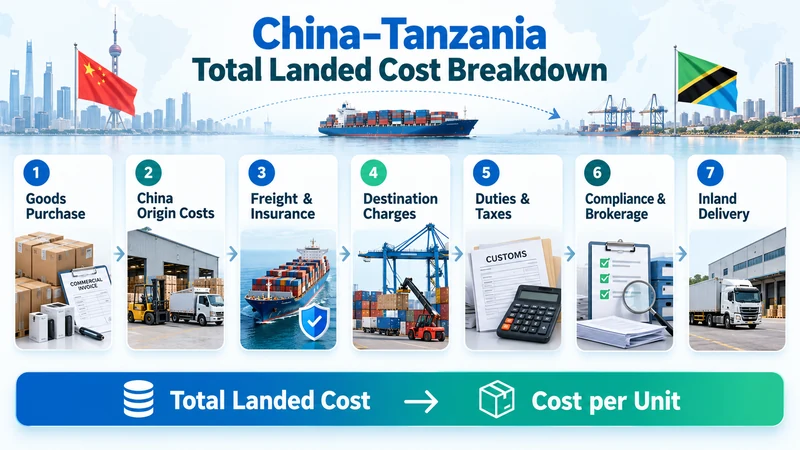
For an importer receiving goods at a Tanzanian warehouse, the total landed cost can be divided into seven main categories.
| Cost category | Expenses to check | Supporting documents |
|---|---|---|
| 1. Product purchase | Goods value, contractual discounts, separately payable packing | Pro forma or commercial invoice |
| 2. China origin | Factory collection, domestic trucking, consolidation, export-side services | Supplier and origin-agent quotations |
| 3. International transport | Sea or air freight, applicable surcharges, cargo insurance | Freight and insurance quotations |
| 4. Destination handling | Port and terminal charges, CFS handling, shipping-line documentation and release fees | Port, terminal, and shipping-line statements |
| 5. Customs and taxes | Import duty, VAT, excise, and other applicable levies | Customs declaration and tax assessment |
| 6. Compliance and brokerage | Clearing-agent fees, relevant permits, inspections, and conformity assessment | Agent quotations and regulatory documents |
| 7. Inland delivery | Transport to final destination, agreed unloading and receiving services | Trucking or delivery quotation |
Not every shipment incurs every charge. Equally, some charges are included in another party’s quotation and must not be counted twice.
China Origin and International Freight
Origin expenses depend on where the supplier releases the cargo and the service already included in the purchase contract.
For example, goods purchased EXW from an inland factory may require collection and transportation to the Chinese export port.
A shipment purchased FOB at a named Chinese loading port will normally have a different buyer-side expense structure.
International freight must then be calculated according to the booked service. LCL cargo can be charged by weight or measurement, FCL by container and applicable additional services, and air freight by chargeable weight.
For shipment-specific transport pricing, use our shipping costs from China to Tanzania guide rather than applying a generic freight rate to your budget.
Dar es Salaam Port and Destination Charges
When cargo arrives at Dar es Salaam, the importer may encounter charges from several different organizations.
These can include:
- Port wharfage and applicable cargo-handling services.
- Container terminal or container freight station (CFS) charges.
- Shipping-line documentation and delivery-order charges.
- Customs brokerage and release-related services.
- Storage, demurrage, or detention when incurred.
- Inland container movement and delivery services.
The Tanzania Ports Authority’s Sea Ports Tariff Book — January 2026 identifies port-service charging categories, including wharfage, shore handling, storage, and port infrastructure-related provisions.
However, the amount payable depends on the relevant service, terminal, cargo category, charging basis, billing party, and current implementation arrangements. A published tariff entry should not automatically be treated as a charge collected from every importer.
In particular, confirm the current application of the tariff book’s Port Infrastructure Development provision before inserting it into the budget.
The most reliable approach is to obtain an itemized destination-cost estimate and reconcile it with the actual invoices.
Customs Clearance, Compliance, and Inland Delivery
Some imported products are subject to additional compliance requirements.
For example, products covered by the Tanzania Bureau of Standards’ Pre-shipment Verification of Conformity (PVoC) program may require a Certificate of Conformity before shipment. The requirement depends on the product and applicable regulatory classification.
Other goods may require import permits, specialist inspections, or approvals from relevant authorities.
Once cleared, the shipment may require inland transport to locations such as Dodoma, Arusha, Mwanza, or a specific receiving warehouse.
The delivery budget should identify loading and unloading responsibilities, the type of vehicle required, whether the cargo is containerized or unpacked, and any special handling arrangements.
Do not treat potential delay charges as unavoidable costs. They may be recorded in a separate contingency allowance until actually incurred or reasonably required for a risk-based budget.
Plan My Total Landed Cost: Share your supplier’s Incoterm, product details, shipment dimensions, purchase value, and Tanzanian delivery location with Winsail Logistics. We can review the logistics components of your planned import budget and help identify charges that require separate confirmation.
How to Calculate Tanzania Import Duty, VAT, and Other Taxes
Import duties and taxes are among the most important variables in a China–Tanzania landed cost calculation.
Unlike freight charges, which can be estimated using shipment dimensions and a defined service, import taxes depend on the product’s customs classification, accepted customs value, applicable legislation, and any qualifying relief or exemptions.
A reliable budget should calculate these amounts separately instead of applying a single estimated tax percentage to every product.
Step 1: Identify the Correct HS Code
The Harmonized System (HS) classifies traded goods according to their characteristics and intended use.
The applicable HS classification influences the import duty rate, possible restrictions, and some regulatory requirements.
For example, different types of machinery, electronic equipment, building materials, and consumer products may be subject to different customs treatment.
Before estimating duty:
- Obtain a detailed product description and the supplier’s suggested HS code.
- Check the applicable classification under the East African Community (EAC) tariff.
- Verify Tanzania-specific measures, exemptions, remissions, and restrictions.
- Have the classification and duty treatment reviewed by the importer or licensed Tanzanian clearing agent.
The EAC Online Customs Tariff provides tariff classification and duty-estimation resources.
Do not assume that every product is subject to the same import duty rate. An incorrect HS classification can materially change the budget and create customs compliance problems.
Step 2: Establish the Customs Value
Import duty is generally calculated using the customs value accepted under the applicable valuation rules.
For many commercial imports, a CIF-based value provides the starting point for the estimate.
A simplified calculation is:
Estimated CIF-equivalent value = Eligible goods value + Relevant freight + Relevant insurance + Required valuation adjustments
However, the legally accepted customs value may differ from the amount shown in a commercial worksheet.
Depending on the transaction, adjustments may be needed for separately invoiced transportation, certain assists, royalties, commissions, or other amounts governed by customs valuation rules.
The clearing agent should verify which expenses are included in the customs value and which remain separate commercial landed-cost items.
Step 3: Calculate the Applicable Import Duty
For goods subject to an ad valorem duty, the basic formula is:
Estimated Import Duty = Accepted Customs Value × Applicable Duty Rate
For example, if a product’s accepted customs value is represented by V and the legally applicable duty rate by r, the estimated duty is:
Import Duty = V × r
Some products may be subject to specific duties, compound calculations, remissions, or other special treatment. In those cases, the relevant statutory calculation must replace the simple percentage formula.
The final rate and assessment method should be confirmed for the actual shipment rather than taken from an unrelated online example.
Step 4: Calculate Import VAT and Other Applicable Levies
Import VAT requires its own calculation basis.
The general formula is:
Estimated Import VAT = Verified VAT Taxable Base × Applicable VAT Rate
The taxable base must be established under the applicable Tanzanian rules. It should not be assumed to equal only the supplier’s invoice value.
As reviewed in October 2026, TRA publishes a standard 18% VAT rate for imports of taxable goods into Mainland Tanzania. However, the actual treatment depends on whether the goods are taxable, exempt, or subject to another applicable provision. The worked example below does not assume that the standard rate applies to a particular product.
Other potential import-related charges should be assessed separately, including:
- Excise duty, where applicable.
- Product-specific regulatory charges.
- Applicable import levies and processing charges.
- Legally applicable port-related charges.
Some charges may have their own percentage, fixed-fee, or quantity-based assessment methods.
Total Estimated Import Taxes = Import Duty + Import VAT + Applicable Excise and Other Import Levies
A customs tax estimate should identify the legal basis for each line item, not merely present one combined percentage.
Step 5: Confirm the Assessment Through a Licensed Clearing Agent
The Tanzania Revenue Authority requires importers to appoint a licensed Clearing and Forwarding Agent (CFA) for customs clearance.
Import documentation is processed through the Tanzania Customs Integrated System (TANCIS). The supporting documents commonly include the commercial invoice, packing list, transport document, applicable permits, and authorization for the clearing agent.
TRA also advises pre-arrival documentation submission, normally at least seven days before vessel arrival.
For your landed-cost calculation, request an itemized estimate showing:
- Declared and accepted customs value.
- HS classification and applicable tariff treatment.
- Import duty and its calculation basis.
- VAT assessment and other levies.
- Exchange rate used for customs purposes.
- Total estimated taxes and subsequent actual assessment.
The final customs assessment, rather than an illustrative online calculator, should be used when reconciling the shipment’s actual cost.
Worked Example: Calculate Total Landed Cost from China to Tanzania
Consider a hypothetical importer purchasing a single product from a manufacturer in China and shipping it to a warehouse in Dar es Salaam.
The importer wants to know the full purchasing cost before confirming the order.
This example assumes an EXW purchase and buyer-paid logistics expenses. It illustrates the calculation method only.
All quantities, prices, fees, and shipment details below are hypothetical assumptions. They are not actual market quotations or official Tanzanian tax assessments.
Step 1: Record the Shipment Assumptions
| Input | Hypothetical assumption |
|---|---|
| Product | General commercial goods |
| Purchase term | EXW China |
| Shipment method | Sea freight |
| Destination | Warehouse in Dar es Salaam |
| Purchase currency | USD |
| Invoice quantity | 1,000 units |
| Saleable quantity | 1,000 units |
| Product HS code | To be verified |
| Import duty rate | To be verified |
| VAT treatment | To be verified |
| Exchange rate for customs | To be verified |
The example assumes all 1,000 units arrive in saleable condition. For an actual shipment, the final unit calculation should use the documented saleable quantity.
Step 2: Complete the Landed Cost Calculation Worksheet
| Cost component | Hypothetical amount (USD) | Required evidence |
|---|---|---|
| Goods purchase value | $10,000 | Supplier invoice |
| China origin and pickup charges | $400 | Origin quotation |
| International sea freight | $1,300 | Freight quotation |
| Cargo insurance | $100 | Insurance quotation |
| Preliminary CIF-equivalent estimate | $11,800 | Subject to customs valuation review |
| Destination handling and release | $650 | Destination service quotation |
| Customs brokerage | $180 | Licensed CFA quotation |
| Applicable compliance expenses | $200 | Regulatory/service quotation |
| Inland delivery to warehouse | $750 | Transport quotation |
| Subtotal before import taxes | $13,580 | Calculated from hypothetical inputs |
| Import duty | Pending HS verification | Customs tariff and assessment |
| Import VAT | Pending tax verification | TRA/CFA assessment |
| Other applicable import levies | Pending verification | Relevant official requirements |
| Total shipment cost | $13,580 + verified taxes and levies | Final reconciled records |
All monetary entries are hypothetical. The $200 compliance item is assumed to be applicable only for the purpose of illustrating the worksheet.
The preliminary CIF-equivalent estimate assumes the example’s origin expenses are relevant to the freight-and-valuation calculation. The accepted customs value must still be independently confirmed. The CIF-equivalent figure is a calculated intermediate result, not an additional charge to be added to the subtotal.
Step 3: Calculate the Pre-Tax Subtotal
The hypothetical calculation is:
$10,000 + $400 + $1,300 + $100 + $650 + $180 + $200 + $750 = $13,580
Therefore:
- Hypothetical pre-tax shipment cost: $13,580.
- Hypothetical saleable units: 1,000.
- Pre-tax cost per unit: $13.58.
This is not the final landed cost. Applicable taxes, accounting adjustments, and any additional verified expenses remain to be calculated.
Step 4: Add Verified Duties, Taxes, and Other Charges
Once the importer or clearing agent confirms the applicable tax treatment, the worksheet can be completed.
For cash budgeting:
Total Shipment Cash Requirement = $13,580 + Import Duty + Import VAT + Applicable Levies + Other Cash Requirements
Refundable deposits and a separately stated contingency allowance may also need to be included in the cash-flow forecast.
For inventory costing, qualifying recoverable import VAT and refundable deposits should not automatically be treated as permanent acquisition expenses.
The difference matters. A business may need to pay import VAT before cargo release while potentially being eligible to claim an input tax credit, subject to the applicable requirements.
Step 5: Calculate the Landed Cost Per Unit
For this hypothetical shipment:
Pre-Tax Cost per Unit = $13,580 ÷ 1,000 = $13.58
After the relevant costs and taxes have been confirmed:
Inventory Landed Cost per Unit = Total Attributable Inventory Cost ÷ Saleable Units
This amount can then support supplier comparisons, inventory costing, wholesale pricing, and purchasing decisions.
The important point is that $13.58 is not a finished landed-cost quotation. It is a calculation result based on hypothetical pre-tax inputs.
Currency Conversion and Calculation Accuracy
Actual China–Tanzania transactions may involve CNY, USD, and Tanzanian shillings (TZS).
Maintain the original currency for every invoice, then convert values to a consistent reporting currency using clearly documented rates.
Separate three different purposes:
- The exchange rate used for supplier payment.
- The official rate applicable to customs valuation and assessment.
- The internal budgeting rate used for financial planning.
These rates may differ, creating differences between the estimated and actual landed costs.
Record each conversion rate, source, and date. Never assume that an indicative market exchange rate automatically equals the customs assessment rate.
Pro Tip — Keep Every Cost Traceable: Record the supplier invoice, freight quotation, customs assessment, port statement, and delivery invoice against the corresponding worksheet line. An unknown fee should remain marked Pending Confirmation, not entered as zero.
How to Calculate Landed Cost Per Unit for Multiple Products
Many Tanzanian importers purchase several product types from different Chinese suppliers or combine different SKUs into one shipment.
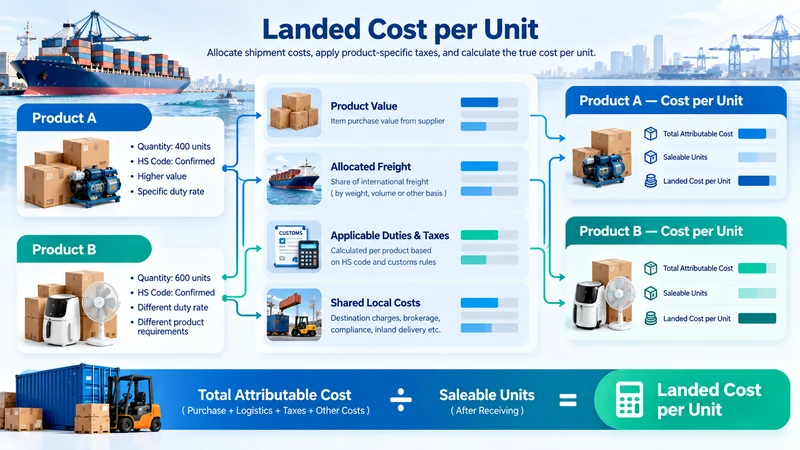
For mixed cargo, dividing the total container cost by the overall quantity can produce misleading results.
Different products may have different unit values, freight allocation characteristics, duty rates, and regulatory requirements.
Allocate Shared Shipping Costs Using an Appropriate Method
Suppose a hypothetical shipment contains two product groups:
| Item | Product A | Product B |
|---|---|---|
| Hypothetical quantity | 400 units | 600 units |
| Hypothetical shipping volume | 3 CBM | 2 CBM |
| Share of total volume | 60% | 40% |
| Allocated freight from a hypothetical $1,300 charge | $780 | $520 |
| Freight allocation per unit | $1.95 | $0.87 (rounded) |
In this illustration, the shared freight charge is allocated by volume because that is the assumed cost driver.
Product A receives $780 of the shared freight cost, while Product B receives $520.
The calculation does not mean that all expenses should be divided by CBM.
Other costs require different treatment:
- Import duties and taxes: Calculate using each product’s relevant customs classification, value, and legal assessment rules.
- Insurance: Allocate using insured value or another justified policy basis.
- Volume-driven handling: Allocate using the relevant shipment volume or chargeable measure.
- Fixed shared fees: Use a consistent, reasonable allocation policy.
- Product-specific inspections: Assign directly to the product requiring the inspection.
After allocation, the combined totals for all SKUs must equal the total allocable shipment costs.
Distinguish Inventory Cost from Cash Flow
A further distinction is necessary for businesses registered for VAT.
The amount paid during customs clearance may include VAT that is subsequently creditable under applicable tax rules.
This creates two useful financial measurements:
| Financial measure | Purpose |
|---|---|
| Shipment cash requirement | Determine how much money must be available for purchasing, clearance, and delivery |
| Inventory landed cost | Establish attributable acquisition cost for accounting and product pricing |
Recoverable import VAT should be treated separately from non-recoverable taxes and inventory expenses, subject to the importer’s eligibility and accounting policy.
For a further commercial estimate, the business may calculate:
Target Selling Price = Fully Attributable Unit Cost ÷ (1 − Target Gross Margin)
This simplified formula assumes the unit-cost definition is appropriate for the intended margin calculation. Selling expenses, warehousing after receipt, distribution, financing, and other operating costs may still require separate consideration.
How to Check and Improve Your Landed Cost Budget Before Ordering
A landed-cost worksheet is most useful when it can be updated as information becomes available.
Before placing an order, compare your original estimate against alternative cost scenarios.
Test the Main Cost Variables
| Variable | What to test | Potential financial effect |
|---|---|---|
| Freight quotation | Higher or lower booked freight | Changes logistics cost and potentially customs valuation |
| Exchange rates | Movement between purchase and payment | Changes local-currency cost |
| Destination charges | Additional verified terminal or handling expenses | Increases landed cost |
| Clearance timing | Possible storage or demurrage exposure | Increases cash requirement if incurred |
| Received quantity | Shortages or damaged stock | Changes cost per saleable unit |
| Customs assessment | Verified changes in value or applicable treatment | Changes taxes and potentially total inventory cost |
For example, if the hypothetical shipment’s total attributable cost increases by $300 while the saleable quantity remains 1,000 units, the direct increase is $0.30 per unit, before any consequential tax or accounting adjustments.
This type of scenario analysis helps purchasing teams identify whether a small change in freight or clearance expenses could materially reduce the expected profit margin.
Reconcile Your Estimate After Cargo Delivery
After the goods have been cleared and received, replace estimated expenses with actual documented amounts.
Use the following reconciliation structure:
| Expense | Estimated | Actual | Variance | Explanation |
|---|---|---|---|---|
| Supplier purchase | From budget | Final supplier invoice | Actual − Estimate | Quantity, price, or exchange rate |
| Freight and insurance | From quotation | Final transport invoices | Actual − Estimate | Surcharges or service changes |
| Customs taxes | From verified estimate | Official assessment | Actual − Estimate | Valuation or tax treatment |
| Destination handling | From local estimate | Final statements | Actual − Estimate | Handling or storage |
| Inland delivery | From delivery quotation | Transport invoice | Actual − Estimate | Distance, unloading, or additional service |
The process should finish with an updated landed cost per unit.
For repeat importers, keeping these records makes subsequent purchase planning more accurate and helps identify recurring cost differences that may be addressed in supplier contracts or freight arrangements.
FAQ
What documents do I need to calculate landed cost before ordering from China?
Start with the supplier’s pro forma invoice, product specifications, proposed HS code, packing details, and Incoterm. You also need an international freight quotation, applicable insurance information, a preliminary destination-cost estimate, and the final delivery location. A licensed Tanzanian clearing agent should review classification and regulatory requirements before you rely on the estimate.
Can I estimate import costs before confirming the HS code?
You can prepare an initial logistics budget, but a dependable customs-tax calculation requires verified HS classification. Keep duty and tax variables provisional until the classification and applicable rules are confirmed. Ask a qualified clearing agent to resolve any genuinely uncertain classifications.
Which exchange rate should I use when purchasing goods in CNY and importing into Tanzania?
Use the actual applicable rate for supplier-payment accounting, a documented budgeting rate for planning, and the officially applicable customs conversion rate for customs assessments. The dates and purposes may differ. Record them separately to explain any variance between estimated and actual landed cost.
Can import VAT be recovered in Tanzania?
Import VAT may qualify for input tax credit if the importer meets the applicable VAT rules and documentation requirements. Eligibility depends on tax status, business activity, use of the goods, and statutory restrictions. Confirm the treatment with TRA or a qualified Tanzanian tax adviser; potential recovery does not eliminate initial cash-flow needs.
How should I divide shipping costs among different products in one container?
Allocate shared expenses using a documented method appropriate to each cost. Volume may work for volume-driven freight, but each product’s customs duties and taxes must follow its actual classification and assessment. Check that the combined SKU allocations reconcile to the total allocable shipment cost.
Does DAP delivery to my warehouse include customs duty and unloading?
Under DAP, the seller generally transports goods to the named place ready for unloading, while import clearance and applicable duties and taxes remain with the buyer. Check unloading costs and any exceptions against the signed contract. Door-to-door transport is not automatically DDP.
Should container deposits, demurrage, and storage charges be included in landed cost?
Include actually incurred and attributable demurrage, detention, and storage under the applicable accounting treatment. Before shipment, potential delays are better shown as a separate contingency. Refundable container deposits are normally cash-flow items rather than permanent inventory costs if they are recoverable. Confirm final classification with the importer’s accountant.
Plan My Total Landed Cost with Winsail Logistics
An accurate China–Tanzania import budget begins with the supplier’s commercial terms and ends with a documented cost per saleable unit.
Before confirming your purchase, make sure you have identified the buyer-paid origin expenses, freight and insurance, destination handling, customs duties and taxes, regulatory requirements, and delivery costs.
Winsail Logistics can help you review the logistics components of your shipment and prepare an itemized freight and delivery quotation based on your cargo requirements.
To plan your shipment, provide:
- Product description and available HS code.
- Supplier location and agreed Incoterm.
- Purchase value and currency.
- Cargo quantities, dimensions, and weight.
- Preferred shipping method.
- Final destination in Tanzania.
Plan My Total Landed Cost
Customs valuation, tariff classification, import tax liability, and regulatory approvals remain subject to confirmation by the relevant Tanzanian authorities and appropriately licensed professionals. Any freight or logistics proposal is subject to a written quotation and agreed service scope.
