
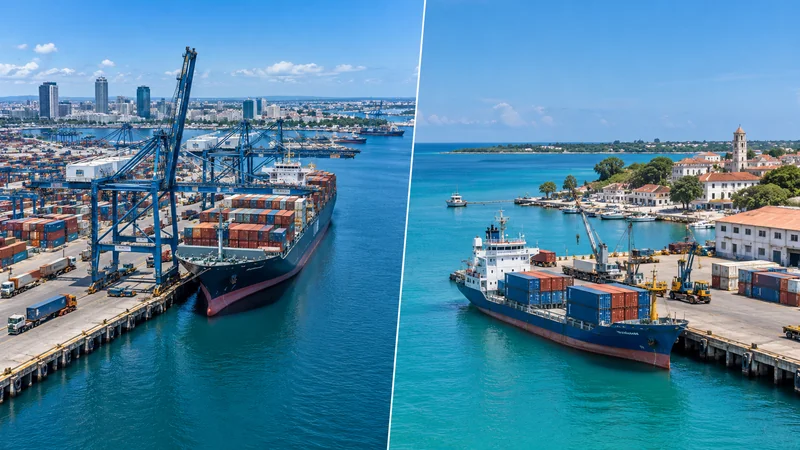
For businesses importing goods from China, choosing between Mainland Tanzania and Zanzibar is not simply a question of selecting the closest port. An industrial equipment buyer in Dar es Salaam, a hotel developer in Zanzibar, and a distributor moving stock from Mainland Tanzania to the islands may face different conformity checks, import permits, and tax considerations—even when purchasing similar products from the same Chinese supplier.
Quick Answer: Import requirements differ between Mainland Tanzania and Zanzibar, although the Tanzania Revenue Authority (TRA) handles customs declarations in both. Regulated Mainland imports may require TBS Pre-shipment Verification of Conformity (PVoC), while Zanzibar operates a separate ZBS conformity programme. Import permits, certificate verification, and applicable taxes also need checking. If goods arrive through Dar es Salaam before moving to Zanzibar, their customs status determines which additional procedures must be confirmed.
Data Note (October 2026): This guide draws on publicly available information from Tanzania’s customs and standards authorities, Zanzibar regulatory agencies, and port operators. Requirements depend on the product’s HS code, importer, declared destination, customs procedure, and applicable tax legislation. Cross-island tax treatment and certain cargo movement procedures require shipment-specific confirmation.
These differences matter before production is completed. A certificate arranged for the wrong destination may not satisfy the applicable conformity programme. A freight booking that identifies Dar es Salaam without specifying the intended customs procedure may leave important clearance responsibilities unresolved.
This guide compares Zanzibar vs Mainland Tanzania import requirements, explains the roles of TBS, ZBS, TRA, and Zanzibar tax authorities, and shows what buyers should verify before shipping. For an overview of transport options and the wider import process, see our guide to shipping from China to Tanzania.
1. Mainland Tanzania vs Zanzibar: Which Import Rules Apply?
Tanzania operates a common customs framework, but importers must distinguish national customs administration from destination-specific product standards, permits, and taxes.
The Tanzania Revenue Authority (TRA) administers customs procedures, including those processed through the Tanzania Customs Integrated System (TANCIS). Importers generally appoint licensed Clearing and Forwarding Agents (CFAs) to prepare and submit declarations.
However, customs clearance and product conformity certification are separate requirements.
The Tanzania Bureau of Standards (TBS) administers the Mainland conformity programme, while the Zanzibar Bureau of Standards (ZBS) operates its own import conformity procedures. Zanzibar also has separate tax legislation administered by the Zanzibar Revenue Authority (ZRA).
Mainland Tanzania vs Zanzibar Import Requirements Comparison
| Import requirement | Mainland Tanzania | Zanzibar | What changes when routing via Dar? |
|---|---|---|---|
| Customs administration | TRA / TANCIS | TRA / TANCIS | Customs entry and release arrangements must be identified. |
| Product conformity | TBS, where applicable | ZBS, where applicable | Certificate acceptance depends on destination and customs procedure. |
| PVoC certificate | TBS-approved CoC for regulated goods | ZBS scheme CoC or applicable exception | A Mainland certificate should not be assumed sufficient for Zanzibar. |
| Clearing agent | Licensed CFA | Licensed CFA with appropriate clearance arrangements | Confirm responsibility for arrival and onward movement. |
| Import registration | Applicable Mainland importer registration | Applicable Zanzibar importer registration | Confirm which entity is legally importing the goods. |
| Product permits | Relevant Mainland authorities | Relevant Zanzibar authorities | Additional destination-specific requirements may apply. |
| VAT framework | Mainland VAT legislation | Zanzibar VAT legislation | Tax treatment depends on the transaction and customs history. |
| Cargo release | Mainland customs release | Zanzibar customs release | Determine whether goods remain under customs control. |
| Final delivery | After applicable import release | After applicable import release and local approvals | Transport to Zanzibar does not itself establish lawful release. |
This comparison describes regulatory responsibilities, not a universal checklist for every commodity. Actual requirements must be checked using the product description, HS code, and intended customs procedure.
Shared Customs Framework, Different Regulatory Authorities
For customs purposes, both Mainland Tanzania and Zanzibar operate within the East African Community customs framework. This provides a common foundation for tariff classification, customs valuation, and import administration.
The distinction becomes important when determining which authority is responsible for a particular compliance requirement.
For example, an importer purchasing electrical equipment from China may need to address product conformity, customs classification, import registration, and possibly additional technical approvals. Those responsibilities cannot be determined solely by the fact that the cargo enters Tanzania.
A Zanzibar-bound shipment must be checked against the applicable ZBS requirements, even when the transport arrangement involves Dar es Salaam. Similarly, a product that satisfies one standards programme should not automatically be regarded as exempt from requirements imposed by another competent authority.
Why the Place of Customs Release Matters
Consider two illustrative purchasing arrangements involving similar machinery from China:
- Scenario A — Mainland Import: A business imports machinery through Dar es Salaam for installation at a Mainland factory. Its clearing agent prepares the applicable import entry, confirms product compliance, and arranges Mainland customs release.
- Scenario B — Zanzibar Import: A business purchases machinery for a facility in Zanzibar. The cargo may arrive directly in Zanzibar or pass through Dar es Salaam before reaching the islands.
In Scenario B, the importer must establish whether the cargo will remain under customs control during onward movement or be formally released for Mainland home consumption first.
These arrangements can require different supporting documents and create different questions about tax, conformity, and local authorization.
The practical rule: Identify the legal importer, intended customs procedure, and place of release before deciding which documentation and certification arrangements to use.
2. TBS vs ZBS: PVoC, CoC and Product Inspections

One of the most important differences between Zanzibar and Mainland Tanzania import requirements concerns Pre-shipment Verification of Conformity (PVoC).
PVoC is intended to verify that imported products meet applicable standards before they are shipped. Where required, the process results in a Certificate of Conformity (CoC) issued through an authorized conformity assessment provider.
Although TBS and ZBS operate similar types of conformity programmes, they are not interchangeable certification authorities.
Mainland Imports: When Does TBS PVoC Apply?
The Tanzania Bureau of Standards administers PVoC requirements for specified categories of regulated imported products.
A Mainland importer should determine whether the intended goods fall within the current regulated HS-code list. The product description alone may be insufficient, particularly for machinery, electrical products, components, or goods containing several materials.
The typical preparation process involves confirming the product classification, identifying the applicable standards, submitting supporting documentation, and arranging inspection or testing where required.
Relevant evidence may include product specifications, test reports, manufacturing information, commercial documents, and inspection results.
For covered consignments, an appropriate CoC must be obtained through the applicable programme. Importing regulated goods without the required certificate can result in destination inspection, additional charges, delays, or other enforcement action.
TBS also publishes exemption criteria and separate arrangements for certain goods, so importers should not assume all products follow the same certification route.
The current programme, regulated HS codes, exemptions, and service providers should be checked through the Tanzania Bureau of Standards PVoC guidance.
Zanzibar Imports: ZBS PVoC and CoC Authentication
Zanzibar operates its own PVoC programme under ZBS.
Its published programme has broad coverage for imported goods while identifying exceptions, including certain products bearing recognized standards marks, used motor vehicles, and petroleum products. An exception from pre-export certification does not necessarily remove other inspection or regulatory obligations.
The ZBS procedure generally involves the following stages:
- Request for Certification: The exporter submits shipment and product information to the applicable ZBS PVoC service provider.
- Document Review and Inspection: The provider assesses technical evidence and conducts inspection or testing when required.
- Certificate Issuance: A CoC is issued where the consignment satisfies the applicable requirements.
- Authentication and Customs Use: The certificate is presented for the required verification and used with the appropriate customs documentation.
ZBS’s published procedure identifies its Import Inspection Office for CoC authentication before the authenticated certificate is used in TRA clearance.
Importers should verify the current submission office and acceptance procedure, because some published government trade-portal instructions refer to a different verification office. See the ZBS official PVoC procedures.
Can a TBS Certificate Be Used for Zanzibar Clearance?
Do not assume that a TBS certificate automatically replaces ZBS certification.
The acceptance of existing conformity evidence depends on the product, the applicable scheme, and any recognized exemptions.
An existing TBS certificate, a manufacturer’s test report, and an East African Community standards mark are not necessarily equivalent documents.
For example, the ZBS programme identifies products bearing a recognized standards mark from an EAC partner-state standards bureau among its PVoC exceptions. However, the existence of a mark does not automatically establish that every product or consignment qualifies, nor does it remove unrelated import-permit or customs obligations.
Where products are being imported specifically into Zanzibar, the importer should obtain confirmation of the required certificate, accepted evidence, and authentication procedure before the supplier books shipment.
What Happens If Goods Arrive Without an Accepted CoC?
Goods that arrive without the required pre-shipment conformity evidence may become subject to destination inspection or other regulatory action.
ZBS has a destination inspection scheme covering goods without a CoC and certain categories that follow different inspection arrangements, including used vehicles and petroleum products.
Depending on the product and applicable procedure, destination inspection may involve document examination, sampling, laboratory analysis, and a decision on whether the goods meet the relevant standards.
Approval should not be assumed. Nonconforming goods may face rejection or other action, and any additional inspection cost may affect the importer’s landed cost.
Because published procedural instructions differ on destination inspection application timing, importers should confirm the deadline directly with ZBS rather than relying on a universal lead-time estimate.
Pro Tip — Verify Certification Before Export: Ask the importer to confirm the intended destination, applicable PVoC programme, accepted certification provider, and required CoC before goods leave China. If existing certificates are available, obtain confirmation of their acceptance rather than arranging a second inspection based on assumptions.
3. Direct Zanzibar Import or Mainland Gateway: What Changes?
A shipping route affects more than transport costs. It can determine which customs process is needed, which documents must accompany the cargo, and how the final place of import release is recorded.
There are three common planning arrangements to compare.
Sea Cargo Entering Through Dar es Salaam
Dar es Salaam is a major commercial gateway for international imports.
For shipments intended for Mainland consumption, the importer generally follows the applicable TRA customs declaration and release process before collecting the goods.
However, cargo arriving at Dar with Zanzibar as its intended destination requires closer examination.
The importer and carrier must clarify whether the goods are to be released for Mainland home consumption or moved onward under an approved customs-controlled arrangement.
If the shipment is intended to remain under customs control, the relevant declarations, manifest information, movement approvals, and carrier instructions must support that procedure.
A freight quotation stating only “China to Dar es Salaam, then Zanzibar” is not enough to determine the correct legal treatment.
Direct Sea Cargo to Zanzibar
Direct import through a Zanzibar port can simplify the definition of the intended destination because the planned international arrival and import release are both associated with Zanzibar.
Malindi Port is an established commercial gateway for Unguja, but actual carrier service, vessel acceptance, cargo handling, and the relevant entry facilities must be confirmed before booking.
For cargo imported directly into Zanzibar, the importer should prepare the applicable ZBS conformity documentation, Zanzibar permits, and customs records.
Direct arrival does not eliminate customs duties, VAT, inspections, or clearance responsibilities.
For shipping methods, port options, and final delivery considerations, see our dedicated guide to shipping from China to Zanzibar.
Zanzibar Airport (ZNZ) vs Dar es Salaam Airport (DAR)
Air cargo presents a similar compliance decision.
A shipment consigned directly to Zanzibar’s Abeid Amani Karume International Airport (ZNZ) may follow a different arrival and handling arrangement from goods entering through Julius Nyerere International Airport (DAR) for subsequent movement to the islands.
Before selecting an airport, confirm:
- Whether the airline and cargo handler accept the commodity, dimensions, packaging, and any dangerous-goods classification.
- The airport of customs entry and intended place of release.
- Whether onward movement requires a separate customs or transfer procedure.
- Which conformity certificates and permits are accepted for the intended destination.
Airlines may also restrict certain batteries, chemicals, equipment, or oversized shipments. A flight’s availability does not establish that the airline will accept the proposed cargo.
Route Comparison: The Compliance Questions That Change
| Route arrangement | Primary compliance concern | What must be confirmed |
|---|---|---|
| China → Dar → Mainland delivery | Mainland import release | TBS applicability, importer, TRA entry, and applicable permits. |
| China → Zanzibar port → Zanzibar delivery | Zanzibar import release | ZBS compliance, Zanzibar permits, customs declaration, and taxes. |
| China → Dar → Zanzibar under customs control | Authorized onward movement | Entry procedure, manifest, responsible agent, movement documents, and final release. |
| China → Dar → Mainland release → Zanzibar | Previously imported goods subsequently transferred | Proof of Mainland release, Zanzibar requirements, and cross-island tax treatment. |
| China → ZNZ airport | Direct Zanzibar air import | Air cargo acceptance, ZBS requirements, customs entry, and permits. |
| China → DAR airport → Zanzibar | Air arrival followed by onward movement | Customs status at DAR and legal basis for subsequent transfer. |
Shipping-line restrictions are another reason to confirm a route rather than assume it is available. For example, Maersk published a Zanzibar in-transit cargo restriction on August 11, 2026, affecting certain arrangements through Dar es Salaam and Mombasa. This was a carrier-specific advisory, not a general prohibition issued by Tanzanian customs. Its current application must be checked for any proposed booking.
The essential distinction is whether a route is operationally available and supported by the appropriate customs procedure.
4. Goods Moving from Dar es Salaam to Zanzibar: Which Customs Procedure Applies?

This is one of the most important questions for businesses importing goods from China through Dar es Salaam.
Two shipments may travel through the same port and arrive at the same destination in Zanzibar, yet follow different customs procedures because their legal status at Dar es Salaam is different.
The key distinction is between cargo remaining under customs control and goods already released for Mainland home consumption.
Scenario A: Cargo Remains Under Customs Control at Dar es Salaam
A shipment may arrive at Dar es Salaam with the intention of continuing to Zanzibar before final import release.
Depending on the authorized arrangement, the cargo may remain subject to customs control during its onward movement.
The Tanzania Ports Authority describes a transshipment process involving cargo identification, shipping-line notification, details of the incoming and onward vessels, and coordination with customs and terminal authorities.
However, this published port process does not establish that every Dar-to-Zanzibar shipment qualifies for transshipment or any particular customs-controlled procedure. The relevant customs authorization must be confirmed for the actual shipment.
Before booking, the importer and appointed agent should establish:
- The intended customs procedure and where the goods will be released.
- Whether the proposed movement requires a customs declaration, bond, approval, or other control.
- How the original manifest, shipping documents, and final destination will be recorded.
- Which party is responsible for the cargo while it remains under customs control.
- What documentation confirms authorized movement and eventual release.
A carrier’s willingness to transport the cargo does not, by itself, authorize the customs procedure.
Scenario B: Goods Are First Cleared for Mainland Home Consumption
A different situation arises when goods from China are imported into Mainland Tanzania, customs-cleared for home consumption, and subsequently moved to Zanzibar.
For example, a Mainland distributor might import equipment into its Dar es Salaam warehouse and later sell part of the stock to a buyer in Zanzibar.
In this situation, the importer should retain the original customs declaration, release evidence, applicable tax receipts, and commercial records supporting the subsequent movement.
The legal treatment cannot be determined solely by describing the shipment as a transfer within Tanzania.
Importers must still consider Zanzibar product standards, the legal status of the subsequent supply, applicable local permits, and the VAT or excise treatment of the goods.
An important distinction in Zanzibar’s excise legislation: Section 18 of Zanzibar’s Excise Duty Act No. 8 of 2017, in its 2025 consolidated version, addresses goods imported and cleared under customs procedures in Mainland Tanzania before being transferred to Zanzibar for home consumption.
The provision addresses excise duty treatment in that context. However, because it appears in the Zanzibar Excise Duty Act, it must be interpreted within that legislation.
It does not establish a general exemption from all customs duties, VAT, standards requirements, permits, or handling charges.
Importers should verify its current legal application and supporting documentation with ZRA and their customs or tax adviser before relying on it.
Scenario C: The Cargo’s Customs Status Is Unclear
A shipment should not proceed on the assumption that onward delivery automatically resolves customs obligations.
Warning signs include a quotation showing Dar es Salaam as the only customs destination, uncertainty about which importer will appear on the declaration, missing authorization for onward movement, or a tax estimate prepared without identifying the legal procedure.
If the cargo has already been released for Mainland consumption, it should not be described as customs-controlled transit without supporting documentation.
Similarly, the importer should not assume that an uncleared consignment can be moved freely to Zanzibar simply because both locations are within Tanzania.
Dar-to-Zanzibar Customs Status Decision Matrix
| Cargo situation | Main compliance question | Documents to check | Recommended action |
|---|---|---|---|
| Goods arrive at Dar and remain under customs control | Is the intended onward movement authorized? | Manifest, customs entry, approved movement documents, and final destination details | Obtain confirmation of the applicable procedure from TRA and the agent. |
| Goods are customs-cleared for Mainland home consumption | What requirements apply to the subsequent Zanzibar transfer? | Mainland release, tax payment evidence, transfer invoice, and movement records | Verify Zanzibar conformity, permits, and tax treatment. |
| Goods have a TBS certificate but are ultimately destined for Zanzibar | Does ZBS accept the certificate or supporting evidence? | CoC, product specifications, HS code, and inspection records | Confirm recognition or alternative certification with ZBS. |
| Cargo destination differs between the booking and customs documents | Which documents require amendment? | Bill of lading, manifest, invoice, consignee information, and declaration | Resolve discrepancies with the carrier and clearing agent. |
| Supplier offers DDP but the importer is unidentified | Who can legally perform import clearance? | Sales contract, importer registration, and agent authorization | Establish a legally workable import arrangement before booking. |
Practical decision sequence: First, identify the actual importer and final consignee. Next, establish whether Dar is the place of Mainland import release or a gateway for customs-controlled onward movement. Then confirm the required declaration, standards certification, and Zanzibar permits. Finally, obtain a written assessment of the applicable taxes and clearance responsibilities.
Pro Tip — Obtain a Written Customs-Status Confirmation: Before accepting a Dar-to-Zanzibar freight arrangement, ask the appointed clearing agent to document the customs procedure at Dar, the authorized movement to Zanzibar, and the intended final release point. This helps prevent disagreements between the buyer, exporter, carrier, and destination agents.
Review Zanzibar Import Compliance
Planning to ship Chinese-manufactured equipment, commercial goods, or project cargo through Dar es Salaam to Zanzibar? Share the product description, HS code, intended importer, and proposed route with Winsail Logistics. We can review the shipment information, identify documentation questions, and help coordinate further verification with the appropriate local parties before booking.
5. Importer Registration, Clearing Agents and Permits
Import documents are only one part of the clearance process. An importer must also establish who is legally responsible for entering the goods, obtaining approvals, and paying applicable charges.
Who Must Be Identified as the Importer and Consignee?
The commercial buyer, importer, consignee, and freight forwarder may be different parties.
The buyer purchases the goods. The importer is the entity responsible for the applicable import declaration and legal obligations. The consignee is identified in the relevant transport documents, while the licensed clearing agent acts within its authorization to handle customs formalities.
These roles should be consistent with the sales transaction and actual clearance arrangement.
Tanzania’s published import procedure requires the importer to appoint a licensed CFA, and customs documentation is processed through TANCIS.
Common supporting documents include the commercial invoice, packing list, transport document, agent authorization, and any applicable import permits or exemptions. Importer identification and tax registration must also be checked.
For a fuller explanation of the declarations and clearance workflow, see our Tanzania customs clearance procedures.
A clearing agent can represent an importer within the applicable legal framework, but appointing an agent does not automatically transfer all importer responsibilities or product-compliance obligations.
Zanzibar Import Registration and Local Permits
Zanzibar has import-related procedures in addition to the common customs framework.
The Tanzania Trade Portal identifies importer registration through Zanzibar’s Ministry of Trade and Industrial Development (MTID), as well as an import-permit procedure. Its published procedural records require confirmation of current applicability before they are used for an individual shipment.
Depending on the commodity, additional regulatory requirements may arise.
For example, imported processed foods may require approvals from the Zanzibar Food and Drugs Agency (ZFDA). Other regulated products may require approvals from the relevant technical, safety, agricultural, or sector-specific authority.
The applicable documentation should be determined from the actual product classification and intended use—not from a general assumption that all imports require the same permits.
For commercial machinery, the importer may need to clarify whether the shipment is covered by conformity controls, technical restrictions, or other applicable approvals. For food-related equipment and products, the equipment and the goods it processes should not automatically be treated as one regulatory category.
Before shipment, ask the local importer or licensed agent to confirm the required registration, commodity permits, and responsible issuing offices.
Incoterms, Door-to-Door Delivery and DDP Responsibilities
A common misunderstanding is that a door-to-door shipping service automatically includes import duties, taxes, and legal importer responsibilities. It does not.
Door-to-door describes a transport arrangement. The allocation of obligations depends on the agreed commercial terms and applicable law.
| Commercial term | Import clearance responsibility | Key consideration |
|---|---|---|
| CIF — Cost, Insurance and Freight | Generally the buyer | The seller pays freight and insurance to the named destination port, but does not ordinarily handle destination import clearance. |
| DAP — Delivered at Place | Generally the buyer | Seller arranges delivery to the named place; buyer handles import formalities and applicable duties/taxes. |
| DDP — Delivered Duty Paid | Seller | Seller is responsible for import clearance and applicable duties/taxes, subject to a legally workable arrangement. |
| Door-to-door service | Defined by the contract | Does not independently determine who pays taxes or acts as importer. |
Under ICC Incoterms 2020, DDP places substantial import-clearance obligations on the seller. It should be selected only when the seller can legally fulfill those responsibilities.
A Chinese supplier offering DDP delivery to Zanzibar should therefore be able to explain the legally authorized importer, clearing arrangement, tax responsibilities, and any necessary local representation.
A freight forwarder coordinating transportation or documentation should not be assumed to act as the importer of record.
Before accepting a DDP quotation, request a written explanation of the responsible importer, clearance services included, duties and taxes covered, and any exclusions.
6. Duties, VAT, Inspection Fees and Local Charges
Import taxes are an important part of comparing Mainland Tanzania and Zanzibar, but the difference cannot be reduced to one VAT percentage.
A reliable landed-cost estimate must consider the product classification, customs value, import procedure, applicable taxes, certifications, and destination charges.
Customs Duty and EAC Tariff Classification
Tanzania participates in the East African Community customs framework, which includes the Common External Tariff (CET).
The applicable import duty depends on the product’s HS classification, tariff provisions, origin, customs valuation, and any valid exemption or special treatment.
Two types of industrial equipment may attract different duty treatments even when imported under the same shipment.
For that reason, buyers should obtain a classification-based assessment rather than applying a general tariff percentage to every product.
The importer or clearing agent should confirm the correct classification and applicable current tariff measures before calculating the expected customs charges.
Where the goods qualify for preferential treatment, exemptions, or other relief, the importer must establish eligibility and retain the necessary supporting documents.
Mainland Tanzania VAT vs Zanzibar VAT
The standard VAT frameworks differ between Mainland Tanzania and Zanzibar.
| Jurisdiction | Published standard VAT rate for taxable imports | Important qualification |
|---|---|---|
| Mainland Tanzania | 18% | Confirm the rate and any product-specific treatment under current legislation. |
| Zanzibar | 15% | Confirm the rate and any applicable exemption, relief, or later amendment. |
Reference: October 2026 review of published tax guidance. These are standard rates, not guaranteed rates for every commodity or movement.
Zanzibar Revenue Authority publishes a 15% rate for taxable imports into Zanzibar and provides separate information on exempt supplies and special relief under the applicable VAT legislation.
The current guidance can be checked through the Zanzibar Revenue Authority VAT information.
The difference in published standard rates does not mean that importing through Zanzibar will necessarily produce a lower total cost.
Import duty, inspection fees, permits, port handling, additional transport, and transaction-specific taxes may affect the overall result.
Importers should also distinguish VAT payable at importation from any later VAT treatment associated with onward sales or business transactions.
What Happens to VAT Already Paid in Mainland Tanzania?
This question is especially important for businesses importing goods through Dar es Salaam before transferring them to Zanzibar.
Zanzibar’s Value Added Tax Act No. 4 of 1998, in its 2025 consolidated version, contains provisions addressing VAT previously paid in Mainland Tanzania.
Sections 3(2) and 3(3) address circumstances in which Mainland VAT has already been paid and how the rates compare. These provisions demonstrate that cross-island VAT treatment is governed by specific legal conditions rather than an automatic rule requiring every shipment to pay the full VAT amount twice.
However, they do not justify a universal conclusion about goods imported through Mainland Tanzania at its standard import VAT rate and subsequently transferred to Zanzibar.
The treatment may depend on the original import transaction, subsequent supply, tax invoices, parties involved, nature of the goods, and current legislation.
Needs confirmation before publishing: The definitive VAT treatment for a shipment first cleared for Mainland home consumption and later transferred to Zanzibar has not been established for all transaction types. The applicable 2026 amendments, documentary conditions, and any available relief must be verified with TRA and ZRA.
Importers should not assume that previously paid VAT is automatically credited, refunded, waived, or charged again.
Instead, the importer should provide the original customs and tax records to a qualified tax adviser or the relevant authorities and obtain confirmation for the proposed movement.
Other Import and Regulatory Charges
Apart from customs duties and VAT, imports may incur several types of operational and regulatory charges.
| Charge category | What may affect the amount |
|---|---|
| PVoC and CoC fees | Applicable standards programme, product, and certification route. |
| Destination inspection | Whether inspection or testing is required after arrival. |
| Import permits | Commodity, importer, and issuing authority. |
| Customs brokerage | Declaration complexity, work scope, and agent agreement. |
| Port and terminal charges | Cargo type, handling, storage, and release arrangements. |
| Onward movement | Approved customs procedure, transport arrangement, and handling. |
| Local duties and levies | Applicable commodity and tax legislation. |
| Final delivery | Destination access, equipment, unloading, and receiving requirements. |
There is no single reliable percentage that can be added to every China-to-Zanzibar shipment to estimate all of these charges.
For procurement planning, a useful calculation is:
Estimated Landed Cost = Purchase Price + Freight and Insurance Not Already Included + Applicable Duties and Taxes + Certification and Permit Charges + Port and Brokerage Costs + Onward Transport and Delivery
The calculation should avoid double-counting freight, insurance, or handling already included in the purchase price or customs value. Recoverable VAT and approved tax relief should be considered separately where legally applicable.
The estimate should specify the currency, quotation date, included services, and assumptions.
Most importantly, a lower published VAT rate does not automatically establish that one route is cheaper than another.
7. Pre-Shipment Compliance Checklist: What Should Be Confirmed Before Booking?
The most effective way to avoid documentation and regulatory problems is to confirm the relevant requirements before cargo leaves China.
A complete review should involve the exporter, importer, clearing agent, and relevant conformity or permit-issuing authorities.
Information the Chinese Exporter Should Prepare
The exporter should provide accurate descriptions and supporting evidence for the goods being shipped.
- Detailed product names, models, specifications, and intended use.
- Proposed HS classification for verification by the importer.
- Commercial invoice and packing list.
- Supplier and exporter information.
- Available technical documents, test reports, and certification evidence.
- Packaging details and any relevant dangerous-goods information.
- Planned shipment method and expected cargo-ready date.
Accurate product descriptions are particularly important for goods with multiple functions or materials. A generic invoice description such as “machine parts” may not provide enough information for reliable classification, conformity assessment, or import-permit verification.
Information the Importer and Clearing Agent Must Confirm
The local importer and appointed clearing agent should review a separate set of responsibilities before shipment.
- Legal importer, consignee, tax identification, and required registration.
- Intended customs release location and declaration procedure.
- Licensed clearing agent and written authorization.
- Applicable TBS or ZBS PVoC requirements.
- CoC authentication and acceptance requirements.
- Zanzibar or Mainland commodity-specific permits.
- Customs-controlled onward movement documents, if applicable.
- Written assessment of duties, VAT, and any relevant relief.
- Carrier acceptance and destination handling arrangements.
- Responsibilities for storage, delivery, unloading, and document retention.
Final Compliance Sign-Off
Not every requirement can be confirmed by the exporter or freight forwarder alone.
Before booking, each material compliance question should have a clear status and an identified responsible party.
| Compliance item | Recommended status | Responsible party |
|---|---|---|
| Product classification | Confirmed after review | Importer / CFA |
| Applicable PVoC scheme | Confirmed or exemption documented | Importer / TBS or ZBS |
| CoC acceptance | Confirmed where applicable | Relevant standards authority |
| Import permits | Approved or verified as not required | Importer / issuing authority |
| Customs procedure | Confirmed before shipment | Licensed CFA / TRA |
| Cross-island tax treatment | Written determination where necessary | TRA / ZRA / qualified tax adviser |
| Carrier and destination acceptance | Confirmed before booking | Carrier / handling parties |
| Delivery and unloading arrangements | Agreed in writing | Contracting parties |
Where a requirement remains uncertain, record it as Conditional or Needs Confirmation, together with the authority or professional responsible for resolving it.
Do not treat unanswered legal or certification questions as approved simply because the shipment has received a freight quotation.
Review Zanzibar Import Compliance
Choosing between direct Zanzibar import and a shipment routed through Mainland Tanzania?
Winsail Logistics can help review your proposed shipment information and clarify which transportation and documentation questions need to be resolved with the relevant parties.
To begin a review, provide the product name, HS code if available, cargo details, Chinese pickup location, intended Zanzibar destination, importer information, and proposed delivery terms.
Review Zanzibar Import Compliance
FAQ
Can I use a TBS Certificate of Conformity for goods imported into Zanzibar?
Not automatically. TBS and ZBS administer separate conformity programmes, and certificate acceptance depends on the product and applicable rules. ZBS recognizes certain categories of products with qualifying standards marks under its published PVoC arrangements, but a Mainland CoC should not be assumed to satisfy Zanzibar requirements without confirmation. Check the existing certificate, product details, and HS classification with ZBS or the relevant authorized conformity assessment provider before export.
If my goods arrive in Dar es Salaam but are destined for Zanzibar, where should customs clearance happen?
The answer depends on the authorized customs procedure. A shipment moving onward under customs control may be handled differently from goods formally released for Mainland home consumption. The importer and licensed clearing agent should confirm the customs status at Dar, documentary requirements for onward movement, and intended final place of release. The port named in a freight quotation does not by itself determine where import clearance must occur.
Will I pay Zanzibar VAT again if import VAT was already paid in Mainland Tanzania?
Not necessarily, but there is no universal answer for every transaction. Zanzibar's VAT legislation includes provisions concerning VAT previously paid in Mainland Tanzania. Their application depends on the legal conditions and actual transaction. Keep the original customs declaration, tax payment evidence, and subsequent commercial records, then seek confirmation from TRA and ZRA. Do not assume automatic double taxation or automatic exemption.
Can a Chinese exporter offer DDP shipping to Zanzibar without a local importer?
A DDP arrangement must be legally workable. Under Incoterms 2020, the seller assumes responsibility for applicable import clearance and duty/tax obligations, but must be able to fulfill them under local law. The parties should identify the legally authorized importer, any required customs or tax representation, the appointed clearing agent, and the service scope. Door-to-door transportation alone does not satisfy these requirements.
Does an EAC standards mark exempt goods from all Zanzibar inspections?
No. ZBS identifies certain products bearing qualifying EAC partner-state standards marks among the exceptions to its PVoC scheme. An exception from pre-export conformity certification does not automatically remove customs requirements, market surveillance, sector-specific permits, or other applicable inspections. Verify that the specific product and mark satisfy the current exception criteria.
Final Considerations: Choose the Import Procedure Before the Shipping Route
When comparing Zanzibar vs Mainland Tanzania import requirements, the most important decision is not simply which port or airport the cargo should use. It is determining which customs, conformity, importer, and tax requirements apply to the actual transaction.
Mainland imports may require TBS conformity certification, while Zanzibar-bound goods must be reviewed against the relevant ZBS procedures. Both operate within Tanzania’s wider customs framework, but their destination-specific standards and administrative obligations should not be confused.
For cargo routed through Dar es Salaam, particular attention should be given to whether the shipment remains under customs control or has already been released for Mainland consumption. This distinction can affect the required documents and the treatment of subsequent movement to Zanzibar.
Tax differences also require careful interpretation. Published VAT rates provide a starting point, but they do not replace an assessment of customs value, commodity classification, applicable legislation, and any cross-island tax provisions.
For importers purchasing goods from China, the practical approach is to verify the product classification, identify the responsible importer, confirm the correct certificate and permits, establish the customs procedure, and obtain a documented tax assessment before shipment.
By resolving these matters early, exporters and buyers can make better-informed decisions about shipping arrangements while reducing the risk of avoidable documentation disputes, clearance interruptions, and unexpected costs.
Regulatory Disclaimer: This article provides general import compliance information based on publicly available sources reviewed in October 2026. It does not constitute binding legal, customs, or tax advice. Requirements may change and vary by product, importer, customs procedure, and destination. Any proposed shipment should be reviewed with the relevant authorities and appropriately qualified local professionals before export or customs declaration.
