
Overview
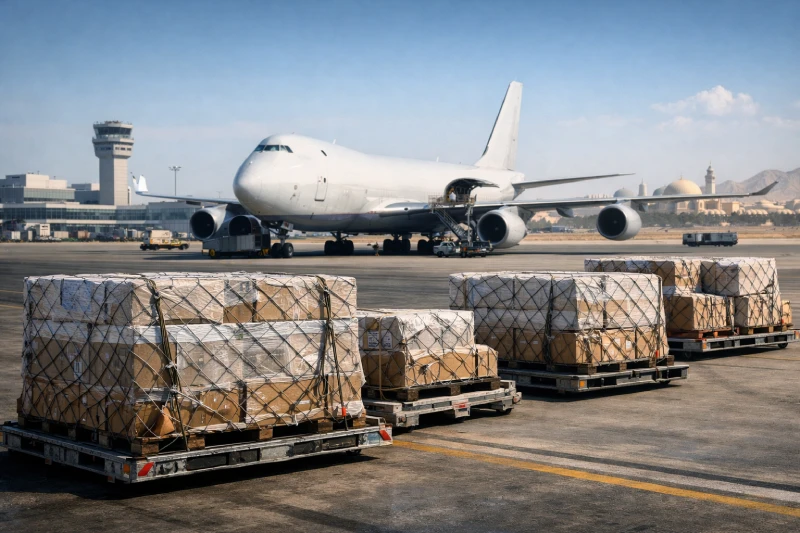
Air freight from China to Saudi Arabia is commonly used by B2B importers when speed, cargo value, or supply chain continuity outweigh the limitations of capacity and cost. This service is typically chosen for commercial shipments that support manufacturing, distribution, or project execution, rather than for personal or courier-style deliveries.
For Saudi-bound imports, air freight plays a strategic role in moving time-sensitive goods through major cargo airports such as Riyadh, Jeddah, and Dammam, while requiring close attention to Saudi customs procedures, product compliance, and documentation accuracy. Importers usually rely on experienced freight forwarders to coordinate export handling in China, airline capacity, and import clearance requirements in Saudi Arabia.
Key Air Cargo Airports in China and Saudi Arabia
Air freight shipments between China and Saudi Arabia are routed through a limited number of cargo-capable airports that offer stable airline networks, customs efficiency, and handling capacity for commercial freight. Airport selection is usually driven by cargo origin, shipment profile, and final destination within Saudi Arabia, rather than proximity alone.
Key Air Cargo Airports in China
Shanghai Pudong International Airport (PVG)
- Strong long-haul international air cargo connectivity
- Commonly used for high-value industrial goods and electronics
- Suitable for shipments requiring stable airline options and frequent departures
Guangzhou Baiyun International Airport (CAN)
- Major gateway for South China manufacturing regions
- Well-suited for mixed commercial cargo and consolidated air shipments
- Often selected for cargo sourced from Guangdong and nearby provinces
Shenzhen Bao’an International Airport (SZX)
- Preferred for technology-related and time-sensitive exports
- Efficient for shipments originating from Shenzhen and Pearl River Delta
- Frequently used for urgent replenishment cargo
Beijing Capital International Airport (PEK)
- Strategic option for North China exporters
- Used for specialized or centrally consolidated cargo
- Less manufacturing-driven, more project- or contract-based shipments
Major Air Cargo Airports in Saudi Arabia
King Khalid International Airport (RUH)
- Primary air cargo gateway for central Saudi Arabia
- Widely used for industrial, government-related, and distribution imports
- Strong customs presence and inland delivery connectivity
King Abdulaziz International Airport (JED)
- Key gateway for western Saudi Arabia
- Frequently used for commercial imports serving Jeddah and surrounding regions
- Often combined with sea-air or hybrid logistics strategies
King Fahd International Airport (DMM)
- Main air cargo hub for the Eastern Province
- Suitable for industrial and energy-related imports
- Common choice for shipments linked to regional industrial projects
Airport Selection at a Glance
| Location | Airport | Best Used For |
|---|---|---|
| China | Shanghai Pudong (PVG) | High-value cargo, stable long-haul routes |
| China | Guangzhou Baiyun (CAN) | South China manufacturing exports |
| China | Shenzhen Bao’an (SZX) | Urgent and technology-related shipments |
| Saudi Arabia | Riyadh (RUH) | Central distribution and industrial imports |
| Saudi Arabia | Jeddah (JED) | Western region commercial cargo |
| Saudi Arabia | Dammam (DMM) | Eastern Province industrial shipments |
Air Freight Shipping Process from China to Saudi Arabia
Air freight shipments from China to Saudi Arabia follow a structured operational flow that combines export handling, airline coordination, and Saudi import clearance. For B2B cargo, accuracy in documentation and process sequencing is often more critical than speed alone.
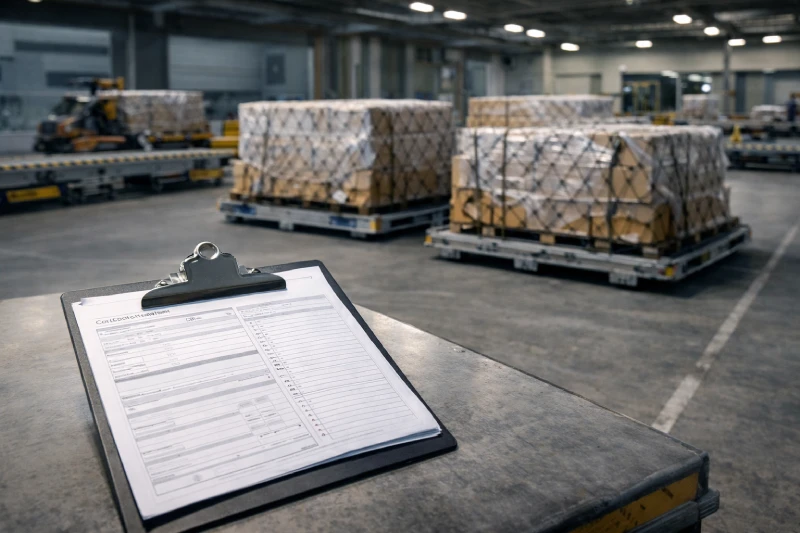
Step 1: Cargo Pickup and Preparation at Origin
- Cargo is collected from the factory, supplier warehouse, or consolidation point in China
- Shipment details are verified, including cargo description, weight, dimensions, and packaging condition
- Air-freight-compliant packaging is applied to protect cargo during handling and flight
Common risk: Incorrect cargo dimensions or weak packaging may cause airline rejection or re-handling delays.
Step 2: Export Documentation and Booking Coordination
- Commercial invoice, packing list, and export declarations are prepared
- Airline space is booked based on cargo profile and routing requirements
- Export customs clearance is arranged at the departure airport
Common risk: Incomplete or inconsistent documents can delay export clearance or disrupt airline acceptance.
Step 3: Cargo Delivery to Airport and Export Handling
- Cargo is delivered to the designated airport cargo terminal
- Airline or ground handling agents inspect cargo and documentation
- Cargo is palletized or containerized according to airline standards
Common risk: Late cargo delivery to the terminal may miss the planned flight, especially during peak periods.
Step 4: International Air Transport
- Cargo is loaded onto scheduled or charter aircraft
- Shipments may move via direct or indirect routes depending on airline network and availability
- Flight tracking and status updates are monitored throughout transit
Common risk: Capacity constraints or flight adjustments may affect routing consistency.
Step 5: Arrival Handling and Import Customs Clearance in Saudi Arabia
- Cargo arrives at the destination airport cargo terminal
- Import documents are submitted to Saudi customs authorities
- Regulatory checks may apply depending on cargo type (e.g. SASO, SFDA-related goods)
Common risk: Missing certifications or incorrect HS classification can trigger inspections or clearance delays.
Step 6: Cargo Release and Final Delivery
- Once customs clearance is completed, cargo is released from the terminal
- Inland transportation is arranged to the importer’s warehouse or project site
- Final delivery confirmation is completed
Common risk: Poor coordination between customs release and inland transport may extend delivery timelines unnecessarily.
Air Freight Service Types for China–Saudi Shipments
Air freight services between China and Saudi Arabia are structured to accommodate different cargo profiles, urgency levels, and shipment sizes. Selecting the appropriate service type helps importers balance speed, cost efficiency, and operational reliability, especially for commercial and project-based cargo.
Comparison of Common Air Freight Service Types
| Air Freight Service Type | Suitable Cargo Scenarios | Operational Characteristics |
|---|---|---|
| Standard Air Cargo | Regular commercial shipments with defined delivery priorities | Uses scheduled airline services; stable routing; suitable for consistent B2B air shipments |
| Air Freight Consolidation | Smaller shipments that do not fill airline unit load devices (ULDs) | Multiple shipments combined under one master air waybill; improves space utilization but requires coordination |
| Charter Air Freight | Oversized, urgent, or project-critical cargo | Dedicated aircraft arranged for specific cargo requirements; offers routing flexibility with higher coordination complexity |
How Importers Typically Choose Between Service Types
- Standard air cargo is commonly selected when shipment schedules are predictable and capacity availability is sufficient
- Consolidated air freight is used when shipment volume is limited and flexibility in routing or handling is acceptable
- Charter services are reserved for cargo that cannot be accommodated within regular airline schedules or size constraints
Decision note: The optimal service type depends on cargo dimensions, regulatory requirements, and supply chain urgency rather than shipment value alone.
Cargo Requirements and Compliance Considerations for Air Freight
Air freight from China to Saudi Arabia places stricter requirements on packaging quality, cargo dimensions, and regulatory compliance than other transport modes. For B2B shipments, many delays occur not during flight, but before airline acceptance or during import inspection, often due to avoidable compliance issues.
Packaging Standards for Air Transport
Core requirements:
- Packaging must withstand repeated handling, palletization, and aircraft vibration
- Cartons and crates must be structurally reinforced and properly sealed
- Wooden packaging must comply with ISPM 15 where applicable
Typical situations where issues arise:
- Export cartons designed for sea freight collapse during air cargo stacking
- Inadequate internal cushioning leads to cargo damage during airport handling
- Non-compliant wooden crates trigger additional inspections at destination
Weight, Volume, and Dimensional Considerations
Key factors airlines assess:
- Chargeable weight based on actual weight vs volumetric weight
- Maximum allowable dimensions for aircraft doors and ULDs
- Weight distribution and balance for palletized cargo
Typical situations where issues arise:
- Cargo dimensions are underestimated before booking, causing space rejection
- Oversized cartons exceed aircraft door limits despite acceptable weight
- Irregularly shaped cargo requires repacking or re-palletization at the terminal
Restricted and Regulated Goods in Air Freight
Commonly regulated cargo categories:
- Batteries, electronics with power units, and energy storage products
- Chemicals, liquids, powders, and industrial materials
- Goods subject to airline or international air transport regulations
Typical situations where issues arise:
- Cargo declared as general goods is reclassified during airline inspection
- Missing or incorrect declarations lead to booking cancellation
- Import clearance is delayed due to regulatory documentation gaps
Operational note: Early cargo classification and disclosure are essential, as airlines apply stricter acceptance rules than ocean carriers.
Documentation Accuracy and Consistency
Documents that must align:
- Commercial invoice
- Packing list
- Air waybill (MAWB / HAWB)
Typical situations where issues arise:
- Cargo description differs between invoice and airway bill
- HS codes are inconsistently applied across documents
- Shipment purpose is unclear, triggering customs queries
Compliance insight: In air freight, minor documentation discrepancies can have disproportionate operational impact, affecting airline acceptance, customs clearance, and final delivery coordination.
Saudi Arabia Import Regulations Relevant to Air Freight
Air freight imports into Saudi Arabia are subject to multi-agency regulatory oversight. For B2B importers, compliance risks often arise not from transportation itself, but from product conformity, certification alignment, and document readiness at the time of customs submission.
Understanding the role of each regulatory authority helps importers anticipate clearance requirements and avoid unnecessary inspection or delays.
Saudi Standards, Metrology and Quality Organization (SASO)
What SASO oversees:
- Product conformity standards for imported goods
- Technical regulations covering safety, performance, and labeling
- Compliance schemes such as product conformity assessment
Air freight–related implications:
- Goods subject to SASO controls may be held upon arrival if conformity documents are incomplete
- Air shipments are often inspected more quickly, leaving less time to correct missing approvals
Common importer issues:
- Assuming SASO requirements apply only to sea freight shipments
- Mismatch between product description and conformity documentation
- Late initiation of conformity processes after cargo is already in transit
Saudi Food and Drug Authority (SFDA)
What SFDA oversees:
- Food products, pharmaceuticals, medical devices, and related materials
- Product registration, licensing, and safety documentation
Air freight–related implications:
- Time-sensitive goods often move by air but face stricter document scrutiny
- Pre-approval and product registration are typically required before shipment
Common importer issues:
- Shipping samples or promotional quantities without proper SFDA clearance
- Incomplete product registration leading to cargo holds at the airport
- Confusion between commercial imports and non-commercial declarations
Saudi Customs
What Saudi Customs oversees:
- Import declaration review and HS code verification
- Duty and tax assessment
- Physical inspection and cargo release
Air freight–related implications:
- Air cargo is processed faster, but documentation errors surface immediately
- Customs queries can delay cargo even when transport time is short
Common importer issues:
- Inconsistent HS codes across invoice, packing list, and airway bill
- Vague cargo descriptions triggering inspection requests
- Underestimating the importance of accurate declared values
How These Authorities Interact in Air Freight Imports
- SASO and SFDA requirements often determine whether cargo is eligible for clearance
- Saudi Customs validates documentation consistency and compliance status
- Failure at any regulatory checkpoint may result in inspection, hold, or return procedures
Compliance insight: For air freight shipments, regulatory readiness must be completed before departure, as post-arrival corrections are limited and operationally costly.
Air Freight vs Sea Freight from China to Saudi Arabia
Both air freight and sea freight are widely used for shipments from China to Saudi Arabia, but they serve very different supply chain objectives. The choice is rarely about one mode being “better,” but about how speed, cargo characteristics, and operational risk align with the importer’s business needs.
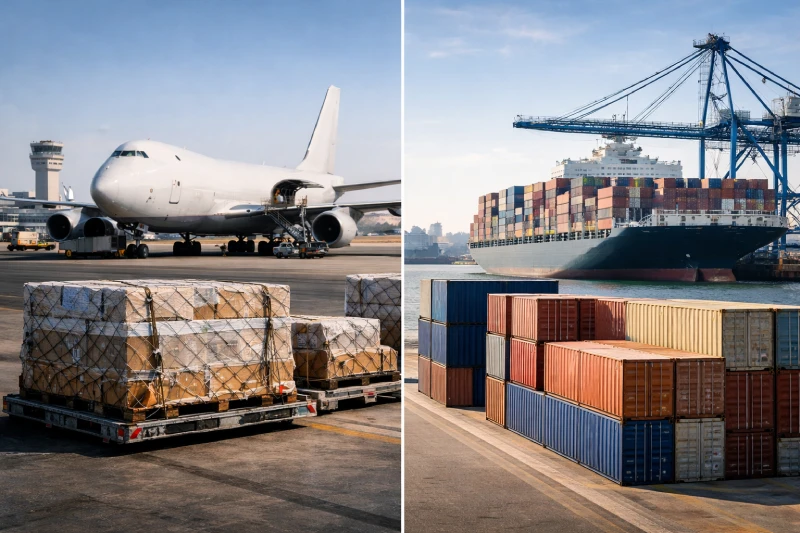
Key Differences Between Air Freight and Sea Freight
| Decision Factor | Air Freight | Sea Freight |
|---|---|---|
| Transport Speed | Fast international transit with short lead times | Longer transit cycles dependent on vessel schedules |
| Cargo Volume | Best suited for smaller, lighter, or high-value shipments | Suitable for large volumes and heavy cargo |
| Cost Structure | Higher unit transport cost | Lower unit transport cost at scale |
| Schedule Flexibility | More frequent departures, easier short-term planning | Fixed sailing schedules with longer planning horizons |
| Customs Handling | Faster processing but stricter document scrutiny | Slower clearance but more tolerance for correction |
| Risk Exposure | Lower transit risk, higher documentation sensitivity | Higher exposure to port congestion and delays |
| Typical Use Cases | Urgent replenishment, spare parts, critical components | Bulk imports, production stock, project cargo |
How Importers Typically Decide Between Air and Sea Freight
Air freight is generally chosen when time sensitivity, supply chain continuity, or cargo value justify higher transport costs and stricter compliance requirements. It is commonly used for urgent production inputs, replacement parts, or high-value goods where delays would cause operational disruption.
Sea freight is typically preferred when cost efficiency and volume optimization are the priority, and delivery schedules can accommodate longer transit times. It remains the dominant mode for bulk commercial imports and large-scale distribution cargo.
Decision insight: Many experienced importers use both modes strategically, relying on air freight to manage exceptions and time-critical gaps, while sea freight supports regular inventory flow.
Incoterms Commonly Used in China–Saudi Air Freight
In air freight shipments from China to Saudi Arabia, Incoterms directly affect export control, cost allocation, and risk exposure. For B2B importers, misunderstandings around Incoterms often lead to gaps in documentation responsibility or unexpected operational issues at origin.
EXW (Ex Works): Factory-Controlled Sales with Importer Responsibility
Typical air freight scenario:
- The seller makes goods available at the factory or warehouse in China
- The importer assumes responsibility for pickup, export handling, and air freight arrangements
Operational considerations:
- Export clearance must be handled by the importer or appointed forwarder
- Additional coordination is required to align factory readiness with airline schedules
Common pitfalls:
- Assuming the seller will assist with export documentation
- Delays caused by unclear handover points between factory and forwarder
Best used when: Importers have strong control over logistics operations in China and require full visibility over air freight execution.
FCA (Free Carrier): Controlled Handover at an Agreed Export Point
Typical air freight scenario:
- The seller delivers goods to a named airport cargo terminal or forwarder’s warehouse
- Export customs clearance is handled by the seller
Operational considerations:
- Clear transfer of responsibility at the agreed location
- Reduces exporter–importer coordination gaps at origin
Common pitfalls:
- Unclear specification of the delivery point under FCA
- Mismatch between FCA location and actual cargo handover practices
Best used when: Importers want cleaner responsibility division while retaining control over international air transport.
CIP (Carriage and Insurance Paid To): Seller-Arranged Transport with Risk Transfer
Typical air freight scenario:
- The seller arranges air freight and insurance to a named destination
- Risk transfers earlier, while cost responsibility extends further
Operational considerations:
- Insurance coverage scope should be clearly defined
- Import clearance and final delivery remain with the buyer
Common pitfalls:
- Misunderstanding insurance limits under CIP
- Confusion over risk transfer timing in air transport
Best used when: Buyers want simplified shipping arrangements without full delivery responsibility.
DAP (Delivered at Place): End-to-End Delivery without Import Duties
Typical air freight scenario:
- The seller arranges transport up to a named delivery point in Saudi Arabia
- Import customs clearance and duties are typically handled by the buyer
Operational considerations:
- Requires strong coordination with local customs brokers
- Final delivery depends on import clearance readiness
Common pitfalls:
- Assuming import duties are included under DAP
- Delays caused by unprepared import documentation at destination
Best used when: Buyers prefer minimal logistics involvement while retaining control over import formalities.
Incoterms insight: In China–Saudi air freight, FCA and EXW dominate export-stage control, while CIP and DAP are chosen to simplify transport coordination. Selecting the right term depends less on habit and more on operational maturity and risk tolerance.
Choosing an Air Freight Forwarder for China–Saudi Trade
Selecting an air freight forwarder for shipments from China to Saudi Arabia is less about price comparison and more about operational control, regulatory familiarity, and risk management capability. For B2B importers, shortcomings in any single area often surface as clearance delays, missed delivery windows, or unexpected compliance issues.
The following checklist reflects the core capabilities importers typically evaluate when managing commercial air cargo on this trade lane.
Operational & Route Management Capability
- Experience handling regular air freight movements between China and Saudi Arabia
- Access to multiple airlines and routing options rather than reliance on a single carrier
- Ability to manage both direct and indirect flight routings when capacity is constrained
Why it matters: Limited airline access reduces flexibility when schedules change or space tightens.
Origin Handling & Export Control in China
- Clear control over cargo pickup, consolidation, and airport delivery
- Familiarity with export customs clearance procedures at major Chinese airports
- Ability to verify cargo dimensions, weight, and airline acceptance requirements before booking
Why it matters: Many air freight delays originate from export-side misalignment rather than flight issues.
Saudi Customs & Regulatory Experience
- Practical experience dealing with Saudi customs clearance for air cargo
- Understanding of SASO, SFDA, and product conformity requirements
- Ability to anticipate inspection triggers and documentation reviews
Why it matters: Air freight leaves little room for post-arrival corrections once cargo reaches the airport.
Documentation Accuracy & Compliance Control
- Consistent alignment between commercial invoice, packing list, and airway bill
- Clear HS code application and cargo description discipline
- Internal checks to reduce discrepancies before submission
Why it matters: In air freight, minor document errors can cause disproportionate clearance delays.
Door-to-Door & Inland Coordination in Saudi Arabia
- Capability to arrange inland trucking after airport release
- Coordination between customs clearance and final delivery scheduling
- Familiarity with site-specific delivery requirements (warehouse, factory, or project site)
Why it matters: Delays often occur between customs release and inland delivery, not during transit.
Communication, Visibility & Exception Handling
- Proactive shipment status updates during transit
- Clear escalation processes when issues arise
- Ability to explain delays or compliance issues in operational terms, not generic language
Why it matters: Transparency and problem resolution capability are critical when shipments are time-sensitive.
Decision insight: A capable air freight forwarder on the China–Saudi lane is defined less by marketing claims and more by process discipline, regulatory familiarity, and the ability to manage exceptions when conditions change.
