
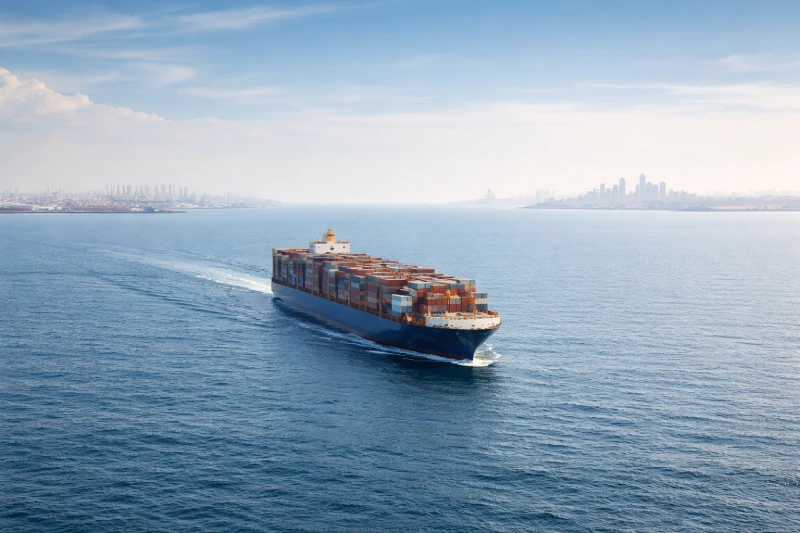
China–Middle East Trade in a Global Context
Trade between China and the Middle East has grown out of complementary economic roles rather than geographic proximity. China’s position as a global manufacturing center aligns closely with Middle Eastern demand for imported goods that support urban development, infrastructure expansion, and consumer markets across the region.
At a global level, this trade lane sits within the broader East–West supply chain that links Asian production with markets in West Asia, Europe, and Africa. The Middle East functions not only as an end market, but also as a strategic bridge—absorbing imports for domestic use while redistributing cargo onward through regional trade and transit networks.
Energy revenues, state-led development projects, and long-term diversification strategies have further reinforced this relationship. As Middle Eastern economies invest heavily in construction, transportation, utilities, and industrial capacity, demand for machinery, materials, and finished goods from China remains structurally strong rather than cyclical.
From a logistics standpoint, these macroeconomic drivers translate into consistent, large-scale cargo flows that favor stable corridors and high-capacity gateways. Understanding China–Middle East logistics therefore starts with recognizing its role in global trade architecture: a mature, high-volume corridor shaped by strategic investment, long-distance connectivity, and region-wide distribution needs—rather than isolated bilateral shipments.
Regional Economic & Logistics Characteristics
The Middle East logistics landscape is defined by structural import dependence, gateway-driven distribution, and a strong focus on regional connectivity rather than self-contained national supply chains.
Import-oriented consumption structure
Many Middle Eastern economies rely heavily on imported manufactured goods, industrial equipment, and construction materials, making inbound logistics from Asia a foundational component of regional trade rather than a supplementary flow.
Gateway and hub-centric logistics model
A limited number of highly developed ports and logistics hubs handle the majority of inbound volumes, with cargo subsequently redistributed to neighboring markets through free zones, bonded facilities, and inland transport networks.
Re-export and transit trade significance
The region plays a dual role as both an end market and a redistribution center, particularly for goods moving onward to North Africa, the Levant, and parts of East Africa.
Project-driven demand patterns
Large infrastructure, energy, and urban development projects create cargo flows that are often scale-intensive and category-specific, influencing how logistics capacity is structured and utilized across the region.
High emphasis on compliance and control
Regulatory oversight, conformity requirements, and centralized customs frameworks shape logistics planning, reinforcing the need for predictable gateways and standardized trade routes rather than fragmented entry points.
Major Trade Corridors Connecting China and the Middle East
Maritime Corridors via the Arabian Gulf
The Arabian Gulf corridor represents the primary maritime entry route for cargo moving from China into the core consumption markets of the Middle East. This corridor connects East Asian manufacturing centers with Gulf-facing economies that serve as both end markets and regional distribution hubs.
Logistically, the strength of this corridor lies in its capacity and consolidation effect. Large volumes of containerized cargo are funneled through a small number of highly developed coastal gateways, allowing goods to be efficiently absorbed into regional supply networks serving industrial, commercial, and retail demand.
Red Sea Routes and Suez-Linked Flows
Red Sea corridors form a parallel East–West route linking China with the western side of the Middle East and onward toward Europe and North Africa. These routes play a strategic role in balancing regional access, particularly for markets positioned closer to the eastern Mediterranean and the Levant.
Beyond serving local demand, Red Sea logistics corridors are deeply integrated into global trade architecture. Their connection to the Suez Canal reinforces the Middle East’s function as a transit region within long-haul intercontinental trade rather than a terminal-only destination.
Overland and Multimodal Extensions into Inland Markets
While maritime routes dominate long-distance transport, inland corridors extend the reach of coastal gateways deep into regional markets. These corridors link ports with industrial zones, urban centers, and landlocked or semi-inland economies through coordinated multimodal networks.
From a strategic perspective, these extensions transform coastal entry points into regional logistics platforms. The effectiveness of China–Middle East trade flows therefore depends not only on sea lanes, but also on how seamlessly cargo moves onward through inland corridors that support construction, manufacturing, and consumption across the broader region.
Key Logistics Gateways & Regional Hubs
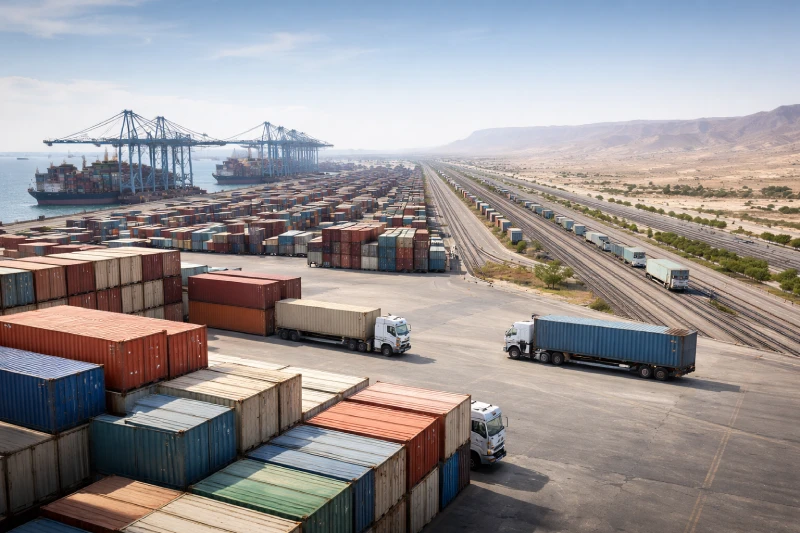
Rather than a fragmented port system, China–Middle East logistics is organized around a small number of high-capacity gateways that concentrate volume, compliance capability, and onward distribution functions.
Gulf-Side Gateway Hubs
Ports along the Arabian Gulf form the primary intake points for cargo entering the heart of the region. These gateways serve large domestic markets while also acting as consolidation and redistribution centers for neighboring economies. Their strength lies in scale, infrastructure depth, and proximity to major consumption and industrial zones in countries such as the United Arab Emirates and Saudi Arabia.
From a regional perspective, Gulf hubs are designed to absorb high volumes consistently. This concentration supports predictable trade flows and reinforces the Gulf’s role as the logistical core of China–Middle East trade.
Red Sea Entry Points
Red Sea gateways provide strategic access to western Middle Eastern markets and function as critical nodes linking Asia with the eastern Mediterranean. These hubs shorten geographic distance to certain markets while maintaining connectivity with global East–West shipping lanes.
Their importance extends beyond local demand. By anchoring trade flows on the western flank of the region, Red Sea gateways enhance route diversity and reduce reliance on a single coastal system.
Inland Logistics Hubs and Bonded Zones
Inland hubs complement coastal gateways by enabling cargo redistribution beyond port cities. These facilities are typically positioned near industrial zones, major urban centers, or cross-border corridors, allowing imported goods to flow deeper into regional markets.
At a strategic level, inland hubs transform seaports from terminal endpoints into regional platforms. They support the Middle East’s function as both an import destination and a logistics bridge connecting Asia with surrounding regions.
Typical Cargo Categories Moving from China to the Middle East
Industrial Machinery & Equipment
This category reflects the region’s ongoing investment in infrastructure, utilities, and industrial capacity. Cargo flows are driven by large-scale projects that require reliable access to manufactured equipment, production lines, and technical systems sourced from China’s industrial base.
In logistics terms, these shipments tend to move in steady waves aligned with project cycles rather than consumer demand, reinforcing the importance of stable corridors and high-capacity gateways that can support sustained industrial imports.
Construction Materials & Building Systems
Urban expansion and real estate development across the Middle East generate consistent demand for construction inputs produced at scale in China. These cargoes underpin residential, commercial, and public-sector projects across multiple markets simultaneously.
From a regional perspective, this category highlights how logistics supports long-term development rather than short-term trade. Building-related cargo often enters through major hubs and is then distributed inland to active development zones.
Consumer Goods & Retail Inventory
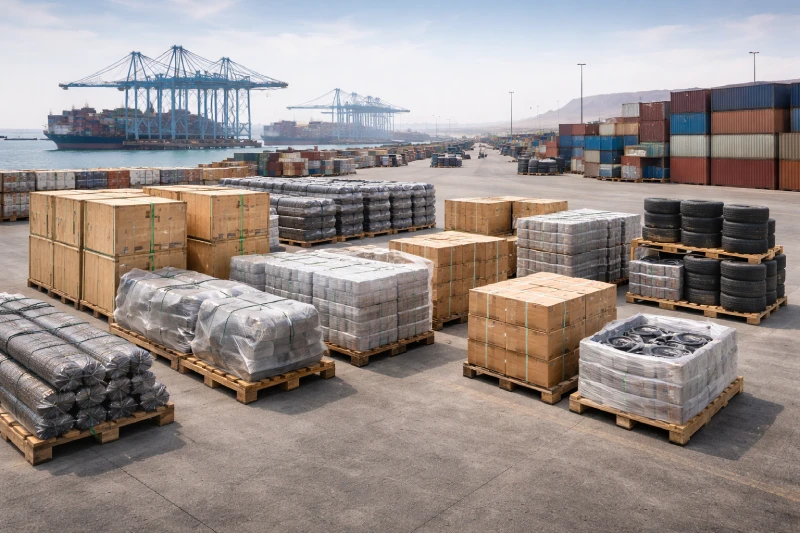
Consumer products represent the most visible layer of China–Middle East trade, supplying retail markets across diverse income segments. These goods support both domestic consumption and regional redistribution, particularly through hub economies.
The logistics significance of this category lies in volume and regularity. Continuous consumer demand sustains baseline cargo flows, helping stabilize trade corridors even when project-driven imports fluctuate.
Automotive Parts & Aftermarket Components
Automotive-related cargo reflects the region’s reliance on imported components to support vehicle assembly, maintenance, and aftermarket services. This trade supports transportation networks, logistics fleets, and growing urban mobility needs.
At a structural level, these shipments illustrate how specialized industrial supply chains coexist with mass consumer flows, reinforcing the Middle East’s role as a multifaceted import market rather than a single-category destination.
High-Level Transport Modes Used in the Region
Containerized Ocean Freight
This mode forms the structural backbone of China–Middle East trade due to its ability to support large, consistent cargo volumes across long distances. It aligns naturally with the region’s hub-centric logistics model, where high-capacity ports concentrate inbound flows before distributing goods across multiple markets.
Air Cargo
Air transport plays a complementary role where speed of access and cargo value justify its use, particularly for goods tied to project timelines, replenishment cycles, or critical supply continuity. Its relevance lies not in volume dominance, but in enabling flexibility within otherwise ocean-based supply structures.
Ro-Ro and Breakbulk Shipping
These modes are suited to cargo that does not conform to standard container formats, such as vehicles, oversized equipment, or industrial units. Their presence reflects the Middle East’s project-driven import profile, where logistics systems must accommodate scale, weight, and non-standard dimensions alongside containerized flows.
Together, these transport modes coexist not as alternatives, but as structurally aligned options—each supporting different layers of regional demand while feeding into the same network of gateways and distribution hubs.
Regulatory & Trade Environment (Non-Operational)
Logistics across the Middle East is shaped by a regulatory environment that prioritizes control, standardization, and conformity, influencing how trade corridors and gateways are structured at a regional level.
- Compliance-driven import frameworks
Many markets emphasize product conformity and regulatory alignment, reinforcing the role of designated entry gateways with established inspection and clearance capacity. - Centralized customs oversight
Trade control is often managed through centralized authorities, encouraging cargo concentration at major hubs rather than dispersed points of entry. - Divergence within regional alignment
While regional cooperation exists, regulatory requirements still vary by country, requiring logistics systems that can adapt without fragmenting trade flows. - Free zones and bonded regimes
Special economic zones support redistribution and transit trade, allowing the region to function as both an import destination and a logistics bridge. - Documentation and standards emphasis
Regulatory focus tends to favor predictability and traceability, shaping corridor selection and reinforcing the importance of established trade routes.
Market Risks & Structural Challenges
- Concentration of trade flows at limited gateways
Heavy reliance on a small number of major hubs increases systemic sensitivity to disruptions affecting ports, sea lanes, or regional chokepoints. - Geopolitical exposure of key corridors
Strategic maritime routes serving the Middle East are influenced by broader political and security dynamics, which can reshape trade patterns without altering underlying demand. - Demand volatility linked to project cycles
Large-scale infrastructure and energy investments create uneven cargo flows, requiring logistics networks that can absorb fluctuations without losing structural efficiency. - Infrastructure capacity alignment
Rapid expansion in some markets can temporarily outpace logistics capacity, while overinvestment in others may lead to underutilized assets across the network. - Regulatory heterogeneity across the region
Differences in national trade controls introduce structural complexity, reinforcing the need for adaptable yet centralized logistics models.
Strategic Outlook for China–Middle East Logistics
Looking ahead, China–Middle East logistics is expected to continue evolving around capacity, connectivity, and regional integration, rather than fundamental shifts in trade direction. Long-term investment in ports, industrial zones, and inland corridors suggests a sustained focus on strengthening the region’s role as a logistics platform serving multiple markets at once.
Digitalization and infrastructure modernization are also shaping how trade flows are managed at scale. Port automation, data-driven coordination, and integrated logistics zones are increasingly positioned as tools to enhance predictability and throughput across complex regional networks, rather than as isolated efficiency upgrades.
At the same time, the Middle East’s strategic position between Asia, Europe, and Africa continues to support its function as a redistribution and transit region. As trade patterns adjust to global supply chain rebalancing, the region’s logistics landscape is likely to reflect gradual adaptation—layering new capabilities onto established corridors instead of replacing them outright.
