
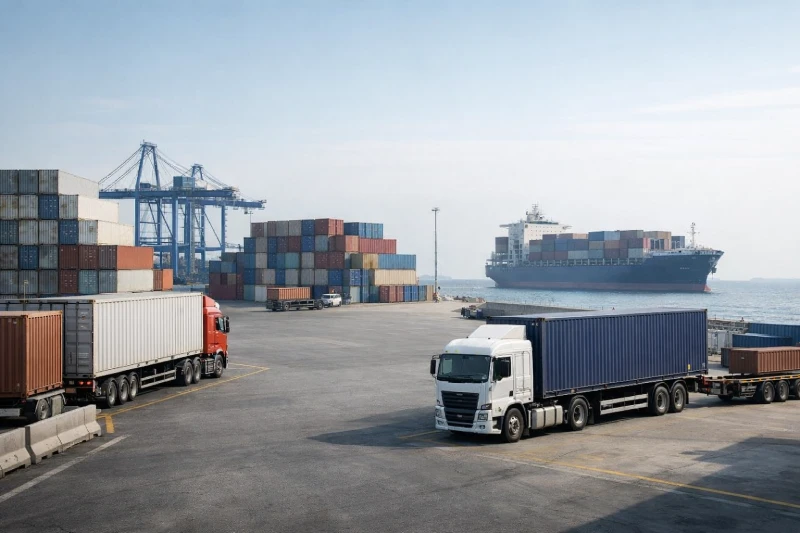
Understanding Door-to-Door Shipping
Door-to-door shipping is best understood as an execution and responsibility framework, rather than a transport option or commercial offer. It describes how a shipment is handled from origin to final delivery under a continuous operational scope.
In a door-to-door arrangement, a single logistics coordinator manages multiple stages of the shipment while coordinating with carriers, customs brokers, and local transport providers. The key feature is not who physically moves the cargo, but how responsibility is transferred and controlled across each stage.
Door-to-door shipping is defined by responsibility continuity, not by transport mode or route selection.
From cargo preparation at origin to customs clearance and final inland delivery, each task is executed under a clearly defined handover structure. When responsibilities are properly assigned and documented, door-to-door shipping functions as a controlled operational process rather than a series of disconnected logistics actions.
End-to-End Operational Flow Overview
Door-to-door shipping follows a continuous operational sequence that links origin handling, regulatory clearance, transportation, and final delivery under a coordinated responsibility structure. While physical cargo moves across multiple locations, the execution logic remains unified and controlled through predefined handover points.

To understand how door-to-door shipments are executed, it is essential to separate cargo movement from process control. The shipment progresses through a series of operational stages, each requiring accurate information transfer, documentation alignment, and responsibility confirmation before moving forward.
Typical door-to-door execution follows this operational sequence:
- Cargo preparation and data confirmation at origin
- Export customs clearance processing
- Handover to international transportation
- Arrival and import customs clearance
- Regulatory settlement and cargo release
- Inland transportation to the final delivery location
Although these stages appear linear, delays or errors in early steps often surface much later in the process. Door-to-door shipping therefore depends less on individual actions and more on how well each stage is connected, documented, and handed over.
Stage 1: Export-Side Cargo Preparation in China
Export-side preparation is the first critical control point in door-to-door shipping execution. Before any customs or transportation process begins, shipment accuracy is largely determined by how well cargo data, physical readiness, and documentation are aligned at origin.
At this stage, the shipper is primarily responsible for cargo readiness, including correct packaging, labeling, and provision of commercial information. The freight forwarder coordinates these inputs, verifies consistency, and ensures that the shipment is operationally ready to enter the export process.
Common operational risks during export-side preparation include:
- Inconsistent information between cargo, commercial documents, and declared shipment data
- Packaging or labeling that does not meet export or carrier handling requirements
- Incomplete or late submission of documentation required for downstream clearance
- Assumptions that discrepancies can be corrected after export procedures begin
When issues occur at this stage, they rarely remain isolated. Errors made during cargo preparation often surface later as customs clearance delays, document rework, or delivery disruptions, reinforcing the importance of accurate responsibility execution at origin.
Stage 2: Export Customs Clearance Execution
Export customs clearance is a compliance-driven process rather than a procedural formality. In door-to-door shipping, this stage serves as the regulatory gateway that determines whether a shipment is permitted to leave the country of origin.
Responsibility at this stage centers on the accuracy and completeness of declared information. While the freight forwarder or appointed customs agent may execute the filing, the obligation to provide correct cargo descriptions, values, and supporting documents ultimately rests with the exporting party.
Most export clearance issues do not result from system failure or inspection volume, but from inconsistencies between physical cargo and submitted data. Errors introduced during preparation often become visible only at this stage, where regulatory tolerance is limited and correction options are constrained.
Because export clearance precedes all downstream activities, any disruption here directly impacts the continuity of the entire door-to-door process. Effective execution therefore depends on treating export customs clearance as a control point, not a checkbox.
Stage 3: International Transportation Handover
The international transportation stage marks a formal handover of execution responsibility from origin-side operations to the contracted carrier. At this point, cargo movement enters a phase where physical handling is no longer directly controlled by the shipper or freight forwarder, but governed by transport and carriage arrangements.
This handover is defined not only by the physical transfer of cargo, but also by the transfer of documentary and data control. Shipping documents, transport references, and movement instructions become the primary tools for monitoring shipment status and managing exceptions during transit.
Although international transportation is often viewed as a single uninterrupted segment, operational risk during this stage is largely shaped by earlier decisions. Incomplete documentation, unclear instructions, or unresolved discrepancies introduced upstream can limit corrective actions once cargo is in transit.
Because direct intervention is restricted after handover, effective door-to-door execution depends on clearly defined responsibility boundaries and accurate information transfer at the moment international transportation begins.
Stage 4: Import Customs Clearance in the Middle East
Import customs clearance represents one of the most sensitive execution stages in door-to-door shipping. At this point, regulatory authority shifts to the destination country, and shipment progress depends on how clearly import responsibilities are defined and authorized.
Importer of Record (IOR)
The importer of record carries the legal responsibility for the shipment’s compliance at destination. This includes the accuracy of declared information, the legitimacy of supporting documents, and the acceptance of regulatory outcomes. Even when clearance execution is delegated, accountability remains with the importer of record.
Customs broker and freight forwarder
The customs broker executes the clearance process on behalf of the importer, while the freight forwarder coordinates document flow and communication. Their role is operational, not legal, and their effectiveness depends on timely authorization and complete data provision.
Most import clearance disruptions stem from unclear responsibility allocation rather than procedural complexity. Missing authorizations, document inconsistencies, or misaligned expectations between parties can quickly halt progress. In door-to-door shipping, import clearance stability relies on role clarity established well before cargo arrival.
Stage 5: Duties, Taxes, and Regulatory Settlement
A common misconception in door-to-door shipping is that responsibility for duties and taxes is determined solely by who makes the payment. In practice, financial settlement and regulatory responsibility are not the same, and confusing the two often leads to compliance issues.
In a door-to-door execution model, duties and taxes are the outcome of import declarations, classification decisions, and valuation accuracy. While a freight forwarder or service provider may facilitate payment as part of the process, regulatory accountability remains with the legally designated importing party.
Another frequent misunderstanding is the assumption that tax-related issues can be resolved after clearance. In reality, errors in declared values or product classification can trigger holds, audits, or post-clearance adjustments, even after cargo has physically arrived.
Understanding duties and taxes as a regulatory consequence, rather than a standalone cost item, is essential for maintaining operational stability throughout the door-to-door shipment process.
Stage 6: Inland Transportation to Final Delivery Address
Inland transportation begins only after import clearance has been completed and cargo has been formally released by customs authorities. At this point, the shipment transitions from a regulatory-controlled process to a locally coordinated delivery operation.
Execution at this stage typically involves arranging local transport, confirming delivery instructions, and coordinating access to the final delivery location. While this phase may appear straightforward compared to customs procedures, it requires accurate handover information and clear communication between the freight forwarder, local transport provider, and consignee.
The final delivery segment is often underestimated in door-to-door shipping. Common risks include incomplete delivery instructions, site access limitations, misaligned delivery expectations, or delays caused by local coordination gaps. Because cargo is already cleared, disruptions here can feel disproportionate to their operational cause.
Effective door-to-door execution treats inland transportation as a controlled continuation of the shipment process, not as an automatic conclusion once customs clearance is complete.
Responsibility Handover Across the Door-to-Door Chain
Door-to-door shipping relies on a series of explicit responsibility handovers, rather than a single party controlling the shipment at all times. Understanding where responsibility changes hands is essential for managing risk and avoiding execution gaps.
Export-side responsibilities:
At origin, responsibility centers on cargo readiness, data accuracy, and regulatory compliance for export. The shipper provides correct commercial information, while the freight forwarder coordinates preparation and confirms operational readiness before clearance and handover.
Transit responsibilities:
Once cargo is handed over to international transportation, physical control shifts to the carrier, while execution oversight is maintained through documentation and status communication. During this phase, corrective options are limited, making pre-handover accuracy critical.
Import-side responsibilities:
At destination, responsibility transitions to the importer of record for regulatory compliance, customs outcomes, and acceptance of clearance decisions. The customs broker and forwarder act in execution roles, but legal accountability does not transfer with operational delegation.
Most door-to-door disruptions occur not because tasks are unclear, but because responsibility boundaries are assumed rather than confirmed. Clear, written definition of handover points ensures that each party understands both its role and its limits within the overall shipment process.

Documentation Control Throughout the Process
In door-to-door shipping, documentation functions as the primary control mechanism that links each execution stage. While physical cargo moves independently, documents determine how the shipment is declared, released, and delivered at every handover point.
Core documents typically include commercial records, transport documents, and regulatory filings. Their importance lies not in their format, but in how consistently information is maintained as responsibility shifts from one party to another. Even minor discrepancies can interrupt clearance or delay downstream actions.
Document control changes as the shipment progresses. At origin, accuracy and completeness are critical; during transit, documents serve as reference and authorization tools; at destination, they become the basis for regulatory decisions and cargo release. When control is unclear or documentation is misaligned, errors introduced early can quickly escalate into operational disruptions.
Effective door-to-door execution depends on treating documentation as a continuous control system rather than a set of isolated administrative tasks.
Common Operational Risks in Door-to-Door Shipments
Operational risks in door-to-door shipping are rarely caused by a single failure. They typically emerge from misalignment across responsibilities, documentation, and communication, becoming visible only when execution reaches a critical stage.
Compliance and regulatory risks:
- Inconsistent cargo descriptions or values across documents
- Incorrect classification or missing regulatory information
- Assumptions that issues can be corrected after clearance submission
Responsibility and scope risks:
- Unclear definition of who is accountable at specific handover points
- Overreliance on verbal agreements instead of written responsibility scope
- Misinterpretation of delegated execution as transferred liability
Coordination and communication risks:
- Delayed or incomplete information sharing between parties
- Lack of visibility during handover between stages
- Misaligned expectations between origin, transit, and destination teams
These risks are structural rather than incidental. When not addressed early, they tend to compound as the shipment progresses, making later intervention more complex and less effective within the door-to-door execution chain.
Operational Best Practices for Stable Execution
Stable door-to-door execution is not achieved through individual optimizations, but through consistent control of responsibilities, information, and expectations across the shipment lifecycle.
First, all shipment data should be aligned and confirmed before execution begins. Early consistency between cargo details, documentation, and declared information reduces the likelihood of downstream corrections, where flexibility is limited.
Second, responsibilities must be defined in writing at each handover point. Clear scope confirmation prevents assumptions about accountability and ensures that operational delegation does not create gaps in legal or regulatory responsibility.
Finally, exception handling should be anticipated rather than improvised. Door-to-door shipping benefits from predefined communication paths and escalation procedures, allowing issues to be addressed within the existing execution framework rather than disrupting the entire process.
When these principles are applied consistently, door-to-door shipping functions as a controlled operational system rather than a sequence of reactive decisions.
Supporting Logistics Guides
The door-to-door execution model outlined above provides a structural overview of how shipments are managed from origin to final delivery. For readers who require deeper clarification on specific operational stages or responsibility areas, the following supporting guides offer focused explanations.
These materials expand on individual components of the door-to-door process, including customs execution, documentation control, and risk management, without altering the responsibility framework described on this page.
- Import Customs Clearance Responsibilities and Role Definitions
- Documentation Management in International Freight Operations
- Common Compliance Risks in Cross-Border Shipments
- Door-to-Door Shipping Responsibility Breakdown
- Managing Operational Exceptions in International Logistics
Together, these guides support a more detailed understanding of door-to-door shipping execution while maintaining consistency with the overall operational flow.
