
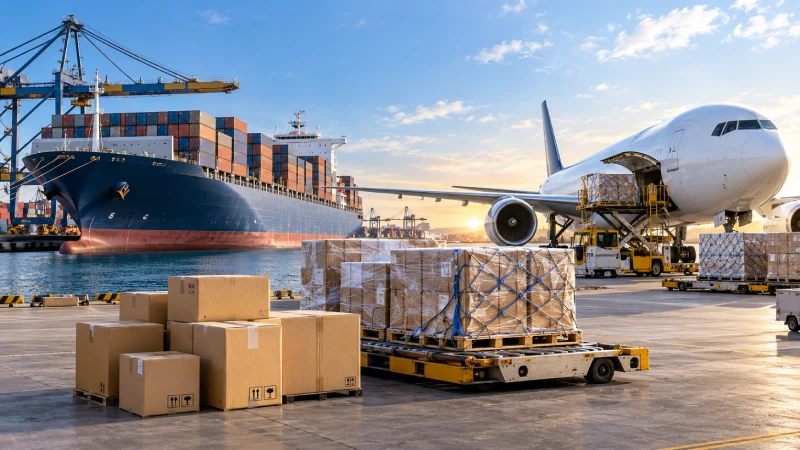
There is no single best shipping method from China to Nigeria for every shipment.
The right choice depends on six things:
- Actual gross weight
- Cargo volume in CBM
- Required delivery deadline
- Cargo value
- Regulatory and customs complexity
- Final delivery city in Nigeria
A shipment of compact machine parts going urgently to Lagos should not be planned the same way as bulky furniture going to Kano. Likewise, a shipment that is physically suitable for air freight may still require additional compliance preparation before it can move.
The most useful question is therefore not:
“Which shipping method is cheapest?”
It is:
“Which two realistic shipping methods should I request comparable quotes for?”
For most importers, the correct comparison is between two plausible modes—not every available shipping product.
This guide helps you narrow the choice between express, air freight, LCL, FCL and managed door delivery without relying on fixed weight or CBM rules that may not reflect current China–Nigeria rates.
Shipping Method Comparison at a Glance
Start with this table before requesting quotations.
| Shipping Option | Relative Cost | Speed | Pricing Basis | Best Cargo Profile | Main Risk |
|---|---|---|---|---|---|
| Express courier | Very high per kg | Fastest | Chargeable weight | Small, urgent, parcel-compatible shipments | Volumetric weight, restrictions and customs charges |
| Air freight | High | Fast | Chargeable weight + handling | Commercial cargo where time has measurable value | High cost for bulky cargo |
| LCL sea freight | Low–medium | Slow | CBM/weight + local charges | Non-urgent cargo that does not justify a full container | Consolidation and destination charges |
| FCL sea freight | Low per unit at good utilization | Slow | Full container + origin/destination charges | Larger shipments or cargo needing container control | Paying for unused container capacity |
| Door-to-door / DAP-type service | Depends on underlying mode | Depends on sea/air | Freight + clearance coordination + inland delivery | Importers wanting one coordinated logistics chain | Unclear responsibility if scope is poorly defined |
| DDP where feasible | Depends on cargo and mode | Depends on sea/air | Managed landed-delivery structure | Eligible cargo where seller-side import responsibility is workable | Regulatory, tax and importer-of-record feasibility |
The important distinction is that sea, air and express describe how cargo moves, while door-to-door, DAP and DDP describe how much of the logistics and import responsibility is included.
You can therefore have:
- sea freight with port delivery;
- sea freight with door delivery;
- air freight with airport delivery;
- air freight with door delivery;
- or, where legally and operationally feasible, a DDP structure using sea or air transport.
Master Decision Matrix: Which Two Methods Should You Quote?
Use this as the main decision tool.
| Cargo Profile | First Mode to Quote | Second Mode to Compare | Main Risk to Check |
|---|---|---|---|
| Small, urgent and parcel-compatible | Express | Air freight | Courier volumetric weight and customs restrictions |
| Commercial cargo with an urgent deadline | Air freight | Express or sea depending on deadline | Air premium versus value of time saved |
| Compact, high-value cargo | Air freight | Express | Security, insurance and customs documentation |
| Bulky, low-value cargo | LCL or FCL | Alternative sea option | Paying air charges on volume rather than useful weight |
| Non-urgent partial-container shipment | LCL | FCL | Destination charges and container crossover |
| Larger shipment with high container utilization | FCL | LCL all-in | Unused capacity versus LCL handling costs |
| Fragile or sensitive commercial cargo | FCL | LCL | Extra handling during consolidation/deconsolidation |
| Cargo for inland Nigeria | Sea or air based on urgency | Same mode via alternative gateway/service scope | Inland delivery cost and reliability |
| SONCAP-regulated or permit-sensitive goods | Compliance check first | Then compare viable modes | Shipment moving before documentation is ready |
| Repeat inventory | Sea for base stock | Air for replenishment | Stock planning rather than freight rate alone |
The purpose of this matrix is not to produce an automatic answer. It tells you which comparison is worth pricing.
Step 1 — Start with Weight and CBM
Weight alone does not determine the best way to ship from China to Nigeria.
Neither does CBM.
You need both.
Parcel-Scale Cargo
If the shipment is small, easy to cartonize and urgent, express should enter the comparison.
But do not use a universal rule such as:
“Below X kilograms, always use courier.”
Courier companies calculate charges using shipment dimensions as well as actual weight. A large lightweight carton can therefore become expensive even when its gross weight appears low.
For parcel-compatible cargo, compare:
Express courier vs air freight
using the same pickup point, customs assumptions and final Nigerian delivery address.
Commercial Kilogram-Scale Cargo
Once the shipment behaves more like commercial freight than a parcel, air freight becomes increasingly relevant.
Compare:
Air freight vs express
rather than assuming courier remains cheaper simply because the cargo is still measured in kilograms.
Light but Bulky Cargo
Products such as:
- furniture components;
- plastic goods;
- display materials;
- packaging;
- foam products;
- lightweight household goods
can become expensive by air because chargeable weight reflects cargo dimensions.
Sea freight can therefore become attractive earlier than gross weight alone suggests.
Increasing CBM
As cargo volume increases, the useful comparison changes again:
LCL all-in cost vs FCL all-in cost
Do not switch automatically at a published CBM number.
The crossover changes with:
- China origin;
- Nigerian gateway;
- container rates;
- LCL destination charges;
- cargo density;
- pickup costs;
- delivery city;
- season;
- carrier capacity;
- free-time requirements.
Six-Question Decision Flow
Use this simple decision tree:
1. Is the cargo genuinely time-critical?
→ Yes: start with express or air.
→ No: continue toward sea freight comparison.
2. Is it parcel-compatible?
→ Yes: compare express with air.
→ No: price normal air cargo or sea freight.
3. Is it bulky relative to its weight?
→ Yes: sea becomes more attractive.
→ No: air may remain commercially reasonable.
4. Is the shipment using a meaningful share of a container?
→ Yes: compare LCL all-in against FCL all-in.
→ No: LCL remains the logical ocean candidate.
5. Is the product regulated, dangerous or permit-sensitive?
→ Yes: confirm compliance before final mode selection.
6. Where in Nigeria must the cargo actually arrive?
→ Compare the complete route to that city—not only the international freight leg.
Step 2 — Put a Cost on the Delivery Deadline
“Urgent” is too vague for shipping decisions.
Instead, identify the business consequence of being late.
Ask:
- When will current inventory run out?
- Will a production line stop?
- Is there a customer contract deadline?
- Is the cargo needed for project mobilization?
- Is there a seasonal sales window?
- What revenue or operational cost is associated with each week of delay?
Imagine sea freight saves USD 3,000 compared with air freight.
That does not automatically make sea freight cheaper.
If waiting creates USD 10,000 of lost sales, production downtime or contract penalties, the air premium may have positive business value.
The reverse is also true.
If the cargo can arrive several weeks later without changing sales, operations or customer commitments, paying an air premium may add no economic value.
Pro Tip: The lowest freight cost does not necessarily produce the lowest total supply-chain cost.
This is why quotes should be compared against the required delivery date, not simply against transit-time marketing claims.
Send Weight, CBM & Deadline
For a useful mode comparison, send:
- product description;
- number of packages;
- gross weight;
- dimensions or total CBM;
- cargo value;
- China pickup city;
- required delivery date;
- Nigerian final city;
- and any known battery, dangerous-goods or regulatory information.
Those details are normally enough to identify the two transport options worth pricing first.
Step 3 — Check Cargo Value and Density
Two shipments with identical weight can require completely different logistics strategies.
High-Value, Compact Cargo
Air freight becomes easier to justify when the cargo carries significant value in a small physical footprint.
Examples may include:
- electronics;
- specialized components;
- industrial spare parts;
- precision equipment;
- urgent replacement parts.
The freight bill may be higher, but freight can still represent a relatively small percentage of the inventory value.
Low-Value, Bulky Cargo
The opposite applies to large, lightweight or lower-margin products.
If transportation consumes too much of the product’s resale margin, sea freight becomes commercially stronger even when air is technically possible.
Dense Cargo
Very dense goods require another check.
A shipment may occupy little space but still be heavy enough to create:
- aircraft payload considerations;
- handling restrictions;
- pallet limitations;
- container floor-loading concerns;
- inland truck payload issues.
Density therefore affects both air and sea decisions.
Do not compare only:
USD/kg vs USD/CBM
Compare the complete shipment configuration.
Step 4 — Check Compliance Before Choosing Speed
A fast aircraft does not make incomplete import documentation move faster.
For Nigeria-bound shipments, compliance should be checked before cargo is dispatched, particularly for regulated products.
The Standards Organisation of Nigeria describes SONCAP as the pre-shipment conformity assessment program for products subject to SON regulation. Applicable goods may require Product Certification and a SONCAP Certificate as part of the import and customs process.
Nigeria Customs guidance also places documents such as Form M, applicable SONCAP documentation and PAAR within the import process before final customs release.
An important 2026 operational change is that SON announced migration of relevant SONCAP and import-permit processes into Nigeria’s National Single Window framework from March 27, 2026, including certificate activation connected with Form M, PAAR and cargo clearance.
Before choosing a shipping method, check whether the cargo involves:
- SONCAP;
- batteries;
- dangerous goods;
- chemicals;
- medical or controlled products;
- special import permits;
- special labeling or testing;
- restricted commodities;
- unusually complex HS classification.
Express courier does not remove customs requirements. Shipments requiring permits, government-agency controls or formal customs procedures may need additional processing regardless of the transport speed.
Practical Decision Rule
If compliance preparation requires more time than transport itself, paying for the fastest freight mode may accomplish very little.
Compliance readiness comes before transport speed.
Step 5 — Choose the Nigeria Gateway and Final City Together
The best shipping method to Lagos is not automatically the best shipping method to Kano, Abuja or Port Harcourt.
Nigeria’s port network includes Lagos Port Complex at Apapa, Tin Can Island Port Complex, Lekki Deep Sea Port, Onne and Rivers Port, among other facilities.
That matters because the international freight leg is only one part of the shipment.
Consider:
China origin → international gateway → customs clearance → Nigerian inland transport → final warehouse
For example, a cheap ocean rate to a Lagos terminal may become less attractive after inland trucking is added for a buyer far from Lagos.
Likewise, an air solution arriving through Lagos and continuing inland may be economically justified for urgent cargo even when the consignee is not located in Lagos.
When requesting quotes, always provide the actual delivery city.
Do not ask only:
“How much to Nigeria?”
Ask:
“What is the all-in logistics cost to my actual destination?”
Express vs Air Freight
These two methods should often be quoted against each other for urgent cargo.
| Decision Factor | Express Courier | Air Freight |
|---|---|---|
| Service style | Highly integrated parcel network | Freight-forwarding and airline cargo network |
| Pricing | Chargeable weight | Chargeable weight plus handling/service components |
| Best fit | Small, parcel-compatible, urgent cargo | Commercial urgent cargo |
| Pickup/delivery | Usually highly integrated | Can be airport-to-airport or door-to-door |
| Customs | Courier-facilitated, but regulations still apply | Broker/importer or managed clearance |
| Main advantage | Simplicity and speed | Better flexibility for commercial freight |
| Compare when | Shipment is small enough for both to be realistic | Shipment is too commercial/bulky to assume courier is best |
Choose Express When
- cargo is parcel-compatible;
- speed is critical;
- simple pickup and delivery matter;
- and an express quote remains competitive on chargeable weight.
Avoid Automatically Choosing Express When
- dimensions create high volumetric weight;
- there are multiple commercial cartons;
- cargo needs specialized handling;
- permits or non-routine customs procedures apply.
For more detail, see Express Shipping from China to Nigeria and Air Freight from China to Nigeria.
LCL vs FCL
The most common mistake in this comparison is looking for a universal CBM crossover.
There isn’t one.
The correct calculation is:
LCL all-in cost
versus
FCL all-in cost
LCL All-In Comparison
Include:
- China pickup;
- export handling;
- consolidation;
- ocean freight;
- documentation;
- Nigerian destination charges;
- customs/clearance scope;
- deconsolidation;
- inland delivery.
FCL All-In Comparison
Include:
- China pickup;
- container loading;
- export charges;
- full-container ocean freight;
- destination terminal charges;
- customs/clearance scope;
- container-related charges;
- inland delivery.
A shipment can reach the point where FCL is economically attractive before the container is physically full.
Conversely, another shipment may remain cheaper as LCL at a relatively substantial volume because the live FCL rate, origin location or destination costs differ.
FCL can also be worth comparing when the decision is driven by control rather than pure CBM.
Examples include:
- fragile goods;
- cargo vulnerable to repeated handling;
- multiple related SKUs;
- loading-control requirements;
- project cargo with coordinated dispatch;
- shipments where deconsolidation risk matters.
Pro Tip: Never compare an LCL port quote with an FCL door-delivery quote. Compare the same final delivery point and the same customs scope.
Read the detailed guides to LCL Shipping from China to Nigeria, FCL Shipping from China to Nigeria and Sea Freight from China to Nigeria before booking.
Port-to-Port vs Door Delivery vs DDP
This is a separate decision from air versus sea.
Transport Mode Answers
How will the cargo move internationally?
- Sea
- Air
- Express
Service Scope Answers
Who will coordinate each stage and where does responsibility end?
- Port-to-port
- Airport-to-airport
- Door-to-door
- DAP
- DDP
Port-to-Port or Airport-to-Airport
This works best when the importer already has:
- a competent Nigerian customs broker;
- local transport arrangements;
- experience controlling destination charges;
- and the ability to coordinate clearance independently.
Door-to-Door / DAP-Type Delivery
This extends the logistics chain to the buyer’s location while keeping import duties, taxes and related importer obligations with the buyer according to the agreed structure.
It is useful when the importer wants fewer handovers but still retains control of import formalities.
DDP
DDP stands for Delivered Duty Paid under the ICC Incoterms® rules. It is a trade term allocating responsibilities between seller and buyer—not a physical shipping mode.
A DDP shipment can therefore move:
- by sea;
- by air;
- or as part of a multimodal logistics solution.
Do not choose DDP simply because you want a fixed number.
First confirm whether DDP is legally and operationally feasible for:
- the product;
- importer structure;
- required certificates;
- HS code;
- tax treatment;
- final destination;
- and intended customs arrangement.
For some cargo, DAP or another correctly structured service may be more appropriate.
See DDP Shipping from China to Nigeria and Door-to-Door Shipping from China to Nigeria for the full responsibility breakdown.
Quick Comparison Cards
Express Courier
Choose when:
Small, urgent, parcel-compatible cargo needs a simple integrated network.
Avoid when:
Volumetric weight, commercial volume or regulatory complexity makes parcel pricing inefficient.
Deeper guide:
Express Shipping from China to Nigeria
Air Freight
Choose when:
The delivery deadline has measurable business value and the cargo’s value/density can support the premium.
Avoid when:
Cargo is bulky, low-margin or non-urgent.
Deeper guide:
Air Freight from China to Nigeria
LCL Sea Freight
Choose when:
Cargo is not urgent and does not justify booking an entire container.
Avoid when:
LCL destination and handling costs bring the all-in price close to FCL.
Deeper guide:
LCL Shipping from China to Nigeria
FCL Sea Freight
Choose when:
Container utilization, cargo control or total landed cost makes a dedicated container attractive.
Avoid when:
You are paying for substantial unused capacity without receiving a meaningful handling or cost advantage.
Deeper guide:
FCL Shipping from China to Nigeria
Door-to-Door Shipping
Choose when:
You want one logistics coordinator from supplier pickup through Nigerian final delivery.
Avoid when:
You already have efficient destination clearance and inland transport arrangements that you prefer to control.
Deeper guide:
Door-to-Door Shipping from China to Nigeria
DDP
Choose when:
DDP is legally feasible and the agreed seller-side import responsibility gives you useful landed-cost certainty.
Avoid when:
The provider cannot clearly explain the importer, customs, tax and compliance structure.
Deeper guide:
DDP Shipping from China to Nigeria
Hybrid Shipping Strategy for Repeat Importers
The best long-term shipping method may actually be more than one method.
Businesses that import repeatedly can separate inventory according to urgency.
Base Stock by Sea
Use LCL or FCL for predictable inventory replenishment.
This protects unit economics and keeps the majority of volume on the lower-cost transport mode.
Urgent Replenishment by Air
If a specific SKU is close to stocking out, move only the quantity needed to bridge the gap until the sea shipment arrives.
You do not need to air-freight the entire purchase order.
Samples and Prototypes by Express
Keep courier for the jobs it handles well:
- samples;
- prototypes;
- pre-production units;
- urgent documents;
- compact replacement components.
Example Hybrid Model
A Nigerian distributor orders 20 product SKUs from China.
Instead of choosing air for the entire order because three SKUs are urgent:
- the majority moves by sea;
- the three stock-critical SKUs move by air;
- new product samples move separately by express.
This often creates a better total supply-chain result than committing every shipment to the same mode.
The objective is not to minimize the freight rate on each shipment.
It is to minimize:
inventory cost + freight cost + stockout risk + clearance risk + delay cost.

How to Compare China–Nigeria Shipping Quotes Correctly
Two quotations are only comparable when they cover the same job.
Before choosing, confirm that both quotes use the same:
- cargo weight;
- CBM;
- package dimensions;
- China pickup location;
- Nigerian final destination;
- customs scope;
- duty/tax assumptions;
- insurance scope;
- delivery scope;
- free-time assumptions;
- cargo classification;
- compliance requirements.
A cheap quote to a Lagos terminal should not be compared directly with a more expensive quote that includes clearance and trucking to Kano.
Likewise, a low air-freight rate excluding destination handling is not directly comparable with an express door-delivered price.
Pro Tip: Compare alternatives using the same final delivery point and customs scope.
Compare Shipping Methods
If you are deciding how to ship from China to Nigeria, do not start by asking for the cheapest method.
Send the actual shipment profile:
- product;
- weight;
- CBM;
- dimensions;
- cargo value;
- China origin;
- required delivery date;
- compliance information;
- Nigerian destination.
Winsail Logistics can then compare the two most realistic shipping structures rather than quoting options that do not fit the shipment.
For a broader overview of routing, customs and import planning, see Shipping from China to Nigeria.
Sources and Operational Review
Information reviewed: October 3, 2026
Commercial methodology: Winsail Logistics China-origin freight planning framework
Key external references used for compliance and responsibility checks:
- Standards Organisation of Nigeria (SON): SONCAP and National Single Window updates
- Nigeria Customs Service (NCS): Form M, PAAR and import clearance procedures
- Nigerian Ports Authority (NPA): Nigerian port and gateway information
- International Chamber of Commerce (ICC): Incoterms® 2020
- Carrier and courier operating guidance for chargeable weight, cargo restrictions and customs handling
Freight rates, carrier space, transit schedules, port conditions and DDP eligibility can change. Any final mode decision should therefore be based on a live quotation using the shipment’s actual weight, dimensions, product classification, regulatory requirements and Nigerian delivery address.
The purpose of this page is to identify which shipping methods should be compared. It is not a fixed-rate table or a substitute for cargo-specific customs and compliance review.
FAQ
What is the best shipping method from China to Nigeria?
There is no universal best method. Small urgent cargo may justify express, commercial time-sensitive cargo may favor air, non-urgent partial loads may suit LCL, and larger or control-sensitive shipments may justify FCL. Compare two realistic options using the same destination and service scope.
Should I use sea or air freight from China to Nigeria?
Compare the additional cost of air freight with the economic value of earlier delivery. If avoiding a stockout, production stoppage or contract delay is worth more than the air premium, air can make sense. If several extra weeks have little business impact, sea freight is usually the stronger candidate.
When should I compare LCL with FCL?
Compare them whenever total LCL cost begins to approach a full-container quotation or when cargo handling and container control become important. Do not use a universal CBM threshold; calculate both options using live origin, ocean, destination, clearance and inland-delivery costs.
Is courier cheaper than air freight?
Sometimes, but not automatically. Express can be competitive for small parcel-compatible shipments, while standard air freight can become more attractive as the shipment becomes more commercial or bulky. Compare both using the same chargeable weight and delivery destination.
Does my Nigerian delivery city change the best shipping method?
Yes. Lagos, Abuja, Kano and Port Harcourt create different inland-delivery requirements. Gateway choice, customs handling and final trucking can change the total cost enough to alter which international transport option is most attractive.
Can I use air freight for only part of an order?
Yes. Urgent or high-margin SKUs can move by air while the remaining stock moves by sea. Repeat importers can also use express for samples, air for emergency replenishment and sea for regular inventory.
Is DDP a shipping method or an Incoterm?
DDP is an Incoterm, not a transport mode. It defines the allocation of delivery, import-clearance, duty and other responsibilities between seller and buyer. The physical transportation underneath a DDP arrangement can still be sea, air or multimodal.
