
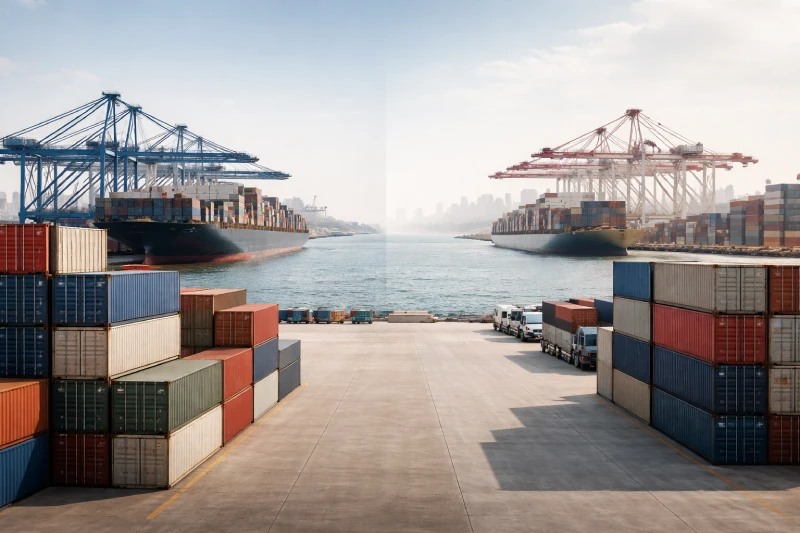
Why DDP vs FOB Shipping to UAE Is Often Misunderstood
When importing goods from China to the UAE, many buyers assume that choosing between DDP and FOB is simply a matter of comparing prices. FOB looks cheaper on the quotation, while DDP appears more expensive—so the decision feels obvious. In reality, this assumption overlooks how responsibility, risk, and cost exposure actually work in the UAE import environment.
The UAE has a relatively efficient customs system, but it is also highly responsibility-driven. Customs clearance, VAT payment, HS code accuracy, and importer registration are clearly assigned to a specific party. Under FOB terms, these obligations shift to the buyer much earlier than many first-time or occasional importers expect. What looks like a “simple” FOB shipment often turns into multiple local arrangements, unexpected fees, and delays once the cargo arrives.
DDP, on the other hand, is frequently misunderstood as “expensive but safe.” Buyers may assume it eliminates all risk, without considering what is bundled into the price—or whether they actually need that level of coverage. The real question is not whether DDP costs more than FOB, but who is better positioned to manage UAE-side execution.
This is why DDP vs FOB shipping to UAE is often misjudged. The decision is less about headline freight rates and more about responsibility alignment. If that alignment is wrong, the shipment may still arrive—but with costs, delays, or compliance issues that were never anticipated.
DDP vs FOB: Responsibility Breakdown from a UAE Perspective
FOB: Responsibility Transfers Earlier Than Many Importers Expect
Under FOB terms, the seller’s responsibility ends once the goods are loaded onto the vessel at the Chinese port of export. From that point forward, the buyer takes control of the shipment. This includes arranging international freight, appointing a local agent in the UAE, handling customs clearance, and paying all applicable import duties and VAT.
In the UAE context, this transfer of responsibility is significant. Customs authorities require a locally registered importer, accurate HS code classification, and compliant documentation at the time of clearance. If any element is incorrect or incomplete, the consequences—delays, penalties, or additional fees—fall entirely on the buyer. FOB is therefore not just a pricing term; it is a commitment to manage UAE-side execution independently.
DDP: Responsibility Extends All the Way to Final Delivery
DDP places the broadest level of responsibility on the seller or the logistics provider acting on their behalf. The seller is responsible for export handling in China, international transportation, UAE customs clearance, payment of duties and VAT, and delivery to the agreed destination within the UAE.
From a practical perspective, this means the buyer is insulated from most operational and compliance risks on the UAE side. However, it also means the buyer gives up direct control over customs processes and cost breakdowns. The DDP price reflects not only freight, but also the assumption of regulatory responsibility and risk.
Understanding this responsibility structure is essential. In UAE imports, responsibility defines cost exposure, not the other way around. Once this framework is clear, pricing differences between DDP and FOB become easier to interpret—and more rational to evaluate.
Cost Comparison: DDP vs FOB Shipping Cost to UAE
When comparing DDP and FOB shipping to the UAE, many importers focus on the initial quotation and assume the lower number represents the cheaper option. This approach is misleading. FOB and DDP distribute costs across different stages of the logistics chain, which means part of the expense under FOB is simply postponed rather than eliminated. To understand the real cost difference, you need to look at total landed cost and cost predictability, not just the first invoice.
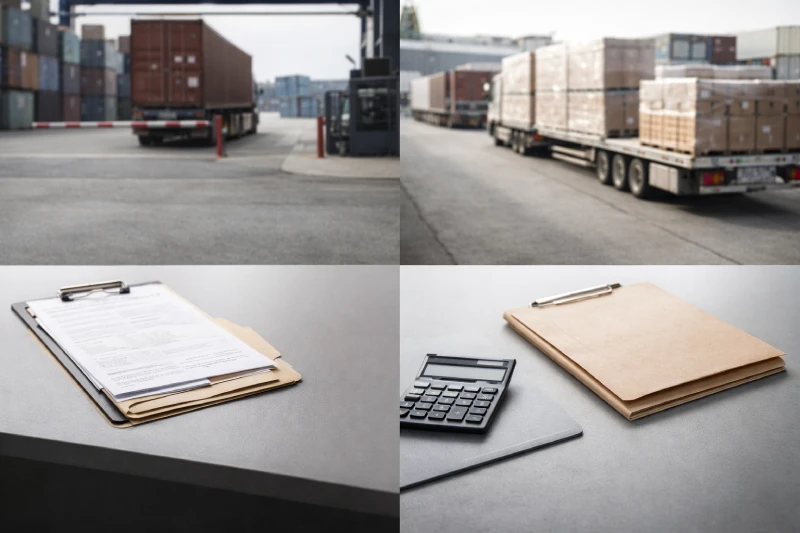
Under FOB, the seller’s quote usually stops at the Chinese port. Everything that happens after—ocean freight, UAE customs clearance, duties, VAT, local handling, and final delivery—is paid separately by the buyer. These costs are often managed by different service providers and invoiced at different times. Under DDP, these same cost elements are bundled into a single door-to-door price, with the seller or logistics provider assuming responsibility for execution and risk.
The table below illustrates how the cost structure differs in practice.
| Cost Item | FOB (Buyer Responsible) | DDP (Seller Responsible) | Cost Uncertainty |
|---|---|---|---|
| Export handling in China | Included | Included | Low |
| International freight | Buyer-arranged | Included | Medium |
| Destination port charges | Buyer-paid | Included | Medium |
| UAE customs clearance | Buyer-paid | Included | High |
| Import duty & VAT | Buyer-paid | Included | High |
| Customs inspection / delays | Buyer risk | Seller risk | High |
| Local delivery in UAE | Buyer-arranged | Included | Medium |
| Total cost visibility | Fragmented | Consolidated | — |
From a budgeting perspective, FOB often appears cheaper because costs are spread across multiple invoices and timeframes. However, this fragmentation increases uncertainty—especially in the UAE, where customs valuation, documentation accuracy, and inspection outcomes can directly affect final cost. DDP, while typically higher upfront, converts many variable expenses into a fixed, predictable figure.
The key takeaway is that DDP prioritizes cost certainty, while FOB prioritizes cost control. The right choice depends on whether your priority is minimizing headline cost or maintaining predictable landed costs for your UAE shipments.
Risk & Liability: UAE Customs Changes the Equation
Why Risk Exposure Is Different in the UAE
The UAE is known for efficient customs processing, but that efficiency is built on strict responsibility assignment. Every shipment must have a clearly defined importer, accurate HS code classification, and compliant supporting documents. When something goes wrong, customs does not treat it as a shared problem—it assigns liability to the responsible party. This makes the choice between FOB and DDP more than a contractual preference; it directly determines who absorbs operational and financial risk.
Risk Allocation under FOB
With FOB shipping, the buyer becomes responsible as soon as the cargo leaves the Chinese port. In the UAE, this means the buyer is fully exposed to customs-related risks. Even small documentation errors can trigger inspection, reassessment of customs value, or delays. These situations are not rare, especially for first-time or irregular importers, and the resulting costs are borne entirely by the buyer.
Common FOB-related risks in the UAE include:
- Customs clearance delays due to HS code or invoice discrepancies
- VAT or duty reassessment following inspection
- Storage, demurrage, and detention charges during resolution
Risk Transfer under DDP
Under DDP, these same risks do not disappear, but they are contractually transferred to the seller or the logistics provider managing the shipment. The party offering DDP prices in the likelihood of inspection, potential tax adjustments, and clearance complexity. For the buyer, this significantly reduces exposure to unexpected costs and administrative intervention at the destination.
The critical point is this: FOB risks in the UAE are not low-probability events—they are common but often underestimated. Understanding how liability is assigned allows importers to choose Incoterms based on realistic risk tolerance, not assumptions.
Operational Complexity: Which Is Easier to Manage?
From an operational standpoint, the difference between FOB and DDP shipping to the UAE is not subtle. The two terms place very different demands on the buyer’s ability to coordinate people, processes, and compliance at the destination.
Under FOB, operational control shifts to the buyer early in the shipment. This requires more than just paying invoices. The buyer must either have a UAE-registered company or work through an authorized local importer, appoint a customs broker, coordinate with shipping lines, and manage last-mile delivery. Each party operates on its own timeline and documentation requirements. When something changes—such as a customs query or inspection request—the buyer becomes the central coordinator, responsible for aligning multiple stakeholders under time pressure.
DDP significantly reduces this operational burden. The buyer typically interacts with a single logistics provider who manages the entire chain, from export handling in China to final delivery in the UAE. Customs clearance, tax payment, and local delivery are handled as part of one integrated process. For the buyer, this simplifies communication, reduces administrative workload, and limits the need for destination-side involvement. The trade-off is less visibility into individual cost components and less direct control over each operational step.
The real distinction here is not convenience versus cost—it is capability versus exposure. FOB assumes the buyer has the systems, local resources, and experience to manage UAE-side execution. DDP assumes the buyer prefers to outsource that complexity in exchange for predictability. When choosing between the two, importers should ask not “Which is cheaper?” but “Do we have the operational capacity to manage this shipment if something goes wrong?”
When DDP Is the Better Choice for Shipping to UAE
DDP is not the right solution for every shipment, but in certain scenarios it aligns far better with how imports are actually executed in the UAE. The following buyer profiles typically benefit most from choosing DDP over FOB:
- First-time or infrequent importers to the UAE
Buyers without prior UAE import experience often underestimate customs requirements and local procedures. DDP reduces exposure by shifting clearance and compliance responsibilities to an experienced party. - Companies without a UAE-registered entity or importer license
UAE customs clearance requires a locally authorized importer. DDP removes the need for the buyer to establish or rely on complex third-party import arrangements. - Project-based or time-sensitive shipments
For construction, retail rollouts, or equipment deliveries with fixed timelines, DDP minimizes the risk of delays caused by documentation issues or coordination gaps. - Importers who prioritize predictable landed costs
DDP consolidates freight, customs, duties, and VAT into a single figure, making budgeting easier and reducing the impact of unexpected destination charges. - Buyers who prefer not to manage customs and logistics details
Some businesses choose to focus on sales, installation, or distribution rather than day-to-day logistics execution. DDP supports this by outsourcing complexity.
In these situations, DDP allows buyers to trade a higher upfront cost for lower operational stress and risk exposure. For many UAE-bound shipments, that trade-off is not just acceptable—it is strategically sensible.
When FOB Makes More Sense for UAE Imports
While DDP is often attractive for reducing risk and operational involvement, FOB remains a practical and efficient option in the right circumstances. For certain importers, FOB offers greater flexibility and control that aligns well with their existing capabilities in the UAE.
- Experienced importers with regular UAE shipments
Buyers who import into the UAE frequently are usually familiar with local customs procedures, documentation standards, and clearance timelines. For them, FOB does not introduce additional complexity—it follows an established process. - Companies with a UAE-registered entity or reliable importer partner
If you already have a licensed UAE company or a long-term customs broker, FOB allows you to leverage those resources directly without outsourcing responsibility. - Importers who prioritize cost transparency and control
FOB separates freight, customs, and delivery costs, giving experienced buyers clearer visibility into each cost component and more flexibility to negotiate locally. - Businesses that want full control over logistics decisions
Some importers prefer to select their own carriers, manage routing choices, or coordinate deliveries internally. FOB supports this level of hands-on management. - Shipments with stable cargo profiles and low compliance risk
For well-documented goods with consistent HS codes and valuation history, FOB can be both efficient and cost-effective.
In these scenarios, FOB is not a riskier choice—it is a deliberate one. When the buyer has the infrastructure and experience to manage UAE-side execution, FOB can deliver both operational control and long-term efficiency.
Common Mistakes Importers Make When Choosing DDP or FOB
Choosing between DDP and FOB is often treated as a pricing exercise, but many importers run into problems because of avoidable misunderstandings. The most common mistakes usually stem from focusing on quotations rather than responsibilities and execution realities in the UAE.
- Comparing headline prices instead of total landed cost
Importers may choose FOB because the initial quote is lower, only to discover later that customs fees, VAT adjustments, inspections, and local charges significantly increase the final cost. - Misunderstanding where responsibility actually transfers
Some buyers assume that under FOB the seller will still “help” with destination issues. In practice, once the cargo departs China, all UAE-side risks and obligations fall on the buyer. - Assuming DDP means zero involvement or zero risk
DDP reduces operational exposure, but it does not eliminate risk entirely. Poorly defined DDP terms or inexperienced providers can still lead to delays or disputes. - Underestimating UAE customs compliance requirements
Errors in HS classification, invoice values, or importer details can trigger inspections and reassessments, especially for buyers without a clearance history. - Choosing an Incoterm without matching internal capability
Selecting FOB without local expertise, or DDP without understanding cost structure, often leads to frustration and avoidable losses.
These mistakes highlight one reality: choosing the right Incoterm requires professional judgment, not just price comparison.
DDP vs FOB Shipping to UAE: A Practical Decision Framework
Rather than asking whether DDP or FOB is “better,” importers shipping to the UAE should focus on whether a specific Incoterm fits their operational reality. The following decision questions are designed to guide that evaluation. There are no universal answers—only clearer decision paths.
- Do you have a UAE-registered entity or a reliable local importer of record?
If the answer is no, managing customs clearance, VAT payment, and compliance under FOB will be difficult and risky. - Can your team handle UAE customs procedures if issues arise?
Inspections, document queries, or valuation reassessments require fast, local responses. Without that capability, FOB exposure increases significantly. - Is cost predictability more important than cost optimization?
If your priority is a fixed, predictable landed cost, DDP may align better. If you are comfortable managing variable charges, FOB offers more flexibility. - Is the shipment time-sensitive or tied to a project schedule?
Delays caused by clearance issues can disrupt downstream operations. DDP shifts that risk away from the buyer. - How much control do you need over carriers and routing decisions?
Buyers who want full logistics control often prefer FOB, while those focused on outcomes may prefer DDP.
These questions are not meant to produce a simple yes-or-no answer. Instead, they highlight where your internal capabilities, risk tolerance, and business priorities sit. In practice, the right choice often emerges only after aligning Incoterms with real operational conditions—and, in many cases, discussing those conditions with a logistics professional familiar with UAE execution.
Final Thoughts: Choosing the Right Incoterm for Your UAE Shipments
Choosing between DDP and FOB when shipping to the UAE is not about finding a universally “better” Incoterm. It is about aligning responsibility, risk, and execution capability with how your business actually operates. What works well for a mature importer with local resources may create unnecessary exposure for a first-time buyer, even if the quoted price looks attractive.
In the UAE, customs clearance, tax handling, and delivery coordination are tightly linked. Decisions made at the contract stage directly affect cost stability, delivery timelines, and operational workload at the destination. Understanding these links helps importers move beyond surface-level comparisons and make choices that support long-term efficiency rather than short-term savings.
If you are unsure which Incoterm fits your specific shipment, it is often helpful to step back and assess the conditions involved—cargo type, delivery urgency, internal resources, and tolerance for variability. UAE imports are rarely one-size-fits-all. Discussing your scenario with a logistics professional who understands local practices can clarify where responsibilities should realistically sit and help you avoid decisions that look correct on paper but prove costly in execution.
