

Overview of Air Freight Shipping from China to Cameroon
Air freight from China to Cameroon plays an important role for businesses that need fast and reliable international transport. Compared with sea freight, air cargo significantly reduces transit time, making it suitable for shipments that are urgent, high-value, or part of time-sensitive supply chains. Many importers in Cameroon rely on air freight when production schedules, equipment maintenance, or commercial projects require goods to arrive quickly.
China is one of the major sourcing countries for companies operating in Cameroon. Electronics, industrial components, telecommunications equipment, and machinery spare parts are commonly transported by air when delivery speed is critical. In these situations, air freight helps reduce operational downtime and keeps projects moving without long delays.
Most air shipments between China and Cameroon are routed through international transit hubs before arriving at Douala, which handles the majority of the country’s international cargo traffic. Freight forwarders typically coordinate export handling in China, airline booking, and arrival arrangements with local partners to ensure the cargo can move smoothly through the supply chain.
For companies evaluating transport options between the two countries, air freight is often used alongside other shipping methods. Businesses that want a broader view of available transport options can also review shipping from China to Cameroon, which explains how air and sea freight fit into different logistics planning strategies.
Major Air Cargo Routes Between China and Cameroon
Air freight shipments from China to Cameroon typically move through major international cargo hubs rather than direct flights. Because Cameroon has limited long-haul cargo connections with Asia, most shipments are routed through transit airports in the Middle East, Europe, or Africa before arriving at Douala International Airport, the country’s primary gateway for international air cargo.
| China Departure Airport | Typical Transit Hub | Cameroon Arrival Airport |
|---|---|---|
| Shanghai Pudong (PVG) | Addis Ababa | Douala (DLA) |
| Guangzhou Baiyun (CAN) | Istanbul | Douala (DLA) |
| Shenzhen Bao’an (SZX) | Doha | Douala (DLA) |
| Hong Kong (HKG) | Paris | Douala (DLA) |
Major cargo airports in eastern and southern China handle a large share of export air freight, especially shipments originating from manufacturing centers in Guangdong, Zhejiang, and the Yangtze River Delta. These airports offer frequent international cargo capacity and strong connections to global airline networks.
Transit hubs play an important role in connecting Asia with Central and West Africa. Airlines consolidate cargo through these hubs before forwarding shipments on regional routes to Douala, allowing freight forwarders to maintain flexible routing options depending on airline schedules and cargo capacity.
Air Freight Service Options to Cameroon
Different air freight service options are available for shipments moving from China to Cameroon, depending on cargo urgency, shipment size, and supply chain priorities. Freight forwarders typically select the most suitable service based on the required transit speed, available airline capacity, and the nature of the goods being transported.
| Service Type | Description | Typical Use Case |
|---|---|---|
| Standard Air Freight | Consolidated cargo shipped on scheduled airline services | Regular commercial imports with balanced speed and cost |
| Express Air Freight | Priority handling with faster airline routing | Urgent shipments requiring shorter transit times |
| Air Charter | Dedicated aircraft arranged for a specific shipment | Oversized cargo, project equipment, or emergency logistics |
Standard air freight is commonly used for routine B2B shipments. In this model, freight forwarders consolidate cargo from multiple shippers into a single airline shipment, allowing businesses to move goods efficiently without booking an entire aircraft.
For more time-critical situations, express air freight prioritizes cargo on faster flight schedules and often uses direct or fewer transit connections. In specialized cases, companies may arrange air charter services when cargo dimensions, project deadlines, or operational urgency require a dedicated aircraft solution.
Typical Air Freight Shipping Process
Air freight shipments from China to Cameroon follow a structured logistics process that involves multiple handling stages across both the export and import sides. Freight forwarders coordinate these steps to ensure cargo moves efficiently from the shipper’s location in China to the consignee in Cameroon.

1. Cargo pickup and preparation in China
The process usually begins with cargo collection from the shipper’s factory or warehouse. The goods are transported to an export warehouse where they are checked, labeled, and prepared for air transport.
2. Export customs clearance
Before leaving China, shipments must complete export customs procedures. This step typically requires documentation such as the commercial invoice, packing list, and export declaration.
3. Airline booking and airport cargo handling
Once export clearance is completed, the cargo is delivered to the departure airport. Airline ground handling teams perform security screening and prepare the shipment for loading onto the aircraft.
4. International air transport
The cargo is transported on scheduled airline services, usually passing through one or more international transit hubs before reaching Cameroon.
5. Arrival handling and import customs clearance
After arriving at Douala International Airport, the shipment enters the import clearance process. Local agents coordinate documentation review and customs procedures before the cargo can be released.
6. Final delivery to the consignee
Once customs clearance is completed, the cargo can be delivered to the importer’s warehouse, project site, or distribution facility.
Air Freight vs Sea Freight for Shipping to Cameroon
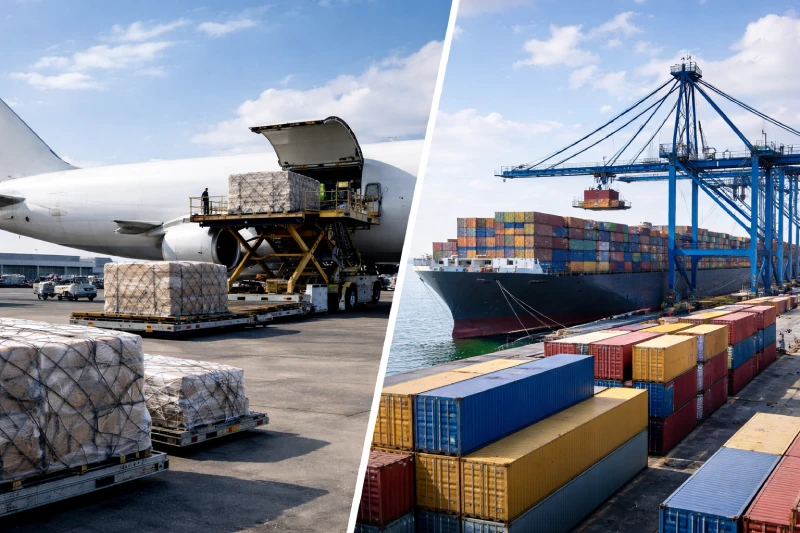
Businesses importing goods from China to Cameroon often compare air freight and sea freight before selecting a transport method. Each option serves different supply chain needs depending on shipment urgency, cargo volume, and overall logistics planning.
| Factor | Air Freight | Sea Freight |
|---|---|---|
| Transport Speed | Fast international transit | Longer transit due to ocean routes |
| Shipment Volume | Best for small to medium cargo volumes | Suitable for large or bulk shipments |
| Cost Efficiency | Higher cost per kilogram | Lower cost for large cargo volumes |
| Typical Use Case | Urgent or high-value goods | Bulk cargo and planned inventory shipments |
Air freight is typically chosen when delivery speed is the primary concern. Importers often rely on air cargo to move urgent spare parts, high-value electronics, or equipment required for ongoing projects. Faster transit can help reduce operational downtime and maintain production schedules.
Sea freight, on the other hand, is generally more suitable for larger shipments where transit time is less critical. Container shipping allows businesses to move high volumes of cargo at a lower cost per unit, making it the preferred option for bulk imports and planned inventory replenishment. Companies evaluating both options may also consider sea freight from China to Cameroon to determine which transport mode aligns better with their logistics strategy.
Common Cargo Shipped by Air to Cameroon
Air freight shipments from China to Cameroon are commonly used for goods that require faster delivery or involve higher value. Importers often select air transport when cargo is needed urgently, when shipment volumes are relatively small, or when delays could disrupt production or commercial operations.
Typical air cargo shipments include the following categories:
- Electronics and electrical components used in telecommunications infrastructure, consumer devices, and industrial control systems
- Medical equipment and healthcare supplies that require rapid transportation or controlled handling conditions
- Industrial spare parts and machinery components needed to support maintenance or equipment repairs
- Automotive parts required for vehicle servicing, assembly operations, or distribution networks
- High-value commercial goods where faster transport helps reduce inventory risk and supply chain delays
Many of these shipments are associated with project-based industries such as construction, telecommunications, and energy development. In these sectors, equipment breakdowns or installation delays can create significant operational disruptions, making air freight a practical solution for delivering critical components within shorter time frames.
Because air cargo capacity is limited compared with ocean transport, companies typically reserve air freight for shipments where speed, reliability, or cargo value justifies the higher transport cost.
Air Cargo Size, Weight, and Packaging Considerations
When shipping goods by air from China to Cameroon, cargo dimensions, weight, and packaging play an important role in determining how shipments are handled and charged. Unlike ocean transport, air freight capacity is limited, so airlines apply specific rules to calculate the chargeable weight of each shipment.
Air freight pricing is generally based on chargeable weight, which considers both the actual weight of the cargo and its volumetric weight. Volumetric weight reflects the space a shipment occupies inside the aircraft. If the cargo is large but relatively light, the airline may calculate charges based on its volume rather than its physical weight.
Importers should also be aware of certain practical limits that may affect air shipments:
- Cargo dimensions must fit within aircraft cargo holds and loading equipment limitations
- Individual package weight may be restricted depending on aircraft type and ground handling capacity
- Stackability and palletization can affect how efficiently cargo is loaded and transported
Proper packaging is essential to ensure safe handling during air transport. Goods are typically packed in strong cartons, crates, or pallets that can withstand multiple handling stages at airports and transit hubs. Clear labeling and secure packaging also help reduce the risk of damage or delays during international transport.
Import Customs Clearance in Cameroon
Air freight shipments arriving in Cameroon must complete import customs clearance before the cargo can be released to the consignee. This process typically takes place at Douala International Airport, where most international air cargo entering the country is handled. Proper documentation and coordination with local agents are essential to ensure the clearance process moves smoothly.
Several key documents are usually required when importing goods by air:
- Commercial invoice, describing the value and details of the goods
- Packing list, outlining package quantities, weights, and dimensions
- Air waybill (AWB) issued by the airline or freight forwarder
- Import permits or licenses, when required for regulated goods
Cameroon’s customs procedures may also involve cargo inspection, document verification, and the calculation of applicable duties and taxes. Because local regulations and administrative procedures can vary depending on the type of goods being imported, many companies work with a local customs broker or logistics agent to manage the clearance process.
Accurate documentation is particularly important for air freight shipments. Errors in cargo descriptions, declared values, or supporting documents can delay clearance and hold cargo at the airport, which may disrupt supply chains that rely on faster air transport.
Industries That Frequently Use Air Freight to Cameroon
Several industries rely on air freight shipments from China to Cameroon when speed and reliability are important for maintaining operations. In many cases, companies choose air transport to move essential equipment, spare parts, or high-value goods that support ongoing projects or supply chains.
Industries that commonly use air freight to Cameroon include:
- Construction and infrastructure projects, where replacement parts or specialized equipment may be required to avoid delays on active job sites
- Energy and industrial sectors, including oil, gas, and power projects that depend on timely delivery of technical components
- Telecommunications infrastructure, where electronic systems, network equipment, and spare modules must arrive quickly to maintain service continuity
- Electronics distribution, where importers handle smaller, higher-value shipments destined for regional wholesale markets
In these industries, project timelines and operational continuity are often critical factors. When a specific component is required to complete installation, repair equipment, or support distribution activities, air freight can provide a faster transport option compared with ocean shipping.
Because these shipments are often smaller in volume but high in importance, businesses frequently integrate air freight into their broader logistics strategy to reduce downtime and maintain supply chain reliability.
When Air Freight Is the Right Choice
Air freight is typically selected when shipment speed is a critical factor in the supply chain. For companies importing goods from China to Cameroon, this transport mode can be useful when delays could interrupt operations, project schedules, or equipment maintenance.
Businesses often choose air freight in situations such as:
- Urgent operational requirements, when replacement parts or equipment are needed quickly to avoid production or project delays
- High-value goods, where faster delivery helps reduce inventory risk and improve supply chain efficiency
- Small shipment volumes, where cargo size does not justify the use of container shipping
- Time-sensitive commercial shipments, such as product launches, seasonal inventory, or project deadlines
While air freight generally involves higher transportation costs than ocean shipping, it can provide important logistical advantages in the right circumstances. Companies often evaluate shipment urgency, cargo value, and supply chain priorities before deciding whether air transport is the most suitable option.
