
Average Shipping Cost from China to Ghana
The ranges below are conservative market-planning figures compiled from multiple publicly available China–Ghana freight sources reviewed on August 27, 2026. Promotional, expired, single-service special offers and prices without a clear route or service scope were excluded. These figures are intended for early budgeting and are not live carrier rates or a binding Winsail quotation.
| Shipping Method | Indicative Planning Range | Billing Basis | Best For | Important Scope |
|---|---|---|---|---|
| LCL Sea Freight | USD 150–260 | Per chargeable CBM | General cargo of roughly 1–15 CBM | Port-to-port planning range; origin and destination charges may be separate |
| FCL 20GP | USD 3,300–4,400 | Per container | Cargo approaching a full 20ft container | Major China port to Tema; freight-only planning range |
| FCL 40GP | USD 4,500–5,900 | Per container | Large or dense commercial cargo | Major China port to Tema; freight-only planning range |
| FCL 40HQ | USD 4,800–6,600 | Per container | High-volume cargo | Major China port to Tema; freight-only planning range |
| Air Freight | USD 4.5–9.0 | Per kg of chargeable weight | General cargo of 45 kg or more | Airport-to-airport; lower rates normally require higher chargeable weight |
| Express Courier | USD 10–18 | Per kg of chargeable weight | Documents, samples and small urgent parcels | Base planning range; fuel, remote-area and dimensional charges may apply |
| DDP Air or Sea | Custom quote | Per shipment | Eligible cargo requiring delivery to a named destination | Depends on product, customs value, importer arrangement, duties and delivery city |
The LCL, FCL and standard air-freight figures above do not represent landed cost. Unless a quotation states otherwise, allow separately for China pickup, origin handling, Ghana destination handling, customs brokerage, duties and taxes, inspection, storage, demurrage or detention, and inland delivery.
How These Planning Ranges Were Prepared
The published figures were rounded into broad budgeting bands after comparing several public market sources. Promotional prices, expired offers and figures without a clear route or service scope were not used as stand-alone benchmarks. Winsail confirms a live rate only after reviewing the cargo details, service scope and shipment-ready date.
Which Shipping Method Should You Compare First?
The right starting point depends on shipment size, urgency and cargo characteristics. Use the table below to decide which service to compare first, then check the complete quotation and service scope before booking.
| Shipment Profile | First Option to Compare | Why |
|---|---|---|
| Documents or samples under 45 kg | Express courier vs. air-freight minimum charge | Simple for small urgent shipments, but dimensional weight can significantly affect the final price |
| Urgent general cargo of roughly 45–300 kg | Standard air freight vs. express courier | Standard air freight often becomes more competitive as chargeable weight increases |
| Urgent cargo above roughly 300 kg | Standard air freight | Weight-tier pricing generally improves with higher chargeable weight |
| Non-urgent general cargo of roughly 1–15 CBM | LCL sea freight | Allows the importer to pay for shared container space rather than a full container |
| Cargo approaching roughly 15–18 CBM | Compare complete LCL cost with a 20GP quotation | LCL origin and destination charges may reduce the cost advantage as volume increases |
| Large or containerized commercial cargo | FCL 20GP, 40GP or 40HQ | Container choice depends on cargo dimensions, weight distribution and loading feasibility |
These are comparison starting points rather than fixed booking rules. Cargo density, dimensions, value, dangerous-goods status, delivery deadline, origin charges and Ghana destination costs may change the most suitable option.
Not sure which method fits your shipment? Prepare the total gross weight and CBM first. These two figures allow LCL, FCL and air-freight options to be compared on a more consistent basis.
FREIGHT COST ESTIMATOR
China to Ghana Freight Cost Calculator
Enter your shipment details to calculate an indicative freight-planning range. The result is not a booking rate or landed-cost quotation.
Rates reviewed: August 27, 2026
What Determines Shipping Costs from China to Ghana?
There is no single fixed shipping price from China to Ghana. The final cost depends on the transport method, cargo size and density, origin and destination, carrier routing, service scope, customs requirements and shipment-ready date.
Sea freight is normally the lowest-cost option for non-urgent commercial cargo, while air freight is used when speed or inventory availability is more important. LCL is usually billed by chargeable volume or weight-and-measure rules, while FCL is quoted by container type. Air freight and express courier use the greater of actual weight and volumetric weight.
The lowest main-freight rate is not always the lowest total cost. A quotation may separate supplier pickup, China origin handling, international freight, destination handling, customs brokerage, duties and taxes, storage and inland delivery. Two quotes should only be compared when their routes and included services are the same.
The agreed Incoterm also changes how costs and responsibilities are divided:
- EXW: The buyer normally arranges collection from the supplier’s premises, export handling, international transport and import procedures.
- FOB: For sea or inland-waterway transport, the seller delivers the goods on board at the named Chinese port, while the buyer arranges the main carriage and Ghana import procedures.
- CIF: For sea or inland-waterway transport only, the seller pays the ocean freight and minimum insurance to the named destination port. The buyer still normally handles Ghana import clearance, duties and taxes, destination charges and final delivery.
- CPT or CIP: These terms can be used for air or multimodal transport. The seller pays carriage to the named destination, and CIP also requires insurance, but Ghana import formalities normally remain with the buyer unless otherwise agreed.
- DDP: The seller is responsible for transport, import formalities, duties and taxes, and delivery to the named place when the arrangement is legally and operationally possible. The importer-of-record arrangement and exact exclusions must be confirmed in writing.
Sea Freight Costs from China to Ghana (LCL & FCL)
Sea freight is usually the most economical option for shipping commercial cargo from China to Ghana. It is especially suitable for shipments over 1 CBM or more than 200–300 kg. Sea freight can be divided into two methods:
- LCL (Less than Container Load): you share container space with other shippers
- FCL (Full Container Load): you book an entire container
LCL Sea Freight Cost Per CBM
LCL is suitable when the shipment does not require a full container. For standard general cargo moving from major Chinese gateways to Tema, use USD 150–260 per chargeable CBM as an indicative port-to-port freight range.
LCL is normally billed according to the forwarder’s weight-or-measure rules and may have a minimum charge. A shipment measuring less than 1 CBM may therefore still be billed at the minimum volume stated in the quotation.
| Cost Component | Usually Included in the Planning Range? | What to Confirm |
|---|---|---|
| International LCL freight and consolidation | Usually | Route, minimum charge and weight-or-measure rule |
| Supplier pickup in China | Usually not | Pickup city, distance and number of suppliers |
| China origin handling and documentation | May be separate | CFS, documentation and export handling |
| Tema CFS and destination handling | Usually not | Destination-agent and warehouse charges |
| Ghana customs clearance, duties and taxes | No | HS classification, customs value and importer details |
| Inland delivery in Ghana | No | Final city, address and cargo-access conditions |
A low per-CBM ocean rate can still result in a higher total bill if origin, destination and minimum documentation charges are excluded. Compare the complete quote rather than the ocean-freight line alone.
FCL Container Pricing
FCL is quoted per container. The figures below are indicative port-to-port freight planning ranges for standard dry general cargo moving from major Chinese gateways to Tema. A live quotation must identify the container type, origin port, carrier or service, direct or transshipment routing, surcharges and validity period.
| Container Type | Indicative Planning Range | Planning Guidance |
|---|---|---|
| 20GP | USD 3,300–4,400 | Compare with the complete LCL cost when volume approaches roughly 15–18 CBM |
| 40GP | USD 4,500–5,900 | Suitable for large or dense commercial cargo, subject to loading and weight limits |
| 40HQ | USD 4,800–6,600 | Suitable for higher-volume cargo, subject to dimensions, weight and loading feasibility |
The 15–18 CBM crossover is only a comparison point, not a fixed rule. Compare the total LCL quote, including origin and destination charges, with the complete 20GP quotation before booking. Cargo weight, packaging and loading feasibility may change the result.
Do not assume that every surcharge is included in the container price. A carrier or forwarder may list ocean freight, origin terminal handling, documentation, seal, equipment-interchange, security, telex-release and other charges separately. Ghana destination handling, customs clearance, duties and taxes, storage, demurrage, detention and inland delivery are normally excluded unless the quotation expressly includes them.
How the China Origin Changes the Quote
| Origin Area | Common Gateways | What the Importer Should Compare |
|---|---|---|
| South China | Shenzhen, Nansha, Guangzhou | Supplier pickup distance, consolidation, sailing schedule, transshipment and origin surcharges |
| East China | Shanghai, Ningbo | Supplier proximity, inland transport, carrier routing and equipment availability |
| North China | Qingdao, Tianjin | Inland pickup, container availability, sailing frequency and total transit plan |
The lowest ocean-freight line is not always the lowest total cost. Choose the origin gateway that minimizes supplier pickup, handling, schedule risk and the complete freight bill. Do not assume that one Chinese port is always the cheapest option for Ghana.
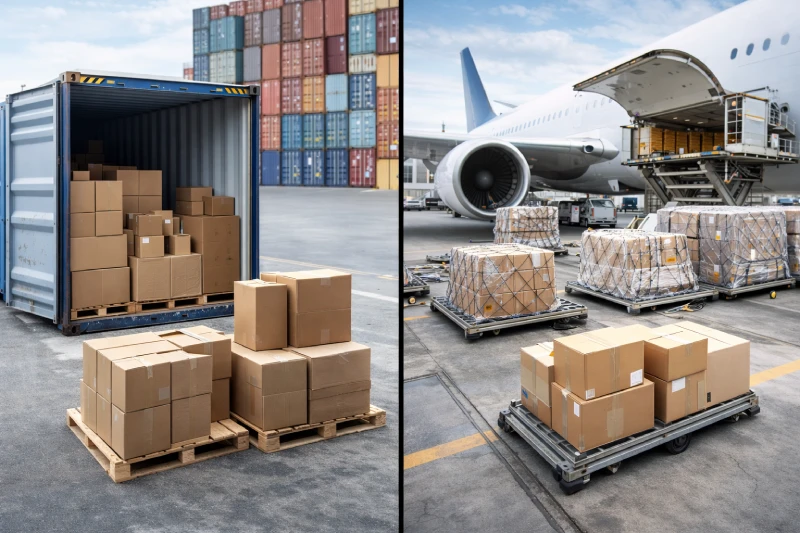
Air Freight Costs from China to Ghana
Air freight is suitable for urgent, time-sensitive or higher-value commercial cargo. Most commercial air shipments enter Ghana through Kotoka International Airport in Accra. Airlines normally charge the greater of actual weight and volumetric weight.
Volumetric Weight (kg) = Length (cm) × Width (cm) × Height (cm) ÷ 6000
The divisor of 6000 is a common general-air-cargo rule. The actual divisor and minimum charge must be confirmed with the airline or forwarder.
Typical Air Freight Rates by Weight Tier
| Chargeable Weight | Indicative Airport-to-Airport Rate | Planning Guidance |
|---|---|---|
| Under 45 kg | Quote required | Compare courier pricing with the airline minimum charge |
| 45–100 kg | USD 6.5–9.0/kg | Small urgent commercial shipments |
| 100–300 kg | USD 5.5–8.0/kg | Electronics, components and commercial replenishment |
| 300–500 kg | USD 5.0–7.0/kg | Larger urgent cargo |
| 500 kg+ | USD 4.5–6.5/kg | Higher-volume general cargo, subject to capacity |
These figures are airport-to-airport planning ranges for standard general cargo. Batteries, liquids, powders, magnets, oversized pieces, temperature-controlled cargo and branded goods may require special handling, additional documentation or carrier approval.
For planning purposes, an 80 kg general-cargo shipment may have an airport-to-airport air-freight component of approximately USD 520–720. This does not include every possible origin charge, Ghana airport handling, customs brokerage, duties and taxes, storage or final delivery.
What an Airport-to-Airport Air Freight Quote May Include
CIF is reserved for sea or inland-waterway transport and should not be used to describe an air-freight quotation. For air or multimodal sales, CPT or CIP may be appropriate depending on the sales contract.
An airport-to-airport air-freight quote may include the main air carriage and certain agreed origin services. It does not automatically include cargo insurance, Ghana terminal handling, import customs clearance, duties and taxes, storage or delivery from Accra Airport to the final destination.
| Cost Item | Usually Included? |
|---|---|
| Main air carriage to Accra Airport | Usually |
| China pickup and origin handling | Depends on quotation |
| Export customs coordination | Depends on quotation |
| Cargo insurance | Only when expressly agreed |
| Ghana airport and terminal handling | Usually not |
| Ghana import clearance, duties and taxes | No |
| Final delivery in Ghana | No |
DDP Air Freight Cost to Ghana
There is no dependable flat DDP air rate for every shipment to Ghana. A shipment-specific quotation changes with the product description, HS classification, customs value, chargeable weight, cargo restrictions, named delivery address and importer arrangement.
To request a DDP air quote, provide the product specification, declared value, gross weight, carton dimensions, battery or liquid status, supplier pickup address and exact Ghana delivery destination.
DDP Shipping Costs from China to Ghana
DDP is an Incoterms sales rule, not simply a freight package. Under a properly agreed DDP sale, the seller—not automatically the freight forwarder—is responsible for arranging transportation, completing export and import formalities, paying applicable duties and taxes, and delivering the goods to the named place.
A freight forwarder may coordinate these services on the seller’s behalf, but the quotation must identify the named destination, the importer-of-record arrangement and every included or excluded charge. DDP may not be practical where the seller cannot lawfully complete import or tax formalities in Ghana.
Why DDP Quotes Vary
| Quote Factor | Why It Matters |
|---|---|
| Product description and HS classification | Affects import treatment, duty and regulatory requirements |
| Customs value | Affects the estimated import-tax component |
| Cargo type | Batteries, liquids, regulated and branded products may require additional review |
| Chargeable weight or volume | Determines the transport basis |
| China pickup location | Changes origin trucking and handling |
| Named destination in Ghana | Changes local delivery cost and service feasibility |
| Importer arrangement | Determines how Ghana import formalities can be completed |
| Included and excluded services | Determines whether two quotations are actually comparable |
How DDP Pricing Should Be Quoted
| DDP Method | Public Planning Rate | Information Required |
|---|---|---|
| Sea DDP | Custom quote | Product, HS details, customs value, CBM, gross weight, China pickup and named Ghana destination |
| Air DDP | Custom quote | Product, HS details, customs value, chargeable weight, cargo restrictions, pickup and named Ghana destination |
A tax-included warehouse-to-warehouse consolidation service is not automatically the same as DDP to the buyer’s final address. Compare DDP quotations only when the named destination, customs arrangement, duties and taxes, delivery scope, unloading responsibility and exclusions are identical.
Express Courier Costs from China to Ghana (DHL, UPS, FedEx)
Express courier is the fastest shipping method from China to Ghana and is usually used for samples, documents, spare parts, and small parcels under 100 kg. Major courier companies such as DHL Express, FedEx, and UPS offer door-to-door delivery from most Chinese cities to Ghana in approximately 3–7 business days.
Courier pricing is usually based on:
- Actual weight or volumetric weight (whichever is higher)
- Fuel surcharge
- Delivery zone
- Remote area surcharge, if applicable
The volumetric weight formula used by most express companies is:
Volumetric Weight (kg) = Length (cm) × Width (cm) × Height (cm) ÷ 5000
A divisor of 5000 is commonly used by international express couriers, but the applicable divisor and minimum billable weight should be confirmed for the selected service.
| Shipment Size | Indicative Base-Freight Range |
|---|---|
| 0.5–5 kg | USD 15–25/kg |
| 5–30 kg | USD 12–18/kg |
| 30–100 kg | USD 10–15/kg |
Courier rates may exclude import duties and taxes, fuel surcharge, remote-area delivery, oversize handling, address correction and other service fees. Use the courier’s live account quotation for the final price.
Courier shipping is usually the best choice when:
- The shipment is urgent
- The cargo is small, urgent, time-sensitive or being sent as a sample
- You are shipping samples before a larger order
- You want the simplest door-to-door process
For shipments above roughly 45–100 kg, compare express courier with standard air freight. The cheaper option depends on chargeable weight, dimensions, service level and destination rather than weight alone.
Full Breakdown of Factors That Influence Shipping Cost
Even when two shipments travel from the same city in China to the same destination in Ghana, the final shipping cost can still be very different. The main reason is that freight companies calculate prices based on several variables, not just the distance.
Cargo Volume and Weight
The most important factor is the size of the shipment. Sea freight is usually charged by cubic meter (CBM), while air freight and courier shipments are charged by the higher of actual weight or volumetric weight.
Two shipments with the same actual weight can have different air-freight costs when one shipment occupies substantially more space. The chargeable weight is based on the greater of actual and volumetric weight.
Larger shipments can benefit from lower unit costs, but the applicable billing rule and minimum charge should be confirmed for the selected service.
Packaging Efficiency and Carton Size
Poor packaging can significantly increase freight costs. Oversized cartons, unnecessary pallets, or empty space inside packaging increase the volume of the shipment and therefore the amount you pay.
Reducing unnecessary carton space can lower chargeable volume or volumetric weight. The actual saving must be recalculated from the final carton dimensions, weight and applicable billing rule; do not assume a fixed percentage.
For businesses shipping regularly, better packaging design can help control freight expenses without reducing cargo protection.
Shipping Route and Transshipment
Direct services may reduce transit time, but they are not always the lowest-priced option. Transshipment services may offer a lower freight rate while adding schedule and connection risk.
The correct origin gateway depends on supplier location, pickup cost, carrier routing, sailing schedule, equipment availability and surcharges. Cargo from an inland Chinese city may require additional trucking or rail transport before export.
Peak Season and Fuel Surcharges
Shipping prices do not stay the same throughout the year. Capacity and pricing may change during:
- Before Chinese New Year (January–February)
- Peak export periods
- Black Friday and Christmas period (October–December)
During busy periods, shipping lines and airlines may add:
- Peak Season Surcharge (PSS)
- Fuel surcharge
- Equipment imbalance surcharge
- Congestion surcharge
Capacity and surcharges can change before Chinese New Year and during other busy export periods. Every quotation should show its validity period, planned sailing or flight, and the surcharges included at the time of issue.
Customs Clearance and Import Duties
Shipping cost and import cost are not always the same thing. If you use FOB or CIF terms, you still need to allow for customs clearance, import duties, taxes and local handling charges after the goods arrive in Ghana.
The assessment may depend on:
- Product type
- HS code
- Declared value
- Whether the shipment requires special permits
The final import assessment depends on the product’s classification, customs value, origin, applicable taxes and any product-specific regulatory requirements. A freight estimate should not be treated as Ghana Customs’ final assessment.
Incoterms: EXW, FOB, CIF, CPT/CIP and DDP
| Incoterm | Correct Transport Scope | Main Cost Responsibility to Verify |
|---|---|---|
| EXW | Any mode | Buyer normally arranges pickup, export, main carriage, import and delivery |
| FOB | Sea or inland waterway only | Seller delivers on board at the named origin port; buyer arranges main carriage and import |
| CIF | Sea or inland waterway only | Seller pays ocean freight and minimum insurance to the named destination port; buyer handles import and local costs |
| CPT / CIP | Any mode, including air and multimodal | Seller pays carriage; CIP also includes insurance; buyer normally handles import |
| DDP | Any mode | Seller handles import formalities and duties to the named place when legally feasible; buyer normally unloads |
Incoterms allocate responsibilities between the seller and buyer. They do not automatically make every freight-forwarder quotation an all-inclusive landed-cost offer.
How to Reduce Shipping Costs from China to Ghana
Shipping from China to Ghana does not always have to be expensive. In many cases, importers can reduce their freight costs by improving the way they plan, package, and book their shipments.
Consolidate Multiple Suppliers into One Shipment
Combining orders from several suppliers can reduce repeated pickup, documentation and minimum-charge costs. However, the result depends on warehouse handling, storage time, cargo compatibility and supplier readiness. Compare separate-shipment and consolidated quotations rather than assuming a fixed saving percentage.
Choose the Origin That Minimizes Total Cost
The best origin is normally the gateway that balances supplier pickup, consolidation, export handling, sailing schedule, routing and carrier charges. A lower ocean-freight line can be offset by higher inland pickup or origin handling.
Compare the complete cost from the supplier location rather than assuming that Shenzhen, Guangzhou, Shanghai or Ningbo will always be the cheapest.
Book Earlier to Avoid Peak Season Rates
Book after the cargo details and ready date are sufficiently stable. Ask the forwarder to state the rate validity, planned departure, equipment or space status, and cancellation conditions. An expired monthly rate should not be used as the booking budget.
Improve Packaging Efficiency
Repacking may lower chargeable volume or volumetric weight, but the saving should be recalculated from the final dimensions and weight. Packaging changes must not reduce cargo protection or create compliance problems.
Avoid:
- Oversized cartons
- Half-empty pallets
- Unnecessary wooden packaging
- Incorrect carton dimensions
Use Sea Freight Instead of Air When Possible
Where delivery time allows, compare sea freight with air freight for non-urgent commercial cargo. Sea freight normally has a lower international freight cost for larger or heavier shipments, while air freight may be justified by shorter lead times, lower inventory risk or urgent replenishment.
Compare complete quotes rather than freight rates alone. Origin handling, destination charges, chargeable weight, storage risk and final delivery can change the result.
Avoid Customs Delays and Extra Charges
Incorrect invoices, missing HS codes, or non-compliant packaging can create delays and unexpected charges after the goods arrive in Ghana.
To avoid extra costs:
- Use accurate commercial invoices
- Confirm the correct HS code before shipping
- Prepare all customs documents in advance
- Make sure labels and packaging comply with Ghana import requirements
Even a small customs delay can increase storage charges and port fees, especially at Tema Port or Kotoka International Airport. Proper preparation can help keep total shipping costs under control.
For additional planning ideas, see our guide to reducing shipping costs and delivery time.
FAQs
What is the cheapest way to ship from China to Ghana?
For non-urgent general cargo that does not fill a container, LCL is usually the lowest freight option. When the shipment approaches roughly 15–18 CBM, compare the complete LCL cost with a 20GP quotation. For urgent cargo under about 45 kg, express courier may be simpler; for larger urgent shipments, compare standard air freight.
How much does it cost to ship a container from China to Ghana?
As an August 2026 planning range, a 20GP container from a major Chinese port to Tema is approximately USD 3,300–4,400, a 40GP is approximately USD 4,500–5,900, and a 40HQ is approximately USD 4,800–6,600.u003cbru003eu003cbru003eThese figures are not landed cost. They may exclude China pickup, origin surcharges, Ghana destination handling, customs brokerage, duties and taxes, storage, demurrage, detention and inland delivery.
How much is air freight from China to Ghana?
For standard general cargo, indicative airport-to-airport planning rates are approximately USD 6.5–9.0/kg for 45–100 kg, USD 5.5–8.0/kg for 100–300 kg, USD 5.0–7.0/kg for 300–500 kg, and USD 4.5–6.5/kg for shipments above 500 kg.u003cbru003eu003cbru003eThe quotation is based on chargeable weight and may exclude origin handling, Ghana airport charges, customs clearance, duties and taxes, storage and final delivery.
Are customs duties included in the shipping cost?
Not in a standard LCL, FCL or airport-to-airport freight quotation. A properly scoped DDP sale may include import clearance, duties and taxes, and delivery to the named place, but the quotation must identify the importer arrangement and every exclusion.u003cbru003eu003cbru003eDo not assume that “door-to-door,” “tax included” and “DDP” cover the same items across different providers.
Why do shipping rates from China to Ghana change so often?
Rates change with carrier and airline capacity, equipment availability, fuel and security surcharges, transshipment routing, cargo-ready date, peak demand, port or airport congestion, chargeable weight and currency movements. Every live quotation should show a validity period.
Is FCL cheaper than LCL?
FCL can become more economical when cargo approaches approximately 15–18 CBM, but this is not a fixed rule. Compare the full LCL bill, including CFS and destination charges, with the complete FCL quotation. Cargo weight, packaging and loading feasibility must also be checked.
How much does 1 CBM cost to ship from China to Ghana?
For standard LCL general cargo, use approximately USD 150–260 per chargeable CBM as an August 2026 port-to-port planning range from major Chinese gateways to Tema.u003cbru003eu003cbru003eHowever, LCL is normally billed using a weight-or-measure rule and may have a minimum charge. China origin handling, Tema destination handling, customs clearance, duties and taxes, storage and inland delivery may also be charged separately.
Does the shipping price include Tema Port charges?
Usually not. Standard LCL and FCL freight-planning rates generally refer to the international freight portion and may exclude Tema destination handling, shipping-line local charges, customs brokerage, duties and taxes, inspection, storage, demurrage, detention and inland delivery.u003cbru003eu003cbru003eAlways check the quotation’s included and excluded charges before comparing two freight offers.
Get an Accurate Shipping Cost for Your Shipment
A useful freight quotation requires more than a product name or a question about the price per kilogram or cubic metre. Prepare the following information before requesting a quote:
- Product name, specification and intended use
- HS code, if known
- Declared commercial value
- Number of cartons, pallets or packages
- Gross weight
- Carton dimensions or total CBM
- Battery, liquid, powder, magnet, chemical or branded-goods status
- Supplier pickup city or address in China
- Destination city, postcode and delivery address in Ghana
- Cargo-ready date
- Required service scope: port-to-port, airport-to-airport, door-to-door, DAP or DDP
With these details, the forwarder can compare LCL, FCL, air freight, express and eligible door-to-door options on the same service scope.
Shipping Cost Disclaimer and August 2026 Rate Review
Rates on this page were reviewed on August 27, 2026 and are broad market-planning ranges, not live carrier rates or binding Winsail quotations. They were compiled from multiple publicly available China–Ghana freight sources, with promotional, expired, single-service special offers and unclear-scope prices excluded. The remaining figures were rounded into practical budgeting ranges. Freight markets may change before booking.
Unless a row expressly states otherwise, LCL and FCL figures refer to the international freight portion for standard general cargo moving from major Chinese gateways to Tema. They may exclude China pickup, origin handling, Ghana destination handling, customs brokerage, duties and taxes, inspection, storage, demurrage, detention and inland delivery.
Air-freight figures use chargeable weight and generally refer to airport-to-airport transport. Express and DDP pricing requires a shipment-specific quotation.
Request a live quotation after the cargo details are confirmed and preferably within 7–14 days of the planned shipment-ready date.
