
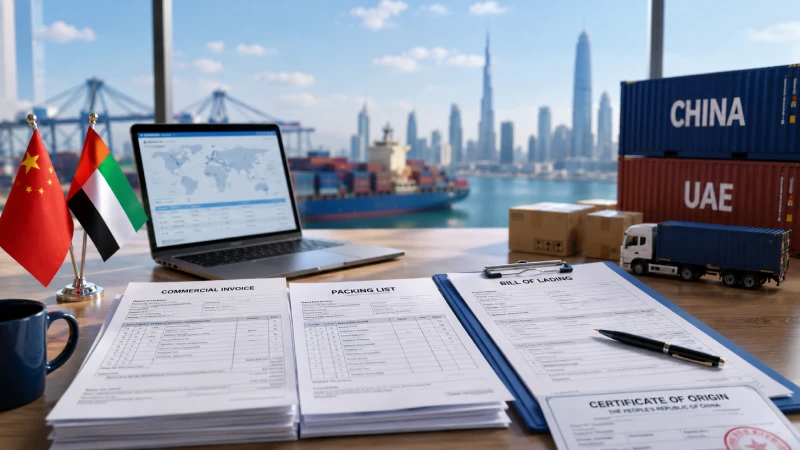
Shipping goods from China to the UAE is not only about finding the right freight rate or choosing between sea freight and air freight. In many cases, customs delays, cargo holds, and unexpected fees happen because of documentation problems rather than transportation itself.
For importers, distributors, and SMEs sourcing products from China, understanding the required shipping documents is essential for smooth customs clearance in the UAE. Even a small mismatch between documents can result in delays, customs inspections, storage charges, or rejected shipments.
This guide explains the key documents required for shipping from China to UAE in practical, easy-to-understand language. You will learn what each document is used for, common mistakes to avoid, and how proper documentation helps reduce customs risks and delivery delays.
Why Shipping Documents Matter for UAE Imports
International shipping involves multiple parties: suppliers, freight forwarders, carriers, customs authorities, and importers. Shipping documents act as the official communication between all of them.
For UAE customs authorities, documents help determine:
- What products are being imported
- Where the cargo originated
- Who owns the shipment
- The declared cargo value
- Whether taxes or duties apply
- Whether the products require import permits
If the documentation is inaccurate or incomplete, customs officers may stop the shipment for further inspection.
Common documentation-related problems include:
- Delayed customs clearance
- Incorrect duty calculations
- Extra storage charges at ports
- Shipment holds
- Cargo release delays
- Fines for incorrect declarations
This is especially important in the UAE because customs procedures are relatively efficient when documentation is correct, but strict when inconsistencies appear.
Main Documents Required for Shipping from China to UAE
Most shipments from China to UAE require the following core documents:
- Commercial Invoice
- Packing List
- Bill of Lading (B/L) or Airway Bill (AWB)
- Certificate of Origin (COO)
Depending on the cargo type, additional documents may also be required, such as:
- Import licenses
- Product certifications
- Inspection certificates
- Insurance certificates
- Special permits
The exact requirements depend on:
- Product category
- Shipping method
- UAE destination
- Mainland or free zone delivery
- Importer registration status
Commercial Invoice
What Is a Commercial Invoice?
The commercial invoice is one of the most important documents in international shipping. It acts as the official sales record between the exporter and importer.
UAE customs uses the commercial invoice to calculate:
- Customs duties
- VAT
- Product classification
- Shipment value
Without a proper invoice, customs clearance becomes difficult or impossible.
Information Required on a Commercial Invoice
A commercial invoice should normally include:
- Seller information
- Buyer/importer information
- Product descriptions
- Quantity
- Unit price
- Total shipment value
- Currency
- Incoterms (FOB, CIF, DDP, etc.)
- Country of origin
- HS code if applicable
The product description should be clear and specific.
For example:
Bad description:
- “Accessories”
Better description:
- “Plastic mobile phone protective cases”
Common Commercial Invoice Mistakes
One of the biggest mistakes is using vague product descriptions. UAE customs officers need enough detail to identify the goods correctly.
Other common issues include:
- Under-declaring cargo value
- Wrong importer name
- Mismatched quantities
- Incorrect currency
- Missing Incoterms
- Different product descriptions across documents
Even small inconsistencies can trigger inspections.
Packing List
What Is a Packing List?
A packing list explains how the cargo is physically packed.
While the commercial invoice focuses on financial details, the packing list focuses on logistics and cargo handling.
It helps:
- Customs officers
- Warehouse staff
- Freight forwarders
- Inspection teams
understand the shipment structure.
Information Included in a Packing List
A packing list usually contains:
- Carton count
- Gross weight
- Net weight
- Dimensions
- Packaging type
- Product quantities
- SKU references
- Pallet details
Why Packing Lists Matter in UAE Customs Clearance
If UAE customs decides to inspect a shipment, officers often compare the physical cargo against the packing list.
Problems happen when:
- Carton quantities do not match
- Weight differs from actual cargo
- Product allocation is unclear
- Dimensions are inaccurate
This can lead to longer inspections and storage fees at UAE ports or airports.
Practical Tip
Always ensure the packing list matches:
- Commercial invoice
- Bill of lading
- Physical cargo labels
Consistency is extremely important.
Bill of Lading (B/L) and Airway Bill (AWB)
What Is a Bill of Lading?
For sea freight shipments, the transport document is called a Bill of Lading (B/L).
The B/L serves several purposes:
- Cargo receipt
- Transport contract
- Ownership document
It is issued by the shipping line or carrier.
What Is an Airway Bill?
For air freight shipments, the equivalent document is called an Airway Bill (AWB).
Unlike a Bill of Lading, an AWB is generally not a title ownership document. It mainly serves as a shipment tracking and transport document.
Key Information Required
Both B/L and AWB usually include:
- Shipper information
- Consignee information
- Departure port
- Destination
- Cargo description
- Weight and volume
- Freight terms
Common Transport Document Errors
Incorrect consignee information is one of the most common causes of cargo release delays in the UAE.
Problems often occur when:
- Importer name differs from import license
- Address is incomplete
- Contact details are wrong
- Product descriptions do not match invoice data
Original B/L vs Telex Release
Many importers today use Telex Release instead of original paper Bills of Lading because it speeds up cargo release.
With Telex Release:
- Original paper documents are not required for cargo collection
- UAE importers can receive cargo faster
- Documentation handling becomes simpler
This is especially useful for SMEs importing smaller shipments frequently.
Certificate of Origin (COO)
What Is a Certificate of Origin?
A Certificate of Origin confirms where the goods were manufactured.
For China-to-UAE shipments, this document is often requested by customs authorities.
Why UAE Customs Requests COO
The Certificate of Origin helps customs verify:
- Manufacturing country
- Trade compliance
- Product legitimacy
It may also affect duty calculations depending on trade agreements or product categories.
Common Certificate of Origin Problems
Typical issues include:
- Product descriptions not matching invoice
- Incorrect manufacturer information
- Missing chamber of commerce authorization
- Wrong country declaration
These inconsistencies can delay customs processing.
Who Issues the COO in China?
In many cases, the COO is issued and certified through authorized Chinese trade organizations or chambers of commerce.
Experienced suppliers and freight forwarders usually handle this process.
UAE Import License and Special Import Permits
When Import Licenses Are Required
In the UAE, many imports require the importer to hold a valid import license.
This is particularly important for mainland UAE imports.
Without proper importer registration, customs clearance may fail even if all shipping documents are correct.
Products That May Need Additional Approval
Some product categories require extra documentation or approvals, including:
- Food products
- Cosmetics
- Medical equipment
- Electronics
- Chemicals
- Batteries
- Telecommunications devices
For example, cosmetics may require municipality approval, while electronics may require conformity certifications.
Free Zone vs Mainland UAE
Documentation requirements may differ depending on whether the shipment goes to:
- UAE mainland
- UAE free zones
Free zones often have simpler procedures for storage and re-export activities.
However, mainland distribution may involve additional customs requirements.
UAE Customs-Specific Documentation Considerations
Accurate HS Codes Matter
HS codes help customs classify products correctly.
Wrong HS codes may lead to:
- Incorrect duty charges
- Shipment inspections
- Customs disputes
Importers should confirm HS codes before shipment departure.
Arabic Labeling Requirements
Some products entering the UAE require Arabic labeling or compliance markings.
This is especially common for:
- Food
- Consumer products
- Cosmetics
- Retail packaging
If labeling requirements are ignored, cargo may be held until relabeling is completed.
VAT and Customs Declarations
The UAE applies VAT on many imported goods.
Accurate invoice values are important because customs uses them for VAT calculations.
Under-declared values may trigger audits or inspections.
Example Shipping Documentation Workflow
Understanding how documents move during the shipping process helps importers avoid confusion.
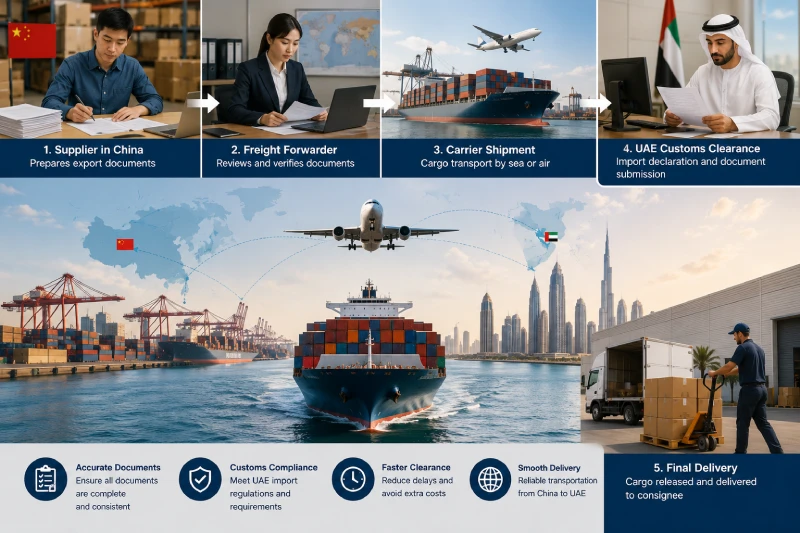
Step 1 — Supplier Prepares Export Documents
The Chinese supplier prepares:
- Commercial invoice
- Packing list
- Certificate of origin
Step 2 — Freight Forwarder Reviews Documents
The freight forwarder checks:
- Cargo consistency
- Shipping details
- Importer information
- Transport booking data
Step 3 — Carrier Issues Transport Documents
After cargo departure:
- Shipping line issues B/L
- Airline issues AWB
Step 4 — UAE Importer Prepares Customs Clearance
The importer or customs broker prepares:
- Import declaration
- VAT processing
- Permit submissions if required
Step 5 — Customs Clearance and Delivery
Once customs approves the shipment:
- Cargo is released
- Final delivery is arranged
Common Documentation Mistakes That Cause Delays
Many shipping delays are preventable.
The most common documentation mistakes include:
Inconsistent Information Across Documents
For example:
- Different weights
- Different product names
- Different quantities
Even small differences may trigger inspections.
Incorrect Product Descriptions
Descriptions that are too general create customs uncertainty.
Avoid vague terms like:
- Accessories
- Parts
- Equipment
Instead, use precise descriptions.
Missing Importer Information
Missing importer license details or incomplete consignee information can stop customs clearance.
Late Document Submission
Freight forwarders need documents before cargo arrival.
Late paperwork often causes unnecessary storage fees.
Practical Tips to Reduce UAE Customs Problems
Double-Check Documents Before Shipment
Review all documents carefully before cargo departure.
Ensure consistency between:
- Invoice
- Packing list
- B/L or AWB
- COO
Use Standardized Templates
Using professional invoice and packing list templates reduces mistakes.
Confirm UAE Import Rules Early
Do not wait until cargo arrival to check permit requirements.
Some approvals take time.
Work With Experienced Freight Forwarders
Freight forwarders familiar with UAE customs procedures can help identify documentation problems before shipping.
This is especially important for:
- First-time importers
- DDP shipments
- Regulated cargo
Keep Digital Copies of All Documents
Always store:
- PDFs
- Scanned copies
- Customs records
This simplifies future shipments and customs audits.
DDP Shipping and Documentation Support
DDP (Delivered Duty Paid) shipping is popular among SMEs importing from China to UAE because the freight forwarder handles much of the logistics and customs process.
In many DDP arrangements, the logistics provider assists with:
- Customs paperwork
- Duty handling
- VAT processing
- Delivery coordination
This reduces operational complexity for importers.
However, importers should still understand the required documents because customs authorities may request supporting information at any stage.
Frequently Asked Questions
What documents are mandatory for shipping from China to UAE?
For most commercial shipments, UAE customs typically requires a commercial invoice, packing list, Bill of Lading or Airway Bill, and a Certificate of Origin. Depending on the cargo type, additional permits or certifications may also be needed. Products such as cosmetics, food items, medical equipment, batteries, and electronics often require extra approvals before customs clearance can be completed.
Can UAE customs clear cargo without a Certificate of Origin?
In some situations, shipments may still clear customs without a Certificate of Origin, but the process can become slower and more complicated. UAE customs authorities may request additional verification documents or conduct extra inspections to confirm the cargo origin. For smoother customs processing, most importers prefer to prepare the Certificate of Origin before shipment departure from China.
What happens if invoice values are declared incorrectly?
Incorrect invoice declarations can create serious customs issues. If the declared cargo value appears too low or inconsistent with the products being imported, UAE customs may stop the shipment for inspection or request revised documentation. This can lead to customs delays, VAT recalculations, penalties, or additional storage charges at the port or airport.
Does every shipment require an import license in the UAE?
Most commercial imports into mainland UAE require a registered importer with a valid import license. However, requirements may differ depending on whether the shipment is entering a UAE free zone or mainland market. Importers should confirm licensing requirements before arranging shipment, especially for regulated or high-value goods.
What is the most common documentation mistake made by importers?
One of the most common mistakes is inconsistency between shipping documents. For example, the product description on the commercial invoice may not match the packing list or Bill of Lading. Even small differences in weight, quantity, or consignee information can trigger customs inspections and shipment delays. Careful document review before cargo departure is one of the best ways to avoid these problems.
How early should shipping documents be prepared before cargo departure?
It is best to prepare and review shipping documents several days before the cargo leaves China. This gives the supplier, freight forwarder, and importer enough time to verify product descriptions, consignee information, HS codes, and permit requirements. Early preparation helps reduce last-minute corrections that often cause customs delays after arrival in the UAE.
Conclusion
Proper shipping documentation is one of the most important parts of importing goods from China to UAE. Accurate paperwork helps avoid customs delays, unnecessary inspections, storage charges, and delivery disruptions.
For most shipments, the key documents include:
- Commercial invoice
- Packing list
- Bill of lading or airway bill
- Certificate of origin
Depending on the cargo, additional permits or certifications may also be necessary.
The best way to reduce customs risks is to prepare documents early, verify consistency across all paperwork, and work with logistics partners experienced in UAE import procedures.
For businesses shipping regularly from China to UAE, professional documentation support can significantly improve shipping efficiency and reduce costly mistakes.
