
For many Qatar importers, the discussion around container shipping costs often starts with a simple question:
“How much does a 40ft container cost from China to Qatar?”
However, for companies importing at scale, that is rarely the most important question.
The real challenge is understanding how to reduce logistics cost per unit, maximize container utilization, and improve inventory efficiency across the entire supply chain.
Whether you are importing construction materials for a large project in Doha, supplying retail chains, furnishing hotels, or managing industrial procurement, a 40ft container can either become a powerful cost-saving tool or an expensive source of inefficiency.
This article explores how experienced importers evaluate 40GP shipping economics and how better planning can significantly lower overall landed costs.
The Economics Behind a 40ft Container to Qatar
Many businesses focus excessively on freight rates while overlooking the broader logistics picture.
A container that costs $3,000 to ship may appear expensive or cheap depending entirely on how effectively that container is utilized.
Sophisticated importers track metrics such as:
- Cost per CBM
- Cost per pallet
- Cost per product
- Cost per project package
Instead of measuring only the ocean freight invoice.
For example, two companies may pay exactly the same freight rate from China to Qatar. Yet one company achieves 95% container utilization while the other only fills 60% of the available space.
The second company effectively pays much higher shipping costs on every product sold.
This is why large importers often combine freight analysis with inventory planning and warehouse management rather than viewing shipping as an isolated expense.
Companies evaluating FCL Shipping from China to Qatar increasingly focus on utilization metrics because these indicators have a much greater impact on profitability than minor fluctuations in freight rates.
When Does a 40ft Container Become Cheaper Than a 20ft Container?
One of the most common misconceptions among importers is that a 40GP container costs twice as much as a 20GP container.
In reality, this is rarely true.
A typical 20GP offers approximately 33 CBM of loading space, while a 40GP provides roughly 67 CBM.
However, shipping rates for a 40GP are usually not double the cost of a 20GP.
This creates economies of scale.
Consider a simplified example:
- 20GP shipping cost: $2,000
- 40GP shipping cost: $3,000
The freight cost per CBM becomes:
- 20GP = approximately $60 per CBM
- 40GP = approximately $45 per CBM
The difference becomes even more significant when destination charges and inland transportation costs are spread across a larger volume of cargo.
In many situations, importers reaching 45–50 CBM of cargo volume should evaluate whether upgrading to a 40GP provides lower cost per unit than shipping a heavily loaded 20GP.
This concept is particularly important for businesses importing:
- Building materials
- Furniture
- Lighting systems
- Hotel supplies
- Industrial equipment
Importers comparing container sizes should also review 20ft Container Shipping Cost from China to Qatar to understand where the break-even point typically occurs.
Cost Per Cubic Meter: The Metric That Actually Matters
Large importers rarely measure logistics performance using container rates alone.
Instead, they calculate effective cost per cubic meter.
The formula is simple:
Total Logistics Cost ÷ Loaded CBM
This calculation includes:
- Factory loading
- Inland trucking
- Export handling
- Ocean freight
- Destination charges
- Final delivery
By using cost per CBM, companies gain a clearer understanding of logistics efficiency.
A shipment costing $4,000 that fills 65 CBM is often more efficient than a shipment costing $3,000 that only fills 35 CBM.
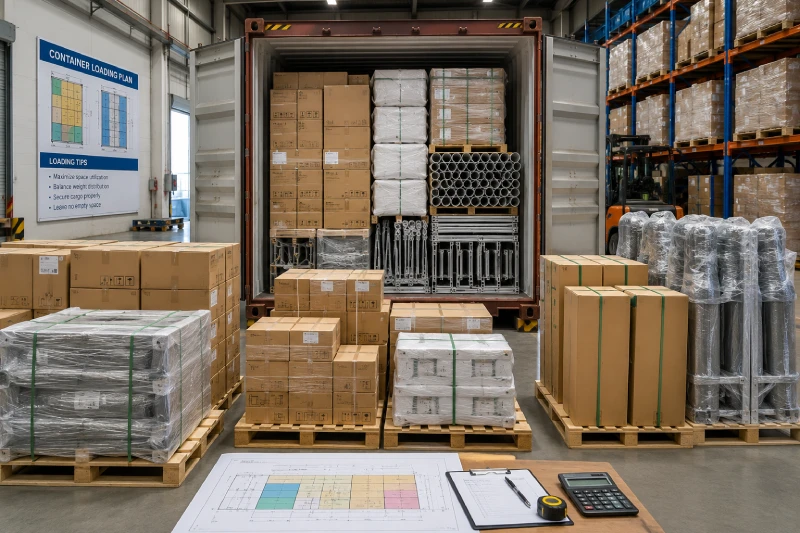
One of the biggest hidden expenses in container shipping is unused air.
Every empty section inside a container represents freight space that has already been paid for.
Importers frequently lose valuable loading capacity due to:
- Oversized cartons
- Poor pallet configuration
- Inconsistent packaging dimensions
- Weak loading plans
For businesses analyzing transportation efficiency, understanding Shipping Cost per CBM from China to Qatar often provides more actionable insights than simply comparing freight quotations.
Why Half-Empty Containers Destroy Margins
The difference between a well-utilized and poorly-utilized container can dramatically affect profitability.
Consider four loading scenarios:
| Utilization | Loaded Volume |
|---|---|
| 40% | 27 CBM |
| 60% | 40 CBM |
| 80% | 54 CBM |
| 95% | 64 CBM |
Even when freight costs remain unchanged, effective logistics cost per product increases significantly as utilization falls.
This is especially important for construction-related imports into Qatar, where project budgets are highly sensitive to logistics expenses.
Many companies unknowingly pay thousands of dollars each year to transport empty space.
The most successful importers view container capacity as an asset that must be fully utilized.
Container Optimization Strategies Used by Large Qatar Importers
The best-performing importers treat container loading as a strategic process rather than a warehouse task.
Product Mix Optimization
Combining different product categories often creates significant efficiency gains.
For example:
- Dense hardware products
- Lightweight insulation materials
- Lighting fixtures
- Packaging materials
can be loaded together to balance both volume and weight utilization.
Rather than filling a container with a single SKU, many importers design shipments around overall loading efficiency.
Carton Engineering
Packaging design directly impacts shipping costs.
Minor packaging improvements can generate substantial freight savings.
Examples include:
- Reducing carton height
- Eliminating unnecessary void space
- Nesting products
- Using knock-down packaging
For furniture and construction materials, optimized packaging can increase container capacity by 10–20%.
That improvement often produces larger savings than freight negotiations.
Supplier Consolidation
Many Qatar importers source products from multiple factories throughout China.
Without coordination, each supplier may create partially loaded shipments.
By consolidating cargo through a single warehouse, companies can build highly optimized 40GP loads.
Businesses utilizing Warehouse Services in China often achieve significantly higher utilization rates because freight planning occurs before export rather than after cargo arrives at the port.
Qatar Construction Demand Is Driving Larger Container Volumes
Qatar continues investing in infrastructure, commercial development, hospitality projects, and industrial expansion.
Many imported products naturally align with 40GP shipping economics.
Examples include:
- Interior finishing materials
- Furniture packages
- Lighting systems
- HVAC accessories
- Construction supplies
- Commercial fixtures
These products are often volume-driven rather than weight-driven, making container optimization particularly important.
For project procurement teams, container planning should begin long before cargo reaches the loading dock.
Shipment schedules should align with:
- Construction milestones
- Installation timelines
- Warehouse capacity
- Site receiving capabilities
This approach prevents both material shortages and excessive inventory accumulation.
Companies involved in large-scale developments frequently benefit from Project Cargo Shipping from China to Qatar, especially when multiple suppliers and phased deliveries are involved.
Warehouse Planning Matters More Than Most Importers Think
Many businesses focus exclusively on freight savings while ignoring inventory costs.
This can create a dangerous situation.
A fully optimized 40GP shipment may reduce freight cost per unit, but importing too much inventory too early can create:
- Storage fees
- Capital lockup
- Inventory aging
- Product obsolescence risks
The goal is not simply to maximize container size.
The goal is to maximize overall supply chain efficiency.
For some businesses, monthly container shipments provide the best balance.
Others benefit from bi-monthly or quarterly purchasing cycles.
The correct answer depends on:
- Sales velocity
- Warehouse space
- Cash flow requirements
- Project schedules
Successful importers evaluate freight economics and inventory economics together.
Freight Cost Per Unit: Measuring Logistics Like a Professional Importer
The most advanced importers rarely discuss freight costs in terms of containers.
Instead, they measure shipping performance using operational metrics.
Cost Per Product
A furniture importer may calculate:
Total Logistics Cost ÷ Total Pieces Shipped
This reveals the actual transportation cost embedded within every product sold.
Cost Per Pallet
Retail distributors frequently evaluate:
Total Logistics Cost ÷ Total Pallets
This provides useful benchmarking for future shipments.
Cost Per Project Package
Construction companies often calculate logistics costs based on project delivery phases.
Rather than measuring freight per container, they measure freight per completed project package.
This approach aligns transportation costs with revenue generation.
Importers focused on continuous improvement often combine these metrics with strategies discussed in How to Reduce Shipping Costs to Qatar.
Common Mistakes That Increase 40GP Shipping Costs
Several recurring mistakes prevent importers from achieving optimal container economics.
Choosing a 40GP Too Early
A larger container is not always the better option.
When shipment volume remains below approximately 40–45 CBM, utilization often becomes too low.
Poor Pallet Configuration
Incorrect pallet design frequently wastes vertical space.
Common issues include:
- Low stacking heights
- Uneven pallet dimensions
- Excessive shrink wrap volume
Ignoring Packaging Dimensions
Small packaging inefficiencies multiplied across thousands of units can consume several cubic meters of valuable space.
Treating Every Shipment Independently
The most successful importers optimize shipping programs annually rather than focusing on individual containers.
Long-term planning consistently produces better utilization and lower logistics costs.
How to Decide Whether Your Next Shipment Should Be a 40GP
Before booking your next shipment, evaluate the following factors:
Cargo Volume
If shipment volume exceeds 45–50 CBM, a 40GP may provide better economics.
Warehouse Capacity
Can your facility efficiently receive, store, and process the inventory?
Demand Forecast
Will the inventory be consumed quickly enough to justify larger purchases?
Cost Objectives
Are you trying to reduce:
- Cost per CBM?
- Cost per unit?
- Cost per project package?
Your answers will determine whether a 40GP genuinely improves logistics efficiency.
Conclusion
For Qatar importers operating at scale, the cheapest container is not necessarily the one with the lowest freight rate.
It is the container that delivers the lowest cost per unit.
Successful companies focus on:
- Container utilization
- Cost per CBM
- Inventory planning
- Warehouse efficiency
- Supplier consolidation
In most cases, the largest logistics savings come from improving how a container is loaded rather than negotiating a slightly lower freight rate.
As import volumes continue growing across Qatar’s construction, retail, hospitality, and industrial sectors, businesses that master container optimization will consistently outperform competitors who focus only on freight prices.
If your goal is to improve shipping economics, reduce landed costs, and optimize procurement planning, understanding Shipping from China to Qatar, Door to Door Shipping from China to Qatar, and Customs Clearance in Qatar can help create a more efficient end-to-end supply chain strategy.
