
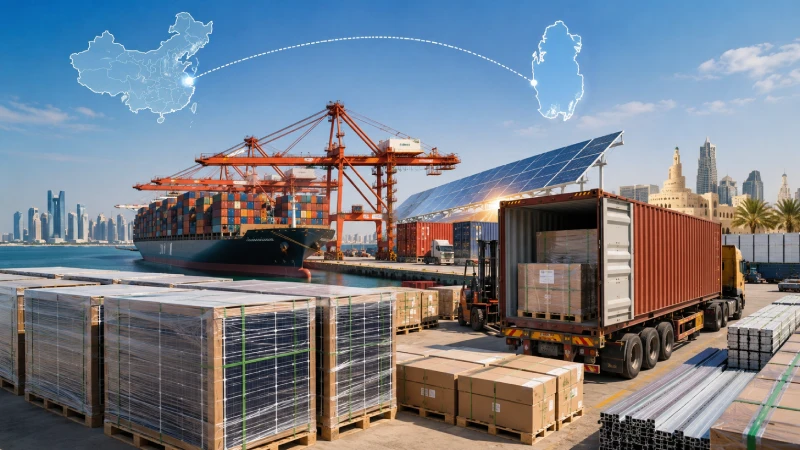
For importers managing renewable energy projects, shipping from China to Qatar is not only about choosing a freight rate. Solar shipments are usually connected to installation milestones, EPC schedules, customs timing, and site delivery requirements. If solar panels arrive damaged, if inverters arrive late, or if mounting systems are delivered before the site is ready, the entire project schedule can be affected. That is why shipping solar products from China to Qatar should be planned as a project logistics decision, not simply as a transportation task.
China is one of the world’s major manufacturing bases for solar panels, inverters, mounting systems, cables, connectors, and energy storage equipment. Qatar importers often source these products from different suppliers, then need to coordinate them into one controlled logistics plan. A successful solar shipment depends on four things: correct cargo classification, safe panel handling, synchronized equipment delivery, and a site delivery plan that supports installation progress.
Quick Answer: How Should Solar Products Be Shipped from China to Qatar?
For most commercial and project-scale solar shipments, FCL sea freight is the preferred option. Solar panels, mounting rails, aluminum structures, cables, and electrical cabinets often take up significant container space, so full-container shipping gives the importer better control over loading, handling, and delivery timing.
Air freight is usually used for urgent parts, replacement inverters, controllers, samples, or small components that could delay project commissioning. In many solar projects, the best solution is not choosing only sea or only air freight. A split shipping strategy may work better: main project cargo moves by sea, while urgent or late-produced components move by air.
| Solar Cargo Type | Common Shipping Method | Main Logistics Concern |
|---|---|---|
| Solar panels | FCL sea freight | Fragile glass, frame protection, loading angle |
| Inverters | Sea freight or air freight | High value, moisture protection, delivery timing |
| Mounting systems | FCL sea freight | Bulky cargo, sorting, installation sequence |
| Solar cables and connectors | LCL, FCL, or air freight | Batch control and documentation |
| Electrical cabinets | Sea freight | Protection, handling, project delivery timing |
| Spare parts | Air freight | Urgency and project continuity |
| Batteries | Specialized transport | Compliance and safety documentation |
What Solar Products Are Commonly Shipped from China to Qatar?
Solar shipments are rarely limited to PV panels only. A complete project shipment may include solar modules, inverters, mounting brackets, aluminum rails, combiner boxes, junction boxes, monitoring devices, transformers, cables, connectors, electrical cabinets, spare parts, and sometimes battery systems.
Each cargo type creates a different logistics challenge. Solar panels are fragile and must be protected from glass breakage, frame deformation, and hidden microcracks. Inverters and monitoring devices are high-value electrical products that need moisture protection and careful handling. Mounting structures are bulky and may be heavy, making container space planning important. Cables, connectors, and small accessories may seem simple, but if they are not clearly labeled, site teams can lose time sorting materials during installation.
For this reason, solar cargo should be grouped by function and delivery phase before shipping. Instead of treating everything as “solar goods,” the importer should separate panels, inverters, mounting systems, cables, accessories, and spare parts in the packing list and delivery plan.
Plan Solar Shipments Around the Project Timeline
The most important logistics question is not “When can the cargo ship?” but “When does the project need each product on site?” A solar installation project usually has a sequence: site preparation, mounting structure installation, panel installation, electrical connection, inverter setup, testing, and commissioning. If cargo arrives in the wrong sequence, the project may still face delays even if the shipment technically arrives on time.
A better approach is to work backward from the installation schedule. Start with the target site delivery date, then add time for customs clearance, port handling, inland trucking, vessel transit, container loading, factory pickup, supplier production, inspection, and documentation review.
For example, mounting systems may need to arrive before solar panels because installation teams need the support structure ready first. Inverters may not be needed at the earliest stage, but if they arrive too late, commissioning can be delayed. Small accessories such as connectors, clamps, and cables must also be controlled carefully because a missing low-value component can stop a high-value project.
For larger projects, working with a freight forwarder in China can help coordinate pickup from different suppliers, check cargo readiness, consolidate shipments, and reduce the risk of disconnected delivery schedules.
Solar Panel Handling: Preventing Damage Before It Happens
Solar panels require special attention during shipping because visible breakage is only one part of the risk. Poor handling can also cause frame bending, corner damage, glass stress, and hidden cell cracks that may not be noticed until installation or testing.
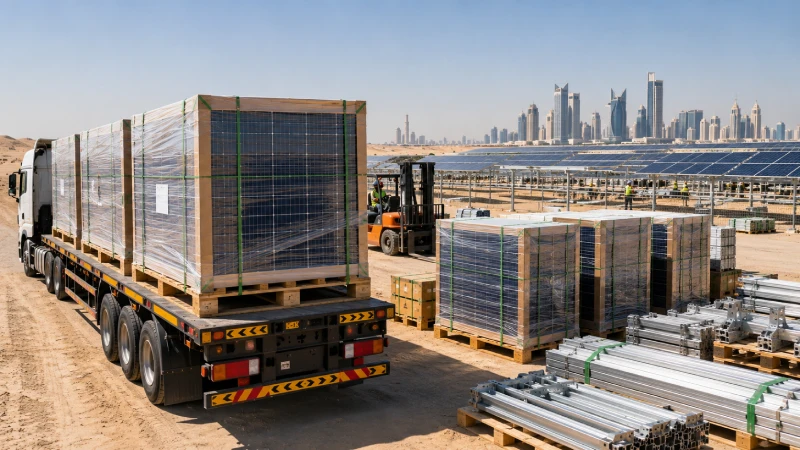
Before shipment, the importer should confirm how panels are packed at the factory. Strong pallets or wooden crates, edge protection, corner guards, moisture-resistant wrapping, and stable internal support are important. If the shipment is high value, tilt indicators, shock indicators, and loading photos can provide additional control.
Container loading should also be managed carefully. Heavy cargo should not press against solar panels. Metal mounting systems, electrical cabinets, and other dense items should be separated from fragile modules. If panels and other equipment must be loaded in the same container, the loading plan should define cargo zones, weight distribution, and securing methods.
Good panel logistics is not only about packaging. It also includes supplier communication, loading supervision, photo records, container sealing records, and arrival inspection. These details make it easier to prevent damage and support claims if problems occur.
Container Loading Strategy for Solar Project Cargo
Solar shipments often combine fragile, bulky, and high-value products. This makes container loading more complicated than general commercial goods.
Panels may take up large space but cannot be squeezed like cartons of ordinary goods. Mounting rails and brackets may be long and heavy. Inverters may require stronger cartons or crates. Accessories may be small but must be easy to find after arrival.
| Cargo Combination | Main Risk | Better Planning Method |
|---|---|---|
| Panels + heavy brackets | Pressure damage | Separate loading zones or separate containers |
| Panels + inverters | High-value cargo exposure | Reinforced packing and controlled loading order |
| Rails + cables + accessories | Site sorting delays | Label cargo by installation phase |
| Multiple supplier cargo | Missing items or mismatched batches | Consolidation and packing list verification |
| Panels + electrical cabinets | Impact and handling risk | Separate protection and secured positioning |
For project cargo, trying to maximize container space at all costs can be a mistake. If panels are loaded too tightly or mixed with heavy metal components without protection, the savings from one container may be lost through cargo damage or installation delays.
In some cases, separating cargo into two containers is safer: one container for fragile panels, another for mounting systems and heavier equipment. The final decision should be based on cargo value, project urgency, loading risk, and site handling conditions.
Coordinating Multiple Solar Suppliers in China
Many Qatar solar importers do not buy all equipment from one factory. Panels may come from one manufacturer, inverters from another, mounting structures from a third supplier, and cables or connectors from several smaller vendors. Without coordination, each supplier may ship at a different time, use different packaging standards, or prepare documents in inconsistent formats.
This is where supplier coordination becomes critical. A China-based logistics partner can help arrange pickup, check cargo quantity, compare packing lists, consolidate cargo in a warehouse, and prepare a unified shipping plan.
For solar projects, cargo should be labeled by product category and project phase. For example:
- Phase 1: mounting structures and foundation-related parts
- Phase 2: solar panels and panel accessories
- Phase 3: inverters, electrical cabinets, and control systems
- Phase 4: spare parts and maintenance components
This helps the Qatar site team unload, store, and install materials more efficiently. It also reduces the risk of small but important parts being buried inside mixed cargo.
Sea Freight, Air Freight, and Split Shipping for Solar Projects
Sea freight is usually the main shipping method for solar products from China to Qatar because solar panels and mounting systems often involve large volumes. FCL shipping gives better control over container loading and reduces the risk of cargo being handled repeatedly during transit.
However, air freight still has an important role in renewable energy project logistics. If a key inverter, controller, monitoring device, or replacement part is delayed, air freight from China to Qatar may protect the project schedule. The cost per kilogram may be higher, but the cost of project delay can be much higher than the air freight cost.
A split shipping strategy is often the most practical choice. Main cargo such as panels, structures, and cables can move by sea. Urgent electrical components, replacement parts, or late-produced items can move by air. This gives the importer better control over both cost and timeline.
Qatar Customs Documentation for Solar Products
Solar product shipments should have clear and accurate documentation. A vague description such as “solar equipment” may not be enough when the shipment includes panels, inverters, cables, mounting systems, and electrical cabinets. Each product category should be listed clearly on the commercial invoice and packing list.
Common documents may include commercial invoice, packing list, bill of lading or air waybill, certificate of origin, product specifications, and HS code information. If the shipment includes batteries or energy storage systems, additional compliance and safety documents may be required.
Before shipping, the importer should review whether the consignee information, cargo description, quantities, values, and product details are consistent across all documents. For mixed solar cargo, documentation mistakes can create customs questions and delay delivery to the project site. A partner experienced in customs clearance in Qatar can help reduce avoidable document-related delays.
Site Delivery Planning in Qatar
Solar logistics does not end when the cargo arrives at Hamad Port or the airport. For renewable energy projects, the final delivery stage is often just as important as the international freight stage.
Before delivery, the importer should confirm site access, unloading area, storage space, security conditions, equipment availability, and delivery appointment requirements. Solar panels may need careful unloading and protected storage. Mounting structures may require forklifts or cranes depending on weight and packaging. Electrical equipment may need to be kept dry and secure.
Early delivery can also create problems. If the site is not ready, panels may sit in an unsuitable temporary area, increasing the risk of damage, dust exposure, handling mistakes, or theft. Late delivery creates another problem: installation teams may wait without materials.
For larger renewable energy projects, project cargo shipping from China should include inland delivery planning, not only ocean freight booking. The logistics team should understand when each cargo batch is needed and where it should be placed after arrival.
How to Reduce Solar Project Delays Caused by Logistics Problems
Solar project delays often come from small coordination failures rather than major shipping disasters. A missing accessory, unclear packing list, wrong delivery sequence, or poor unloading plan can create avoidable downtime.
| Logistics Problem | Project Impact | Prevention Method |
|---|---|---|
| Panels arrive before storage is ready | Higher damage risk | Confirm site storage before delivery |
| Inverters arrive late | Commissioning delay | Ship critical electrical items earlier |
| Supplier cargo is not synchronized | Missing project components | Use consolidation and shipment tracking |
| Poor pallet labeling | Site sorting delays | Label by phase, zone, and product type |
| Heavy cargo loaded with panels | Panel breakage risk | Separate fragile and heavy cargo |
| Incomplete documents | Customs delay | Review documents before departure |
| No unloading plan | Delivery disruption | Confirm equipment and site access early |
The goal is to make logistics support the project schedule. Freight should not be treated as a separate step after purchasing. It should be part of the project execution plan from the beginning.
Solar Cargo Insurance and Risk Control
Because solar products can be high value, importers should consider cargo insurance and risk documentation. Insurance is especially important for panel shipments, inverters, electrical cabinets, and complete project cargo.
However, insurance should not replace prevention. The importer should still request proper packaging, loading photos, container seal records, and arrival inspection. If damage occurs, these records can help identify where the problem happened and support the claim process.
Solar panels should be checked after arrival for visible glass damage, frame deformation, pallet collapse, and water exposure. For project cargo, inspection should be done as soon as possible because installation teams may not discover all problems immediately.
How Winsail Supports Solar Product Shipping from China to Qatar
Winsail can support Qatar solar importers by coordinating the logistics process from supplier pickup in China to final delivery planning in Qatar. Instead of only offering a freight quote, Winsail helps importers think through the full project logistics chain.
Support can include supplier pickup, cargo consolidation, FCL sea freight, LCL shipping for smaller batches, air freight for urgent parts, loading coordination, documentation review, Qatar customs coordination, and port-to-site delivery planning. For importers shipping solar panels, inverters, mounting structures, cables, and accessories from different factories, this coordination can reduce project risk significantly.
To prepare a more accurate shipping plan, importers should provide the product list, supplier locations, cargo dimensions, total weight, delivery deadline, site location in Qatar, required delivery sequence, and whether batteries or other regulated products are included.
Conclusion
Shipping solar products from China to Qatar requires more than booking a container. It requires a logistics plan that supports renewable energy project execution. Panels must be protected, inverters must arrive on time, mounting systems must be sorted properly, and final delivery must match the site schedule.
For Qatar importers, the best shipping solution is the one that protects both cargo and project timelines. By planning supplier coordination, container loading, customs documentation, and site delivery together, solar project teams can reduce delays, control risks, and keep installation work moving smoothly.
FAQ About Shipping Solar Products from China to Qatar
What is the best way to ship solar panels from China to Qatar?
For project quantities, FCL sea freight is usually the best option because it provides better control over loading, handling, and container security.
Can solar panels be shipped by air freight?
Yes, but air freight is usually used for samples, urgent replacements, or small project-critical components because it is much more expensive than sea freight.
Should solar panels and mounting systems be shipped together?
They can be shipped together if the loading plan is carefully designed. However, heavy metal parts should not create pressure or impact risk for fragile panels.
How can I reduce solar panel damage during shipping?
Use strong packaging, corner protection, loading supervision, moisture-resistant wrapping, proper container securing, and photo records before shipment.
Can Winsail coordinate cargo from multiple solar suppliers in China?
Yes. Winsail can help arrange supplier pickup, cargo consolidation, packing list control, and shipment coordination before export.
What documents are needed for solar product shipping to Qatar?
Common documents include commercial invoice, packing list, bill of lading or air waybill, certificate of origin, product specifications, and HS code details.
When should air freight be used for solar projects?
Air freight is useful when a missing inverter, controller, cable, or replacement part could delay installation or commissioning.
Why is site delivery planning important for solar shipments?
Because solar cargo must often arrive according to installation phases. If products arrive too early, too late, or without unloading preparation, the project may face storage problems, cargo damage, or labor delays.
