

Choosing a freight forwarder from China to Qatar is not only about getting the lowest shipping quote. At the partner selection stage, the real question is whether your logistics provider can protect your shipment, control your timeline, coordinate with Chinese suppliers, and reduce the risk of customs or delivery problems in Qatar.
A professional China-to-Qatar freight forwarder is usually the right choice if you are importing commercial cargo, buying from multiple suppliers, shipping by sea or air, or need support with pickup, documentation, customs coordination, and final delivery.
It may not be the right choice if you are only sending a small personal parcel, a low-value sample, or a shipment that can be handled more efficiently through a simple courier platform.
For most importers, the best freight forwarder is not the cheapest quote provider. It is the team that asks the right questions before quoting, explains the trade-offs clearly, and can manage the shipment from factory pickup in China to delivery in Doha or another Qatar destination.
If your shipment involves commercial value, deadlines, multiple suppliers, fragile goods, heavy cargo, customs documentation, or door delivery, working with an experienced shipping from China to Qatar partner is usually the safer decision.
Quick Decision Summary
Use a freight forwarder from China to Qatar when your shipment needs control, not just transportation. This includes commercial goods, consolidated cargo, heavy or fragile items, urgent shipments, project cargo, or door-to-door delivery requirements.
Do not choose a provider only because the quotation looks low. A cheap quotation may exclude pickup, export handling, destination charges, customs coordination, delivery, storage, demurrage, special handling, or documentation support.
The strongest freight forwarding partner should help you answer four commercial questions before you book:
| Decision Question | Why It Matters |
|---|---|
| Which shipping option fits the shipment? | Avoids overpaying for speed or underestimating risk. |
| What is included in the quote? | Prevents hidden cost surprises after cargo arrival. |
| What can go wrong before departure? | Reduces supplier, packing, document, and pickup problems. |
| Who controls delivery in Qatar? | Protects the final stage, where many delays and extra costs happen. |
For B2B importers, the best freight forwarder is a decision partner. The provider should help you choose the right balance of cost, speed, risk, and convenience.
What This Solution Is Best For
A freight forwarder is best used when your shipment has operational complexity. This does not always mean the cargo is large. Complexity can come from supplier coordination, documentation, delivery timing, cargo risk, or Qatar-side clearance requirements.
Commercial Importers Buying from Chinese Suppliers
If you are importing goods for resale, construction, manufacturing, retail, project use, or wholesale distribution, you need more control than a supplier-arranged shipment usually provides.
A freight forwarder can coordinate pickup from factories in Guangzhou, Shenzhen, Yiwu, Ningbo, Shanghai, Qingdao, Xiamen, or other China origins, then arrange the right route to Qatar based on cargo type and urgency.
This is valuable when your supplier’s shipping offer is unclear, incomplete, or based only on port-to-port transport.
Multi-Supplier Shipments
If you are buying from several factories in China, a forwarder can consolidate goods before shipping. This helps avoid separate shipments, duplicated destination charges, inconsistent documentation, and unnecessary delivery confusion in Qatar.
For example, a Qatar importer sourcing furniture from Foshan, lighting from Zhongshan, and accessories from Yiwu may not want three independent shipments arriving at different times. A freight forwarder can consolidate the cargo, check packing, align documents, and create one more controlled shipping plan.
Cargo That Needs Route Selection, Not Just Freight Booking
Some shipments should not be moved by the first available option. Machinery, tiles, marble, kitchen cabinets, batteries, solar products, electrical goods, and project cargo all require route decisions based on risk, cost, and delivery conditions.
A good forwarder helps you decide whether sea freight, air freight, LCL, FCL, DDP, or door-to-door service makes sense. The value is not only in booking space. The value is in avoiding the wrong shipping method.
Importers Who Need Qatar Delivery Control
If your shipment must reach a warehouse, retail store, construction site, project location, or customer address in Qatar, a forwarder with destination coordination is more useful than a port-only rate.
This is especially important when cargo is heavy, oversized, fragile, or difficult to unload. A low freight rate does not help if the cargo arrives but cannot be delivered smoothly.
When NOT to Use This Solution
A freight forwarder is powerful when the shipment needs coordination. But it is not always the best solution.
Very Small Samples
If you are sending one or two small samples, documents, or lightweight items, an express courier service may be faster and easier. In this case, using a freight forwarder may add unnecessary communication steps.
However, once samples become cartons, pallets, commercial stock, or repeated shipments, a forwarder becomes more valuable.
Personal Parcels with No Commercial Import Purpose
If the shipment is personal, low-value, and non-commercial, a simple courier or postal solution may be enough. A freight forwarder is usually built for commercial cargo, not casual personal parcels.
Cargo with No Clear Product Information
If you cannot provide product name, material, packing details, HS code reference, supplier contact, weight, dimensions, or cargo photos, a reliable forwarder may not be able to quote accurately.
In this case, the first step is not booking freight. The first step is collecting shipment data.
Importers Who Only Want the Lowest Number
If your only selection rule is the cheapest quote, you may be disappointed. China-to-Qatar shipping can involve origin charges, destination charges, customs documentation, clearance coordination, delivery fees, inspection risk, storage, demurrage, and special handling.
A quote that looks cheap at the beginning may become expensive later if the scope is incomplete.
Shipments Already Controlled by a Strong Internal Logistics Team
If your company already has contracted carrier rates, customs brokers, warehouse teams, and China-side logistics staff, you may only need limited support. In this case, a full-service freight forwarder may not be necessary unless you need extra flexibility, supplier pickup, consolidation, or project support.
Decision Framework: How to Choose the Right Freight Forwarder
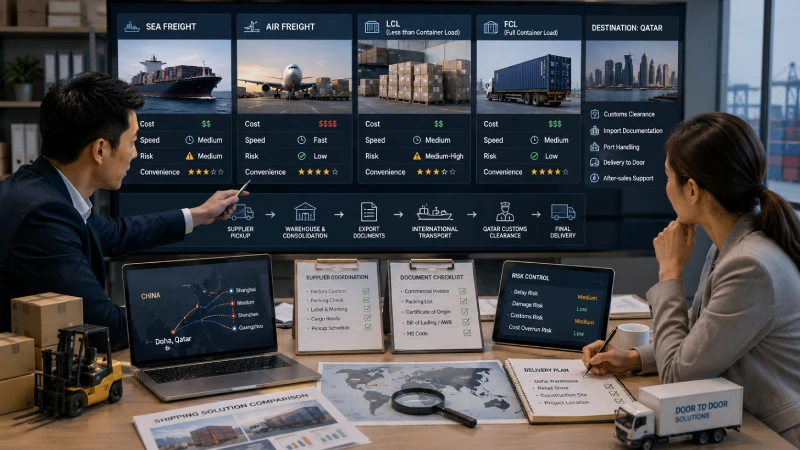
Do not choose a freight forwarder from China to Qatar based only on price. Use a decision framework that tests whether the provider can actually manage your shipment.
1. Can They Understand Your Cargo Before Quoting?
A serious forwarder should ask what you are shipping, how it is packed, where it is located in China, where it should be delivered in Qatar, whether the goods are fragile, whether customs documents are ready, and whether you have a deadline.
If they quote immediately without understanding the cargo, the price may not reflect the real shipment.
2. Can They Explain the Trade-Off?
A good forwarder should tell you when air freight is worth the cost, when sea freight is better, when LCL is risky for fragile cargo, when FCL is safer, and when DDP or door delivery makes the most sense.
If every question receives the same answer, the provider may not be thinking strategically.
3. Can They Coordinate with Chinese Suppliers?
Many problems start before the cargo leaves China. Incorrect carton data, weak packing, unclear labels, late factory release, missing documents, and supplier communication delays can all affect the shipment.
Choose a forwarder that can communicate directly with your supplier, confirm cargo readiness, check pickup details, and identify obvious risks before booking.
4. Can They Support Qatar-Side Requirements?
For Qatar imports, documentation accuracy matters. Your freight partner should understand that commercial shipments need consistent invoice, packing list, certificate of origin, bill of lading or airway bill information, and cargo descriptions.
The forwarder does not replace your importer responsibilities, but the right partner helps you avoid avoidable documentation mistakes.
5. Can They Handle Problems Transparently?
Delays, inspections, schedule changes, airline space issues, port congestion, supplier delays, or customs questions can happen. The difference is whether your forwarder hides the issue or manages it clearly.
A reliable forwarder gives updates, explains options, and tells you what decision is needed.
Cost vs Risk vs Convenience Analysis
The best freight forwarding decision depends on how you balance cost, risk, and convenience.
| Option | Best For | Main Advantage | Main Risk |
|---|---|---|---|
| Lowest cost route | Flexible, standard, non-urgent cargo | Reduces freight spend | May exclude important handling or delivery support |
| Balanced route | Most commercial imports | Good mix of cost, control, and reliability | Not always the absolute cheapest |
| Fastest route | Urgent stock, spare parts, samples, deadlines | Protects sales or project timing | Higher freight cost |
| Most convenient route | Importers wanting one accountable partner | Less coordination work for the buyer | Higher service cost than basic port-to-port shipping |
The lowest cost option is often suitable when your cargo is not urgent, not fragile, not high-value, and not difficult to handle. This may work for standard commercial goods with flexible delivery timing.
The balanced option is usually best for most importers. It may not be the cheapest rate, but it gives better visibility, route planning, supplier coordination, and destination support.
The fastest option is suitable when stockouts, project delays, or customer commitments are more expensive than freight. Air freight may be justified for urgent spare parts, electronics, samples for approval, high-value products, or time-sensitive retail goods.
The most convenient option, such as DDP shipping from China to Qatar or door-to-door service, can reduce workload for importers who do not want to manage multiple logistics parties. The trade-off is that convenience usually costs more than basic port-to-port shipping.
Comparison with Alternatives
A freight forwarder is not the only option. The right choice depends on your shipment size, risk level, internal capability, and how much control you want.
| Alternative | When It Works | Limitation |
|---|---|---|
| Supplier’s shipping agent | Simple orders from one supplier | May prioritize supplier convenience over buyer control |
| Courier company | Small samples and urgent parcels | Expensive for cartons, pallets, and commercial inventory |
| Direct carrier booking | Experienced importers with internal logistics teams | Limited support for pickup, consolidation, and documents |
| Qatar customs broker only | Buyer already controls China-side shipping | Problems before departure may be discovered too late |
| Online freight platform | Quick rate comparison | Limited human judgment for complex cargo |
Freight Forwarder vs Supplier’s Shipping Agent
Supplier-arranged shipping may be convenient, but the supplier’s agent often represents the supplier’s interests, not yours. The quote may only cover part of the journey, and communication after cargo departure may be limited.
A buyer-appointed forwarder gives you more control over route, cost structure, documents, consolidation, and delivery planning.
Freight Forwarder vs Courier Company
Courier is suitable for small parcels and urgent samples. A freight forwarder is better for cartons, pallets, commercial inventory, bulky goods, heavier cargo, or shipments requiring customs and delivery planning.
For repeated B2B shipments, courier costs can become inefficient quickly.
Freight Forwarder vs Direct Carrier Booking
Direct carrier booking can work for experienced importers with internal logistics teams. But carriers usually do not manage supplier pickup, cargo consolidation, packing checks, documentation alignment, or final delivery problem-solving.
A forwarder adds operational management between the factory, carrier, customs broker, and consignee.
Freight Forwarder vs Local Qatar Customs Broker Only
A Qatar customs broker can help with clearance, but may not control the China-side origin work. If the problem begins with incorrect documents, poor packing, or supplier delays, Qatar-side help alone may be too late.
For China-to-Qatar shipments, the strongest solution is often China-side forwarding plus Qatar-side coordination.
Freight Forwarder vs Online Freight Platform
Online platforms are useful for quick rate comparison. But many importers still need human judgment when cargo is fragile, mixed, oversized, urgent, regulated, or linked to a project deadline.
For high-intent commercial shipments, a dedicated forwarding team usually provides better problem-solving than a rate-only platform.
Real Importer Scenarios
Scenario 1: Furniture Importer in Doha
A furniture importer buys from three suppliers in Foshan. Each factory offers a separate shipping quote, but none of them can coordinate consolidation.
A China-to-Qatar freight forwarder arranges collection from all suppliers, consolidates the goods, checks packing labels, and ships under one controlled plan. The importer avoids multiple arrivals, repeated clearance work, and scattered delivery schedules.
Best choice: freight forwarder with consolidation and door delivery support.
Scenario 2: Construction Contractor Importing Building Materials
A contractor needs tiles, sanitary ware, doors, and lighting for a project in Qatar. The shipment is not extremely urgent, but damage and delivery timing matter.
The wrong provider may choose a cheap LCL route without considering breakage risk or unloading needs. A better forwarder recommends a safer cargo plan, stronger packing instructions, and delivery coordination based on the project schedule.
Best choice: forwarder with project cargo and fragile goods experience.
Scenario 3: Retailer Facing Stock Pressure
A Qatar retailer is running low on fast-moving products. Sea freight is cheaper, but the stockout risk is high.
A strategic forwarder may suggest splitting the shipment: urgent inventory by air freight and the remaining stock by sea freight. This balances cash flow, speed, and freight cost.
Best choice: forwarder who can design a mixed shipping solution, not just quote one method.
Scenario 4: Machinery Buyer Importing from Shenzhen
A buyer imports equipment with accessories, spare parts, and wooden packing. The shipment is valuable and cannot arrive damaged or incomplete.
The forwarder must verify cargo data, confirm packing, coordinate pickup, review documents, and choose a suitable shipping route. For machinery, the cheapest option may create expensive risk.
Best choice: freight forwarder with cargo inspection awareness and destination delivery planning.
Scenario 5: Importer Buying Electrical Products
An importer purchases electrical products from China and needs clear documentation before shipping to Qatar. If invoice descriptions, HS code references, origin details, or packing lists are inconsistent, clearance may become difficult.
A qualified forwarder cannot guarantee customs results, but can help identify documentation issues before cargo departure.
Best choice: forwarder with documentation review and commercial import experience.
Common Mistakes Importers Make
Choosing the Cheapest Quote Without Checking Scope
Many importers compare only the headline freight price. They do not check whether pickup, export handling, destination charges, customs coordination, delivery, or special handling are included.
This often leads to unexpected costs later.
Asking for a Quote Without Cargo Details
A vague request such as “How much shipping from China to Qatar?” cannot produce an accurate quote. A serious quote needs product name, origin city, destination, weight, volume, carton count, packing method, cargo value, and urgency.
The better your data, the more reliable your freight plan.
Allowing the Supplier to Control Everything
Some suppliers offer shipping because it helps close the sale. But their priority may be dispatching goods, not protecting your total landed cost or Qatar delivery experience.
For commercial imports, buyer-controlled logistics often gives better visibility.
Ignoring Packing Risk
Fragile goods, furniture, tiles, marble, lighting, machinery, and electronics need proper packing decisions before shipment. Freight forwarding cannot fully solve damage caused by weak factory packing.
A good forwarder should flag obvious packing concerns early.
Waiting Until the Cargo Is Ready
Importers often contact a forwarder only when cargo is finished. By then, there may be no time to correct documents, improve packing, consolidate suppliers, or choose a better route.
For higher-value shipments, contact the forwarder before production is completed.
Not Defining the Delivery Point in Qatar
Port arrival is not the same as final delivery. If you need delivery to a warehouse, store, project site, or customer address, say so before quoting.
The delivery location affects vehicle planning, unloading needs, timing, and cost.
Final Recommendation
Use a freight forwarder from China to Qatar if your shipment is commercial, valuable, time-sensitive, multi-supplier, fragile, heavy, bulky, or requires delivery coordination in Qatar.
Do not choose a freight forwarder only because they offer the lowest rate. Choose one because they reduce uncertainty, identify risk before shipment, and help you make better logistics decisions.
For small samples or simple personal parcels, courier may be enough. For serious B2B imports, a dedicated China-to-Qatar freight forwarder is usually the better partner.
The right decision is simple: if your shipment only needs transportation, compare rates. If your shipment needs control, coordination, and risk reduction, choose a freight forwarding partner.
Get a China to Qatar Freight Quote
If you are deciding how to ship from China to Qatar, send us your cargo details and our team will recommend the most suitable option based on cost, timing, cargo risk, and delivery requirements.
To receive an accurate quote, please provide:
- Product name
- Supplier city in China
- Destination city or address in Qatar
- Total cartons, pallets, weight, and CBM
- Cargo photos or packing list
- Required delivery timing
- Preferred shipping method if known
- Whether you need pickup, customs support, or door delivery
We will help you compare practical options and choose the right logistics solution for your shipment from China to Qatar.
Get a Quote Today and let our team review your shipment before you book the wrong route.
FAQ
Is a freight forwarder necessary for shipping from China to Qatar?
A freight forwarder is recommended for commercial cargo, supplier coordination, consolidated shipments, door delivery, fragile goods, heavy cargo, or shipments that need documentation and risk control.
When should I not use a freight forwarder from China to Qatar?
You may not need a freight forwarder for very small samples, personal parcels, or simple courier shipments with low commercial value and no special delivery requirements.
How do I choose the best freight forwarder from China to Qatar?
Choose a forwarder that asks for full cargo details, explains trade-offs, coordinates with Chinese suppliers, reviews documentation risks, and provides clear quote scope.
Is the cheapest freight quote the best option?
Not always. A cheap quote may exclude pickup, destination charges, customs coordination, delivery, storage, or special handling. Importers should compare total scope, not only the headline rate.
Can a freight forwarder collect goods from multiple suppliers in China?
Yes. A freight forwarder can collect goods from different suppliers, consolidate cargo, align documents, and arrange one controlled shipment to Qatar.
Should I let my Chinese supplier arrange the shipping?
Supplier-arranged shipping may work for simple orders, but buyer-appointed forwarding usually gives the importer better control over route, cost, documents, and delivery planning.
What cargo details are needed for a China to Qatar freight quote?
You should provide product name, supplier city, destination address, carton or pallet quantity, gross weight, volume, cargo photos, packing list, cargo value, and required delivery timing.
Can a freight forwarder help with Qatar customs documentation?
A freight forwarder can help review shipment documents and coordinate with customs partners, but the importer must still provide accurate commercial information and meet Qatar import requirements.
Is door-to-door shipping better than port-to-port shipping?
Door-to-door shipping is better when you want one partner to manage pickup, international freight, destination coordination, and final delivery. Port-to-port shipping may be cheaper but requires more importer-side coordination.
What is the biggest benefit of using a China to Qatar freight forwarder?
The biggest benefit is control. A good forwarder helps reduce uncertainty across supplier pickup, route selection, documentation, cargo handling, and final delivery in Qatar.
