
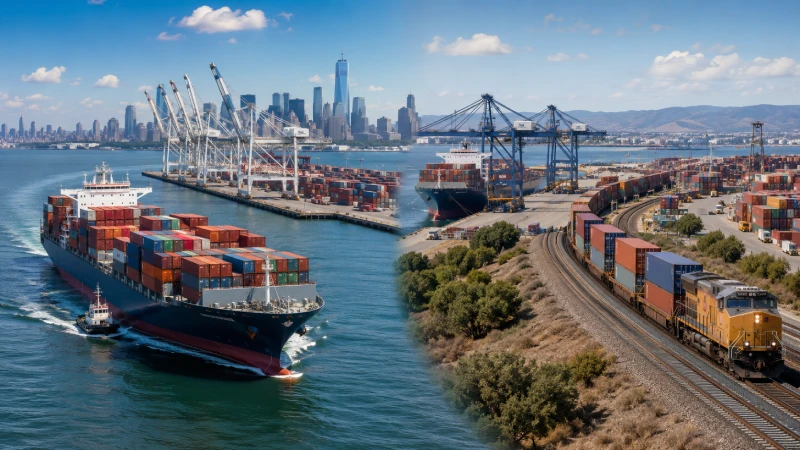
For importers serving the northeastern United States, the best route is not always the one with the lowest ocean freight rate. Cargo may sail directly to New York and New Jersey, enter through a West Coast port and continue by rail, or use another East Coast gateway before final delivery. The right choice depends on the complete route to the warehouse. For a broader overview of transport modes, costs, customs and destination planning, start with Shipping from China to USA before comparing the Northeast-specific options below.
The central question is whether cargo should travel farther by sea to reach the New York and New Jersey gateway or arrive on the West Coast and cross the country by rail or truck. To answer it accurately, compare total port-to-door cost, end-to-end transit, cargo handoffs, warehouse proximity and inventory requirements—not ocean freight alone.
Quick Route Verdict for Northeast-Bound Cargo
The final US delivery location should be the starting point for route selection.
Direct ocean service to the Port of New York and New Jersey is often a strong option for cargo delivered to New Jersey, New York City, eastern Pennsylvania and parts of New England. Although the ocean portion may be longer than a transpacific route to the West Coast, the domestic delivery leg can be shorter and operationally simpler.
West Coast routing may still be practical when the destination is close to an inland rail ramp, the importer has recurring container volume, or an established intermodal program already supports the receiving warehouse.
| Final destination | Route worth prioritizing | Main comparison factor |
|---|---|---|
| New Jersey warehouse | Direct New York/New Jersey arrival | Local drayage versus cross-country rail |
| New York City or nearby area | Direct East Coast arrival | Delivery access and appointments |
| Upstate New York | Compare both routes | Rail-ramp and final-mile distance |
| Eastern Pennsylvania | Direct East Coast is often competitive | Warehouse distance |
| Western Pennsylvania | Compare multiple gateways | Total inland transport |
| New England | Direct East Coast is often practical | Regional delivery and container return |
| Inland rail-based DC | West Coast intermodal may work | Rail-ramp proximity |
| Urgent replenishment | Compare complete schedules | Required warehouse arrival date |
These are screening principles, not fixed recommendations. For wider gateway planning, see Shipping Routes from China to USA.
Two Complete Routing Models to Compare
Direct Ocean Service to New York and New Jersey
The direct East Coast model normally follows this sequence:
China origin → export port → ocean service → New York/New Jersey terminal → customs and terminal release → drayage or transloading → final warehouse
Its main benefit is a shorter domestic leg. An FCL container may move directly to a nearby warehouse, while cargo requiring palletization, sorting or split delivery can be transloaded near the port.
Importers should confirm whether the service is direct or transshipped, the arrival terminal, free time, chassis responsibility, appointments and empty-container return procedures.
West Coast Arrival Plus Intermodal Rail
The alternative model may follow this sequence:
China origin → West Coast port → terminal release → rail transfer or transloading → cross-country rail → inland ramp → final drayage → warehouse
The ocean portion may be shorter, but the domestic route is more complex. The container may move intact by rail, or cargo may be transferred into domestic equipment before final delivery.
This model can work when the warehouse is near a rail ramp, regular volume supports intermodal service, or the combined quotation is commercially attractive.
The West Coast port is only an intermediate point. Rail handling, destination drayage and the final appointment must all be included. For broader ocean-service information, refer to Sea Freight from China to USA.
Compare Total Landed Logistics Cost, Not Ocean Freight Alone
An ocean freight quotation represents only part of the total shipping cost.
A lower port-to-port rate can become more expensive after rail, drayage, transloading, storage and final delivery are added. Conversely, a higher ocean rate to New York or New Jersey may produce a lower total delivered cost when the receiving warehouse is nearby.
Port-to-Port Cost Categories
A port-to-port quotation may include China pickup, export documentation, origin terminal handling, ocean freight, carrier surcharges, transshipment charges and some US terminal costs. The scope varies, so two quotations should never be treated as comparable without checking inclusions.
Port-to-Door Cost Categories
A complete Northeast comparison may also include:
- Customs brokerage, duties and taxes
- Terminal and examination charges
- Chassis and port drayage
- Rail transportation and inland-ramp charges
- Destination drayage
- Transloading and palletization
- Storage and warehouse appointments
- Demurrage, detention or waiting time
- Empty-container return
- Final-mile or multi-stop delivery
Not every shipment will incur every cost. The objective is to identify which charges apply to each route and which remain excluded or conditional.
| Cost category | Direct New York/New Jersey | West Coast plus rail |
|---|---|---|
| Ocean freight | Route-specific | Route-specific |
| Cross-country rail | Usually unnecessary for nearby delivery | Frequently required |
| Drayage legs | Often one principal destination move | May involve port and inland-ramp moves |
| Transloading | Optional | May be required or preferred |
| Storage exposure | Terminal or transload facility | Port, rail or transload facility |
| Warehouse delivery | Regional container or truck delivery | Inland-ramp drayage or truck delivery |
| Major handoffs | Often fewer | Usually more |
A useful quotation should separate confirmed, estimated and conditional charges. For a wider explanation of pricing variables, use Shipping Cost from China to USA.
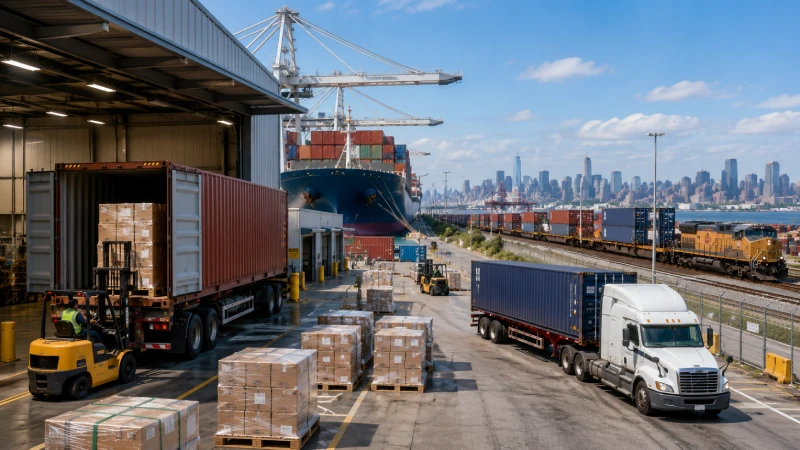
Include Inventory Cost in the Route Decision
A route that creates uncertainty around warehouse arrival may require more safety stock, tie up capital or increase stockout exposure. Delays can also trigger expedited replenishment, missed seasonal sales or appointment penalties.
Direct East Coast shipping may involve a longer ocean journey, while a West Coast route may involve a longer and more complex domestic journey. The relevant question is which route best supports the required arrival date at the final warehouse.
Compare three milestones: the cargo-ready date in China, the estimated port or inland-ramp availability date, and the realistic warehouse delivery date. The third date matters most to inventory planning.
Transit Time and Cargo Handoffs
Port-to-port transit does not describe the complete schedule. The full timeline may include origin handling, export processing, loading, ocean transport, customs clearance, terminal release, inland movement, an appointment and final delivery.
Each handoff creates another dependency. A West Coast intermodal shipment may move from the terminal to rail, from rail to an inland ramp, and from the ramp to a drayage carrier. A transloaded shipment also requires unloading, sorting and reloading.
More handoffs do not automatically make a route unreliable. Established intermodal programs can operate efficiently, but each transfer adds scheduling, documentation and communication requirements.
Predictability depends on vessel frequency, document readiness, terminal release, rail connections, drayage capacity and appointment availability. For general timing factors, see Shipping Time from China to USA.
Delivery Planning by Northeast Destination
New Jersey Warehouses
A New Jersey warehouse is one of the clearest cases for comparing direct New York/New Jersey arrival. When the facility is close to the terminal, an FCL container may be delivered directly by drayage. Confirm container access, live-unload or drop options, unloading time, chassis responsibility and empty return.
When the facility cannot accept containers, port-area transloading may be more practical. Cargo can be palletized, sorted and delivered by a standard truck.
New York State
New York State is not one uniform destination. Direct arrival may reduce inland mileage for New York City, Long Island and nearby areas, although access restrictions and appointment rules still matter.
For upstate or western New York, compare direct East Coast service with rail or alternative gateway options. The preferred route can change significantly with the delivery ZIP code.
Pennsylvania and New England
Eastern Pennsylvania often fits the New York/New Jersey gateway because of its regional proximity. Western Pennsylvania requires a broader comparison because inland distance is greater.
For New England, direct East Coast arrival can reduce inland distance. Compare regional trucking, container return, multi-stop needs and transloading.
FCL, LCL and Transloading Differences
Direct FCL Delivery
FCL cargo may move directly from the terminal to the consignee when the facility can accept and unload a container. The plan must account for the appointment, chassis use, driver waiting time, unloading window and empty return.
Port-Area Transloading
Transloading can be useful when the consignee cannot receive containers, cargo needs palletization or purchase-order separation, several warehouses will receive the goods, or the final appointment is not yet available. The trade-off is another handling stage and possible storage expense.
LCL Destination Delivery
LCL cargo is normally deconsolidated at a destination container freight station before pickup or final delivery. Importers should confirm CFS handling charges, availability notices, customs-release coordination, free-storage periods and final-mile appointment requirements.
When Each Route Is Justified
Direct service to New York and New Jersey deserves strong consideration when:
- The final warehouse is in New Jersey, New York City, eastern Pennsylvania or New England
- The importer wants fewer inland transfers
- Cargo is valuable or handling-sensitive
- Warehouse appointments are strict
- The shipment is suitable for direct FCL drayage
- Cross-country rail adds significant complexity
West Coast intermodal routing may remain practical when:
- A sailing provides a meaningful departure or commercial advantage
- The destination is close to an inland rail ramp
- The importer has recurring FCL volume
- Rail receiving procedures are established
- Cargo can tolerate additional transfers
- The distribution network serves multiple US regions
A small ocean-rate saving may not justify added complexity for a one-time shipment. Recurring programs can become efficient once responsibilities and exception procedures are standardized.
Use a Like-for-Like Route Comparison Worksheet
Keep the cargo and delivery assumptions identical when requesting two options.
| Comparison field | Direct New York/New Jersey | West Coast plus intermodal |
|---|---|---|
| China pickup location | ||
| Cargo-ready date | ||
| Ocean service | ||
| Direct or transshipment | ||
| Destination terminal charges | ||
| Rail charges | ||
| Number of drayage moves | ||
| Transloading and storage | ||
| Warehouse appointment | ||
| Empty-container return | ||
| Estimated warehouse delivery | ||
| Total quoted logistics cost | ||
| Excluded or conditional charges |
Prepare the China origin, cargo-ready date, commodity, carton or pallet count, volume, gross weight, FCL or LCL requirement, delivery ZIP code, required arrival date, inventory urgency, warehouse receiving hours, appointment rules, unloading capability, rail preference and customs-clearance requirement.
Request a Direct East Coast Versus West Coast Comparison
The best route for shipping from China to New York, New Jersey or another Northeast market cannot be selected from the ocean rate alone.
Winsail Logistics can compare two end-to-end options where practical: direct ocean service to the New York and New Jersey gateway, and West Coast arrival followed by intermodal rail or inland transportation.
Send the China origin, cargo-ready date, volume, weight, shipment type, delivery ZIP code, required arrival date, inventory urgency, appointment conditions, rail preference and customs requirements. Both routes can then be evaluated using the same assumptions.
FAQ
Is shipping directly from China to New York cheaper than using a West Coast port?
Not necessarily. Direct East Coast ocean freight may cost more, but it can reduce rail, inland drayage and cargo-transfer expenses. Compare the complete port-to-door cost.
How long does sea freight from China to New York take?
Timing depends on the China origin, carrier schedule, direct or transshipment routing, customs release and destination delivery. Use a shipment-specific schedule rather than one fixed transit figure.
What is the best route for shipping to a New Jersey warehouse?
Direct New York/New Jersey arrival should normally be included because of regional proximity. The final choice depends on total delivered cost, warehouse access and the required arrival date.
Should I compare port-to-port or port-to-door quotations?
Port-to-door quotations are more useful because port-to-port rates may exclude rail, drayage, transloading, storage and final delivery.
Can an FCL container be delivered directly to a New Jersey warehouse?
Yes, when the warehouse can receive and unload the container and the plan covers appointments, chassis use and empty-equipment return.
When is port-area transloading useful?
It is useful when the warehouse cannot receive containers, cargo needs palletization or sorting, delivery must be split, or the container needs to be returned before the final appointment.
Is West Coast rail suitable for Northeast cargo?
It can be suitable when the warehouse is close to an inland rail ramp, the importer has recurring volume and the commercial advantage justifies the additional handoffs.
What information is needed to compare both routes?
Provide the China origin, cargo-ready date, commodity, volume, weight, FCL or LCL status, delivery ZIP code, required arrival date, customs scope and warehouse requirements.
