
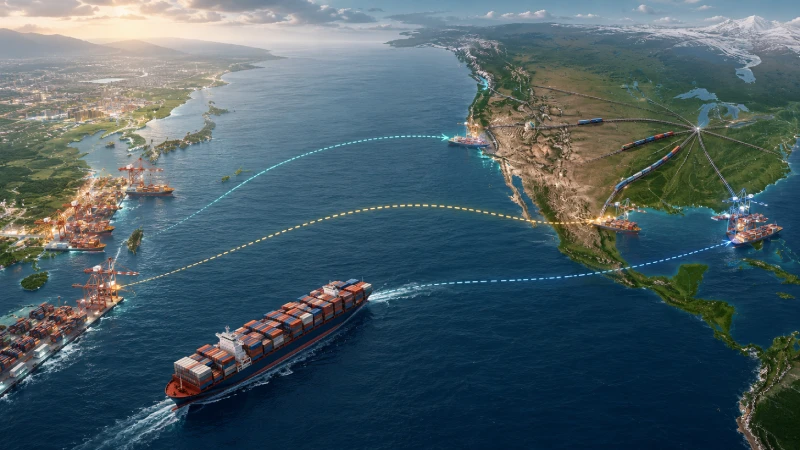
Choosing a shipping route from China to the United States is not simply a matter of selecting the shortest ocean passage. The right route depends on where the cargo begins, where it must ultimately be delivered, how urgently it is needed and how much inland transportation is required after arrival. For a complete overview of available transport options, documentation and shipment planning, start with our shipping from China to USA guide.
A shipment may reach a West Coast port faster by sea but spend additional time moving by rail to the Midwest or Northeast. An East Coast route may involve a longer ocean voyage but reduce domestic trucking distance. For cargo destined for Texas, a Gulf Coast gateway may produce a better total logistics result than either coast.
The most effective approach is to select the route backward from the final delivery address rather than forward from the lowest advertised ocean rate.
Quick Route Selector by US Destination Region
The following matrix provides a starting point for route screening. It should not be treated as a fixed routing rule because carrier services, port calls, equipment availability and capacity can change.
| Final US destination | Gateway family to evaluate first | Alternative route to compare | Main decision factor |
|---|---|---|---|
| California and nearby Western states | West Coast | Alternative West Coast gateway | Ocean time and local drayage |
| Pacific Northwest | Seattle/Tacoma region | Southern California plus rail | Sailing options versus inland distance |
| Texas | Gulf Coast | West Coast plus rail or truck | Total delivered cost |
| Midwest | West Coast plus intermodal rail | East Coast or Gulf Coast | Rail schedule and total transit |
| Northeast | East Coast | West Coast plus rail | Ocean time versus domestic rail |
| Southeast | Southeast or East Coast | Gulf Coast for selected locations | Warehouse proximity |
| Amazon or 3PL warehouse | Gateway based on exact ZIP code | Alternative port with better inland delivery | Appointments and final-mile requirements |
| National distribution network | Multiple gateways | Split-routing strategy | Inventory allocation and resilience |
These recommendations are screening options. The best route should be confirmed using the cargo-ready date, current vessel schedules, final delivery ZIP code and inland transport availability.
Start With the Final Delivery Point
The US port is not the real destination unless the importer is collecting cargo directly from the terminal. In most shipments, the actual destination is one of the following:
- An importer’s warehouse
- A distribution center
- An Amazon fulfillment center
- A third-party logistics warehouse
- An inland rail ramp
- A factory or customer delivery address
This distinction matters because port selection affects far more than the ocean voyage.
A complete route normally includes:
Supplier location → China origin port → ocean service → US gateway → customs and terminal release → rail or truck movement → final warehouse
Before selecting a port pair, identify the US delivery city and ZIP code. A port located closer on a map may still be less efficient if it has limited service options, expensive drayage or weak connections to the final inland market.
West Coast, East Coast and Gulf Coast Route Families
China-to-USA ocean routes can generally be screened through three gateway families. Each offers a different balance of ocean distance, inland transportation and operational risk.
West Coast Entry
West Coast ports are often the first option evaluated for cargo destined for California, the Pacific Northwest and other Western states. Representative gateways include Los Angeles, Long Beach, Oakland and Seattle/Tacoma.
The main advantages may include:
- A relatively short transpacific ocean leg
- Frequent service options from major Asian ports
- Direct truck delivery to Western markets
- Access to inland rail networks for Midwest destinations
- Potentially faster replenishment when vessel and rail schedules align
However, a West Coast arrival is not automatically the fastest option for cargo going to Chicago, Dallas, New York or other distant inland markets. Cross-country rail introduces additional handoffs, terminal transfers and schedule dependency.
East Coast Entry
East Coast gateways are commonly evaluated for cargo destined for the Northeast and Southeast. Representative ports include New York/New Jersey, Savannah, Norfolk and Charleston.
The ocean voyage is usually longer than a direct transpacific route to the West Coast, but the domestic inland leg may be significantly shorter.
An East Coast entry may be suitable when:
- The warehouse is located near a major Eastern population center
- The importer wants to reduce cross-country rail dependency
- The cargo can tolerate a longer ocean voyage
- Direct truck delivery from the port is practical
- Inland delivery predictability is more important than minimizing ocean days
The relevant comparison is not West Coast ocean time versus East Coast ocean time. It is total origin-to-warehouse time through each route.
Gulf Coast Entry
Gulf Coast gateways, especially Houston, can be effective for cargo destined for Texas and selected central or southern US markets.
Potential benefits include:
- Shorter inland transport to Texas warehouses
- Reduced dependence on cross-country rail
- Alternative gateway capacity
- Supply-chain diversification
- Better regional positioning for some Central US destinations
The trade-off is that service coverage, ocean duration and sailing frequency may differ by origin port and carrier. Gulf Coast routing should therefore be compared using current schedules rather than assumed to be faster or cheaper.
Match the China Origin Port to the Supplier Location
The US gateway is only one side of the port-pair decision. The China origin port should also reflect the location of the factory or consolidation warehouse.
| China manufacturing region | Representative origin gateways | Possible US gateway strategy |
|---|---|---|
| Yangtze River Delta | Shanghai or Ningbo | West Coast, East Coast or Gulf comparison |
| Pearl River Delta | Yantian, Nansha or nearby ports | West Coast for speed or East/Gulf for inland savings |
| North China | Qingdao or nearby gateways | Route selected according to US destination |
| Fujian region | Xiamen or nearby ports | Compare origin trucking and service coverage |
| Multiple supplier regions | Consolidation gateway | Select port based on total origin collection plan |
A nearby China port may reduce factory-to-port trucking, but it is not always the best loading gateway. A slightly farther port can sometimes provide:
- Better vessel availability
- A more suitable direct service
- More reliable container equipment
- A later cargo cutoff
- Lower total origin and ocean cost
- Better alignment with the required delivery date
Importers who need a deeper comparison of origin gateways can refer to top ports in China for shipping to the USA rather than treating this route guide as a complete China port directory.
Direct Service Versus Transshipment
A direct service generally means that the container remains on the same vessel until it reaches the US destination port. A transshipment service requires the container to move through an intermediate hub and transfer to another vessel.
When Direct Service Is Usually Preferred
Direct routing is often suitable for:
- Urgent inventory
- High-value cargo
- Time-sensitive product launches
- Recurring shipments requiring consistency
- Cargo with a low tolerance for additional handling
Fewer connections can reduce missed-connection risk and make shipment tracking easier.
However, “direct” does not always mean “fastest.” A direct vessel may depart later, call at several ports before reaching the United States or have limited space for the required sailing.
When Transshipment May Still Work
A transshipment route may be reasonable when:
- It offers an earlier available departure
- The China origin has limited direct services
- It provides access to a secondary US gateway
- The cargo has a flexible delivery window
- The rate saving justifies the additional schedule risk
The decision should consider the connection buffer at the transshipment hub, not only the published port-to-port transit.
Port-to-Port Transit Is Not Total Delivery Time
One of the most common route-planning mistakes is comparing only the number of days between the China port and the US port.
Total delivery time usually includes:
- Factory pickup or supplier delivery
- Export preparation and consolidation
- Waiting time before vessel departure
- Ocean transit
- US discharge and customs release
- Rail or truck movement
- Warehouse appointment and final delivery
A useful planning formula is:
Total delivery time = origin preparation + departure wait + ocean transit + destination release + inland transportation + appointment delay
This explains why the shortest ocean route may not produce the shortest total supply-chain time.
For example, a West Coast shipment may arrive at the port earlier but require a long inland rail movement. An East Coast shipment may spend more time at sea but reach a nearby warehouse shortly after customs release.
For broader mode-level timelines and delay factors, refer to how long it takes to ship from China to USA rather than using fixed route times that may become outdated.
Rail, Trucking and Inland Point Intermodal Routing
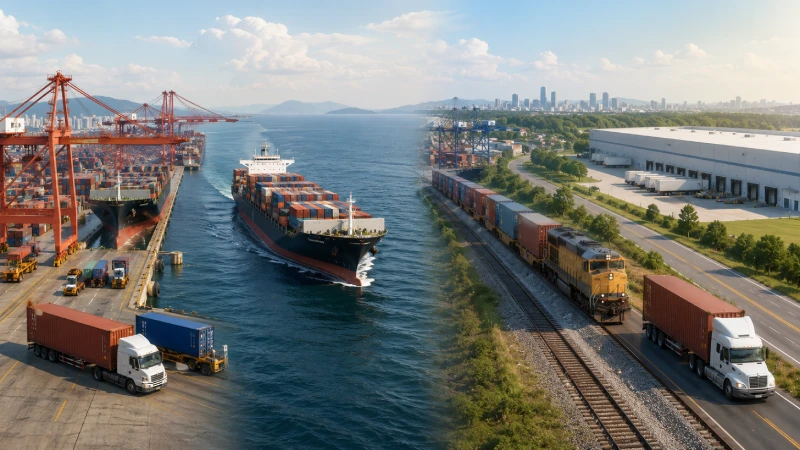
For inland destinations, port selection must be coordinated with the domestic transport plan.
Inland point intermodal, commonly called IPI, moves a container from a coastal port to an inland rail destination before final local delivery.
A typical IPI route may involve:
US port → rail transfer → inland rail ramp → local drayage → warehouse
Important considerations include:
- On-dock or near-dock rail availability
- Rail departure schedule
- Transfer time between terminal and railroad
- Container availability at the inland ramp
- Chassis availability
- Final drayage distance
- Free-time limits
- Empty-container return location
IPI can be efficient for Midwest destinations, but it also creates additional handoffs. A route with a shorter ocean leg can lose its advantage if the container waits several days for a rail departure or inland appointment.
Truck delivery is usually more straightforward for warehouses located within a practical distance of the arrival port. However, long-distance trucking can become expensive and expose the shipment to driver availability, fuel surcharges and appointment delays.
Compare Total Logistics Cost, Not Only Ocean Freight
The cheapest ocean rate does not necessarily produce the lowest delivered cost.
A proper route comparison should include:
- Factory pickup in China
- Origin terminal and export charges
- Ocean freight
- Transshipment handling
- Destination terminal charges
- Customs brokerage
- Drayage
- Rail transportation
- Chassis and fuel charges
- Storage or demurrage exposure
- Warehouse appointment delivery
- Empty-container return
- Inventory-carrying cost
Consider two possible routes to a Midwest warehouse. The West Coast option may have a lower ocean rate but require cross-country rail. The East Coast option may cost more by sea but reduce inland transportation and handling.
Only after combining all cost layers can the importer identify the better commercial route. Detailed pricing factors should be handled through the dedicated shipping cost from China to USA guide rather than repeated as broad rate estimates here.
Route Reliability and Seasonal Risk
Routing decisions should also reflect the importer’s tolerance for delay.
Blank Sailings and Capacity Changes
Carriers may cancel sailings, reduce capacity or change port rotations in response to demand and operational conditions. These changes can affect:
- Available departure dates
- Rolled cargo risk
- Transshipment connections
- Equipment positioning
- Spot rates
- Delivery planning
Published schedules should therefore be treated as planning information requiring current verification.
Peak-Season Routing
During peak periods, importers may need to book earlier and allow more route flexibility. Important factors include:
- Vessel space
- Container availability
- Export cutoff dates
- Chinese holidays
- US retail replenishment cycles
- Port and rail capacity
- Warehouse receiving limits
A flexible importer may compare two US gateways and authorize an alternative route if the preferred service becomes constrained.
Container Availability
Equipment shortages can occur even when vessel space is available. The chosen origin port should be checked for:
- Required container size
- Empty-container pickup location
- Supplier loading schedule
- Equipment release timing
- Return depot requirements
Route Selection by Shipment Scenario
Different shipments require different route priorities.
Delivery to California
A West Coast gateway is generally the logical starting point. The main comparison is often between nearby ports, vessel availability, terminal conditions and final drayage.
Delivery to Texas
Compare a Gulf Coast route with a West Coast arrival plus rail or truck. The Gulf route may reduce inland distance, while the West Coast option may offer an earlier departure or shorter ocean passage.
Delivery to the Midwest
Evaluate several architectures:
- West Coast plus IPI rail
- East Coast plus rail or truck
- Gulf Coast for selected central destinations
Rail timing and terminal handoffs can matter as much as the ocean voyage.
Delivery to the Northeast
An East Coast gateway may reduce domestic transportation, but a West Coast-plus-rail option may still be competitive if the sailing departs earlier or the East Coast service requires transshipment.
Delivery to the Southeast
Ports such as Savannah, Charleston and Norfolk may be considered depending on the exact warehouse location. Gulf Coast routing can also be screened for western parts of the Southeast.
Amazon or 3PL Delivery
Use the exact warehouse or fulfillment-center ZIP code. The route must account for:
- Appointment requirements
- Pallet and labeling compliance
- Delivery windows
- Possible rejections
- Storage risk
- Final-mile carrier capability
The nearest port is not automatically the best gateway for an appointment-controlled warehouse.
Urgent Replenishment
Prioritize the earliest reliable complete route, not simply the service with the shortest advertised ocean transit. A direct sailing departing in ten days may be less useful than a well-connected route departing tomorrow.
Predictable Recurring Containers
Recurring importers should prioritize stability, repeatable cutoffs, reliable inland connections and backup gateway options. The cheapest route for one shipment may not be the best long-term routing program.
Importers who are still comparing ocean, air, express or other transport modes should review best shipping methods from China to USA before choosing a specific port architecture.
Information Needed for a Route Comparison
A freight forwarder can provide a more useful recommendation when the inquiry includes:
- China pickup city
- Cargo-ready date
- Preferred China port, if known
- US delivery city and ZIP code
- Cargo description
- Cargo volume and gross weight
- FCL or LCL preference
- Required delivery date
- Warehouse receiving hours
- Appointment requirements
- Acceptable transshipment
- Acceptable gateway flexibility
- Shipment frequency
- Priority between speed, cost and reliability
You do not need to select the US port before requesting a quotation. A route comparison should evaluate at least two reasonable gateway options whenever the shipment schedule permits flexibility.
FAQ
Is the West Coast always the fastest route from China to the USA?
No. West Coast entry often shortens the ocean leg, but rail, customs release, terminal dwell and final trucking can make an East Coast or Gulf Coast route faster for some inland destinations.
Should I use the US port closest to my warehouse?
Not automatically. Geographic distance should be compared with vessel availability, port charges, rail connections, drayage rates, appointment requirements and total delivery time.
Is direct service always better than transshipment?
Direct service usually reduces handling and connection risk. However, a transshipment service may provide an earlier departure, better destination coverage or a lower total cost for flexible cargo.
Is New York or Los Angeles better for Midwest delivery?
Both may be viable. Los Angeles may offer a shorter ocean route followed by rail, while New York may involve a longer ocean voyage but a different inland connection. Compare the complete schedules.
When should I consider a Gulf Coast port?
A Gulf Coast gateway is worth evaluating for Texas, Louisiana and selected central or southern destinations, especially when it reduces long-distance rail or trucking.
What is inland point intermodal shipping?
IPI is a container movement from a US coastal port to an inland rail ramp, followed by local truck delivery to the final warehouse.
Which route is best for Amazon FBA shipments?
The route should be selected using the exact fulfillment-center ZIP code, delivery appointment rules, drayage capability and required inventory date, not only the nearest port.
How often should a route be reviewed?
Recurring importers should review routes when schedules, rates, capacity, warehouse locations or inventory priorities change. A route that worked last season may not remain optimal.
Get a China-to-USA Route Plan, Not Just an Ocean Rate
The best shipping route balances the China pickup location, ocean service, US gateway, inland transportation, cargo urgency and total logistics cost.
Send Winsail Logistics your China pickup city, cargo-ready date, final US ZIP code, cargo volume, required delivery date and acceptable route flexibility. We can compare West Coast, East Coast and Gulf Coast options based on total route time and total delivered logistics cost, not only the ocean freight rate.
