
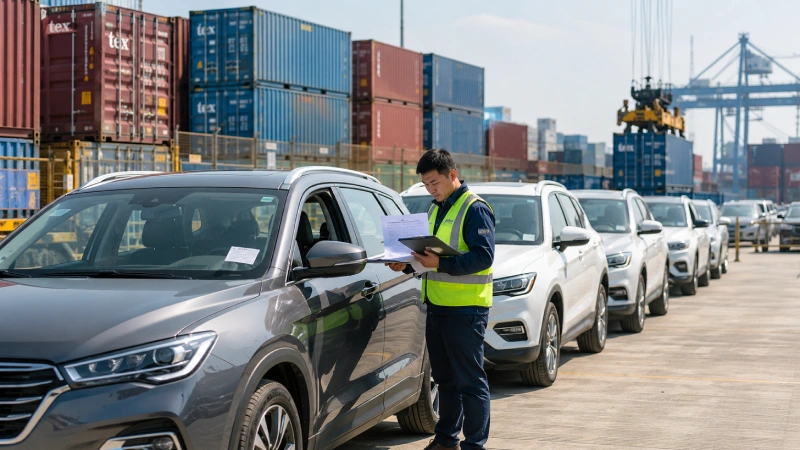
Exporting a used vehicle from China involves more than collecting an invoice and arranging ocean freight. Buyers, approved exporters, customs brokers, freight forwarders, carriers, and destination agents each prepare different parts of the document file, and a vehicle that clears export procedures in China may still be ineligible for import or registration at destination.
Quick Answer
Used car export documents from China fall into four groups: China-side legal records, customs and commercial paperwork, carrier documents, and destination-country import documents. The approved exporter normally needs the registration record, export contract, inspection report, target-market declaration, export license, invoice, packing list, and customs declaration. The buyer must confirm import eligibility and prepare any permit, conformity, roadworthiness, or importer-registration documents. Containers also need Verified Gross Mass, while electric vehicles may require separate dangerous-goods information and carrier approval.
Key Takeaways
- A Chinese export license is not a Bill of Lading or an import permit.
- The approved exporter, not the overseas buyer or freight forwarder, applies for the used-vehicle export license.
- The Vehicle Identification Number (VIN), owner, model, registration date, and quantity must remain consistent across the file.
- Requirements change by destination, vehicle category, registration age, propulsion system, carrier, and shipping method.
- China export clearance does not automatically make a vehicle eligible for overseas import or registration.
Before You Buy the Vehicle
Start document control before payment. Confirm that the destination permits the vehicle’s age, steering configuration, emissions category, condition, and intended use.
Request the VIN, model, first registration date, propulsion type, registered owner, and registration records. Check for mortgages, seizure, customs supervision, scrapping limits, or unresolved violations and accidents.
Under the 2024 Ministry of Commerce used-vehicle export rules, vehicles with incomplete legal records, inconsistent registration data, failed inspections, unresolved violations, or prohibited legal status cannot follow the normal export procedure.
A further rule applies from January 1, 2026. When a vehicle has been registered for 180 days or less, the exporter must submit a manufacturer-issued After-Sales Maintenance Service Confirmation identifying the destination, vehicle, and service network. The 2025 joint government notice states that the export license will not be issued without this applicable document.
Used Car Export Documents from China
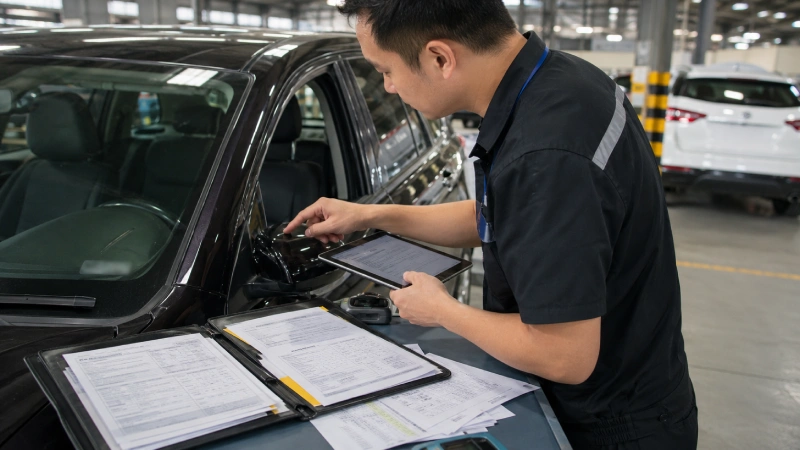
The seller, approved exporter, inspection agency, registration authority, and customs declarant prepare the China-side legal file. A freight forwarder coordinates document copies and deadlines but does not issue approvals.
Ownership and Export-License File
The core file normally includes:
- Motor Vehicle Registration Certificate
- Evidence of legal ownership transfer
- “Transfer Pending Export” registration record
- Export contract containing after-sales provisions
- Chinese translation for a foreign-language contract
- Third-party vehicle inspection report
- Inspection agency compliance declaration
- Exporter’s target-market access compliance declaration
- Export License Application and PRC Export License
- Manufacturer confirmation when the 180-day rule applies
The registered owner on the Motor Vehicle Registration Certificate must match the approved exporter. Under the “who exports, who applies” principle, another party cannot apply in its place.
The license uses a one-batch, one-license system. One commodity-code line can cover no more than 20 used vehicles, and the quantity must match the customs declaration. If fewer vehicles are declared than licensed, a new license is required.
Document Responsibility Matrix
| Document | Purpose | Usually Provided By | When Required | Notes |
|---|---|---|---|---|
| Motor Vehicle Registration Certificate | Confirms vehicle and owner data | Seller or exporter | Before transfer and licensing | VIN and owner must match |
| Export contract | Supports sale and license application | Exporter and buyer | Before license filing | Must include after-sales content |
| Inspection report | Confirms export quality inspection | Qualified inspection agency | Before license filing | Standard depends on vehicle category |
| Target-market declaration | States destination access compliance | Approved exporter | Before license filing | Does not replace foreign approval |
| PRC Export License | Authorizes China-side export clearance | Provincial commerce authority | Before customs declaration | Winsail does not issue it |
| Commercial invoice | States parties, vehicle, and value | Exporter or seller | Customs, booking, and import | Use VIN-level detail |
| Packing list or VIN list | Identifies each vehicle | Exporter or forwarder | Customs and booking | One line per vehicle is practical |
| Customs declaration | Records export to China Customs | Exporter or customs broker | Before release | Must identify a used vehicle |
| Bill of Lading or Sea Waybill | Evidence of carriage | Carrier or NVOCC | After loading | Check VIN and consignee |
| Import permit | Authorizes import where required | Buyer or importer | Often before shipment | Destination-specific |
Customs and Commercial Documents
Customs and commercial paperwork converts the vehicle file into a declarable shipment. The exporter and customs broker should reconcile every key field before submission.
China’s rules require the customs commodity description to identify the goods as used and include the vehicle brand, engine displacement, and vehicle type. The declaration, license, registration record, invoice, packing list, and VIN list must not conflict on quantity, model, or identification.
Commercial documents commonly include the contract, invoice, vehicle packing list, insurance certificate when arranged, and Certificate of Origin when required. Origin and insurance certificates are not universal.
After customs release, the exporter should retain the cleared declaration. The vehicle must then be deregistered within two months using the export declaration and other required evidence.
Winsail can coordinate shipping information and customs-document handover through its customs clearance and cargo insurance services, but customs decisions remain with the competent authorities.
Container and RoRo Shipping Documents
Container and Roll-on/Roll-off (RoRo) shipments share booking data, but handover records differ. Confirm carrier cut-offs and acceptance rules before port delivery.
| Document or Record | Container | RoRo |
|---|---|---|
| Booking confirmation | Required | Required |
| Shipping Instructions | Required | Required |
| VIN, dimensions, weight, and fuel type | Required | Required |
| Container and seal number | Required | Not applicable |
| Loading and lashing record | Recommended | Carrier controlled |
| Verified Gross Mass (VGM) | Required | Not applicable |
| Dock receipt or shipping note | Carrier-dependent | Common |
| Vehicle condition or gate-in record | Recommended | Common |
| Draft and final B/L | Required | Required |
For a packed container, the shipper named in the transport contract is responsible for VGM. The International Maritime Organization VGM guidance states that verified mass must reach the terminal and vessel representative in time for stowage planning and is a condition for loading.
RoRo carriers commonly request ownership or registration evidence, a shipping note or dock receipt, invoice, identification, and destination-specific records. The exact list remains carrier-specific; Höegh Autoliners’ vehicle guidance is an example, not a universal rule.
For method selection, review Winsail’s RoRo ocean freight guide and ocean freight services from China.
Destination-Country Documents
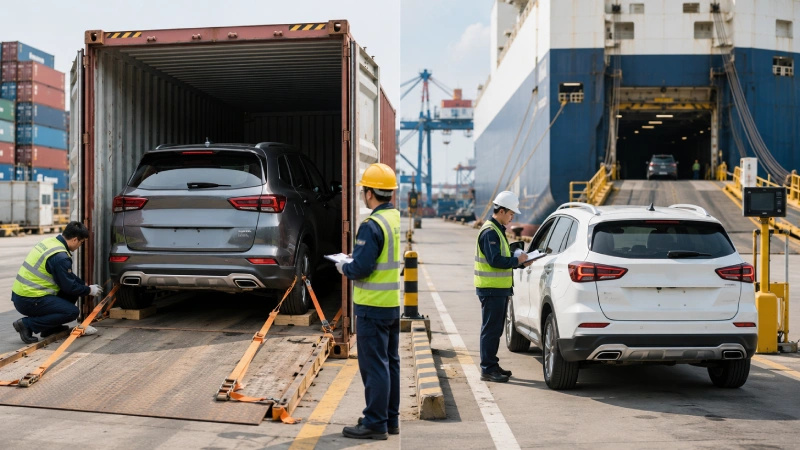
Destination documents are primarily the importer’s responsibility. They should be checked before purchase because China export clearance does not prove that the vehicle can be imported, registered, or driven overseas.
Depending on the market, the buyer may need:
- Import permit or vehicle-import authorization
- Importer registration and tax number
- Customs broker authorization
- Pre-shipment inspection certificate
- Certificate of Roadworthiness or Conformity
- Emissions or fuel-economy evidence
- Cancelled or translated registration record
- Import customs declaration
- Pre-arrival manifest or cargo reference
Confirm the final list with destination customs, the vehicle regulator, and the broker. Winsail’s guides for shipping from China to Saudi Arabia, shipping from China to Kenya, and shipping from China to Nigeria provide route context but do not replace official vehicle-import approval.
Additional Documents for Electric Vehicles
Electric vehicles require a separate transport review. Do not add dangerous-goods paperwork to a fuel-vehicle checklist without confirming battery classification, condition, shipping mode, and carrier policy.
The International Maritime Dangerous Goods (IMDG) Code 2024 Edition, Amendment 42-24, became mandatory on January 1, 2026. The International Maritime Organization’s current IMDG publication notice confirms this date.
Under the revised classification, Maersk’s 2026 carrier advisory identifies UN 3556, UN 3557, and UN 3558 for applicable lithium-ion, lithium-metal, and sodium-ion vehicles, replacing the former generic UN 3171 entry.
| Possible EV Document | When It May Apply |
|---|---|
| Battery chemistry and vehicle classification | Initial booking review |
| Dangerous Goods Declaration | When required by classification and carrier |
| Container Packing Certificate | Applicable containerized DG shipment |
| Battery-condition declaration | Common carrier review |
| State-of-charge declaration | Carrier-specific |
| Operating and emergency instructions | Frequently requested for RoRo |
| SDS or UN 38.3 test summary | Only when specifically required |
| Carrier DG approval | Before confirmed loading |
Damaged, defective, leaking, recalled, or modified battery vehicles require separate review and may be rejected. One carrier’s approval does not cover another sailing.
Who Prepares Each Document: Six-Step Workflow
Responsibility should be assigned before port delivery.
- Buyer: Confirms import eligibility, permits, inspection rules, importer status, and consignee data.
- Seller: Supplies authentic ownership, registration, vehicle-history, and identification records.
- Approved exporter: Completes ownership transfer, inspection coordination, export contract, license application, and deregistration.
- Customs broker: Submits the export declaration using verified commercial and license data.
- Freight forwarder: Coordinates pickup, storage, booking, loading, Shipping Instructions, VGM, terminal handover, and draft B/L review.
- Carrier: Reviews cargo acceptance, receives and transports the vehicle, and issues the final B/L or Sea Waybill.
Common Documentation Mistakes
The most expensive errors are usually inconsistencies rather than missing paper.
- VIN differs between registration, invoice, license, packing list, or B/L.
- Exporter is not the registered owner.
- Export contract omits required after-sales terms.
- The 180-day rule applies, but manufacturer confirmation is missing.
- Invoice and packing list use vague vehicle descriptions.
- Buyer checks age, steering, inspection, or conformity rules after loading.
- Final B/L is expected before shipment, although it is normally issued after loading.
- Old EV classifications are reused without checking IMDG 42-24.
- A carrier request is incorrectly presented as Chinese law.
- Origin, insurance, SDS, or UN 38.3 documents are described as universally mandatory.
Final Pre-Shipment Checklist
Before authorizing port delivery, verify:
- VIN matches every document.
- Registered owner matches the approved exporter.
- First registration date has been checked.
- The 180-day document is available when applicable.
- Third-party inspection has passed.
- Export contract and translation are complete.
- License quantity matches the customs shipment.
- Invoice, packing list, and declaration are aligned.
- Buyer has confirmed destination eligibility.
- Carrier has approved vehicle type and condition.
- Container VGM or RoRo handover records are ready.
- EV documents are confirmed separately.
- Draft B/L data is ready for review.
- Deregistration responsibility is assigned.
What Winsail Can Coordinate
Within the agreed scope, Winsail can coordinate vehicle pickup, China-side storage, container loading, lashing, carrier booking, ocean transport, Shipping Instructions, VGM submission, terminal handover, draft transport-document review, and communication with destination agents. Storage arrangements can be reviewed through Winsail’s China warehouse services.
Winsail does not issue export licenses, determine import eligibility, approve dangerous-goods classifications, or guarantee customs or carrier acceptance. Those decisions remain with the exporter, authorities, inspection bodies, carrier, and importer.
FAQ
What documents are needed to export a used car from China?
The usual China-side file includes registration and ownership records, an export contract, inspection report, target-market declaration, export license, invoice, packing list, and export customs declaration. Shipping and destination documents are additional.
Can an overseas buyer apply for the Chinese used-car export license?
No. The approved Chinese exporter applies under the “who exports, who applies” rule. The buyer normally provides contract, consignee, importer, and destination information.
Can a vehicle registered for less than 180 days be exported?
Potentially. From January 1, 2026, a vehicle registered for 180 days or less requires the manufacturer’s After-Sales Maintenance Service Confirmation. Without it, the export license is not issued under the current rule.
Are container and RoRo documents identical?
No. Both need booking data, Shipping Instructions, VIN details, and a transport document. Containers also require VGM and container or seal records, while RoRo commonly uses a shipping note, dock receipt, gate-in record, and condition handover.
What extra documents may be needed for a used electric vehicle?
Possible requirements include correct UN classification, a Dangerous Goods Declaration, Container Packing Certificate, battery-condition or state-of-charge statements, operating instructions, emergency procedures, and carrier approval. The exact set depends on classification, vehicle condition, shipping mode, and carrier.
Send Your Documents for a Pre-Check
Send Winsail the available documents with the VIN list, vehicle type, first registration date, fuel or battery type, China location, destination port, and preferred shipping method. We can identify freight-planning and booking gaps, then coordinate an appropriate shipping solution.
Government permits, customs release, destination approval, and carrier acceptance remain subject to the responsible authorities and providers.
Sources Reviewed
- Ministry of Commerce and four departments: Announcement No. 6 of 2024
- Four Chinese authorities: 2025 notice effective January 1, 2026
- International Maritime Organization: IMDG Code 2024 Edition
- International Maritime Organization: SOLAS Verified Gross Mass guidance
- Maersk: 2026 battery-powered vehicle classification advisory
- Höegh Autoliners: Automotive shipping requirements
