
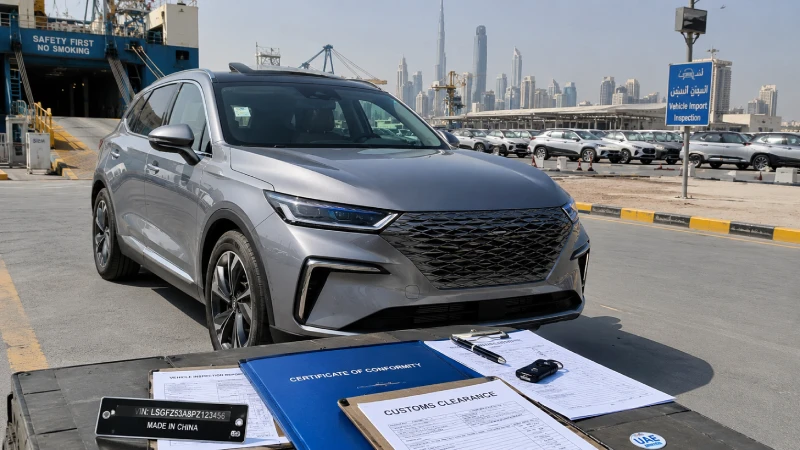
Yes, a China-spec car may be registered in the UAE, but approval is not based simply on where the vehicle was manufactured. The exact VIN, model year and configuration must clear customs, satisfy the applicable UAE/GCC conformity requirements, pass required inspections and be accepted by the traffic authority in the emirate where it will be registered.
A vehicle made in China is not automatically a China-spec vehicle, and a China-spec vehicle is not automatically prohibited from UAE registration. The safest approach is to complete a VIN-level compliance review before purchasing or shipping the vehicle.
Most importantly, customs clearance is not registration approval. A Vehicle Clearance Certificate, or VCC, is an important import document, but it does not guarantee UAE number plates.
Quick Answer: Is a China-Spec Car Legal to Register in the UAE?
There is no simple nationwide rule stating that every China-spec vehicle can or cannot be registered. Approval depends on the exact vehicle, its conformity evidence, condition and intended registration emirate.
When the answer may be yes
A vehicle will generally need:
- A valid and verifiable VIN and ownership record
- Conformity evidence covering the exact model and model year
- UAE customs clearance and the required customs certificate or VCC
- MoIAT imported-used-vehicle status approval where applicable
- Required technical inspection
- Valid motor insurance
- Acceptance by the local traffic authority
Dubai provides a useful example. The RTA vehicle registration requirements state that when a customs card does not show Gulf Specifications compliance, additional conformity documentation from MoIAT is required.
This means a non-GCC-spec vehicle is not necessarily rejected automatically. However, it also does not mean every China-spec car can obtain the required conformity evidence.
When registration is likely to be refused
Risk is higher when:
- Model-specific conformity evidence cannot be obtained
- VIN, invoice, manufacturer plate or export documents do not match
- The vehicle has prohibited damage or salvage history
- Major body, chassis, powertrain or safety-system modifications are unapproved
- A specific model is subject to a local restriction
- The vehicle fails technical inspection
A successful customs clearance or possession of a VCC does not guarantee that the vehicle will receive UAE plates.
“China-Spec,” “Made in China” and “GCC-Spec” Are Not the Same
| Term | Meaning | Registration implication |
|---|---|---|
| Made in China | Vehicle was manufactured in China | Not automatically a problem |
| China-spec | Version designed or certified mainly for China’s domestic market | Requires case-by-case conformity verification |
| GCC-spec | Version certified for applicable Gulf requirements | Usually provides a clearer registration route |
| Parallel import | Imported outside the local authorised distribution channel | May be registrable, but documentation and warranty risks are higher |
Chinese factories can produce both China-domestic and GCC-certified versions of the same model. Country of manufacture therefore does not determine registration eligibility by itself.
Two visually identical cars may also have different VIN coverage, lighting, safety systems, emissions, software or powertrain configurations. A GCC conformity certificate for one version should never be assumed to cover a China-domestic version simply because the badge and body shape are the same.
Who Actually Decides Whether the Car Can Be Registered?
UAE vehicle importation and registration involve several separate stages.
1. Customs authority
Customs verifies import documents, vehicle identity, valuation and duties, then issues the relevant customs certificate or VCC.
Dubai Customs describes the Vehicle Clearance Certificate as a required document for imported vehicles seeking registration. It remains a customs document and does not replace conformity approval or traffic registration.
2. MoIAT and the GCC conformity framework
The Ministry of Industry and Advanced Technology, or MoIAT, is involved in vehicle and product conformity. For imported used vehicles, it also provides VIN-based services used to evaluate whether a vehicle has a history that affects its eligibility for UAE road use.
3. Approved vehicle inspection centre
Imported or used vehicles may need technical inspection for roadworthiness and safety. Failed vehicles may require repairs and reinspection, while substantially modified vehicles can require additional technical assessment.
4. Traffic authority in the selected emirate
The final registration application is processed by the relevant emirate authority, such as Dubai RTA or the Abu Dhabi Police/TAMM system.
Federal technical requirements provide the broader framework, but procedures and model-specific notices can differ. Choose the intended registration emirate before shipment.
Registration Eligibility by Vehicle Type
| Vehicle scenario | Likely position | Main condition |
|---|---|---|
| China-made GCC-certified new car | Generally possible | Exact model/VIN covered by valid conformity evidence |
| New China-domestic-spec petrol car | Potentially possible | MoIAT/Gulf conformity evidence and inspection |
| Used China-spec car | Higher scrutiny | VIN history checks, Product Status Statement and inspection |
| China-spec EV | Case-by-case | MoIAT conformity plus any local model restrictions |
| Salvage, flood or fire-damaged car | High refusal risk | May fall within prohibited used-vehicle categories |
| Heavily modified vehicle | Uncertain | May require additional technical review |
| Chinese-made Volkswagen EV in Dubai | Special restriction | Current RTA rule must be checked before shipment |
This matrix is a risk guide rather than a registration guarantee.
Documents to Verify Before the Car Leaves China
Vehicle identity documents
Collect:
- Complete 17-character VIN
- VIN plate and manufacturer plate photographs
- Engine or motor number where applicable
- Exact model, trim and model year
- Production date
- Country of production
Every VIN character should match the invoice, registration documents and export paperwork.
Ownership and export documents
Depending on the transaction, the file may include:
- Commercial invoice or purchase agreement
- Chinese registration document for a used vehicle
- Deregistration or export documentation
- Certificate of origin where applicable
- Bill of lading
- Vehicle condition report
Compliance documents
Verify whether you can provide:
- GSO/MoIAT conformity evidence covering the correct vehicle
- Manufacturer’s Certificate of Conformity where available
- Technical specifications
- Requested emissions or safety documentation
- Written guidance from the receiving authority for uncertain models
Do not rely only on a seller saying that the same model is already registered in Dubai. Another vehicle may have a different VIN range or specification.
Used-vehicle history
For used cars, check accident, flood, fire, salvage, scrap and dismantling history, airbag condition and previous structural repairs.
MoIAT’s Imported Used Vehicle Product Label Card provides a VIN-based route for checking relevant imported-used-vehicle status information.
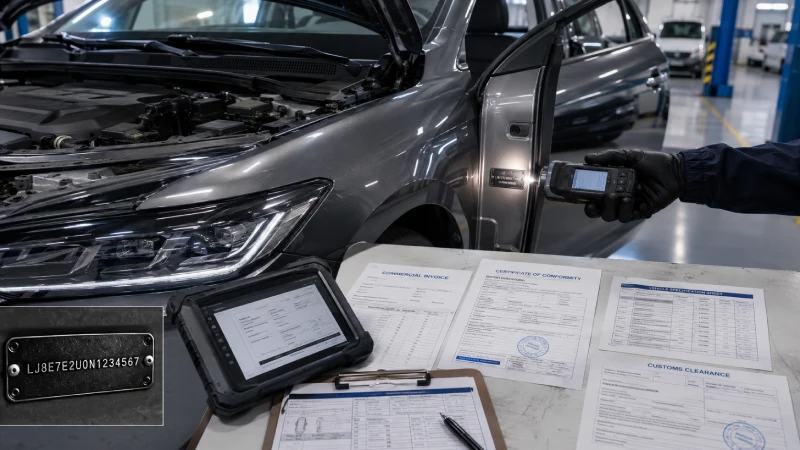
Step-by-Step Registration Process
Step 1 — Choose the registration emirate first
Confirm whether the owner can register in the chosen emirate, whether the authority has special requirements for the model, and what conformity or inspection documents will be required.
Step 2 — Obtain VIN-level pre-clearance
For an uncertain China-spec model, submit the VIN, model year, powertrain, manufacturer plate, available conformity documents and modification history to the relevant authority or qualified compliance channel.
Where possible, obtain a written answer instead of relying only on verbal confirmation.
Step 3 — Export and ship the car from China
Ensure ownership and export authority are clear and that the VIN matches across every document. For EVs, battery and powertrain information should be declared to the carrier as required.
For transport planning, see vehicle shipping from China.
Shipping acceptance by a carrier does not confirm that the vehicle can be registered.
Step 4 — Complete UAE customs clearance and obtain the VCC
After arrival, the vehicle goes through customs clearance and the relevant customs certificate is issued.
The VCC confirms customs clearance; it does not replace conformity approval or the traffic safety test.
Step 5 — Complete the imported-used-vehicle status process
For a used car, the process may include:
- Checking the VIN through the MoIAT Product Label Card service
- Reviewing safety or damage history
- Applying for the Product Status Statement
- Confirming whether the vehicle can enter the traffic registration system
The currently published fee for the Product Status Statement is AED 200.
Step 6 — Pass the technical inspection
Imported vehicles should be prepared for required technical inspection. A failed vehicle may need repairs and reinspection, while substantially modified vehicles can require further technical review.
For Dubai light vehicles, the currently published technical inspection fee is AED 150 plus AED 20 in knowledge and innovation fees. Reinspection and other charges may apply.
Step 7 — Buy insurance and submit the registration application
The registration file may include Emirates ID, electronic customs certificate, sale agreement, conformity documentation, technical inspection result, electronic insurance and any applicable company, mortgage or authorisation documents.
Why a China-Spec Car May Fail UAE Registration
Missing model-specific Gulf conformity
Certification must correspond to the correct manufacturer, model, model year, VIN range and powertrain configuration. A GCC-certified version and a China-domestic version of the same model are not automatically interchangeable.
Prohibited damage history
MoIAT states that specified categories of seriously affected vehicles are prohibited from import, registration and insurance. These include vehicles associated with conditions such as flood or fire damage, scrap or junk status, dismantling, non-repairable damage and major uncorrected safety or manufacturing defects.
A repaired salvage vehicle should not be assumed registrable simply because it can pass a basic inspection.
Unapproved modifications
Risky modifications include:
- Structural body or chassis changes
- Powertrain replacement
- Airbag or safety-system modifications
- Unapproved lighting or electrical changes
- Non-original EV charging-system modifications
Passing inspection does not convert a China-spec vehicle into a GCC-spec vehicle.
VIN and document inconsistencies
VIN typing errors, model mismatches, confusion between production year and model year, inadequate translations or unclear ownership relationships can delay or prevent registration. These problems are easier to correct before shipment.
Special Considerations for China-Spec Electric Vehicles
MoIAT conformity is the primary registration issue
The first question is whether the exact EV can satisfy the applicable UAE conformity route.
Dubai RTA guidance indicates that EVs other than specifically restricted models are not automatically required to have an authorised UAE dealer, provided the required MoIAT conformity documentation can be produced. Dealer support, warranty and registration eligibility should therefore be treated separately.
Check for model-specific restrictions
Dubai currently has a published restriction concerning certain Chinese-manufactured Volkswagen electric vehicles. RTA states that, following a decision effective March 6, 2023, first registration using a customs certificate was suspended for the affected vehicles, while vehicles imported and registered before that date can continue receiving subsequent services.
This is a Dubai-specific published rule and should be rechecked before every shipment.
It should not be expanded into a claim that all Chinese EVs are banned in Dubai or across the UAE.
Charging connector compatibility
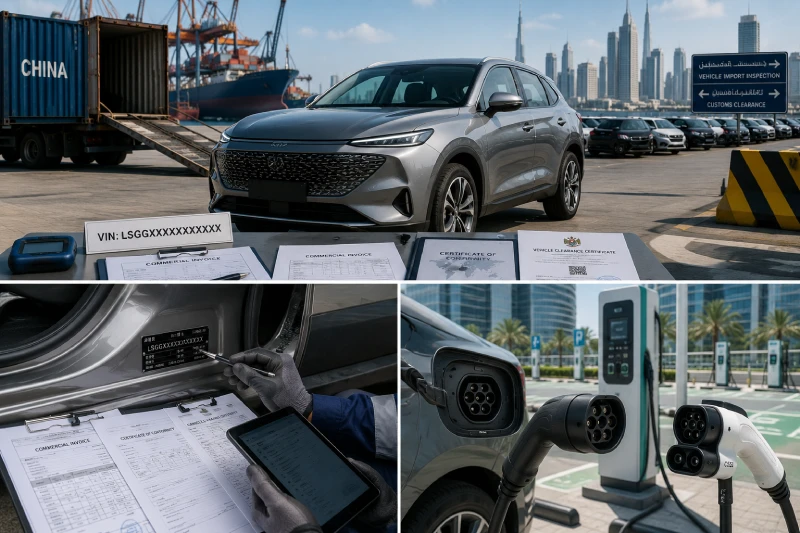
DEWA’s public charging network primarily provides Type 2, CCS Combo and some CHAdeMO connections. A China-market EV fitted with GB/T therefore requires compatibility checks before shipment.
Verify:
- AC and DC charging connectors
- Whether the vehicle uses GB/T, Type 2, CCS2 or another standard
- Compatibility with the intended charging network
- Manufacturer approval for any adapter
- Safety requirements for home charging equipment
A simple adapter is not a universal solution to every charging problem.
Software and after-sales risks
Even if registration is possible, consider region-locked apps, OTA updates, navigation, eSIM connectivity, diagnostic support, battery warranty and spare-parts availability.
These issues may not directly determine registration, but they can significantly affect practical ownership.
Expected Government and Inspection Costs
| Item | Current published amount |
|---|---|
| Dubai Customs VCC | AED 30 per vehicle |
| MoIAT Product Status Statement for imported used vehicle | AED 200 |
| Dubai light-vehicle technical inspection | AED 150 + AED 20 |
| Dubai light-vehicle reinspection | AED 50, plus applicable additional fees |
| Dubai inspection without appointment | Additional AED 100 where available |
| Registration, plates and ownership certificate | Depends on vehicle and plate type |
| Insurance | Depends on VIN, model, value and insurer |
| Conformity testing or technical assessment | Case-specific |
Government fees and service rules can change. Check the relevant official pages again immediately before import and registration.
Pre-Shipment Decision Checklist
- Final registration emirate selected
- Complete VIN and manufacturer-plate photographs obtained
- Conformity evidence covers the correct model year and VIN range
- Local registration route confirmed for uncertain models
- Used-vehicle history checked for prohibited damage
- Chinese ownership and export documents complete
- Insurer willing to cover the exact vehicle
- No undeclared major modifications
- EV charging compatibility checked
- Warranty, software and spare-parts risks assessed
- Shipment not based solely on a seller’s verbal registration promise
FAQ
Can a non-GCC-spec car be registered in the UAE?
Potentially. It may require additional MoIAT or Gulf conformity evidence and technical inspection. Approval depends on the exact VIN, model and registration authority.
Does a UAE customs certificate guarantee registration?
No. Customs clearance, conformity assessment, technical inspection and traffic registration are separate stages. A VCC does not guarantee UAE plates.
Is every car manufactured in China considered China-spec?
No. Chinese factories also produce export vehicles certified for Gulf markets. “Made in China” describes manufacturing origin, while “China-spec” describes the intended market specification.
Does a China-spec car need an authorised UAE dealer?
Not in every case. Dubai RTA guidance for EVs indicates that certain vehicles may proceed with MoIAT conformity documentation even without a local authorised dealer.
Can a Chinese salvage car be registered after repair?
Do not assume so. Certain damage or vehicle-status categories are prohibited even if physical repairs have been completed.
Can a GB/T China-spec EV use UAE public chargers?
Compatibility must be checked vehicle by vehicle. UAE charging infrastructure commonly uses Type 2, CCS and some CHAdeMO connections, while many China-market vehicles use GB/T.
Which UAE emirate is easiest for registering a China-spec car?
There is no guaranteed “easy” emirate. The correct route depends on owner eligibility, vehicle conformity and the requirements of the local traffic authority.
Final Takeaway
A China-spec car is not automatically prohibited in the UAE, but it is also not automatically registrable.
The key questions are whether the exact VIN has an acceptable conformity route, whether the vehicle history satisfies imported-used-vehicle requirements, whether it can pass technical inspection, and whether the traffic authority in the intended emirate will approve it.
For importers, the expensive mistake is shipping first and investigating registration later. Verify the VIN, model year, powertrain, conformity documents, vehicle condition and intended UAE registration emirate before purchase or shipment.
If you are planning to ship a vehicle from China to the UAE, send the VIN, model year, powertrain, vehicle condition and intended registration emirate for a pre-shipment document review and shipping assessment.
