
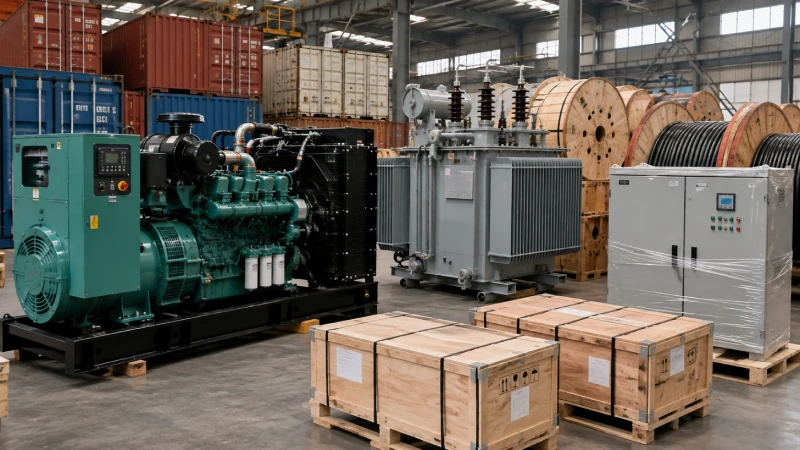
Shipping electrical equipment from China to Ghana is not simply a matter of choosing a container and booking ocean freight. A portable generator, an industrial diesel genset, a dry-type transformer, a liquid-filled transformer, a cable drum and a switchgear cabinet can have completely different requirements for packing, lifting, cargo securing, container selection and regulatory checks.
For project buyers, EPC contractors, mining companies and electrical equipment distributors, the safest approach is to define the equipment technically before requesting freight rates.
The key information includes packed dimensions, gross weight, support footprint, center of gravity, lifting points, transport orientation, liquids or batteries inside the equipment, packaging construction and the final delivery location in Ghana.
For a broader overview of the route, ports and shipping methods, see Winsail’s shipping from China to Ghana guide.
Quick Answer
Generators, transformers, cables and other electrical equipment should not be shipped under one standard logistics rule.
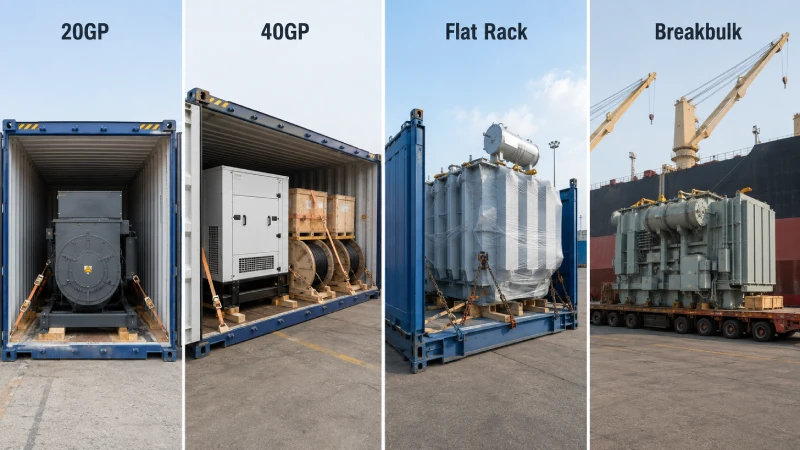
A relatively compact industrial generator may fit inside a 20GP, while another genset of similar weight may require different equipment because its footprint, enclosure, center of gravity or loading method is unsuitable for a standard container. Large transformers may require flat-rack or breakbulk planning, while cable drums require specific measures to prevent rolling and lateral movement.
Before choosing 20GP, 40GP, flat rack or breakbulk, confirm:
- Packed dimensions and gross weight
- Base or support footprint
- Center of gravity
- Lifting and jacking points
- Loading and unloading method
- Liquids, batteries or pressurized components
- Packaging and moisture-protection requirements
- Ghana product-compliance requirements
- Tema discharge arrangements
- Inland transport and site-access conditions
There is no reliable rule such as “below X tonnes use a 20GP” or “all transformers above X tonnes require flat rack.” Actual carrier equipment limits and load distribution must be checked for each shipment.
Equipment Shipping Matrix
| Equipment | Main Logistics Concern | Typical Protection | Possible Shipping Method | Extra Question |
|---|---|---|---|---|
| Small generator | Dense weight, fuel system | Pallet, cage or crate | LCL / 20GP / FCL | Fuel, oil and battery status |
| Industrial diesel generator | High mass, skid footprint, lifting | Skid, crate or weatherproof enclosure | 20GP / 40GP / Flat Rack | Fluids, batteries, CoG |
| Dry transformer | Concentrated load, moisture, impact | OEM skid or wooden crate | 20GP / 40GP / Flat Rack | Orientation and lifting |
| Liquid-filled transformer | High mass, liquid condition, leakage | OEM transport configuration | Container / Flat Rack / Breakbulk | Insulating liquid and SDS |
| Cable drums | Rolling, tipping, point loading | Drum with chocks or cradle | 20GP / 40GP / Flat Rack | Drum size and securing plan |
| Switchgear | Upright stability, moisture, shock | Sealed crate or skid | FCL / special equipment | Batteries or gas if installed |
| Control panels | Electronics, moisture, impact | Sealed crate | LCL / FCL | UPS or battery components |
This matrix is only the starting point. Equipment selection should follow the manufacturer’s transport data and carrier acceptance.
Why Generators, Transformers and Cable Drums Ship Differently
Weight alone does not tell a freight forwarder how equipment should move.
Consider a transformer and a cable drum that both weigh eight tonnes. The transformer may sit on two narrow base channels and have a relatively high center of gravity. The cable drum has a cylindrical shape, small contact areas at the flanges and a natural tendency to roll. They therefore create completely different load-distribution and securing problems.
An industrial generator creates another set of questions. Its engine, alternator, fuel system, cooling system and starter batteries may all affect the transport review. A switchgear cabinet may weigh far less but can be tall, top-heavy and sensitive to shock, condensation or incorrect lifting.
For heavy electrical equipment, Winsail therefore needs to look at weight, footprint, center of gravity and handling geometry together.
Current carrier guidance for out-of-gauge cargo also emphasizes that center of gravity and the location of effective supporting points influence whether a load can safely use special equipment such as a flat rack. The final acceptance decision remains shipment-specific and should be based on the actual cargo data submitted to the carrier.
20GP vs 40GP vs Flat Rack vs Breakbulk
When Can a 20GP Be Used?
A 20GP can be a good candidate for dense machinery because it provides a relatively compact container footprint, but the equipment must pass several checks.
The packed cargo must physically fit through the door and inside the container. Gross weight must remain within the limits of the actual container and booking. More importantly, a heavy generator or transformer cannot place excessive concentrated loads on a small part of the floor.
The support footprint, longitudinal weight distribution and center of gravity therefore matter just as much as total weight.
Loading must also be practical. A machine that technically fits inside a container may still be unsuitable if it cannot be safely inserted, positioned and removed.
Do not use a fixed rule such as “equipment under 20 tonnes always goes in a 20GP.” That is not a safe shipping rule.
When Is a 40GP Useful?
A 40GP may work better for a long generator enclosure, several switchgear crates, multiple cable drums or equipment shipped with separate accessories.
However, more space does not automatically make a 40GP the better choice for very dense equipment. The actual load distribution and container limits still have to be checked.
For more background on containerized ocean transport, see sea freight from China to Ghana.
When Might a Flat Rack Be Required?
Flat racks become relevant when cargo requires:
- Top loading by crane
- Side loading
- Over-width clearance
- Over-height clearance
- Special lifting access
- A support configuration unsuitable for a closed container
Flat-rack planning requires accurate dimensions, weight, support positions and center of gravity before carrier technical approval.
Weather protection also becomes more important because the cargo may have less protection from the marine environment than equipment inside a dry container.
When Does Breakbulk Become an Option?
Breakbulk may be considered when the equipment’s size, weight, lifting configuration or support geometry makes practical containerization difficult.
Large power transformers are a typical project-cargo example, but there is no universal transformer-weight threshold at which breakbulk automatically becomes mandatory.
Technical Data Required Before Quoting
A reliable heavy electrical equipment quotation should begin with technical data rather than only CBM.
Winsail should receive the following information before recommending a shipping method.
Equipment Details
- Equipment type and model
- Manufacturer
- Quantity
- Datasheet
- Packing list
- Supplier’s proposed HS code
Dimensions and Weight
- Equipment dimensions
- Final packed dimensions
- Net weight
- Gross packed weight
- Base or skid dimensions
- Support-point positions
Heavy-Lift Information
- Center-of-gravity drawing
- Lifting-point drawing
- Lifting lug information
- Forklift pockets
- Jacking points where relevant
- Required transport orientation
Liquids and Batteries
- Fuel type and quantity
- Engine oil
- Coolant
- DEF/urea if fitted
- Transformer insulating liquid
- Battery chemistry
- Pressurized components
- SDS where relevant
Photos of the actual equipment and final packaging are also valuable before booking. The factory address, Chinese port, Tema delivery scope, final Ghana project location, Incoterm and site-access conditions should also be included.
Generator Shipping to Ghana: Pre-Shipment Checklist
Start by identifying exactly what kind of generator is being purchased.
A portable gasoline generator is not equivalent to an open industrial diesel genset, a silent canopy genset or a containerized power package. Each can have a different footprint, lifting arrangement and transport condition.
The freight forwarder should ask the manufacturer what fluids remain inside the equipment at the time of shipment.
Depending on the model, these could include:
- Diesel or gasoline
- Lubricating oil
- Coolant
- DEF
- Other service fluids
- Starter batteries
Do not automatically instruct the factory to drain every liquid.
The correct preparation should be based on the actual manufacturer’s transport instructions together with the carrier’s current acceptance requirements. The same applies to batteries: identify the chemistry and whether the battery is installed in the equipment or packed separately before deciding what documentation or preparation is necessary.
Where dangerous-goods rules apply, sea transport should be reviewed under the current IMDG Code published by the International Maritime Organization. Amendment 42-24 became mandatory on January 1, 2026.
The manufacturer should also confirm the generator’s skid condition, lifting points, center of gravity and any transport locking requirements.
Transformer Shipping to Ghana: Dry-Type vs Liquid-Filled
The first question should be whether the unit is a dry-type transformer or a liquid-filled transformer.
Dry-Type Transformers
Dry transformers remove the obvious insulating-liquid question, but they can still be challenging freight.
Check:
- Total packed weight
- Base channels and supporting points
- Center of gravity
- Required upright orientation
- Lifting instructions
- Shock sensitivity
- Moisture protection
Never determine lifting positions from photographs. Use the manufacturer’s transport or lifting drawing.
Liquid-Filled Transformers
Do not assume that every transformer is shipped fully filled with oil, and do not assume that all transformer oil must be drained.
Transport configuration depends on transformer design and manufacturer requirements. Larger transformers may be shipped partly dismantled, with accessories removed, while some configurations may move with a different liquid condition in the main tank.
Before booking, obtain:
- Exact insulating-liquid product
- SDS
- Liquid quantity
- OEM transport condition
- Whether the tank is full, partially filled or drained
- Whether radiators remain attached
- Conservator and accessory configuration
- Valve and sealing status
Only after obtaining this information should the freight forwarder and carrier determine whether additional transport or dangerous-goods requirements apply.
Are Shock and Tilt Indicators Necessary?
Shock and tilt indicators can be useful for high-value or handling-sensitive equipment, but they are not a universal requirement for every generator or transformer.
They are most valuable when requested by the manufacturer, project owner, insurer, surveyor or EPC contractor. They can also provide useful evidence when a transformer passes through several handling stages before reaching the project site.
Cable Drum Securing Is a Separate Engineering Problem
Cable drums should never be treated like rectangular palletized cargo.
Their main risks are rolling, lateral movement, tipping and concentrated loading through the drum flanges.
Before loading, collect:
- Drum diameter
- Drum width
- Gross weight
- Cable length
- Drum construction
- Flange condition
A securing arrangement may use appropriate chocks, cradles, blocking, anti-slip materials and lashings designed for the actual drum.
Heavy drums should be restrained against both longitudinal and transverse movement.
The CTU Code provides international guidance for packing and securing cargo in freight containers and other cargo transport units and stresses proper load distribution and securing throughout multimodal transport.
The number of chains, lashing angles and chock dimensions should not be copied from another shipment without engineering review.
Switchgear and Control Panels Need Their Own Checklist
Switchgear and control panels may not be the heaviest cargo in the project, but incorrect handling can still cause expensive damage.
Confirm:
- Required upright orientation
- Lifting eyes or base lifting positions
- Transport locks
- Door securing
- Loose internal components
- Busbar protection
- Shock sensitivity
- Moisture protection
- Installed batteries or UPS systems
- Gas-containing components, if any
Tall cabinets should also be reviewed for center-of-gravity and tipping risk.
Wooden Crates, Moisture and Salt-Air Protection
Heavy electrical equipment is frequently packed in plywood cases, solid-wood crates or hybrid packaging using timber skids and plywood panels.
The important ISPM 15 question is not simply whether there is a wooden box.
ISPM 15 applies to relevant wood packaging material made from raw wood, including items such as pallets, dunnage, crates and some wooden cable drums. Packaging made wholly from qualifying processed wood such as plywood is treated differently under the standard.
A plywood crate can therefore still contain regulated timber if its skid, blocking or internal braces use solid raw wood.
For electrical cargo, moisture protection may include, where compatible with manufacturer instructions:
- Moisture-barrier packaging
- Desiccant
- Humidity indicators
- Protected ventilation openings
- Sealed terminals
- Raised skids
- Condensation management
Flat-rack cargo needs particular attention because exposure to salt-laden air and weather can be greater than inside a closed dry container.
Corrosion protection should be compatible with the equipment manufacturer’s requirements rather than applied as a generic treatment.
Get the Center of Gravity and Lifting Points from the Factory
One of the most common weaknesses in heavy-cargo enquiries is an incomplete packing list.
A line stating “1 package — 4.2 × 1.8 × 2.3 m — 8,500 kg” does not provide enough information to plan every heavy lift.
Ask the Chinese manufacturer for:
- Lifting drawing
- Center-of-gravity coordinates
- Lifting lug positions
- Lifting restrictions
- Transport orientation
- Jacking points
- Forklift pockets
- Base/support drawing
- Detachable-component information
For heavy transformers and generators, this information should come from the manufacturer rather than being estimated by the freight forwarder.
Ghana Compliance Pre-Check Before Shipment
Electrical equipment should also be checked for Ghana compliance before it leaves China.
Confirm the HS Classification
The Ghana Revenue Authority uses the Harmonized System to classify imports and determine the applicable customs treatment. Generating sets commonly fall within heading 8502, transformers within 8504 and insulated electrical cables within 8544, while switchgear and control equipment can fall under other headings depending on design and function.
These are only heading families. The final classification must be based on the exact product specification.
Do not rely on a single “Ghana generator import duty” percentage without confirming the precise tariff classification and current treatment.
Check Ghana Standards Authority Requirements
The Ghana Standards Authority lists electrical products, electrical cables and industrial machinery among broad groups of High Risk Goods covered by its import-inspection framework.
Its published procedure refers to applicable Ghana Standards and conformity documentation for relevant High Risk Goods. The importer should therefore confirm the applicable standard and current conformity route for the exact generator, transformer, cable or other equipment before shipment.
Do Not Treat EasyPASS as a Blanket Rule
This distinction is particularly important in 2026.
In July 2026, GSA clarified the operation of EasyPASS and its direct administration by the Authority. The programme should not be presented as a new universal certification requirement automatically applied to every generator, transformer or electrical import.
The safer approach is to confirm which conformity-assessment route applies to the actual product and shipment.
Electrical Wiring Cables Have an Additional Regulatory Layer
Electrical wiring cables and electrical wiring accessories should be checked separately.
Ghana’s Energy Commission publishes the Electrical Wiring Cables and Electrical Wiring Accessories Regulations, 2023, L.I.2478, covering products within the regulation’s defined scope.
This should not be interpreted as a blanket Energy Commission registration rule for generators, transformers or every industrial electrical product. Buyers should confirm the exact cable or accessory scope before placing the purchase order and before shipment.
Confirm Technical Specifications Before Purchasing
Freight planning cannot correct an equipment specification that is unsuitable for the Ghana project.
Before the purchase order is finalized, the buyer or EPC contractor should confirm the project’s electrical requirements.
For a generator, this may include:
- Output voltage
- Frequency
- Phase
- Earthing arrangement
- Breaker configuration
- AVR and governor requirements
- Enclosure/IP requirement
For transformers:
- Primary voltage
- Secondary voltage
- Rated power
- Frequency
- Vector group
- Impedance
- Tap range
- Cooling type
- Project or utility standard
Cable specifications should cover conductor material, insulation, voltage class, conductor size and the applicable project or Ghana standard.
Do not purchase industrial equipment simply because the supplier describes it as “suitable for Ghana” or “African standard.”
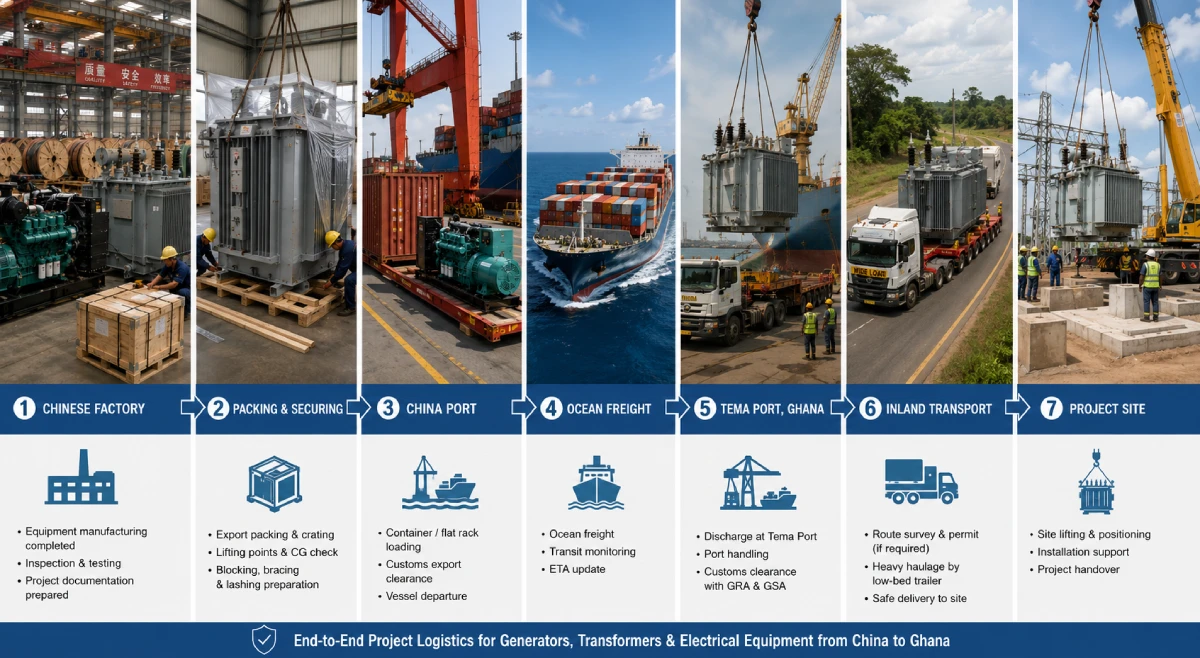
From Chinese Factory to Tema to the Project Site
A project shipment should be planned as one continuous chain:
Factory technical release → Packing and securing → China pickup → Port loading → Ocean freight → Tema discharge → Customs and compliance → Inland transport → Site lifting
Tema Port handles containerized cargo as well as general cargo and machinery or equipment, but that does not mean a particular transformer or generator lift is automatically covered by standard terminal handling. The handling method should be confirmed for the actual cargo.
For heavy inland cargo, assess:
- Loaded height
- Overall width and length
- Gross transport weight
- Axle-load distribution
- Trailer configuration
- Bridge and route constraints
- Overhead clearance
- Turning radius
- Project-site access
A low-bed or other specialized trailer may be required, but equipment weight alone should not determine that decision.
The Ghana Highway Authority publishes information on axle-load, gross-weight and dimension controls. Shipment-specific abnormal-load, route or permit requirements should therefore be verified with the relevant Ghana authority and local heavy-haul provider before movement.
Heavy-Lift Responsibility Matrix
| Party | Main Responsibility |
|---|---|
| Manufacturer | Weight, center of gravity, lifting points, transport condition |
| Packing company | Crate/skid, blocking, moisture protection |
| Securing contractor | Lashing and securing arrangement |
| Freight forwarder | Mode, routing and carrier coordination |
| Ocean carrier | Container/OOG technical acceptance |
| Tema terminal/stevedore | Port discharge and handling |
| Customs/GRA | Customs classification and release |
| GSA | Applicable standards and conformity process |
| Energy Commission | Applicable cable/accessory requirements |
| Ghana haulier | Vehicle and inland transport planning |
| Site crane/rigging contractor | Final lift and placement |
| Buyer/EPC | Project specifications and site readiness |
Responsibilities should be defined before shipping rather than after cargo reaches Tema.
What Winsail Needs for a Project Logistics Quote
A useful heavy electrical equipment quotation needs more than cargo volume.
Equipment
- Equipment type
- Manufacturer and model
- Quantity
- Datasheet
- Packing list
Dimensions
- Final packed L × W × H
- Gross weight
- Base dimensions
- Support-point positions
Heavy Lift
- Center of gravity
- Lifting-point drawing
- Transport orientation
- Crate and equipment photos
Fluids and Batteries
- Fuel status
- Oil
- Coolant
- Insulating liquid
- DEF
- Battery chemistry
- SDS where relevant
Route
- Factory address in China
- Preferred loading port
- Tema delivery requirement
- Final Ghana project location
- Incoterm
- Required delivery date
- Crane or unloading availability at destination
For general market freight references, use the dedicated guide to shipping costs from China to Ghana rather than applying standard container rates directly to heavy electrical equipment.
Plan the Shipment Before the Equipment Leaves the Factory
The most expensive problems in industrial equipment shipping are often created before the vessel is booked.
A transformer may already be packed without suitable lifting information. A generator may arrive at the warehouse with undeclared fuel or batteries. A cable drum may be loaded without adequate rolling restraint. An oversized unit may reach Tema before anyone has confirmed the inland route or site lifting method.
The better sequence is:
Identify the equipment → Confirm technical specifications → Determine transport condition → Design packing and securing → Check Ghana compliance → Select shipping equipment → Confirm Tema handling → Plan inland delivery
When these decisions are made using actual manufacturer data rather than assumptions, shipping generators, transformers, cable drums and other heavy electrical equipment from China to Ghana becomes much easier to control from the factory floor through to the final project site.
FAQ
Can a generator from China be shipped to Ghana in a 20GP?
Yes, some generators can be shipped in a 20GP, but suitability depends on packed dimensions, gross weight, support footprint, center of gravity, loading method and the limits of the actual container and booking. Weight alone is not enough to make the decision.
Must fuel, oil and coolant be drained from a generator before shipping?
Not under one universal rule. The exact generator model, fluids present, manufacturer's transport instructions and carrier requirements should be checked before deciding how the unit must be prepared.
Can a transformer be shipped with insulating oil inside?
Possibly. The correct condition depends on transformer design and manufacturer transport instructions. Obtain the OEM requirements, SDS, liquid quantity and actual transport condition before carrier review.
When is a flat rack needed for a transformer or generator?
A flat rack may be considered when cargo is over-width or over-height, requires top or side loading, or cannot practically be loaded and supported inside a closed container. Final use depends on carrier technical acceptance.
How should cable drums be secured?
Cable drums should be restrained against rolling, lateral movement and tipping using a securing arrangement designed around the actual drum weight, diameter, support areas and transport configuration.
Do wooden crates for electrical equipment need ISPM 15?
Relevant raw-wood packaging, pallets, dunnage, chocks and wooden drums may fall within ISPM 15. Qualifying processed wood such as plywood is treated differently, so the complete packaging construction should be checked rather than only the outer panels.
Do electrical cables require special Ghana compliance checks?
Electrical wiring cables and wiring accessories within the scope of Ghana's L.I.2478 require specific Energy Commission attention in addition to applicable Ghana Standards requirements. The precise product scope should be verified before shipment.
What information is needed to quote heavy electrical equipment to Ghana?
At minimum, provide the datasheet, packing list, final packed dimensions, gross weight, support footprint, center of gravity, lifting points, packaging photos, liquid and battery information, China pickup location and final Ghana delivery location.
