

If you are importing electrical equipment, machinery, electronics, PPE, toys or other regulated products from China, one question often comes up before shipment:
Does the product need CE marking, UKCA marking, or both?
The answer in 2026 is more nuanced than many older Brexit guides suggest.
There is no general rule that all products imported into Great Britain must carry UKCA marking. For many regulated product categories, Great Britain continues to recognise CE marking, while UKCA remains an available conformity route. Some products follow separate sector rules, and some products do not require either CE or UKCA marking at all. GOV.UK guidance on placing UKCA or CE marked products on the market in Great Britain therefore requires businesses to identify the relevant product regulations rather than applying one marking rule to every imported product.
Northern Ireland is different again. Relevant EU manufactured-product rules continue to apply there under the Windsor Framework, meaning CE—and in specific circumstances CE together with UKNI—remains important. See the GOV.UK guidance on placing CE or CE and UKNI marked products on the market in Northern Ireland.
For a UK importer buying from China, the practical question should therefore not start with:
“Does my supplier have CE?”
It should start with:
What is the product, where will it be sold, which regulations apply, what conformity procedure is required, and do the finished product and documents actually meet those requirements?
This guide explains that process from an importer and shipping perspective. It is not legal or product-certification advice.
For broader freight methods, transit times, costs, customs procedures and route planning, see our Shipping from China to the UK guide.
Quick Answer: Does the UK Accept CE Marking on Chinese Products in 2026?
Yes, CE marking continues to be accepted for many products placed on the Great Britain market in 2026—but not because the product comes from China, and not as a universal rule covering every product.
The Product Safety and Metrology etc. (Amendment) Regulations 2024 introduced continued recognition of EU requirements across 21 product areas. Current GOV.UK guidance shows UKCA or CE as available GB marking routes for many common categories, including electrical equipment, electromagnetic compatibility, machinery, radio equipment and toys. See the official regulatory changes guidance.
However:
- not every product requires CE or UKCA marking
- a single product can fall under several regulations
- special sectors may follow separate arrangements
- GB and Northern Ireland are not the same market for product-marking purposes
- having a CE logo on the product does not by itself prove regulatory compliance
- the conformity-assessment route can vary according to the product and regulation
A useful starting point is:
| Situation | Initial Direction |
|---|---|
| Product does not fall within a conformity-marking regime | Do not add CE or UKCA simply because it is imported |
| Product falls within a GB regime recognising relevant EU requirements | CE may be available; UKCA may also be available |
| Manufacturer chooses the UKCA route | Check applicable GB legislation and conformity-assessment requirements |
| Product will be placed on the Northern Ireland market | Check CE / CE+UKNI requirements and NI sector guidance |
| Mandatory third-party assessment applies | Confirm which recognised conformity-assessment body is appropriate |
| Medical device, construction product, marine equipment or another specialist product | Use the dedicated sector guidance rather than generic CE/UKCA advice |
The safest sequence is: product → market → regulation → conformity assessment → marking and documentation → shipping.
Does Great Britain Still Accept CE-Marked Products from China?
For many product categories, yes.
Great Britain means England, Scotland and Wales. Current Department for Business and Trade guidance states that, where the relevant UK legislation recognises EU requirements, CE continues to be recognised alongside or in place of UKCA.
This is an important change from older Brexit guidance that predicted UKCA would become the only acceptable marking for most relevant products after a fixed transition deadline.
For example, current official sector guidance lists both UKCA or CE for GB in categories including:
- electrical equipment
- electromagnetic compatibility
- machinery
- radio equipment
- personal protective equipment
- toys
- pressure equipment
- gas appliances
See the GOV.UK product regulations by sector table.
But “CE is accepted in Britain” is still too broad to use as an import rule.
CE Recognition Depends on the Product Regime
Conformity marking is required only when the relevant sector legislation requires it. GOV.UK specifically states that not all products need a conformity marking, and it is common for several regulations to apply to one product.
Consider a wireless electrical product sourced from Shenzhen.
Depending on its design and intended use, the importer may need to investigate several areas rather than looking only for one generic “CE certificate,” such as:
- electrical safety
- electromagnetic compatibility
- radio equipment requirements
- restrictions on hazardous substances
- other product-specific requirements
The exact combination depends on the product.
That is why the supplier’s description—“Bluetooth device,” “LED light” or “industrial machine”—is not enough to determine compliance.
You need the exact model, specifications, functions and intended application.
First Check Whether the Product Actually Needs CE or UKCA
One of the most common importing mistakes is assuming:
Made in China + sold in Britain = UKCA required.
That is not how the system works.
CE and UKCA are conformity markings attached to particular regulatory regimes. The country of manufacture does not itself create the marking requirement.
Some products fall outside ordinary CE/UKCA regimes. Others may require different markings or regulatory procedures.
The first task is therefore to identify the product accurately.
Define the Product Before Checking the Mark
Before asking a supplier about compliance, establish details such as:
- exact model or SKU
- product function
- intended use
- electrical rating
- radio or wireless functions
- materials and components
- intended user
- installation environment
- whether it forms part of another machine or system
- whether you will sell it under your own brand
This matters because products that look commercially similar can have different regulatory requirements.
One Product Can Trigger Multiple Regulations
GOV.UK explicitly notes that it is common for multiple regulations to apply to one product. A conformity mark can only be applied appropriately once the product satisfies all relevant requirements under the chosen conformity route.
That makes a simple supplier statement such as “we have CE” insufficient for serious commercial importing.
You need to know what regulations and what exact product that declaration covers.
Great Britain vs Northern Ireland: Choose the Market Before the Mark
Before approving packaging, labels or conformity documents with a Chinese manufacturer, determine where the goods will actually be placed on the market.
England, Scotland and Wales: Great Britain
For many common manufactured-product regimes, businesses currently have flexibility to use either an accepted CE route or UKCA route for the GB market.
Current official examples include electrical equipment, EMC, machinery and several other product categories.
This does not mean that CE and UKCA documentation can simply be swapped.
UKCA relates to applicable GB requirements. CE relates to applicable EU requirements recognised for the relevant GB regime.
The standards and technical requirements can also diverge over time.
Northern Ireland
Northern Ireland must be treated separately.
Under the Windsor Framework, relevant EU rules for manufactured products continue to apply in Northern Ireland. For products covered by the CE regime, CE is therefore generally the relevant marking route.
If mandatory third-party conformity assessment is required and a Northern Ireland notified body based in the UK is used, the product must generally carry:
CE + UKNI
The UKNI mark is never used by itself.
If an EU Notified Body performs the applicable EU third-party assessment, CE without UKNI may apply under the relevant regime.
What If You Plan to Sell in Both GB and Northern Ireland?
Do not automatically instruct the Chinese factory to “put CE and UKCA on everything.”
First determine:
- which regulations apply in GB
- which rules apply in Northern Ireland
- which conformity-assessment route is being used
- whether third-party assessment is required
- whether the evidence supports each marking being applied
Products can carry multiple markings where permitted and where the corresponding requirements have genuinely been met. GOV.UK allows multiple markings where applicable, but a marking should not be treated as a decorative label.
CE vs UKCA Decision Tree for Importers Buying from China
A better way to solve the CE vs UKCA question is to follow five steps.
Step 1: What Exactly Is the Product?
Identify:
- product category
- model
- technical characteristics
- intended use
- target customer
- applicable safety or performance functions
Do not base the decision only on the commercial product name shown on Alibaba, a quotation or commercial invoice.
Step 2: Is the Destination GB or Northern Ireland?
For product compliance purposes:
GB = England + Scotland + Wales
NI = Northern Ireland
This distinction should be made before production labels and packaging are finalised.
Step 3: Which Regulations Apply?
Check the current GOV.UK sector guidance for the exact product.
One finished product may fall within several regulatory regimes.
Step 4: Is Self-Declaration Allowed?
Not every CE- or UKCA-marked product requires an independent certification body.
Under certain GB regulations, manufacturers can self-declare conformity. Current GOV.UK examples include all products within the Electrical Equipment (Safety) Regulations and EMC Regulations, while other regimes or product categories can require third-party assessment.
Therefore, asking only for a “CE certificate” can sometimes reveal that the buyer does not yet understand the applicable conformity route.
The more useful question is:
What conformity procedure applies to this exact product?
Step 5: What Marking and Documents Follow From That Route?
Possible outcomes could include:
- no CE/UKCA conformity mark
- CE
- UKCA
- CE + UKNI
- another sector-specific marking
- a specialist regulatory route
Only after these five questions have been answered should the importer treat the conformity-marking plan as reasonably defined.
CE, UKCA and UKNI for Common Products Imported from China
The following table is a starting point only, based on current 2026 government sector guidance. The exact regulation and product design still need to be checked.
For electrical goods specifically, the electronics shipping and compliance guide combines freight choices with batteries, RoHS and product-compliance checks.
| Product / Regulatory Area | Great Britain | Northern Ireland | Importer Note |
|---|---|---|---|
| Electrical equipment | UKCA or CE | CE / CE+UKNI where applicable | Other regulations such as EMC or RoHS may also apply |
| Electromagnetic compatibility | UKCA or CE | CE / CE+UKNI where applicable | Often applies alongside other product legislation |
| Radio equipment | UKCA or CE | CE / CE+UKNI where applicable | Important for Wi-Fi, Bluetooth and other radio-enabled products |
| Machinery | UKCA or CE | CE / CE+UKNI where applicable | Conformity route depends on machinery type and applicable procedures |
| PPE | UKCA or CE | CE / CE+UKNI where applicable | Assessment requirements vary by PPE category |
| Toys | UKCA or CE | CE / CE+UKNI where applicable | Product safety obligations go beyond simply displaying the mark |
| Construction products | UKCA or CE under the current framework | Separate NI arrangements apply | UK construction-product regulation is undergoing reform |
| Medical devices | Specialist UKCA / CE transitional arrangements | Separate NI medical-device regime | Always use current MHRA guidance |
This table should never replace checking the current government guidance for the exact product.
CE vs UKCA: What Actually Changes for an Importer?
For an importer, the important differences are not the shapes of the two logos. They involve the regulatory route behind them.
Legal Requirements and Standards
For the UKCA route, compliance is assessed against applicable GB legislation.
Great Britain uses designated standards, which can provide a presumption of conformity with particular essential requirements.
The CE route uses relevant EU legislation and harmonised standards.
For many products these systems remain closely aligned, but importers should not assume they will always remain identical.
GOV.UK specifically warns that where an EU harmonised standard and a GB designated standard differ—or where a GB standard has been restricted—additional technical evidence may be necessary for some CE-marked products being placed on the GB market. In certain product regulations, stricter conformity-assessment procedures can also apply.
So the correct question is not merely:
“Does Britain still recognise CE?”
It is also:
“Does the product satisfy the currently applicable requirements under the CE route being relied upon?”
Self-Declaration vs Third-Party Conformity Assessment
A CE logo does not automatically mean an independent laboratory or notified body “certified” the product.
Some regulations allow the manufacturer to self-declare conformity.
Other products require third-party assessment.
For the GB UKCA route, UK conformity assessment bodies performing relevant third-party assessments are known as UK Approved Bodies. EU conformity assessment organisations used under applicable CE procedures are generally Notified Bodies.
Before accepting a certificate from a supplier, check:
- whether third-party assessment was actually required
- which body issued the certificate
- whether that body is recognised for the relevant scope
- whether the certificate covers the exact product model
Fast-Track UKCA
Great Britain also has a Fast-Track UKCA route.
Under relevant regulations, manufacturers can use recognised EU essential requirements and conformity-assessment procedures as part of the process for applying UKCA marking. See the GOV.UK Fast-Track UKCA guidance.
This is another reason the modern CE-vs-UKCA framework should not be described as two completely isolated systems.
For most importers, however, the practical priority remains the same: determine the relevant regulation and obtain evidence supporting the chosen route before goods leave China.
What Documents Should You Ask Your Chinese Supplier For?
One of the weakest purchasing questions is:
Use the UK import documents checklist to prepare the commercial, transport, customs and product-specific paperwork before departure.
“Do you have CE?”
A supplier may respond with a photograph of the CE logo, a test report for a different model, an expired document or a certificate that does not address the regulations applying to the finished product.
A better supplier compliance request starts with the exact model you intend to purchase.
Declaration of Conformity
Where the applicable regulations require a Declaration of Conformity, obtain the declaration covering the exact product.
Depending on the regime, it may include information such as:
- manufacturer name and address
- product model, serial number or type
- applicable legislation
- relevant standards or technical specifications
- conformity-assessment body details where applicable
- responsible signatory
- issue date
GOV.UK describes the Declaration of Conformity as the formal manufacturer statement that the product complies with applicable legislation.
Technical and Test Evidence
Depending on the product and regulation, relevant technical documentation may include:
- test reports
- design documentation
- risk assessments
- conformity-assessment certificates where required
- technical specifications
- supporting evidence required by the applicable legislation
GOV.UK’s current GB guidance specifically identifies test reports, design documents and risk assessments as common components of a technical file.
The importer may not always receive the manufacturer’s entire confidential technical file, but the importer should ensure that the required documentation exists and that its own document-retention obligations are understood.
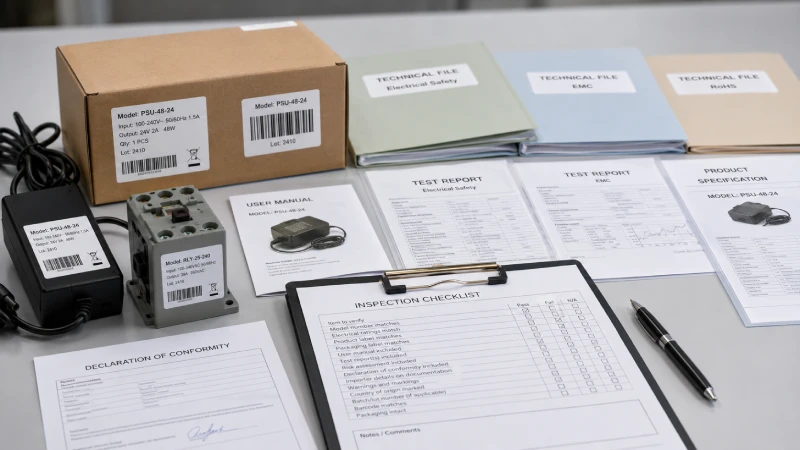
Check the Finished Product, Not Just the PDF
Before approving a shipment, compare:
product model → Declaration of Conformity → test evidence → product label → packaging → user instructions
They should tell the same story.
Common red flags include:
| Document / Item | What to Check | Red Flag |
|---|---|---|
| Declaration of Conformity | Exact manufacturer and model | Generic declaration with no model reference |
| Test report | Exact product/specification | Report covers a “similar” product |
| Third-party certificate | Body, scope and product | Unknown issuer or irrelevant assessment scope |
| Rating/product label | Model, manufacturer, markings | Different model from documentation |
| Instructions | Appropriate English information where required | Supplier provides Chinese-only instructions |
| Packaging | Importer/manufacturer details where applicable | Final artwork does not match approved compliance plan |
Pro Tip: Ask for the conformity documentation before paying the final production balance, not after the container has been booked.
Private-Label Importers Need Extra Caution
Many UK importers buy OEM or ODM products from Chinese factories and sell them under their own brand.
That can materially affect regulatory responsibilities.
Current GOV.UK guidance states that where an importer places a product on the market under its own name or trademark, or modifies the product in a way that affects conformity, it may assume the responsibilities of the manufacturer.
That makes it particularly risky to rely automatically on paperwork prepared for another customer’s version of the product.
For private-label purchasing, confirm whether changes have been made to:
- brand
- enclosure
- components
- electrical specifications
- firmware
- accessories
- intended use
- packaging
- warnings or instructions
Even apparently minor changes may require review against the applicable conformity documentation.
What Responsibilities Does the UK Importer Have?
Importers should not view product compliance as solely the Chinese factory’s responsibility.
For GB product regulations, GOV.UK defines an importer broadly as a UK-established individual or business that supplies a product from outside the UK for commercial distribution, consumption or use.
Current guidance lists importer responsibilities that can include:
- confirming the manufacturer followed the required conformity procedures
- checking required technical documentation exists
- ensuring the correct marking has been applied
- fulfilling importer identification obligations
- retaining relevant documentation
- ensuring storage or transportation does not jeopardise compliance
- monitoring conformity issues
- cooperating with market-surveillance authorities
- maintaining contact with the manufacturer
The precise duties depend on the applicable product regulation.
Importer Identification and Traceability
Importer details are another issue that should be checked before packaging is printed.
Current GB guidance states that manufacturers and importers must provide relevant identification details, including name or trade name/trademark and postal address, subject to the rules of the applicable product regime.
Do not assume that putting a UK warehouse address on an invoice automatically satisfies a product-law requirement.
Confirm:
- who is legally fulfilling the importer role
- what information must appear
- where it must appear
- whether the sector regulation allows information on packaging or accompanying documentation
This is especially important when using Amazon fulfilment, a 3PL warehouse, a distributor or a door-to-door shipping arrangement.
DDP Shipping Does Not Automatically Solve Product Compliance
Importers sometimes assume that if a Chinese supplier or logistics provider offers DDP shipping, responsibility for CE or UKCA compliance has also been transferred.
That assumption is unsafe.
Incoterms, customs representation and product-safety legislation address different issues.
A shipment may involve separate parties acting as:
- seller
- buyer
- customs declarant or customs representative
- consignee
- product-law importer
- distributor
- authorised representative
These roles should not be assumed to be identical.
For regulated goods, DDP feasibility should therefore be reviewed according to the actual importer structure, VAT treatment, customs representation, commodity, product requirements and final-delivery arrangement.
Winsail should not be assumed to act as the UK importer of record or product compliance representative merely because a door-to-door freight solution is being discussed.
Why Product Compliance Should Be Checked Before Freight Is Booked
Product compliance is primarily a pre-production and pre-shipment issue, not something that should first be investigated when the container reaches Felixstowe or the air shipment arrives at Heathrow.
A better sequence is:
1. Approve the exact product specification
↓
2. Confirm GB, Northern Ireland or both as the destination market
↓
3. Identify applicable product regulations
↓
4. Determine conformity-assessment requirements
↓
5. Review supplier documentation
↓
6. Approve marking, importer information, packaging and instructions
↓
7. Confirm cargo-specific shipping requirements
↓
8. Book freight
This sequencing can prevent an importer from discovering too late that the commercial stock differs from the model covered by the supplier’s documents.
What the Freight Forwarder May Need
For transportation planning, the freight forwarder may need information such as:
- accurate cargo description
- quantity
- gross weight and dimensions
- pickup location
- UK destination
- packaging type
- battery content
- dangerous-goods classification where relevant
- supporting transport documents
- consignee/importer details
Product-compliance documents and customs documents can overlap operationally in some shipments, but they are not the same thing.

Customs Clearance Is Not the Same as Product Compliance
CE and UKCA requirements should also be kept separate from customs classification.
For the declaration and cargo-protection side of the shipment, Winsail’s customs and cargo-insurance support can be coordinated separately from conformity assessment.
A UK import declaration requires the goods to be classified using the appropriate commodity code. The UK Trade Tariff uses commodity classification to identify matters such as Customs Duty, VAT treatment and applicable tariff measures or documentary controls.
For imports into England, Scotland or Wales, a business involved in the import process will normally need the appropriate GB EORI arrangements. Goods moving to or from Northern Ireland may involve an XI EORI depending on the circumstances. See the GOV.UK EORI guidance.
These are customs questions.
They do not answer:
“Is this product legally compliant with the product regulations under which CE, UKCA or another marking applies?”
Similarly, customs clearance does not itself certify that a product conforms to applicable product-safety legislation.
Special Product Regimes Where Generic CE vs UKCA Advice Can Be Dangerous
Some products should never be handled using a generic “CE or UKCA?” checklist alone.
Medical Devices
Medical devices have a separate regulatory framework administered by the Medicines and Healthcare products Regulatory Agency (MHRA).
As of September 2026, current official guidance still provides transitional acceptance of qualifying CE-marked medical devices in Great Britain until 30 June 2028 or 30 June 2030, depending on the type of device and EU legislation relied upon. Medical devices also have additional requirements such as MHRA registration, and non-UK manufacturers placing devices on the GB market generally need a UK Responsible Person. See the GOV.UK medical device guidance.
The government has been developing further medical-device regulatory reform, so this area should be checked against the latest MHRA position immediately before relying on it for a live shipment.
Needs confirmation before publishing: Recheck MHRA guidance immediately before publication or whenever this article is substantially updated.
Construction Products
Construction products also have a specialist framework.
The UK government has committed to continued CE recognition for construction products while the regulatory system is reformed. Because this area remains subject to active policy development, importers should use the current construction-products guidance rather than assuming the ordinary CE/UKCA rules for electrical equipment or machinery apply unchanged.
Needs confirmation before publishing: Check current GOV.UK construction-products guidance before giving product-specific advice.
Other Specialist Products
Additional dedicated rules may apply to areas such as:
- marine equipment
- rail products
- transportable pressure equipment
- cableways
- drones and uncrewed aircraft
- aerosols
Do not extrapolate rules for electrical equipment or machinery to specialist product sectors.
Common CE and UKCA Mistakes When Buying from China
Mistake 1: “The Supplier Put a CE Logo on It, So It Is Compliant”
A printed logo is not a substitute for determining which legislation applies and whether the required conformity procedure has been completed.
Mistake 2: “The Factory Has a CE Certificate”
Ask:
- for which exact model?
- against which legislation?
- what assessment procedure was required?
- who issued the document?
- is a third-party certificate even required for that product?
- does the Declaration of Conformity match the goods you are purchasing?
Mistake 3: Using Test Reports from a Similar Product
A report for Model A does not automatically support Model B simply because the casing looks the same.
Check specifications and product identity.
Mistake 4: Assuming GB and Northern Ireland Have Identical Rules
They do not.
Confirm the destination market before approving conformity labels.
Mistake 5: Checking Documents After the Vessel Has Departed
If labels, instructions or documentation need correction, discovering the problem while the goods are already in transit can significantly reduce your options.
Mistake 6: Assuming the Freight Forwarder Certifies Compliance
Freight forwarding and product conformity assessment are different services.
Winsail Logistics does not certify CE, UKCA or UKNI compliance.
Mistake 7: Using Another Buyer’s Compliance File for Your Private-Label Product
If the product is being sold under your own brand or has been modified, review whether your regulatory responsibilities or conformity documentation have changed.
Pre-Shipment CE / UKCA Checklist for Imports from China
Before releasing regulated products for shipment, work through this checklist.
Product and Market
- Exact model and intended use confirmed
- Final market confirmed as GB, Northern Ireland or both
- Applicable product regulations identified
- Confirmed whether conformity marking is actually required
Conformity Route
- Appropriate CE / UKCA / CE+UKNI / specialist route identified
- Self-declaration versus third-party assessment confirmed
- Relevant assessment body verified where required
- Any product-specific sector requirements reviewed
Supplier Documentation
- Declaration of Conformity reviewed where applicable
- Exact model matches documentation
- Relevant test reports are available
- Third-party certificates checked where required
- Product label matches the approved model
- Manufacturer identification is correct
- Importer/economic-operator information has been reviewed
- English instructions and safety information are available where required
Shipping and Customs
- Commodity code separately reviewed
- Import licences or controls checked where applicable
- Battery or dangerous-goods status confirmed
- Commercial invoice and packing list prepared accurately
- Importer/consignee/customs arrangements confirmed
- Freight method and UK delivery arrangement finalised
Pro Tip: Treat compliance approval as a production milestone. Ideally, documentation and label artwork should be checked before mass production is released—not after cartons reach the freight forwarder’s warehouse.
Can Winsail Help with CE or UKCA Shipments from China?
Winsail Logistics is a China-based freight forwarder. We can coordinate international freight and China-side logistics arrangements for commercial shipments to the UK, depending on the cargo and agreed service scope.
For a planned shipment, useful information normally includes:
- product description
- pickup city in China
- number of cartons or pallets
- weight and dimensions
- battery or dangerous-goods information where relevant
- GB or Northern Ireland destination
- consignee/importer arrangements
- preferred freight method or delivery requirement
Depending on the shipment, customs clearance and final delivery can also be coordinated where applicable.
However:
Winsail Logistics does not certify CE, UKCA or UKNI compliance and does not provide legal or product-certification advice.
We do not automatically act as the UK importer of record, conformity-assessment body or regulatory representative.
Where specialist product interpretation is required, the manufacturer or importer should consult the relevant GOV.UK authority, an appropriate conformity-assessment body, trade association or qualified product-compliance adviser.
If you are still planning the overall route, compare sea freight, air freight, door-to-door options, customs processes and transit times in our Shipping from China to the UK guide before finalising your shipment.
FAQs
Does the UK still accept CE marking in 2026?
Yes. Great Britain continues to recognise CE marking for many product regimes in 2026, while UKCA remains available. However, recognition is sector-specific, and some products follow separate rules. Always check the current GOV.UK product-sector guidance for the exact product.
Do products imported from China need UKCA marking?
Not automatically. The fact that a product comes from China does not itself create a UKCA requirement. You first need to identify the product, destination market and applicable product regulations.
Can I sell a CE-marked Chinese product in Great Britain?
Potentially, if the product falls within a regime where the CE route is recognised and the product genuinely complies with all applicable requirements. A CE logo alone is not enough.
What is the difference between CE, UKCA and UKNI?
CE is the EU conformity marking used under applicable EU product regulations and is also recognised for many product regimes in Great Britain. UKCA is the GB conformity marking. UKNI is used in Northern Ireland in specific UK third-party-assessment situations and must accompany CE; it is never used alone.
Does Northern Ireland require CE or UKCA?
For products within the relevant CE regime, Northern Ireland generally follows applicable EU product rules under the Windsor Framework. CE is therefore central to the NI route, with CE+UKNI applying in certain UK third-party-assessment situations.
Does CE marking guarantee that UK customs will clear my shipment?
No. Product conformity and customs clearance are separate regulatory processes. Customs procedures involve commodity classification, declarations, EORI arrangements, duty, VAT and any applicable controls, while CE or UKCA relates to product conformity requirements.
What should I get from my Chinese supplier before shipping?
Depending on the product, request and review the appropriate Declaration of Conformity, test evidence, technical information, third-party certificates where required, product labels, manufacturer details, importer information, packaging and English instructions. Confirm that the documentation covers the exact model being shipped.
Final Takeaway
For importers buying commercial products from China, CE vs UKCA is no longer a simple Brexit deadline question.
The practical 2026 approach is:
- Identify the exact product.
- Decide whether it will be sold in GB, Northern Ireland or both.
- Identify every applicable product regulation.
- Determine whether self-declaration or third-party conformity assessment is required.
- Confirm the correct marking and documentation.
- Match those documents to the actual production goods.
- Confirm importer and customs arrangements.
- Then release the shipment for freight booking.
For many common product regimes in Great Britain, recognised CE and UKCA routes are both available in 2026. Northern Ireland follows a different framework, and specialist sectors such as medical devices and construction products require their own current guidance.
The biggest practical mistake is therefore not choosing CE instead of UKCA—or UKCA instead of CE.
It is shipping first and investigating product compliance later.
Winsail Logistics can coordinate freight from China to the UK subject to cargo review and the agreed service scope, but product conformity remains the responsibility of the relevant manufacturer, importer and other regulated economic operators.
Continue with related UK shipping guides
Use these focused guides for the next part of your China-to-UK shipping plan.
