
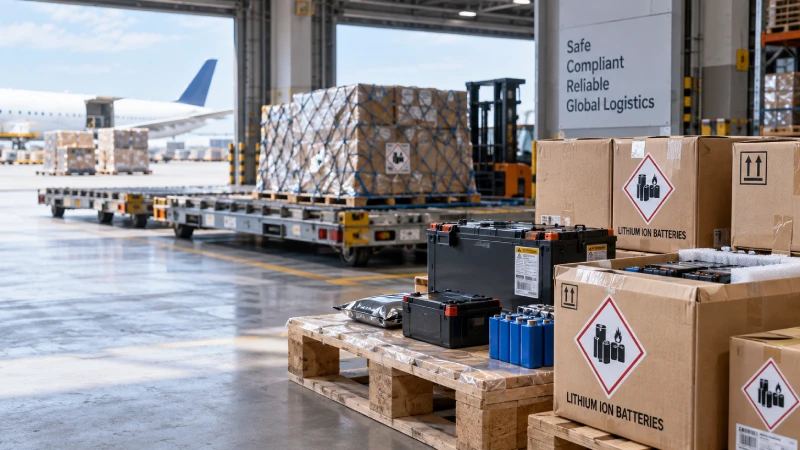
Shipping lithium batteries from China to the UK is possible, but the booking process is very different from shipping ordinary commercial cargo. The correct route depends on the battery chemistry, Watt-hour rating or lithium content, battery condition, how the battery is packed, and whether the selected airline, shipping line, courier and handling facilities will accept that specific dangerous-goods profile.
A lithium battery shipment therefore should not start with the question, “Is air or sea cheaper?” It should start with classification.
For broader information on standard freight methods, shipping costs, transit times, UK ports, airports and customs planning, see our Shipping from China to the UK guide. This article focuses specifically on lithium battery and dangerous-goods shipping.
Quick Answer: Can You Ship Lithium Batteries from China to the UK?
Yes. Lithium batteries can be shipped from China to the UK by air freight, sea freight and, for some qualifying shipments, express courier. However, not every lithium battery can travel by every method.
The first distinction is whether the shipment contains lithium-ion or lithium-metal batteries and whether the batteries are shipped alone, packed with equipment, or contained in equipment. These distinctions determine the applicable UN number and, for air freight, the relevant IATA Packing Instruction.
Standalone lithium-ion batteries classified as UN3480 and standalone lithium-metal batteries classified as UN3090 are forbidden as normal cargo on passenger aircraft. They may instead require a suitable cargo-aircraft route and carrier acceptance. Current 2026 IATA rules also impose important State of Charge requirements on standalone lithium-ion batteries and lithium-ion batteries packed with equipment. See the IATA 2026 Lithium Battery Guidance Document.
Sea freight can be a more practical option for larger or less time-sensitive battery consignments, but lithium batteries do not become ordinary cargo simply because they move by vessel. Sea shipments remain subject to the IMDG Code, carrier DG approval, correct packaging, marking and documentation. The IMDG Code 2024 Edition incorporating Amendment 42-24 became mandatory on 1 January 2026.
The safest starting point is:
Battery chemistry → packing configuration → UN number → Wh/lithium content → UN38.3 status → packing → carrier acceptance → UK import requirements.
First Identify What Lithium Battery You Are Shipping
A quotation that simply describes the cargo as “battery,” “electronics” or “products with batteries” does not provide enough information to determine a transport route.
Lithium-ion vs lithium-metal batteries
Lithium-ion batteries are normally rechargeable and are widely used in laptops, mobile phones, power tools, consumer electronics and industrial equipment. Lithium-polymer batteries are treated within the lithium-ion category for IATA purposes.
Lithium-metal batteries are generally primary, non-rechargeable batteries and are common in items such as watches, sensors, key fobs and some medical or electronic devices. IATA separates lithium-ion and lithium-metal batteries because they use different UN classifications and packing instructions.
For lithium-ion cargo, the Watt-hour rating is an important screening parameter. For lithium-metal batteries, the lithium content in grams is relevant.
Do not assume that voltage alone is enough to classify the battery.
Batteries alone, packed with equipment or contained in equipment
This distinction is one of the most common causes of incorrect battery declarations.
| Configuration | Typical example | Lithium-ion UN number |
|---|---|---|
| Batteries shipped alone | Replacement laptop battery packs | UN3480 |
| Batteries packed with equipment | Camera supplied with a separate battery in the same package | UN3481 |
| Batteries contained in equipment | Battery installed in a laptop | UN3481 |
For lithium-metal batteries, the corresponding classifications are UN3090 for batteries shipped alone and UN3091 for batteries packed with or contained in equipment.
“Packed with equipment” has a specific meaning. The battery must be packed with the device or apparatus it is intended to power. IATA notes that a box containing lithium-ion batteries together with only a charger, AC adaptor or cables is not automatically UN3481 packed with equipment; in that situation the batteries may still need to be treated as UN3480.
Power banks also need particular attention. IATA treats power banks primarily designed to provide power to another device as batteries, not equipment. A lithium-ion power bank is therefore normally classified as UN3480 rather than automatically becoming UN3481 because it is shipped near a phone or other electronic product.
Check the battery condition before planning transport
New and undamaged commercial batteries are very different from batteries that are swollen, damaged, recalled or being returned following a safety problem.
IATA states that lithium batteries identified by the manufacturer as defective for safety reasons, or damaged batteries capable of producing a dangerous evolution of heat, fire or short circuit, are forbidden for transport by air. This also applies when those batteries are installed inside equipment.
Used batteries are not automatically prohibited simply because they are used, but their condition and reason for transport must be established before booking.
Prototype batteries, low-production-run batteries, battery-powered vehicles, large battery systems and damaged or defective batteries should be treated as specialist cases rather than forced into a normal UN3480 or UN3481 quotation.
UN3480, UN3481, UN3090 or UN3091: Which Classification Applies?
For commercial China–UK shipments, the following table provides a useful starting point.
| Battery | Configuration | UN number | Air Packing Instruction |
|---|---|---|---|
| Lithium-ion | Shipped alone | UN3480 | PI965 |
| Lithium-ion | Packed with equipment | UN3481 | PI966 |
| Lithium-ion | Contained in equipment | UN3481 | PI967 |
| Lithium metal | Shipped alone | UN3090 | PI968 |
| Lithium metal | Packed with equipment | UN3091 | PI969 |
| Lithium metal | Contained in equipment | UN3091 | PI970 |
IATA classifies lithium batteries as Class 9 miscellaneous dangerous goods for air transport. Even when a smaller battery qualifies for Section II provisions and receives relief from some packing, labelling or documentation requirements, that does not mean the battery has become normal non-dangerous cargo.
This is why the frequently used statement “anything under 100 Wh is general cargo” is misleading.
For lithium-ion batteries, 20 Wh per cell and 100 Wh per battery are important thresholds within the IATA classification and packing framework. For lithium-metal batteries, relevant small-cell/battery thresholds include 1 g lithium content per cell and 2 g per battery. These thresholds influence the applicable packing provisions, but they do not remove the need to identify the battery correctly.
UN38.3, SDS and the Documents to Check Before Booking
Battery documentation is another area where importers frequently receive conflicting advice.
Three documents are commonly mentioned together—UN38.3 information, an SDS/MSDS and the dangerous-goods declaration—but they do different jobs.
| Document | Main purpose | Important point |
|---|---|---|
| UN38.3 test summary | Shows the relevant cell/battery design type has met the required transport tests | Should match the actual battery/product model |
| SDS/MSDS | Provides safety/chemical information | Not itself an IATA transport document |
| Shipper’s Declaration for Dangerous Goods | Declares regulated DG for air shipments where required | Must follow the applicable IATA provisions |
What does UN38.3 mean?
UN38.3 refers to subsection 38.3 of Part III of the UN Manual of Tests and Criteria. Lithium battery designs must meet the applicable testing requirements before normal transport.
For practical shipment screening, the critical issue is not simply whether a supplier emails a file named “UN38.3.pdf.” The model and battery information should correspond to the battery or product actually being shipped.
IATA says manufacturers and subsequent distributors must make the relevant test summary available for applicable cells, batteries and equipment. The physical description and identifiers allow someone in the supply chain to determine whether the summary relates to the product presented for transport.
Does the UN38.3 test summary have to travel with every shipment?
Not necessarily.
IATA’s current guidance says the test summary must be made available on request and specifically notes that it does not support requiring a shipper to provide the test summary with every shipment. It may be supplied electronically, including through a website or other accessible method.
In practice, however, an airline, courier, freight forwarder, DG warehouse or other party in the transport chain may ask to review it before accepting the booking.
That operational request should not be confused with a rule saying the document must physically accompany every carton.
Is an SDS or MSDS mandatory for lithium battery shipping?
An SDS is frequently requested in international freight operations, but its regulatory role should be stated accurately.
IATA’s 2026 Battery Guidance Document says that neither the IATA DGR nor the regulatory requirements applicable to other modes of transport require an SDS simply when batteries are being offered for transport. IATA also states that an SDS is not a transport document.
A freight forwarder or carrier may nevertheless request an SDS during operational screening to help verify chemistry, specifications or internal DG acceptance criteria.
The important distinction is:
SDS does not replace UN38.3, and UN38.3 does not replace a Dangerous Goods Declaration where one is required.
Lithium Battery Air Freight from China to the UK
Air freight can be available for lithium batteries, but the correct question is not simply “Can lithium batteries fly?”
The answer depends on the UN number, battery size, configuration, State of Charge, Packing Instruction, package quantity and airline/operator policy.
UN3480: standalone lithium-ion batteries
Standalone lithium-ion cells and batteries move under UN3480 / PI965.
IATA’s 2026 guidance requires UN3480 lithium-ion batteries shipped by themselves to be offered at a State of Charge not exceeding 30% of their rated capacity under the ordinary provisions. A battery above 30% SoC requires the applicable State approvals under Special Provision A331.
UN3480 is also forbidden as normal cargo on passenger aircraft. PI965 Sections IA and IB therefore use Cargo Aircraft Only provisions.
This means an importer should never assume that a normal passenger-flight air-freight service will accept a carton of replacement lithium-ion battery packs simply because each pack is under 100 Wh.
The battery may still need a compatible cargo-aircraft route, suitable origin handling, compliant packaging and an operator willing to accept the shipment.
UN3481 packed with equipment: an important 2026 change
The 2026 rules introduced a particularly important change for lithium-ion batteries packed with equipment under PI966.
From 1 January 2026, PI966 Section I cells and batteries must normally be offered for air transport at no more than 30% of rated capacity. For Section II, cells or batteries above 2.7 Wh must also be offered at no more than 30% SoC. Batteries above the permitted SoC do not simply move as a routine exception; the relevant approval provisions apply.
This matters because many older battery-shipping guides were written before the change.
For example, a Chinese manufacturer shipping a cordless device together with its separate rechargeable battery cannot safely rely on an old 2024 or 2025 checklist without checking the 2026 PI966 rules.
UN3481 contained in equipment: not the same SoC rule
Lithium-ion batteries contained in equipment move under PI967, and the 2026 position is different.
IATA recommends that batteries contained in equipment be offered at no more than 30% SoC, or with an indicated battery capacity not exceeding 25%. However, its current guidance states that reduced State of Charge is not mandatory under these ordinary PI967 provisions and describes the reduction as a strongly recommended transport-safety measure.
This distinction is important.
It is therefore inaccurate to write:
“All lithium batteries shipped by air must be below 30% SoC.”
The correct requirement depends on how the battery is classified and which Packing Instruction applies.
An airline may also impose an operator variation stricter than the baseline IATA rule, so actual acceptance must still be confirmed before tendering the cargo.
UN3090 and UN3091 lithium-metal batteries
Standalone lithium-metal batteries are classified as UN3090 under PI968. Like standalone UN3480 lithium-ion batteries, UN3090 batteries are forbidden as normal cargo on passenger aircraft.
Lithium-metal batteries packed with equipment use UN3091 / PI969, while batteries contained in equipment use UN3091 / PI970. Lithium-metal classification is based on lithium content rather than applying the lithium-ion Wh and SoC framework directly.
Do not apply a “30% charge” rule designed for rechargeable lithium-ion cells to lithium-metal batteries simply because both are lithium batteries.
Regulatory compliance does not guarantee airline acceptance
A shipment can meet the applicable IATA requirements and still be rejected by a particular airline or service.
The practical sequence is:
regulatory classification → packing and documentation → operator variation → origin airport/handler acceptance → route availability → final booking acceptance.
That final operator layer is why lithium battery air freight should normally be pre-checked rather than booked in the same way as ordinary general cargo.
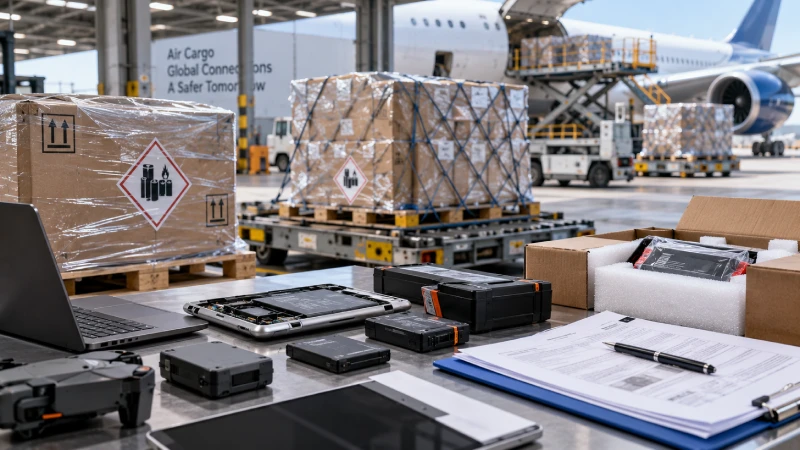
Lithium Battery Sea Freight from China to the UK
For larger commercial quantities, recurring stock replenishment or cargo that does not need urgent air delivery, sea freight may be worth evaluating.
As of 2026, the applicable maritime framework is the IMDG Code 2024 Edition incorporating Amendment 42-24, which became mandatory on 1 January 2026. See the International Maritime Organization’s IMDG Code page.
Sea freight removes the passenger-aircraft issue, but it does not remove the dangerous-goods classification.
The booking still has to be reviewed for the correct UN number, Proper Shipping Name, packaging, marks and labels, DG declaration or notification requirements, shipping-line acceptance and applicable port or transshipment restrictions.
FCL vs LCL for battery cargo
For larger DG consignments, FCL may offer a more controlled routing because the cargo does not need to be accepted into an LCL consolidation alongside cargo belonging to multiple other shippers.
LCL lithium battery shipping can be possible for qualifying cargo, but availability depends on more than the ocean carrier. The origin DG warehouse, consolidator, shipping line, transshipment arrangements and UK destination handling must all be able to accept the shipment.
A carrier accepting UN3481 in principle does not mean every LCL consolidation service from every Chinese city will accept that particular shipment.
This is why an LCL quote should be issued after reviewing the battery profile rather than by applying a normal general-cargo CBM rate.
Sea freight is not a workaround for damaged batteries
Importers should also avoid treating sea freight as a universal solution when batteries cannot fly.
Damaged, defective, recalled, waste or recycling batteries can fall under special and significantly more complex provisions. They require case-specific review under the current maritime and downstream road-transport rules.
They should not be booked as a normal commercial UN3480 or UN3481 shipment simply because the carrier is a vessel rather than an aircraft.
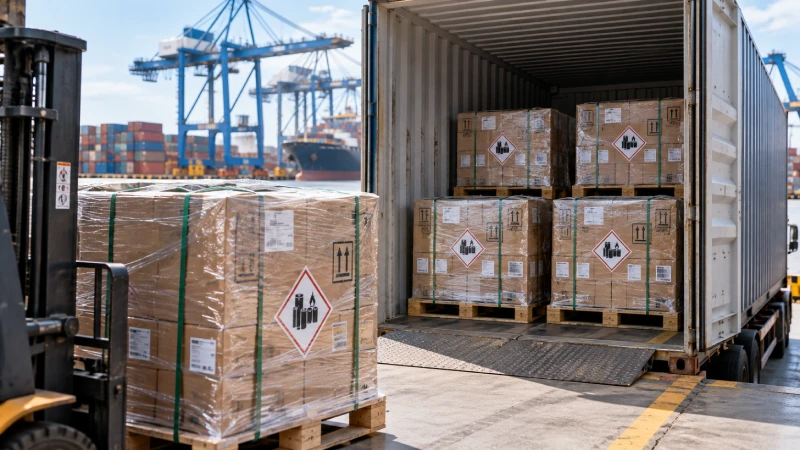
Can DHL, UPS or FedEx Ship Lithium Batteries from China to the UK?
Sometimes—but express does not mean exempt from dangerous-goods regulations.
Express shipments moving by air remain subject to the relevant air dangerous-goods framework plus the courier’s own operator rules, account requirements and route restrictions.
DHL states that lithium batteries are dangerous goods and that some, but not all, lithium-battery shipments are accepted. Acceptance may depend on the battery configuration, route, account and applicable service requirements. See DHL Express shipping guidance.
UPS also applies operator-specific requirements. Its dangerous-goods guidance shows that standalone UN3480 and UN3090 air shipments are subject to fully regulated dangerous-goods provisions rather than being treated as ordinary express parcels. See UPS hazardous materials guidance.
FedEx publishes its own battery-shipping requirements and advises shippers to confirm whether the commodity and international route are acceptable. See FedEx battery shipping guidance.
Therefore, the correct question is not:
“Does DHL ship lithium batteries?”
It is:
“Will this specific carrier and service accept this UN number, battery configuration, Packing Instruction, origin, destination and shipper/account profile?”
Express can sometimes be attractive for small, urgent and compliant battery-containing products, but it should never be presented as a way to bypass DG procedures.
Air vs Sea vs Express: Which Method Fits Your Battery Shipment?
| Shipment situation | Air freight | Sea freight | Express |
|---|---|---|---|
| Standalone lithium-ion batteries | Possible only on suitable compliant routes with operator acceptance | Often worth evaluating | Usually more restricted |
| Batteries packed with equipment | May be possible under PI966 and 2026 SoC requirements | May be possible | Carrier-specific |
| Batteries installed in equipment | Often more workable than standalone batteries, subject to PI967 and carrier rules | Common option for commercial quantities | May be available for qualifying products |
| Large recurring battery orders | Possible but DG cost and capacity require review | Often a stronger candidate | Usually less economical |
| Urgent small shipment | Potentially suitable if air-eligible | Usually slower | Potential option if accepted |
| Damaged/safety-defective batteries | Not a normal air option | Specialist assessment required | Do not assume acceptance |
| Large industrial battery system | Specialist DG review | Often more relevant | Usually not the default option |
The fastest-looking service is not always the fastest service in practice.
If a battery shipment spends several days being rejected, reclassified, repacked or moved between handlers because the documentation was not checked before pickup, selecting an express product on day one does not create a fast supply chain.
For dangerous-goods cargo, booking feasibility is part of transit planning.
Packaging, Marks and DG Declarations
Battery packaging should be determined from the applicable classification and current packing provisions, not copied from another supplier’s shipment.
At a basic level, lithium batteries need protection against physical damage, movement and short circuit. Terminals should not be able to contact conductive material, and cells or batteries must be appropriately secured within the packaging.
IATA packaging requirements vary significantly between PI965, PI966, PI967, PI968, PI969 and PI970 and between the applicable sections. Some fully regulated shipments require UN specification packaging, while qualifying Section II shipments may follow different provisions.
The required package communication can also vary. Depending on the shipment, this may include the applicable battery mark, Class 9 lithium battery label, Cargo Aircraft Only label, UN number, Proper Shipping Name and overpack markings.
The Shipper’s Declaration for Dangerous Goods is required for particular fully regulated air shipments, while qualifying provisions can produce different documentation requirements. The exact rule should therefore be determined from the applicable Packing Instruction rather than applying one declaration template to every battery shipment.
Importers should not rely on a generic online DG declaration template without competent review. Battery documentation errors can result in rejected cargo and, more importantly, safety and compliance risks.
China-Side Checks Before the Battery Leaves the Supplier
A common operational mistake is arranging normal pickup first and asking the dangerous-goods warehouse to “check the documents later.”
For battery cargo, document review is better performed before the goods leave the factory.
The freight forwarder should be able to establish the battery model, chemistry, Wh rating or lithium content, packing configuration, number of batteries, battery net weight, condition of the batteries and availability of the relevant UN38.3 information.
The model shown on the test summary should also be checked against the cargo being collected.
This is especially important when suppliers manufacture multiple battery variants that look similar externally.
A current China export-control point for 2026
China’s Ministry of Commerce and General Administration of Customs issued Announcement No. 58 of 2025 covering, among other items, rechargeable lithium-ion cells and battery packs with a gravimetric energy density of 300 Wh/kg or more.
However, that control is not currently operating as an active blanket measure as of September 2026. The Ministry of Commerce and General Administration of Customs subsequently issued Announcement No. 70, suspending implementation of Announcement No. 58 and several related measures from 7 November 2025 through 10 November 2026. See the official MOFCOM suspension announcement.
This distinction matters because an older or incomplete article may state that the ≥300 Wh/kg rule is already operating without mentioning the suspension.
It is also important not to confuse 300 Wh/kg gravimetric energy density with IATA’s 100 Wh per battery threshold. They are different measurements used for different regulatory purposes.
Because the suspension is currently scheduled to run only through 10 November 2026 unless the authorities make another change, this point should be rechecked for shipments or articles published after that date.
UK Customs and Battery Product Compliance Are Separate from DG Classification
Transport classification only answers part of the importer’s problem.
A battery shipment arriving in the UK also needs normal customs treatment and, where the product is being placed on the UK market, relevant product and producer-compliance review.
UN number vs UK commodity code
These should never be treated as the same identifier.
| Identifier | Purpose |
|---|---|
| UN3480 / UN3481 / UN3090 / UN3091 | Dangerous-goods transport classification |
| UK commodity code | Customs classification used for tariff, duty, VAT and trade measures |
A shipment can therefore correctly be declared as UN3481 for transport while still requiring separate analysis of the finished product’s UK customs commodity code.
The UK Trade Tariff should be checked against the actual product rather than assuming every lithium battery or battery-powered device attracts the same duty treatment.
EORI requirements
For imports into England, Scotland or Wales, GOV.UK states that businesses normally need an EORI number beginning with GB. Businesses moving goods to or from Northern Ireland may require an XI EORI. See GOV.UK guidance on making an import declaration.
This is one reason the delivery destination should not simply be recorded as “UK” during customs planning.
Import VAT and postponed VAT accounting
UK VAT-registered businesses may be able to use postponed VAT accounting to account for import VAT on their VAT Return rather than paying it upfront at import and reclaiming it later.
HMRC guidance explains the circumstances in which importers can account for import VAT through postponed VAT accounting. See GOV.UK postponed VAT accounting guidance.
PVA should be treated as part of the importer’s tax and customs setup, not as something a freight forwarder should automatically apply just because the shipment is described as door-to-door.
Do lithium batteries need UKCA or CE marking?
For batteries themselves, the answer differs between Great Britain and Northern Ireland.
Current Department for Business and Trade guidance states that conformity assessment is not a battery-regime requirement in Great Britain. See the GOV.UK product regulations by sector guidance.
This does not mean a battery-powered finished product such as a machine, electrical appliance, radio device, toy or medical device has no conformity requirements. The finished equipment may fall under other UK product legislation depending on what the product is.
Northern Ireland requires separate checking
GOV.UK confirms that Regulation (EU) 2023/1542 applies directly in Northern Ireland under the Windsor Framework. Current July 2026 guidance also describes new and future requirements involving battery labelling, marking, conformity assessment and other obligations, with some dates dependent on supplementary legislation. See EU Batteries Regulations in Northern Ireland.
An importer supplying Belfast should therefore not simply copy the product-compliance checklist used for a shipment to Birmingham.
Battery producer responsibility
Transport compliance also does not replace the UK’s producer-responsibility rules.
A business with a UK presence can become a battery producer when it is the first party in the selling chain to place qualifying batteries on the UK market, including batteries contained in appliances. Registration, reporting and other obligations depend on the battery category and circumstances. See GOV.UK waste batteries producer responsibility guidance.
These obligations concern placing batteries on the market and managing producer responsibility; they are separate from IATA or IMDG dangerous-goods requirements.
Can Lithium Batteries Be Shipped DDP from China to the UK?
Potentially, but DDP should be treated as a feasibility question, not as a universal battery-shipping product.
The Incoterm does not change the battery’s dangerous-goods classification. A UN3480 battery remains UN3480 whether the commercial sale is EXW, FOB, DAP or DDP.
Before a DDP structure is offered, the transport route still needs to be accepted, and the commercial parties need to establish who will act as importer, which EORI and VAT arrangements apply, how customs representation will work, how Customs Duty and Import VAT will be treated, whether the product can legally be placed on the intended UK market and whether the final UK delivery leg can carry the dangerous goods.
For road delivery in Great Britain, dangerous-goods requirements can continue to matter after the international leg. See the UK Health and Safety Executive guidance on the carriage of dangerous goods.
Winsail can coordinate China–UK transport and customs arrangements where applicable and depending on the agreed service scope, but DDP availability should only be confirmed after the battery profile, importer structure and complete delivery arrangement have been reviewed.
DDP should not be understood to mean that a freight forwarder automatically becomes the UK importer of record, certifies product compliance or assumes every UK tax obligation.
What Determines Lithium Battery Shipping Cost and Transit Time?
There is no responsible single “lithium battery price per kg” for the China–UK market.
Two shipments with the same gross weight can produce very different costs if one is UN3481 contained in equipment and the other is standalone UN3480 requiring a fully regulated cargo-aircraft service.
| Cost or timing factor | Why it matters |
|---|---|
| UN number | Determines the transport classification |
| Packing Instruction and section | Influences air acceptance, packaging and documentation |
| Battery Wh/lithium content | Influences applicable provisions |
| State of Charge | Can determine air eligibility |
| Battery net weight | Important for DG quantity limits |
| Gross/chargeable weight | Air and express pricing input |
| CBM | LCL sea-freight pricing input |
| FCL vs LCL | Changes ocean booking and handling |
| DG packaging | May create additional preparation costs |
| Origin city in China | Affects suitable DG gateway and pre-carriage |
| Carrier | Acceptance policies and DG surcharges differ |
| UK postcode | Affects final delivery |
| Customs scope | Changes the clearance and delivery arrangement |
Dangerous-goods shipments can also require additional time before departure for document review, DG space approval, carrier confirmation, packing correction or warehouse acceptance.
For that reason, an importer comparing quotations should distinguish:
booking/acceptance lead time + international transport time + customs/final delivery time.
Actual rates depend on the battery classification, shipment quantity, current DG capacity, route and service scope. Live carrier acceptance and freight pricing should be checked against the actual shipment rather than relying on a generic online rate table.
Common Reasons Lithium Battery Shipments Are Rejected or Delayed
Most avoidable problems happen before the cargo boards an aircraft or vessel.
A battery shipment is more likely to face delays when the battery model does not match the UN38.3 information, the Wh rating or lithium content is missing, batteries have been declared only as “electronics,” a loose battery has been incorrectly described as contained in equipment, or an importer assumes that having an MSDS means all DG documentation is complete.
Another frequent problem is using an outdated State of Charge rule. In 2026, PI966 packed-with-equipment cargo must be evaluated under the new SoC requirements, while PI967 contained-in-equipment cargo has a different position.
Carrier acceptance can cause a separate issue. A courier or airline may accept the UN number generally but reject the specific origin, service, account type, package quantity or routing.
Power banks are also commonly misdeclared. IATA treats a power bank as a battery, and shipping it next to electronic equipment does not automatically make it “packed with equipment.”
The most effective way to reduce these problems is to perform the battery-document and classification check before pickup from the Chinese supplier.
What to Send Before Requesting a China–UK Battery Shipping Quote
For an initial feasibility and freight review, send the following information in one request:
- battery chemistry/type;
- Wh rating for lithium-ion batteries, or lithium content where relevant for lithium-metal batteries;
- UN number if already known;
- battery and product model;
- whether the battery is shipped alone, packed with equipment or contained in equipment;
- quantity and number of batteries per package;
- carton/pallet dimensions and gross weight;
- battery net weight;
- packing photos or packing specification;
- SDS/MSDS if available;
- UN38.3 test summary;
- pickup city in China;
- UK delivery postcode;
- whether the batteries are new, used, returned, damaged, prototype or subject to recall;
- required delivery timing.
Sending this information at the start makes it possible to screen air, sea or express options before cargo is moved into a warehouse that may not be able to accept it.
Winsail can review the battery profile and coordinate a suitable China–UK shipping option subject to dangerous-goods classification, document review, current carrier acceptance and the agreed customs and delivery scope.
FAQs
Can lithium batteries be shipped from China to the UK by air?
Yes, some lithium batteries can be shipped by air, but the available route depends on chemistry, Wh or lithium content, battery configuration, State of Charge and airline acceptance. Standalone UN3480 lithium-ion and UN3090 lithium-metal batteries are forbidden as normal cargo on passenger aircraft and require the applicable cargo-aircraft or approval arrangements.
What is the difference between UN3480 and UN3481?
UN3480 applies to lithium-ion batteries shipped by themselves. UN3481 applies when lithium-ion batteries are either packed with the equipment they are intended to power or contained inside that equipment. The distinction changes the applicable IATA Packing Instruction and can significantly affect air-shipping requirements.
Is UN38.3 required when shipping lithium batteries from China to the UK?
Applicable lithium battery design types must meet the relevant UN38.3 transport tests. Manufacturers and subsequent distributors must make the required test summary available for applicable products. The test summary does not necessarily have to physically accompany every individual shipment, although a carrier or forwarder may ask to review it before acceptance.
Do I need an MSDS or SDS to ship lithium batteries?
An SDS is often requested by freight forwarders and carriers during operational review, but IATA states that an SDS is not itself a transport document and is not universally required by the IATA DGR simply for offering batteries for transport. It does not replace UN38.3 information or a Dangerous Goods Declaration where that declaration is required.
What is the 30% State of Charge rule in 2026?
The rule depends on classification. Standalone UN3480 lithium-ion batteries under PI965 normally need to be at no more than 30% SoC. From 1 January 2026, PI966 lithium-ion batteries packed with equipment are also subject to reduced-SoC requirements, including Section I and Section II batteries above 2.7 Wh. For PI967 batteries contained in equipment, a reduced SoC is strongly recommended but is not generally mandatory under the standard provisions.
Can DHL, UPS or FedEx ship lithium batteries from China to the UK?
Some qualifying shipments may be accepted, but courier rules differ and can be stricter than the underlying IATA provisions. Acceptance can depend on the UN number, Packing Instruction, battery size, shipper approval, account type, origin, destination and service. The specific China–UK courier route should therefore be checked before booking.
Is sea freight better than air freight for large lithium battery shipments?
It can be. Sea freight is often worth evaluating for larger or recurring battery consignments where urgent delivery is not essential. However, lithium battery sea freight remains regulated under the IMDG Code, and FCL or LCL availability still depends on shipment classification and carrier, terminal and consolidation acceptance.
Plan the Battery Classification Before You Plan the Route
The most important step in shipping lithium batteries from China to the UK is not choosing air, sea or express. It is establishing exactly what battery is being shipped and how it is presented for transport.
A lithium-ion replacement battery, a battery packed beside a power tool and a battery installed inside the same tool can follow different transport provisions even though the chemistry is identical.
UN38.3, State of Charge, packaging and dangerous-goods documentation must then be checked against the current transport rules, followed by actual carrier acceptance. UK customs classification, EORI, Import VAT and product-market obligations form a separate compliance layer and should not be confused with the battery’s UN number.
If you are preparing a shipment, send the battery type, Wh rating, UN number if known, model, quantity, packing configuration and available SDS/UN38.3 documents, together with the China pickup location and UK delivery postcode. Winsail can review the shipment profile and check appropriate China–UK freight options subject to DG and carrier acceptance.
