
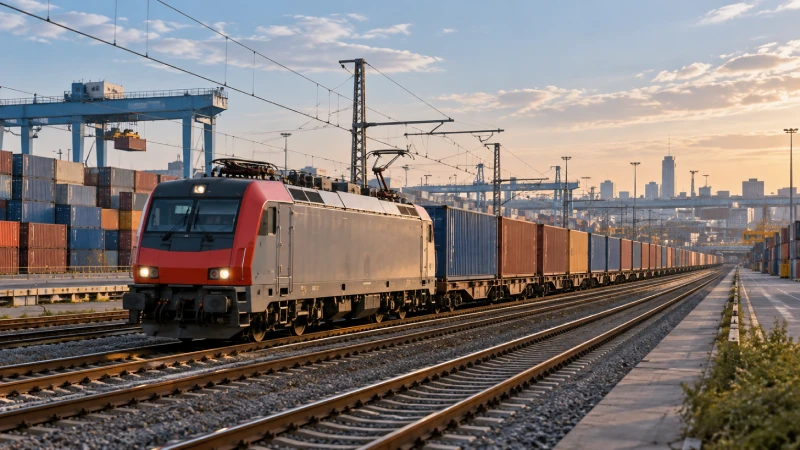
Rail freight from China to Germany sits between ocean and air freight in both cost and speed. It is normally more expensive than sea freight, but it can shorten inventory lead time significantly without the much higher per-kilogram cost of air freight.
For importers already comparing different options for shipping from China to Germany, rail is most useful when sea freight is too slow but air freight is difficult to justify commercially.
However, there is no single “China to Germany rail rate.”
Your actual cost depends on where the cargo is collected in China, which rail terminal it departs from, whether you use LCL or FCL, cargo density, the European arrival terminal, customs arrangements and the final delivery postcode in Germany.
The same applies to transit time. Some scheduled China-Europe services have achieved very fast terminal-to-terminal journeys, but the fastest advertised train time should never be treated as the normal door-to-door lead time.
This guide explains how China-Germany rail freight pricing actually works, including LCL rates, FCL container costs, chargeable volume and weight, Duisburg delivery, customs transit, route risks and when paying more for rail makes commercial sense.
How Much Does Rail Freight from China to Germany Cost?
Rail freight is normally quoted in two different ways:
- Rail LCL: typically based on CBM, weight or another chargeable-unit calculation.
- Rail FCL: normally quoted per container.
As a September 2026 public market reference, published China-Germany freight rate pages show rail LCL at around USD 210/CBM, 20GP rail containers at approximately USD 4,770-5,830, and 40GP containers at approximately USD 7,470-9,130. These figures are useful only for understanding the general market level; they are not fixed Winsail rates and may not include pickup, customs, terminal charges or final delivery.
Needs confirmation before publishing.
China-Germany Rail Freight Cost Reference
| Rail Service | Public Market Reference | Common Pricing Basis | Important Note |
|---|---|---|---|
| Rail LCL | Around USD 210/CBM | CBM / chargeable basis | Final price also depends on weight and handling rules |
| Rail FCL 20GP | Around USD 4,770-5,830 | Per container | Quote scope varies |
| Rail FCL 40GP | Around USD 7,470-9,130 | Per container | Pickup and German delivery may be separate |
| 40HQ | Quote individually | Per container | Equipment availability and rate may differ |
| German final delivery | Quote individually | Shipment / truck / pallet | Depends heavily on postcode and shipment profile |
Needs confirmation before publishing.
The important point is that the international rail linehaul is only one part of the total logistics bill.
For a realistic comparison, calculate:
China pickup + origin handling + rail freight + transit/customs handling + European terminal charges + final delivery
rather than comparing only headline rail rates.
Pro Tip: Always ask whether a quoted rail price is terminal-to-terminal, station-to-station or door-to-door. Two quotes with different inclusions cannot be compared directly.
How Rail LCL Pricing from China to Germany Works
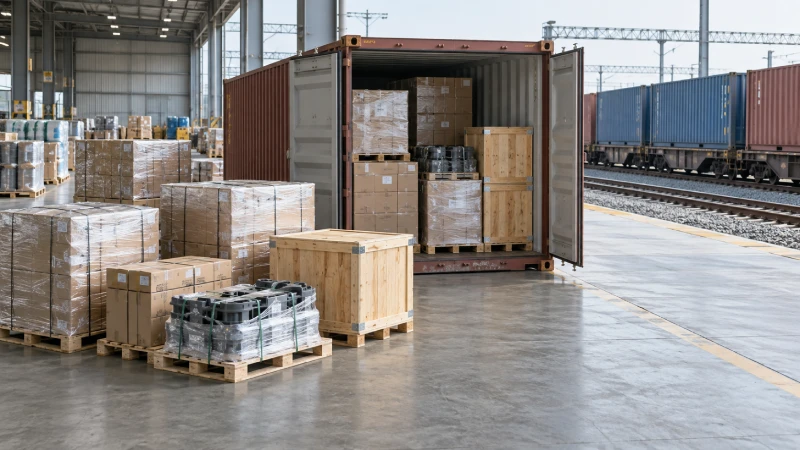
Rail LCL allows several importers to share container space.
It can be useful for shipments that are too large or heavy for economical air freight but still do not justify paying for a complete rail container.
Common examples include:
- machinery components,
- automotive parts,
- electronics,
- industrial spare parts,
- commercial equipment,
- seasonal inventory,
- e-commerce replenishment.
Unlike FCL, however, LCL pricing is not simply “one container rate divided by CBM.”
Rail LCL Cost per CBM
The first calculation is shipment volume.
For each package:
Length × Width × Height = volume
If dimensions are measured in meters:
Length (m) × Width (m) × Height (m) × quantity = CBM
For example, 10 cartons measuring 0.8 m × 0.6 m × 0.5 m produce:
0.8 × 0.6 × 0.5 × 10 = 2.4 CBM
But 2.4 CBM does not automatically mean the forwarder simply multiplies 2.4 by an advertised USD/CBM rate.
Weight also matters.
Volume vs Weight: How Chargeable Rail Freight Is Calculated
Dense cargo consumes relatively little container space while placing more weight on the equipment. Very light cargo does the opposite.
For this reason, rail consolidators may compare gross weight with volumetric or chargeable weight.
DHL’s freight guidance, for example, illustrates rail freight using a 1:3 density ratio, with volumetric weight calculated by dividing cubic dimensions in centimeters by 3,000. DHL also warns that different carriers may apply different density ratios.
That distinction matters.
Suppose your shipment is:
- 5 CBM
- 2,200 kg
- palletized machinery parts
Another shipment may also be:
- 5 CBM
- 600 kg
- lightweight commercial goods
Although both occupy 5 CBM, they do not necessarily create the same operational load or receive the same chargeable treatment.
There is therefore no universal China-Europe rail conversion rule that should be assumed for every shipment.
Do not automatically assume rules such as:
1 CBM always equals 500 kg.
The correct density ratio, minimum billing unit and weight threshold must be checked against the actual consolidation service being booked.
Needs confirmation before publishing.
Other LCL Charges to Consider
An LCL quotation may also involve:
- supplier pickup,
- consolidation warehouse handling,
- pallet handling,
- export declaration,
- origin CFS charges,
- oversize or non-stackable surcharge,
- rail terminal handling,
- destination deconsolidation,
- customs clearance,
- transit documentation,
- warehouse storage if delayed,
- German final-mile delivery.
This is particularly important with very small shipments.
A cheap international rail rate can become less attractive once minimum handling charges are added.
Pro Tip: Send your forwarder the number of packages, exact dimensions, gross weight and total CBM. Providing CBM alone may not be enough to calculate an accurate rail LCL price.
How Rail FCL Pricing Works
FCL rail pricing works differently.
If you book a full container, you are generally paying for the container movement rather than each CBM inside it.
This makes FCL attractive when cargo volume becomes large enough that paying repeated LCL charges is no longer economical.
Common equipment may include:
- 20GP,
- 40GP,
- 40HQ,
subject to the specific rail service and equipment availability.
20GP vs 40GP vs 40HQ
A larger container does not mean that every shipment can simply be loaded until all physical space is filled.
The practical payload depends on:
- equipment specification,
- cargo weight distribution,
- terminal restrictions,
- rail operating requirements,
- border handling requirements,
- container ownership or supply arrangement.
Heavy industrial cargo may reach a weight restriction before the container reaches its maximum cubic capacity.
Lightweight cargo may reach its volume limit first.
For this reason, both gross weight and CBM should still be provided for an FCL quotation.
When Does FCL Become Cheaper Than Rail LCL?
There is no reliable universal crossover such as:
“Book FCL once you reach 15 CBM.”
The correct comparison is:
LCL freight + LCL origin/destination handling
versus:
FCL container rate + FCL terminal and container-related costs
The crossover changes with current rates.
If your shipment is approaching a significant portion of a container, it is often worth asking for both options.
Compare Your Rail LCL and FCL Cost
Send the cargo dimensions, total CBM, gross weight, China pickup city and German delivery postcode so both LCL and FCL can be compared on the same cost basis.
What Is Included in a China-Germany Rail Freight Quote?
One of the easiest mistakes is assuming that an advertised rail price represents the total cost from the Chinese supplier to the German consignee.
It often does not.
A China-Germany rail shipment can contain the following cost stages:
| Cost Stage | May Apply |
|---|---|
| Supplier pickup in China | Yes |
| Truck or feeder transport to rail hub | Yes |
| Origin terminal handling | Yes |
| Export customs declaration | Yes |
| Main rail freight | Yes |
| Border transfer / reloading | Usually built into certain rail products |
| European terminal handling | Yes |
| Customs transit documentation | If required |
| German import customs clearance | If arranged |
| Import duty and VAT | Normally separate unless explicitly included |
| LCL deconsolidation | For LCL |
| German final delivery | If requested |
| Cargo insurance | Usually optional |
| Storage / inspection | If incurred |
This creates three very different quotation concepts.
Station-to-Station
Covers mainly transport between rail terminals.
Terminal-to-Terminal
Similar in principle, although the exact included terminal services depend on the product.
Door-to-Door
Adds pickup and/or delivery legs around the rail service.
Even “door-to-door” should be checked carefully to determine whether customs brokerage, duties, VAT, inspections or special delivery services are included.
China Rail Origin Terminals: Why Your Factory Location Changes the Cost
Your supplier does not need to be located beside an international China-Europe Railway Express terminal.
Cargo from manufacturing centers such as:
- Guangzhou,
- Foshan,
- Dongguan,
- Shenzhen,
- Ningbo,
- Shanghai,
can first move by domestic truck, feeder service or domestic rail connection to a suitable international railway hub.
Major China-Europe rail hubs include cities such as:
- Xi’an,
- Chengdu,
- Chongqing,
- Zhengzhou,
- Yiwu,
- Wuhan.
This means a quotation from:
Xi’an terminal → Duisburg
is not equivalent to:
Guangzhou factory → Xi’an → Duisburg → customer address
The second shipment includes a substantial first-mile logistics stage before the international train even begins.
The Closest Terminal Is Not Always the Cheapest Option
Terminal selection should consider the total logistics chain.
A forwarder may compare:
- pickup distance,
- domestic feeder cost,
- consolidation availability,
- departure option,
- rail space,
- cargo acceptance,
- expected route performance,
- destination connection.
A more distant terminal can sometimes produce a better total solution if it has a more suitable train product or consolidation arrangement.
Pro Tip: Compare the full supplier-to-Germany cost rather than choosing a departure terminal only because its rail linehaul looks cheaper.
What Route Does China-Germany Rail Freight Use?
There is not one single train route used for every shipment.
However, an important northern China-Europe corridor crosses Central Asia and Eastern Europe before entering the EU.
A documented Xi’an-Duisburg full-timetable train has operated via:
China → Kazakhstan → Russia → Belarus → Poland → Germany
The original service covered approximately 9,908 km according to China’s National Development and Reform Commission.
This corridor involves multiple railway networks.
China and most EU networks use standard-gauge rail, while Kazakhstan, Russia and Belarus use a wider gauge. Containers therefore need operational transfer arrangements at gauge-change interfaces.
These border processes are one reason rail transit should be understood as a network operation rather than one train running continuously from a Chinese factory to a German warehouse.
Why Małaszewicze Matters
Małaszewicze in eastern Poland is an important gateway for rail cargo arriving from Belarus into the European Union.
For traffic using the main northern corridor, it is also associated with the transition back to the European standard-gauge network.
Recent operational data illustrates the difference between reaching the EU gateway and reaching Germany.
A September 2026 dataset covering completed China-Europe train movements reported the following latest-ten-train averages:
- Chengdu → Małaszewicze: 16.8 days
- Chengdu → Duisburg: 20.7 days
The same dataset reported a wider 90-day average of 26 days for Chengdu-Duisburg, demonstrating why importers should not treat a promotional train time as a guaranteed planning time.
These figures are historical station-to-station observations, not service guarantees.
Why Duisburg Is Important for Rail Freight from China
Duisburg is one of the most important inland logistics gateways in western Germany.
Duisport describes the location as the world’s largest inland port. Its rail operation manages around 200 km of port rail infrastructure, and the Duisburg location is connected with more than 100 European destinations, alongside intercontinental rail connections with China.
This makes Duisburg important for more than cargo actually destined for the city itself.
A container arriving in Duisburg may continue toward:
- Düsseldorf,
- Cologne,
- Frankfurt,
- Stuttgart,
- southern Germany,
- the Netherlands,
- Belgium,
- other European distribution points.
Duisburg Is a Gateway, Not Necessarily the Final Destination
If your consignee is in Cologne, Düsseldorf or another western German industrial area, Duisburg may create a relatively efficient final delivery leg.
For cargo destined for Munich or another distant region, a different terminal or onward arrangement may produce a better total cost.
Therefore:
Duisburg should not automatically be assumed to be the cheapest German destination terminal.
The correct terminal depends on the actual route and delivery postcode.
How Much Does Duisburg-to-Door Delivery Cost?
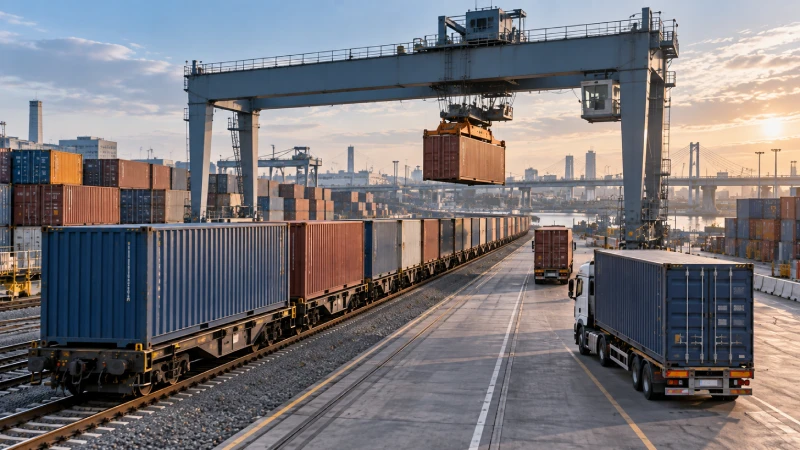
There is no responsible nationwide flat price for final delivery from Duisburg.
German inland transport depends on:
- destination postcode,
- number of pallets,
- package dimensions,
- gross weight,
- stackability,
- LCL or FCL,
- container trucking requirements,
- commercial vs residential delivery,
- tail-lift requirement,
- unloading arrangements,
- delivery appointment,
- limited-access location,
- container waiting time,
- empty container return point.
For example, an LCL shipment may follow:
China supplier → rail consolidation → China rail hub → Małaszewicze → Duisburg → LCL deconsolidation → customs procedure → pallet delivery
An FCL shipment may instead follow:
China supplier → rail terminal → Duisburg → customs → full-container truck delivery → empty return
The final-mile cost structures are completely different.
Needs confirmation before publishing.
Pro Tip: A USD 210/CBM rail linehaul with expensive destination handling can cost more overall than a higher headline rail rate with better destination inclusions.
How Long Does Rail Freight from China to Germany Take?
Rail freight is faster than traditional ocean shipping in many cases, but importers should be cautious with claims such as:
“China to Germany by train takes 11 days.”
That number can be real without representing the normal shipment experience.
Chinese government data published in July 2026 reported that the Xi’an-Duisburg full journey had been reduced to as short as 11 days.
The important phrase is:
as short as.
An operational dataset of completed Chengdu-Duisburg trains tells a more useful planning story. Over the latest 90-day period measured, 119 trains averaged approximately 26 days station-to-station, while the latest ten averaged 20.7 days, with individual journeys ranging from 18 to 25 days.
These datasets represent different origins and different rail products, so they should not be treated as contradictory.
They demonstrate that:
scheduled fastest service ≠ network-wide normal transit
Station-to-Station Is Not Door-to-Door
A complete shipment can include:
- supplier pickup,
- domestic movement to the rail hub,
- consolidation,
- export customs,
- departure waiting time,
- main railway movement,
- border transfers,
- EU entry procedure,
- destination terminal handling,
- deconsolidation for LCL,
- import customs,
- German delivery.
Therefore an 11-day train journey cannot reasonably be presented as an 11-day factory-to-customer delivery promise.
Needs confirmation before publishing.
Sea vs Rail vs Air Freight from China to Germany
Rail should not be evaluated as an isolated transport product.
Its main commercial purpose is to occupy the middle ground between sea and air.
| Factor | Sea Freight | Rail Freight | Air Freight |
|---|---|---|---|
| Freight cost | Lowest | Medium | Highest |
| Speed | Slowest | Medium | Fastest |
| Large FCL cargo | Excellent | Good when time matters | Usually uneconomical |
| Medium shipments | Sea LCL | Rail LCL | Air depending on weight/value |
| High-value urgent cargo | Sometimes too slow | Strong option | Strongest option |
| Inland China origins | Requires port positioning | Can work well via rail hubs | Airport positioning |
| German inland access | Seaport + inland transport | Strong inland-terminal network | Airport + road |
| Best reason to use | Minimize freight cost | Balance cost and lead time | Minimize transit time |
A September 2026 public comparison lists 40GP ocean freight to Germany at approximately USD 4,095-5,005, compared with approximately USD 7,470-9,130 by rail. Air freight in the same market reference was quoted by kilogram rather than container.
Needs confirmation before publishing.
The takeaway is more useful than the exact numbers:
Rail usually costs more than sea because you are buying a shorter supply-chain lead time.
When Is Rail Worth Paying More Than Sea Freight?
The correct decision is not always based on freight cost alone.
Consider three scenarios.
Scenario 1: Sea Freight Is the Better Choice
Your cargo is:
- heavy,
- relatively low value,
- not urgent,
- supported by stable inventory,
- not exposed to significant stockout risk.
If several extra weeks of transit do not affect the business, paying the rail premium may provide little benefit.
Scenario 2: Rail Freight Is the Better Balance
Your cargo is:
- medium to high value,
- inventory-sensitive,
- required faster than normal ocean replenishment,
- too heavy for economical air freight,
- important enough that waiting several additional weeks has a real business cost.
Rail often fits automotive components, machinery parts, electronics and production materials for exactly this reason.
Scenario 3: Air Freight Is the Better Choice
The cargo is:
- urgently needed,
- relatively small,
- high value,
- required to prevent production downtime,
- needed for a critical project or product launch.
In those cases, even rail may be too slow.
Compare Rail vs Sea for Your Shipment
If ocean shipping is too slow but air freight is too expensive, compare rail and sea using the same pickup address, cargo details and German delivery postcode.
Calculate the Real Transit-Cost Trade-Off
A purchasing manager should not ask only:
Which mode has the cheapest freight?
A better question is:
What does the additional transit time cost the business?
Consider:
Transport cost
+ inventory carrying cost
+ stockout risk
+ production-delay risk
+ destination logistics cost
Imagine:
- sea freight costs USD 5,000,
- rail freight costs USD 8,000.
At first glance, rail is USD 3,000 more expensive.
But suppose rail significantly reduces replenishment time and prevents:
- two weeks of lost sales,
- emergency air shipments,
- production downtime,
- excessive safety stock.
The USD 3,000 freight difference may no longer be the most important number.
This is why rail works best as a supply-chain option, not simply as a more expensive alternative to sea freight.
What Determines Your China-Germany Rail Freight Price?
The main pricing factors include:
| Pricing Factor | Why It Matters |
|---|---|
| China pickup location | Determines first-mile trucking or feeder cost |
| Rail departure terminal | Services and rates differ by hub |
| Destination terminal | Changes European rail and delivery cost |
| LCL or FCL | Uses a different pricing model |
| CBM | Major driver for LCL |
| Gross weight | Can change chargeable basis |
| Cargo density | Important for heavy cargo |
| Container type | Changes FCL cost |
| Equipment arrangement | SOC/other arrangements can affect pricing |
| Cargo type | May affect acceptance and handling |
| Battery/DG status | Requires specific approval |
| Cargo-ready date | Determines available departure |
| Rail capacity | Rates can change with space |
| Customs arrangement | Adds brokerage or transit costs |
| German postcode | Changes final-mile trucking |
| Insurance | Optional additional cost |
| Inspection/storage | Contingency costs if incurred |
Rail prices should therefore be quoted against an actual shipment profile rather than copied from a monthly market table.
China-Germany Rail Route Examples
The following examples demonstrate how the transport chain can differ.
They are not fixed routing promises.
Xi’an → Duisburg
Xi’an is one of China’s major China-Europe rail hubs.
A documented full-timetable Xi’an-Duisburg service runs through:
China → Kazakhstan → Russia → Belarus → Poland → Germany
This is useful for cargo already positioned in or consolidated through inland China.
Chengdu → Małaszewicze → Duisburg
This route is useful for illustrating the difference between EU gateway arrival and final German rail-terminal arrival.
Recent completed-train data shows that arrival at Małaszewicze can occur several days before the same general corridor reaches Duisburg.
Guangzhou / Foshan / Dongguan → Rail Hub → Duisburg
South China manufacturing cargo often needs a domestic feeder leg before joining the international railway.
The cost may therefore include:
factory pickup → domestic transfer → international rail → German inland delivery
Exact feeder terminal and service:
Needs confirmation before publishing.
Alternative Trans-Caspian / Middle Corridor
Alternative China-Europe rail and multimodal routings can move through Central Asia and the Caspian region rather than using the principal Russia-Belarus corridor.
However, transfer points, capacity, frequency, Germany connections and costs differ materially.
It should not be presented as an automatically available substitute for every shipment.
Needs confirmation before publishing.
Customs and Transit for Rail Freight into Germany
Crossing into the European Union does not necessarily mean the goods must be import-cleared immediately at the first EU rail terminal.
The EU external transit procedure, commonly referred to as T1, is generally used for non-Union goods. It allows goods to move between customs points while import duties and other charges remain suspended until the transit procedure reaches its destination.
This can be relevant to China-Europe rail cargo entering through Poland but moving onward for customs processing elsewhere.
Typical Documents
Depending on the shipment, prepare:
- commercial invoice,
- packing list,
- HS code,
- shipper and consignee information,
- transport documents,
- EORI details,
- customs authorization where applicable,
- product compliance documents,
- certificates or licenses where required.
Product compliance should be checked separately from freight availability.
Getting space on a train does not mean the goods automatically meet German or EU import requirements.
Customs Delays Can Create Additional Cost
Possible costs include:
- terminal storage,
- customs broker charges,
- inspection fees,
- transit-document handling,
- guarantee-related costs,
- document correction,
- delivery rescheduling.
Pro Tip: Verify the HS code and applicable EU product requirements before the shipment enters the international rail network, especially for regulated industrial or technical products.
Route and Geopolitical Risks
The main northern China-Europe rail corridor crosses countries including Russia and Belarus.
This creates compliance and disruption considerations that do not exist in exactly the same form for direct ocean shipping.
EU sanctions relating to Russia and Belarus remain active and continue to be updated.
Therefore shipments using these corridors should be checked for:
- HS code restrictions,
- sanctioned goods,
- restricted technologies,
- involved parties,
- end use,
- consignee,
- route-specific carrier restrictions.
The fact that a rail service operates through a country does not eliminate sanctions-screening obligations.
Operational Risks Also Matter
Possible disruptions can arise from:
- border congestion,
- customs inspection,
- train re-marshalling,
- gauge-change operations,
- terminal capacity,
- equipment shortage,
- railway maintenance,
- political border measures,
- weather,
- onward connection delays.
For this reason, Winsail should not promise a fixed China-Germany rail arrival date unless a particular service contract explicitly supports such a commitment.
What Cargo Is Suitable for Rail Freight to Germany?
Rail works particularly well where cargo has enough value or time sensitivity to justify paying more than sea freight.
Automotive Parts
A strong rail use case because manufacturing and aftermarket supply chains can be sensitive to long replenishment cycles.
Machinery and Industrial Components
Rail can reduce lead time without the high cost of flying heavy equipment.
Industrial Spare Parts
Useful when waiting several extra weeks could affect production or maintenance schedules.
Electronics
Higher value density can make rail economically attractive, especially for larger replenishment volumes.
Photovoltaic and Energy Equipment
China-Europe trains have carried products including photovoltaic equipment, and such industrial cargo can fit the rail model depending on technical characteristics.
E-commerce Replenishment
Rail can support inventory replenishment where sea shipping does not respond quickly enough to demand changes.
Apparel and Seasonal Goods
Rail may help when a fashion or seasonal sales window makes ocean lead time commercially risky.
What Cargo May Be Unsuitable for Rail?
Rail is not automatically the right choice for every shipment.
It may be less suitable for:
- very low-value heavy commodities,
- extremely urgent cargo,
- very small high-value shipments better suited to air,
- oversized cargo requiring specialist handling,
- cargo exceeding equipment limits,
- prohibited goods,
- sanctions-controlled goods,
- temperature-sensitive cargo without suitable equipment,
- dangerous goods that are not accepted on the selected service.
Batteries and Dangerous Goods
Do not assume that batteries or dangerous goods are either universally accepted or universally prohibited.
Acceptance can depend on:
- product chemistry,
- UN number,
- DG classification,
- battery configuration,
- packaging,
- documentation,
- departure terminal,
- border route,
- train operator,
- current operating rules.
Needs confirmation before publishing.
For lithium batteries, chemicals or other regulated cargo, send the MSDS, UN classification and packing information before booking.
Practical Tips for Reducing Rail Freight Cost
1. Compare More Than the Rail Linehaul
Include pickup, handling and destination delivery.
2. Provide Accurate Dimensions
Understated dimensions can change the final LCL charge after cargo reaches the consolidation warehouse.
3. Confirm Stackability
Non-stackable cargo can consume much more usable container space.
4. Compare LCL and FCL
Large LCL shipments may cross the economic threshold where a full container becomes more attractive.
5. Optimize the China Origin
A slightly different consolidation terminal may reduce the total cost if domestic feeder and international rail pricing work better together.
6. Avoid Last-Minute Compliance Problems
Incorrect HS codes, missing product documents or restricted cargo can cost far more than minor differences between rail quotations.
7. Compare Rail Against Inventory Cost
Saving several thousand dollars on freight is not helpful if the longer ocean lead time creates a much larger stockout or production loss.
FAQ
How much does rail freight from China to Germany cost?
Rail LCL is usually priced by CBM, weight or another chargeable basis, while FCL is normally quoted per container. A September 2026 public reference places rail LCL around USD 210/CBM, 20GP at approximately USD 4,770-5,830 and 40GP at approximately USD 7,470-9,130. These are market references rather than fixed Winsail rates and may exclude pickup, customs and German delivery. Needs confirmation before publishing.
How is rail LCL freight from China to Germany calculated?
The forwarder calculates shipment volume and may compare it against gross or volumetric weight according to the tariff being used. Minimum charges and consolidation handling may also apply, and not every China-Europe rail consolidator uses the same CBM-to-weight conversion rule.
How much does a 40ft container cost by rail from China to Germany?
A public September 2026 market reference shows approximately USD 7,470-9,130 for a 40GP rail container to Germany. The actual cost depends on departure terminal, equipment, route, booking date and quote inclusions. Needs confirmation before publishing.
Is rail freight cheaper than sea freight from China to Germany?
Usually not when comparing freight charges alone. Rail normally costs more because it provides a shorter supply-chain lead time, but it can become commercially attractive when faster replenishment reduces inventory, stockout or production-delay costs.
How long does rail freight from China to Duisburg take?
There is no single reliable number for every train. Certain Xi'an-Duisburg full-timetable services have achieved journeys as short as around 11 days, while recent completed Chengdu-Duisburg data shows longer actual station-to-station performance. Use the current service-specific estimate rather than the fastest historical journey, and allow additional time for pickup, consolidation, customs and final delivery.
Can batteries or dangerous goods be shipped from China to Germany by rail?
Potentially, but acceptance depends on the product, UN classification, packaging, route and operator. Provide the MSDS and DG information before booking. Needs confirmation before publishing.
Check Your China-Germany Rail Freight Cost
For an accurate rail freight comparison, prepare:
- commodity,
- HS code if available,
- pickup city or address in China,
- number of cartons or pallets,
- dimensions,
- gross weight,
- total CBM,
- cargo value,
- Incoterm,
- German delivery postcode,
- cargo-ready date,
- battery or dangerous-goods status.
Winsail can then compare the relevant rail LCL, rail FCL and alternative sea freight options based on the actual shipment rather than relying on generic online rates.
Rail is most valuable when it solves a specific supply-chain problem: sea freight takes too long, air freight costs too much, and the value of faster inventory replenishment is greater than the additional freight cost.
That is the right way to evaluate rail freight from China to Germany—not by chasing the lowest headline USD/CBM rate or the fastest advertised train time.
