
Introduction
Shipping inventory from China to Amazon FBA warehouses often seems simple—many freight forwarders offer “DDP to FBA” services and promise smooth customs clearance, prepaid duties, and direct delivery to the assigned fulfillment center. For busy sellers, this sounds efficient and risk-free. But the real question is not whether DDP can move cargo. The real question is whether it aligns with Amazon’s platform rules, Importer of Record (IOR) requirements, and long-term account safety.
DDP (Delivered Duty Paid) means the shipper assumes responsibility for import clearance and duties (for a full definition, see our dedicated DDP guide). In an FBA context, however, this structure creates a critical compliance issue: Amazon is not the importer, and it does not accept liability for customs declarations or unpaid taxes. If the declared importer, tax ID, or clearance structure is inconsistent with your seller account, the shipment may be delayed, rejected, or trigger account review.
This guide focuses specifically on Amazon FBA shipments from China. We will examine Amazon’s official position, how Importer of Record works in DDP scenarios, where sellers commonly make costly mistakes, and when DDP is practical—or absolutely inappropriate—for FBA inventory.
Does Amazon Allow DDP Shipments to FBA Warehouses?
From a technical standpoint, Amazon does not explicitly prohibit shipments arranged under DDP terms. However, Amazon’s policies do not evaluate shipments based on Incoterms alone—they evaluate them based on compliance structure. This distinction is critical. A shipment labeled “DDP” can still violate Amazon’s requirements if the Importer of Record (IOR), customs declarations, or tax documentation are not properly aligned with the seller’s legal entity.
What Amazon Officially States About Importer of Record
Amazon clearly states in its Seller Central guidance that it will not act as the Importer of Record, customs broker, or declarant for inbound FBA shipments. Amazon fulfillment centers are delivery locations only. They do not assume responsibility for customs clearance, duty payment, or regulatory compliance.
This means the seller—or a properly appointed third-party importer—must legally handle the import process before the goods arrive at the FBA warehouse. If duties are unpaid, paperwork is incomplete, or the importer information is inconsistent, Amazon may refuse delivery.
Importantly, Amazon also does not resolve customs disputes. If a shipment is held by customs due to documentation issues, tax ID mismatches, or compliance questions, the responsibility remains entirely with the seller and their logistics partner.
Therefore, the key issue is not whether “DDP is allowed,” but whether the DDP structure being used satisfies Amazon’s requirement that the importer be legally responsible, identifiable, and compliant.
Who Is the Importer of Record in FBA DDP Shipments?
In any Amazon FBA shipment entering a foreign country, the most important compliance role is the Importer of Record (IOR). The IOR is the legal entity responsible for customs declarations, tariff classification, duty payment, and regulatory compliance. In a standard structure, this is either the seller’s registered company in the destination country or a properly authorized third-party importer.
In DDP arrangements from China, however, this structure often becomes opaque. Sellers are frequently told that the freight forwarder “will handle everything,” including customs clearance and taxes. The critical question is: under whose name?
When the Freight Forwarder Acts as IOR
In some cases, a licensed freight forwarder or local partner may act as the Importer of Record through its own legal entity. If this structure is legitimate, documented, and compliant with local customs law, it can be legally valid. The forwarder must have proper authorization, maintain accurate customs filings, and be able to provide official entry documents upon request.
However, not all DDP services operate this way. Some use shared importer entities, borrowed tax IDs, or intermediary trading companies that have no direct contractual relationship with the Amazon seller. When the seller does not know the exact importer name declared on customs documents, compliance risk increases significantly.
Why Amazon May Reject Improper IOR Structures
Amazon fulfillment centers verify shipment details, including consignee information and labeling consistency. If customs documents list an importer unrelated to the seller’s business, or if the tax ID used for clearance cannot be linked to the seller, this may trigger delays or scrutiny.
More importantly, if customs authorities later audit the entry and determine misdeclaration or tax discrepancies, the investigation may involve the shipment’s commercial documents—where the seller’s name appears as exporter or commercial party. Even if a forwarder acted as IOR, insufficient transparency can expose the seller to operational and account-level risks.
For FBA shipments, clarity of the Importer of Record structure is not optional. It is the foundation of compliant DDP use.
DDP vs DDU in Amazon FBA: What Actually Changes for Sellers?
When shipping inventory to Amazon FBA from China, the difference between DDP and DDU (or DAP) is not just about who pays duties. The real distinction lies in who controls the import process and who bears legal responsibility for customs compliance. In an FBA environment, that difference can directly affect shipment stability and account risk.
Under both structures, Amazon remains only the delivery destination—not the importer. The key question for sellers is: who is legally declared to customs, and how transparent is that structure?
Under DDP: Who Controls the Customs Process?
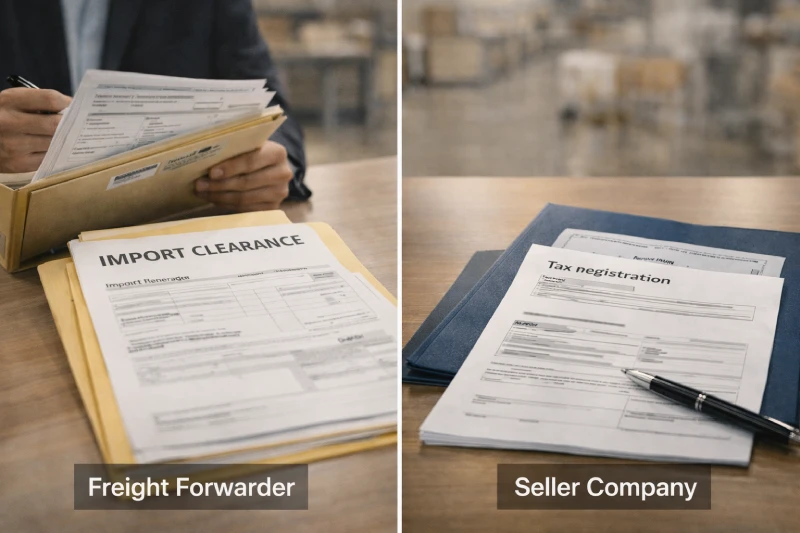
In a DDP arrangement, the freight forwarder (or its partner entity) typically handles import clearance and duty payment. From a convenience perspective, this reduces the seller’s operational workload. However, it also means the seller may not directly control:
- The declared Importer of Record
- The tariff classification used
- The valuation method applied
- The tax ID registered in the entry
If the seller does not receive official entry documentation, they may not even know under which entity the goods were cleared. While this can appear smooth at first, it creates dependency on the forwarder’s compliance practices.
Under DDU (or DAP): Why Sellers Remain the Legal Importer
Under DDU/DAP, the seller remains responsible for import clearance and duties, either directly or through an appointed customs broker. This structure requires more administrative preparation—such as having a valid tax ID, importer registration, or VAT/EIN where applicable—but it ensures that the seller’s legal entity is consistently declared as the importer.
From a compliance standpoint, this structure offers greater transparency and documentation control. The seller can retain customs entry records, verify tariff classifications, and ensure tax reporting aligns with their accounting and regulatory obligations.
In Amazon FBA scenarios, the difference between DDP and DDU is ultimately about visibility and legal alignment—not just cost or convenience.
Common FBA DDP Mistakes Chinese Sellers Make
Many Amazon sellers choose DDP for FBA shipments because it appears simple: one quote, one payment, and the forwarder “handles everything.” However, most compliance problems do not arise from the Incoterm itself—they arise from misunderstanding how the structure is executed. Below are the most common mistakes that create operational and account-level risks.
“Tax Included” Doesn’t Mean Compliant
A frequent misconception is that if a freight forwarder includes duties in the quote, the shipment must be compliant. In reality, prepaid duties do not guarantee that the customs declaration is properly structured.
Problems occur when:
- The declared Importer of Record is unrelated to the seller
- The declared value is adjusted to reduce duties
- The tariff code does not match the actual product
- The importer entity cannot legally represent the goods
If customs later reviews the entry and finds discrepancies, documentation inconsistencies may trace back to the commercial invoice and packing list—documents bearing the seller’s name. Even if the forwarder handled clearance, incomplete transparency can expose the seller to investigation or shipment disruption.
Using Shared or Borrowed Tax IDs
Some low-cost DDP services rely on shared importer entities or borrowed tax IDs to clear multiple sellers’ shipments. While this may reduce cost, it creates structural risk:
- The seller has no direct contractual relationship with the importer
- Customs records may not align with the seller’s business
- Official entry documents may not be available upon request
If Amazon requests proof of import compliance, or if customs requires supporting documentation, the seller may struggle to provide it.
Choosing DDP Solely Based on Price
Very low DDP quotes often indicate one of three issues:
- Aggressive undervaluation
- Misclassification of goods
- Non-standard clearance channels
While shipments may initially arrive without issue, this approach increases the likelihood of delayed inspections, random audits, or sudden clearance failures. For FBA sellers operating at scale, one disrupted shipment can affect stock levels, listing performance, and revenue continuity.
In FBA logistics, DDP mistakes are rarely visible at the quoting stage. They typically surface only when documentation is requested or when something goes wrong. That is why structural clarity matters more than convenience.
When You Should NOT Use DDP for Amazon FBA
DDP is not inherently non-compliant. However, there are specific scenarios where using DDP for Amazon FBA shipments creates unacceptable structural risk. Sellers should avoid DDP if any of the following conditions apply.
You Cannot Clearly Identify the Importer of Record
If your freight forwarder cannot clearly state:
- The full legal name of the Importer of Record
- The tax ID or importer registration used
- The country where the entity is registered
then the shipment structure lacks transparency. In FBA logistics, unknown importer structures create downstream compliance exposure.
You Will Not Receive Official Customs Entry Documents
If the forwarder cannot provide official customs clearance documents (such as entry summaries or import declarations), you lose visibility over how your goods were declared. Without documentation, you cannot verify:
- Declared value
- Tariff classification
- Duty payment status
For Amazon sellers operating long term, this documentation gap is a major compliance weakness.
The Structure Uses Borrowed or Shared Tax IDs
If the DDP arrangement relies on “shared” importer entities or borrowed tax numbers that are unrelated to your business, the risk increases significantly. You are effectively disconnecting your seller account from the legal import record.
You Are Expanding Into Regulated or High-Scrutiny Markets
In markets with stricter customs enforcement, VAT systems, or regulatory documentation requirements, opaque DDP structures are more likely to face inspection. If you do not have clear importer alignment, DDP becomes structurally unstable.
When any of these conditions exist, choosing DDP prioritizes short-term convenience over long-term compliance security.
When DDP May Be Practical for FBA Shipments
While DDP carries structural risks if improperly executed, it can be practical in certain controlled situations. The key difference lies in transparency and legal alignment—not the Incoterm itself.
You Have a Verified, Licensed Import Partner
If your freight forwarder operates through a legitimate, licensed importing entity in the destination country—and can clearly disclose that entity’s legal name, registration number, and tax ID—DDP can function within a compliant framework. The importer must have the legal authority to declare goods and assume responsibility for customs obligations.
You Receive Complete Customs Documentation
DDP becomes more stable when the forwarder provides:
- Official customs entry records
- Proof of duty payment
- Import declaration details
- Tariff classification used
If you can retain these records and reconcile them with your commercial invoices, the risk of future disputes decreases significantly.
You Lack Local Import Registration but Need Controlled Entry
For new sellers entering a market without a local tax registration, DDP can serve as a transitional logistics solution—provided the importer structure is legitimate and documented. This may allow inventory to flow while the seller prepares to establish their own importer registration.
The Structure Is Contractually Defined
If the roles and responsibilities are clearly defined in writing—specifying who acts as Importer of Record, who handles regulatory compliance, and who retains liability in case of customs audits—DDP can operate within a controlled risk environment.
In short, DDP is practical when it is transparent, documented, and legally structured. It becomes dangerous only when it is opaque, undocumented, or based solely on convenience.
Pre-Shipment Checklist Before Choosing DDP for FBA
Before confirming a DDP shipment to Amazon FBA, sellers should conduct a structured compliance review. This is not about price comparison—it is about verifying legal alignment and documentation control. The following checklist helps identify whether the proposed DDP structure is operationally stable.
1. Who Is the Importer of Record?
- What is the full legal name of the importer?
- In which country is the entity registered?
- Is the importer contractually linked to your shipment?
If the answer is vague or undisclosed, reconsider the structure.
2. Will You Receive Official Customs Entry Documents?
- Can the forwarder provide the customs entry summary or import declaration?
- Will duty payment receipts be available?
- Can you verify declared value and HS classification?
Without documentation access, you cannot confirm compliance.
3. Is the Tax ID Aligned With the Import Structure?
- Is your own tax ID being used?
- If not, whose tax ID is declared?
- Is that entity legally authorized to import your product category?
Importer transparency is essential for long-term platform stability.
4. Does the Structure Align With Amazon’s Receiving Policy?
- Is Amazon listed only as delivery consignee—not importer?
- Are shipment labels and documentation consistent?
- Is the declared importer prepared to respond if customs requests clarification?
Misalignment between customs documents and FBA shipment details can cause delivery refusal.
5. What Happens If Customs Audits the Shipment?
- Who responds to inquiries?
- Who bears liability for underpayment or misclassification?
- Are responsibilities defined in writing?
If liability is unclear, the risk ultimately falls on the seller’s supply chain continuity.
Using this checklist before approving a DDP shipment helps convert a convenience decision into a compliance-based decision.
Final Decision Framework: Should You Use DDP to Ship to Amazon FBA?
The decision to use DDP for Amazon FBA shipments should not be based on convenience, speed, or a “tax included” quote. It should be based on structural clarity, legal alignment, and documentation control. Below is a simplified decision framework sellers can apply before confirming a shipment from China.
Scenario 1: You Have Your Own Import Registration
If you:
- Hold a valid importer registration (EIN, VAT, or equivalent)
- Can appoint a licensed customs broker
- Want full visibility over customs declarations
Then a DDU/DAP structure generally provides stronger compliance control. You remain the declared Importer of Record, retain entry documents directly, and reduce reliance on third-party importer entities.
Scenario 2: You Do Not Have Local Import Capability — But the Structure Is Transparent
If you:
- Do not yet have local import registration
- Work with a licensed forwarder that discloses its importer entity
- Receive full customs documentation
- Have contractual clarity regarding liability
Then DDP may function as a controlled logistics solution. The key condition is documentation transparency and legal traceability.
Scenario 3: The Structure Is Opaque or Undocumented
If:
- The importer name is undisclosed
- Tax IDs are “shared” or unclear
- Customs documents are not provided
- Liability terms are undefined
Then DDP should be avoided. In this case, the risk is not theoretical—it is structural. A shipment may arrive successfully once, but long-term account stability depends on compliance consistency.
Final Principle
Amazon FBA warehouses are delivery destinations—not import partners. Whether you use DDP or DDU, the core requirement remains the same: the importer structure must be legal, identifiable, and documentable.
DDP is not inherently unsafe. It becomes unsafe when transparency is missing. For Amazon sellers building sustainable operations, structural compliance should always outweigh short-term convenience.
