
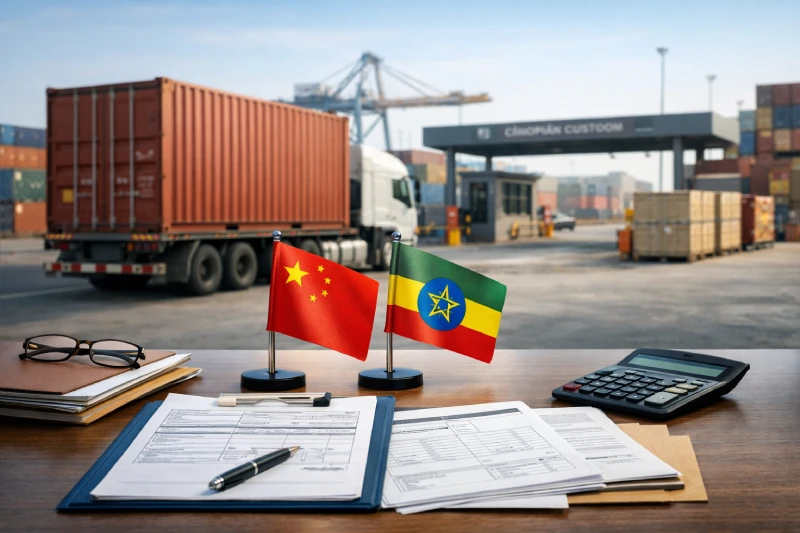
When importing from China to Ethiopia, customs clearance is often the most difficult part of the process. Even if your cargo arrives on time, missing paperwork, incorrect HS codes, or unpaid duties can leave the shipment stuck for days.
Compared with many other African countries, Ethiopia has stricter customs procedures, tighter foreign exchange controls, and more document requirements. Understanding the process before your cargo ships can help you avoid delays and unexpected costs.
If you are still planning your overall import process, start with our Ship from China to Ethiopia guide before arranging customs clearance.
How Customs Clearance Works in Ethiopia
Customs clearance begins after the shipment arrives in Ethiopia. Air freight is usually cleared at Addis Ababa Bole International Airport, while most sea freight from China first arrives in Djibouti and then moves inland to Modjo Dry Port.
The basic customs process normally follows these steps:
- Cargo arrives in Ethiopia
- The importer or customs broker submits documents
- A customs declaration is filed
- Ethiopian Customs calculates duties and taxes
- Customs may inspect the cargo
- Duties are paid
- Cargo is released for delivery
The main parties involved are:
- The Ethiopian Customs Commission
- The importer
- A licensed customs broker or clearing agent
- The freight forwarder
For importers choosing between air freight and sea freight, the arrival point and customs process may vary depending on the shipping mode. See Best Shipping Methods from China to Ethiopia for a comparison.
Where Customs Clearance Usually Happens
- Air freight: Addis Ababa Bole International Airport
- Sea freight: Djibouti Port first, then Modjo Dry Port in Ethiopia
- Final release: Usually at Modjo Dry Port for container cargo
Because Ethiopia is landlocked, most sea freight imports are not cleared directly at Djibouti. Instead, the goods move inland before customs release.
Who Is Responsible Under Different Incoterms?
One of the most common mistakes importers make is assuming the supplier will handle customs clearance. In reality, responsibility depends entirely on the agreed Incoterm.
EXW (Ex Works)
Under EXW, the buyer is responsible for almost everything:
- Export clearance in China
- Freight from China to Ethiopia
- Ethiopian customs clearance
- Duties, taxes, and delivery
EXW gives the buyer maximum control, but it also creates the most work.
FOB (Free On Board)
With FOB, the seller handles export procedures in China and loads the goods onto the ship or aircraft. After that, the buyer becomes responsible for:
- Freight
- Ethiopian customs clearance
- Import duties and taxes
- Inland delivery
CIF (Cost, Insurance and Freight)
Under CIF, the seller pays for freight and insurance to Ethiopia or Djibouti. However, customs clearance in Ethiopia is still the buyer’s responsibility.
Many first-time importers incorrectly assume that “freight included” means customs included. It does not.
DDP (Delivered Duty Paid)
With DDP shipping, the supplier or freight forwarder manages the entire process:
- Freight from China
- Ethiopian customs clearance
- Duties and taxes
- Final delivery
DDP is usually the easiest option for small businesses or first-time importers that do not have their own customs team in Ethiopia. However, it only works well when the freight forwarder has an experienced local customs partner.
For a detailed explanation, see DDP Shipping from China to Ethiopia.
| Incoterm | Who Handles Customs Clearance? | Who Pays Duties? |
|---|---|---|
| EXW | Buyer | Buyer |
| FOB | Buyer | Buyer |
| CIF | Buyer | Buyer |
| DDP | Seller / Forwarder | Seller / Forwarder |
Documents Required for Ethiopia Customs Clearance
The most common reason shipments are delayed in Ethiopia is incomplete or incorrect paperwork. Customs clearance is heavily document-based, and even a small mistake can stop the process.
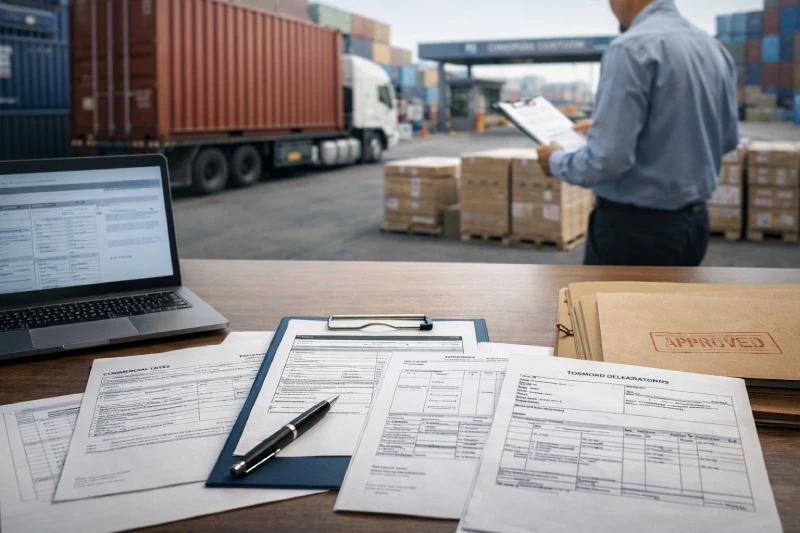
Core Documents Required for Most Shipments
Almost all imports into Ethiopia require the following:
- Commercial Invoice – Shows the product description, quantity, unit price, and total value
- Packing List – Lists the number of cartons, weight, and package details
- Bill of Lading or Air Waybill – Proof of shipment
- Import Permit or Import License – Required for some products
- Tax Identification Number (TIN) – The importer’s Ethiopian tax registration number
- Customs Declaration Form – Submitted by the broker or importer
- Bank or Foreign Exchange Documents – Ethiopia often requires proof of payment or bank approval
The declared value on the invoice is especially important because Ethiopian Customs uses it to calculate duties and taxes. If you want to understand how customs charges affect your final landed cost, review Shipping Cost from China to Ethiopia.
Product-Specific Documents
Some products require extra approvals:
- Food and beverages: health certificate or sanitary approval
- Electronics: conformity certificate
- Medical products: approval from the relevant authority
- Chemicals: safety data sheet and import permit
- Machinery: technical specification sheet
Always confirm the requirements before the goods leave China.
Common Document Mistakes
The following errors often lead to customs delays:
- Product descriptions that are too general, such as “parts” or “goods”
- Different quantities or weights on the invoice and packing list
- Missing TIN number
- Incorrect importer name
- Wrong HS code
- Invoice values that do not match the shipment
Import Duties, Taxes, and Customs Valuation
Most shipments imported into Ethiopia may be subject to:
- Import duty
- VAT
- Excise tax
- Withholding tax
The amount depends on the type of goods and the HS code. Ethiopian Customs normally calculates taxes based on the CIF value, which includes:
- Product value
- Freight cost
- Insurance cost
For example, if your goods are worth USD 10,000 and freight plus insurance is USD 2,000, customs may calculate taxes based on USD 12,000.
Declaring an unrealistically low value can create serious problems. Customs may reject the invoice, inspect the cargo, or reassess the shipment at a higher value.
Products that often face higher import duties include:
- Consumer electronics
- Vehicles and spare parts
- Luxury goods
- Alcohol and tobacco
Because duties and taxes can make up a large part of the final landed cost, importers should estimate these charges before shipping.
How Long Does Customs Clearance Take in Ethiopia?
The actual customs clearance time depends on the cargo type, the quality of the paperwork, and whether the shipment is selected for inspection.
Typical ranges are:
- Air freight: 1–3 working days
- Sea freight through Djibouti and Modjo Dry Port: 3–7 working days
- DDP shipments: Often faster from the buyer’s point of view because the forwarder handles the process
However, delays are common when:
- Documents are incomplete
- The HS code is wrong
- Customs requests a physical inspection
- An import permit is missing
- Djibouti or Modjo becomes congested
Customs clearance time should always be added to the total transit time of your shipment. To understand the full schedule from China to Ethiopia, see How Long Does Shipping from China to Ethiopia.
Common Customs Problems and Delays in Ethiopia
Wrong HS Code or Product Description
If the HS code is incorrect, customs may apply the wrong duty rate or stop the shipment for review. Vague descriptions such as “machine parts” often trigger questions.
A better description would be something like:
“Plastic injection molding machine spare parts, HS code XXXX.XX”
Missing Import Permit
Some goods cannot clear customs without a permit or approval. This is especially common for food, chemicals, electronics, and medical products.
Under-Declared Cargo Value
Trying to reduce taxes by declaring a lower value is risky. Customs may compare the declared price with market value and request additional proof.
Delays at Djibouti or Modjo Dry Port
Even if all documents are correct, cargo can still be delayed because of:
- Port congestion
- Container shortages
- Inland transport delays between Djibouti and Ethiopia
- Paperwork backlog at Modjo Dry Port
How to Avoid These Problems
Before shipping, make sure to:
- Confirm the HS code
- Prepare all permits in advance
- Double-check invoice and packing list details
- Use an experienced customs broker
- Submit documents before the cargo arrives
Customs Clearance Under DDP Shipping
When using DDP shipping, the importer usually does not need to manage customs directly. The freight forwarder or logistics company handles:
- Document preparation
- Duty and tax payment
- Customs declaration
- Coordination with the local customs broker
- Final delivery
The main advantages of DDP shipping are:
- Simpler process
- More predictable total cost
- Fewer customs mistakes
- Better choice for first-time importers
However, DDP is not always the best option. Large importers with their own Ethiopian office or customs team may save money by using FOB or CIF and handling customs themselves.
Who Should Handle Customs Clearance?
| Situation | Best Choice |
|---|---|
| First shipment to Ethiopia | Use DDP or a customs broker |
| Small importer with no local team | Use DDP |
| Experienced importer with Ethiopian office | Handle customs internally |
| High-value or regulated goods | Use a licensed customs broker |
In most cases, businesses without experience in Ethiopia should not try to manage customs alone.
FAQ
How long does customs clearance take in Ethiopia?
Air freight usually clears within 1–3 working days, while sea freight through Modjo Dry Port usually takes 3–7 working days.
What documents are required for customs clearance in Ethiopia?
You normally need a commercial invoice, packing list, bill of lading or air waybill, TIN number, customs declaration, and sometimes an import permit.
Who pays customs duty under CIF shipping?
Under CIF, the buyer still pays Ethiopian customs duties and taxes.
Can I import without a customs broker?
Technically yes, but most importers use a licensed broker because Ethiopian customs procedures are complex.
Is DDP shipping better for Ethiopia imports?
DDP is often the best choice for first-time importers or companies without a local office in Ethiopia.
What causes the biggest customs delays?
The most common reason is missing or incorrect documents, especially wrong HS codes and incomplete invoices.
Conclusion
Customs clearance in Ethiopia can be straightforward when the documents are accurate and responsibilities are clearly defined. Before shipping from China, make sure you understand which Incoterm you are using, prepare the required documents, and estimate duties in advance.
For first-time importers, DDP shipping or a reliable customs broker is usually the safest approach. For experienced businesses, FOB or CIF may provide more flexibility and lower cost.
If you are still deciding how to ship, return to our Ship from China to Ethiopia guide and Best Shipping Methods from China to Ethiopia for the next step.
