
Why Import Documents Matter
Importing goods from China to the United States remains one of the most efficient ways for businesses to scale, but the process still depends heavily on accurate and complete documentation. In 2025, U.S. Customs and Border Protection (CBP) continues to tighten data-accuracy requirements, placing greater scrutiny on product descriptions, HS codes, valuations, and security filings. Even a small error—such as inconsistent carton counts or a vague product description—can trigger customs holds, ISF penalties, storage fees, or multi-day delays at ports and airports.
For importers, understanding exactly which documents are required and how they are used during clearance is essential to keeping cargo moving smoothly. This guide provides a structured, practical overview of every document needed to import from China to the USA, helping businesses avoid costly mistakes and prepare shipments with confidence.
Related Guide:
shipping from China to the USA overview
Essential Import Documents at a Glance
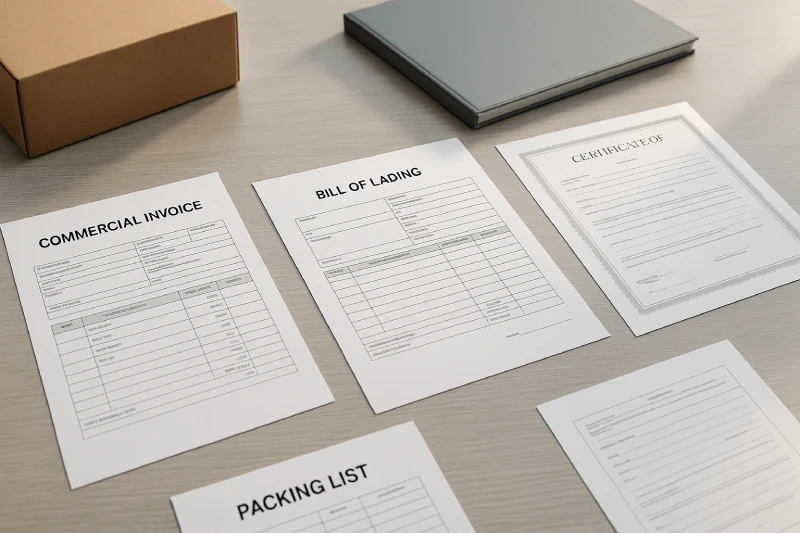
Before diving into the details, here is a quick overview of the key documents required when importing from China to the United States. Each plays a specific role in valuation, compliance, risk control, and final cargo release.
| Document | Purpose | Issued By |
|---|---|---|
| Commercial Invoice | Product valuation, duty calculation | Supplier |
| Packing List | Physical cargo verification | Supplier |
| Bill of Lading / AWB | Proof of shipment, release process | Carrier / Forwarder |
| HS Code Declaration | Classification, duty assessment | Importer / Broker |
| Certificate of Origin | Confirms manufacturing origin | Supplier |
| ISF 10+2 (Ocean Only) | Advance security filing | Importer / Broker |
| Customs Bond | Duty guarantee for CBP | Surety Company |
| Arrival Notice | Confirms cargo arrival | Carrier / Forwarder |
| Product Compliance Certificates | Regulatory clearance (FDA, FCC, EPA, etc.) | Testing Labs / Supplier |
| Power of Attorney | Authorizes customs broker | Importer |
Commercial Invoice
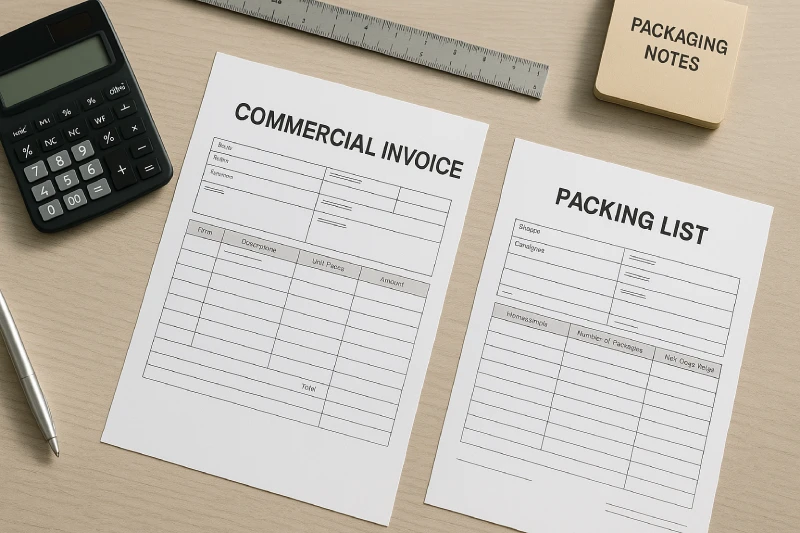
The Commercial Invoice is the most important document in the entire import process, serving as the foundation for CBP valuation, duty calculation, and entry declaration. It acts as the official record of the transaction between the seller in China and the importer in the United States. CBP reviews the invoice to verify product descriptions, quantities, unit values, HS classifications, and the declared Incoterms used for the shipment.
A compliant invoice should include: full seller and buyer details, detailed product descriptions, material composition, HS codes, unit prices, total value, currency, country of origin, and shipping terms. Any inconsistencies—such as vague descriptions (“plastic item”), incorrect HS codes, or missing Incoterms—may delay customs clearance or trigger additional inspection.
Winsail Tip: Ensure your supplier’s invoice matches your product catalog and HTS classification. Accurate, transparent descriptions significantly reduce CBP scrutiny and prevent unexpected duty adjustments.
Packing List
The Packing List provides a detailed breakdown of how the goods are physically packaged and is used by CBP, warehouses, and trucking companies to verify cargo accuracy. While it does not include pricing information, it must clearly list carton numbers, packaging type, product quantities inside each carton, net and gross weight, and dimensions. This information helps ensure that what appears on the Commercial Invoice matches what is actually loaded into the container or air shipment.
If the Packing List contains errors—such as mismatched carton counts, missing weights, or inconsistent item descriptions—CBP may flag the shipment for inspection. Warehouses may also refuse receipt if the details do not align. Importers should always cross-check this document carefully before the cargo departs China.
Bill of Lading (B/L) or Air Waybill (AWB)
The Bill of Lading (for sea freight) or Air Waybill (for air shipments) serves as the official contract of carriage between the shipper, carrier, and consignee. It confirms that the goods have been loaded, outlines transport terms, and is required for release at U.S. ports and airports. CBP uses B/L or AWB data to validate shipment details, cross-check ISF filings, and ensure that the cargo matches the declared information.
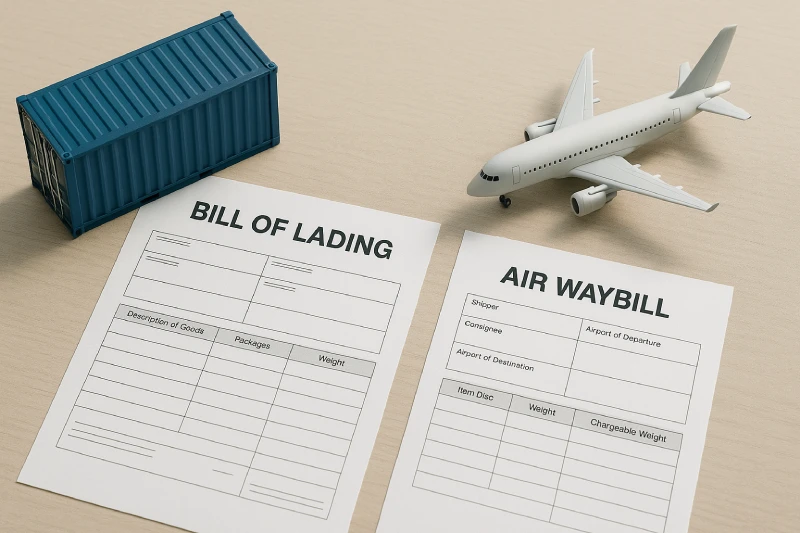
Sea freight shipments may use Original B/L, Telex Release, or Express Release, while air shipments always use AWB. Errors in these documents—such as incorrect consignee information, wrong container numbers, or inconsistent cargo descriptions—can prevent carriers from releasing cargo and may lead to storage or demurrage fees.
Winsail Tip: Always verify consignee name, address, HS codes, and cargo details on the B/L or AWB before the shipment departs China to avoid costly delays upon arrival.
HS Code & Customs Declaration Requirements
HS codes (Harmonized System codes) determine the duty rate, taxes, admissibility requirements, and whether additional regulations—such as anti-dumping duties or FDA rules—apply to a shipment. For imports from China to the USA, correct classification is essential because CBP relies on HS codes to validate product descriptions, ensure accurate valuation, and assess compliance risks.
A proper HTS (Harmonized Tariff Schedule) classification should reflect the true nature, material composition, and function of the product. Common importer mistakes include relying solely on the supplier’s suggested HS code, choosing overly broad categories, or using outdated classifications. Such errors can lead to duty reassessments, penalties, or shipment delays.
Winsail Tip: Use CBP’s HTS database and cross-reference previous CBP ruling letters. Proper classification not only ensures compliance but can also help optimize duty costs legally.
Certificate of Origin (CO)
A Certificate of Origin confirms that the goods were manufactured in China and is often requested by CBP as part of its risk-assessment and import verification procedures. Although the United States does not offer preferential tariffs for Chinese-origin products, the CO still plays an important role in validating the declared country of origin for labeling, duties, and compliance purposes.
The CO is typically issued by the supplier or manufacturer and should match the information on the Commercial Invoice and Packing List. Inconsistent or incomplete CO details—such as incorrect factory address or mismatched product descriptions—may trigger additional questions from CBP or delay cargo release.
Winsail Tip: Ensure your supplier uses a standardized CO template and double-check that all product details align with other shipment documents.
ISF 10+2 Filing (Ocean Shipments Only)
The Importer Security Filing (ISF), commonly known as ISF 10+2, is a mandatory requirement for all ocean shipments entering the United States. It must be filed at least 24 hours before the vessel departs from China, allowing CBP to conduct advance security screening and assess potential risks. Failure to file on time—or filing inaccurate data—may lead to penalties of up to USD 5,000 per violation, shipment holds, or delayed container release.
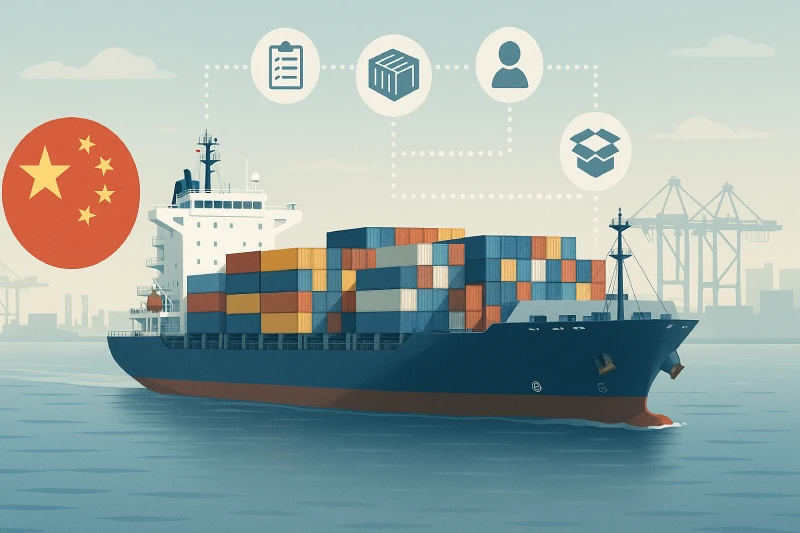
The ISF requires 10 data elements from the importer, including the buyer, seller, manufacturer, importer of record, consignee number, HTS code, and country of origin. The carrier provides the remaining 2 elements related to container stuffing location and consolidator details.
Because the ISF links directly to the Bill of Lading and Commercial Invoice, any inconsistent information can trigger an automated CBP review.
Winsail Tip: Send your invoice, packing list, and supplier details to your forwarder early, so ISF can be filed accurately and on time.
U.S. Customs Bond (Continuous or Single Entry)
A U.S. Customs Bond is a financial guarantee required by CBP to ensure that duties, taxes, and potential penalties will be paid. Any commercial shipment valued above USD 2,500—or any shipment subject to government agency oversight such as FDA or EPA—must have an active customs bond in place before clearance. A bond is also required for ISF filing if the importer is acting as the Importer of Record.
Importers can choose between a Single-Entry Bond, suitable for occasional shipments, or a Continuous Bond, which covers all imports for 12 months and is recommended for frequent or high-value shipments. Without a valid bond, CBP cannot release the cargo, which may result in storage fees or delays.
Winsail Tip: Most U.S.-based importers benefit from a continuous bond due to lower annual cost and smoother customs processing.
Arrival Notice
The Arrival Notice is issued by the carrier or freight forwarder to inform the importer that the shipment has reached a U.S. port or airport. This document includes key details such as the vessel or flight number, arrival date, container number, storage location, and any destination charges owed. Importers need the Arrival Notice to coordinate customs clearance, arrange delivery, and avoid demurrage or storage fees.
Because the Arrival Notice reflects the final transport data, it should match the Bill of Lading or Air Waybill. Any discrepancies may cause delays or require manual verification.
Importer of Record (IOR) Documentation Requirements
The Importer of Record (IOR) is the party legally responsible for ensuring that goods imported into the United States comply with all CBP regulations. The IOR must provide accurate documentation, pay duties and taxes, and ensure that all required filings—such as ISF, entry summaries, and compliance certificates—are completed correctly. In most cases, the IOR must be a U.S. entity with a valid EIN (Employer Identification Number), although licensed customs brokers may sometimes act on behalf of foreign companies.
IOR documentation typically includes full company details, tax identification, contact information, and an active customs bond. Missing or incorrect IOR information can delay clearance or prevent cargo release entirely.
Winsail Tip: Ensure your IOR details match the information on the Commercial Invoice and Bill of Lading to avoid discrepancies during CBP review.
Power of Attorney (POA) for Customs Broker
A Power of Attorney (POA) authorizes a licensed U.S. customs broker to act on the importer’s behalf during the clearance process. Without a signed POA, the broker cannot submit entry documents, file ISF, pay duties, or communicate with CBP in the importer’s name. The POA must include the importer’s legal business name, EIN, full address, and an authorized signature.
Because the information on the POA must match all other import documents, inconsistencies can cause filing delays or require re-submission. Importers should complete the POA before the first shipment departs to ensure smooth processing.
Product-Specific Compliance Documents
Depending on the type of product being imported from China, additional U.S. regulatory documents may be required to prove safety, quality, and compliance. These certificates go beyond standard customs paperwork and are reviewed by agencies such as the FDA, FCC, EPA, and CPSC.
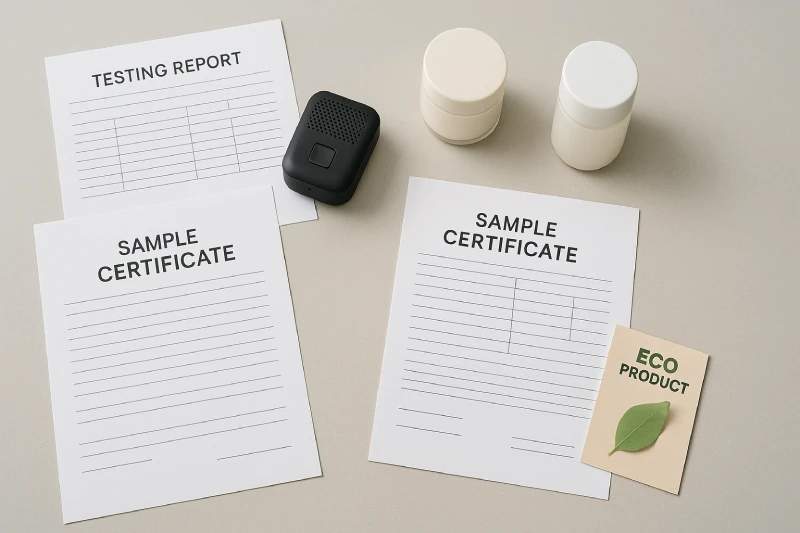
FDA (Food, supplements, cosmetics, medical devices)
These shipments may require FDA registration, prior notices, ingredient statements, or manufacturer compliance documentation. Non-compliance can result in detention or product refusal.
FCC (Electronics with radio frequency components)
Items such as Bluetooth devices, Wi-Fi equipment, and RF electronics must include FCC certification to verify electromagnetic compliance.
EPA (Chemicals, engines, and environmental products)
Products like pesticides, engines, and certain chemical substances may require EPA declarations or emission certifications.
CPSIA (Children’s products)
Toys, apparel, and juvenile items must include Children’s Product Certificates (CPC) and third-party lab testing results.
Because these regulations vary by product category, importers should confirm requirements before production begins to avoid last-minute compliance issues.
Document Requirements by Shipping Method
Different shipping methods require different levels of documentation, and understanding these variations helps importers prepare correctly and avoid delays.
Sea Freight (FCL & LCL)
Ocean shipments require the most paperwork. Importers must provide the Commercial Invoice, Packing List, Bill of Lading, HS Code declaration, and Certificate of Origin. In addition, ISF 10+2 must be filed before vessel departure, and a valid customs bond is mandatory for U.S. clearance.
Air Freight
Air shipments typically move faster, but still require key documents such as the Commercial Invoice, Packing List, Air Waybill, and any applicable compliance certificates (FDA, FCC, EPA, etc.). ISF is not required for air cargo.
Courier / Express (DHL, FedEx, UPS)
Express carriers handle most customs documentation on behalf of the importer. However, compliance regulations—especially for FDA or FCC-controlled items—still apply, and CBP may request additional documents if needed.
DDP Shipping
Under DDP terms, the supplier or forwarder manages customs paperwork, duties, and taxes. Importers still need to ensure product compliance to avoid regulatory issues.
Amazon FBA
FBA shipments require standard import documents plus correct FBA warehouse addresses, carton/pallet labels, and any product-specific certificates.
Winsail Tip: Request compliance documents early—preferably before the goods leave the factory—to prevent CBP holds at arrival.
How to Prepare All Required Import Documents
Preparing import documents systematically helps prevent delays and ensures smooth CBP clearance. The following workflow outlines the essential steps:
- Gather product information — Confirm materials, specifications, and intended use to determine the correct HS code.
- Request Commercial Invoice and Packing List — Ensure suppliers provide complete and accurate details before shipment.
- Submit ISF 10+2 (Sea Freight Only) — Provide invoice, packing list, and supplier details early so your forwarder can file on time.
- Verify the B/L or AWB draft — Check consignee information, cargo descriptions, and container or flight details for accuracy.
- Prepare necessary compliance documents — FDA, FCC, EPA, CPSIA certificates, or lab tests depending on the product type.
- Provide Importer of Record details and POA — Authorize your customs broker and confirm all IOR data matches other documents.
- Review all documents for consistency — Ensure descriptions, HS codes, and quantities align across all paperwork.
- Send documents for customs entry filing — Your broker will prepare the Entry Summary and coordinate release.
- Monitor cargo arrival — Use the Arrival Notice to schedule pickup and avoid storage fees.
Common Document Mistakes & How to Avoid Them
Many shipment delays and unexpected customs issues stem from avoidable documentation errors. Common mistakes include incorrect or inconsistent HS codes, vague product descriptions, mismatched quantities between the invoice and packing list, and missing Importer of Record details or POA. For sea freight, late or inaccurate ISF 10+2 submissions often result in penalties or automatic CBP holds.
Compliance documents such as FDA or FCC certificates are also frequently overlooked, especially by first-time importers. To prevent these problems, importers should use a standardized checklist, verify all documents before shipment, and maintain consistent product data across every form. Working closely with an experienced customs broker or freight forwarder significantly reduces the risk of costly mistakes.
FAQs
1. Do I need a customs bond for small shipments?
Yes. Any commercial shipment valued above USD 2,500 or regulated by agencies such as FDA requires a customs bond.
2. What happens if the ISF 10+2 is filed late?
CBP may issue penalties of up to USD 5,000 and place the container on hold, leading to significant delays and storage fees.
3. Can my supplier in China act as the Importer of Record?
No. Only a U.S.-based company or licensed customs broker may serve as the IOR.
4. Which documents are required for Amazon FBA shipments?
Standard documents (invoice, packing list, B/L or AWB) plus accurate FBA warehouse addresses and labeling compliance.
5. Are express shipments exempt from compliance checks?
No. Even though DHL, FedEx, or UPS handle paperwork, CBP may still request compliance certificates such as FDA or FCC.
6. How do I get a Certificate of Origin?
Your supplier issues the CO, but you must verify that all product descriptions match other documents.
7. Do cosmetics or supplements require FDA approval?
Yes. These categories often require FDA prior notices or manufacturer compliance documentation.
8. What should I do if document information does not match?
Correct discrepancies immediately. Inconsistent details are one of the main triggers for CBP inspections.
How Winsail Can Support Your Import Process
Navigating the documentation required to import from China to the USA can feel overwhelming, especially as U.S. regulations continue to evolve. Yet with the right preparation—accurate invoices, clear packing details, proper HS codes, and timely ISF filings—most clearance delays are fully avoidable. Ensuring product-specific compliance documents are ready before shipping is equally important for FDA, FCC, EPA, and other regulated categories.
Working with a knowledgeable partner can make the entire process smoother and more predictable. Winsail Logistics helps importers review documents, file customs entries correctly, manage ISF submissions, and anticipate compliance requirements based on product type.
If you want your shipments to clear faster and avoid costly mistakes, our team is ready to assist. Contact Winsail Logistics for expert guidance and end-to-end support for your China-to-USA imports.
