
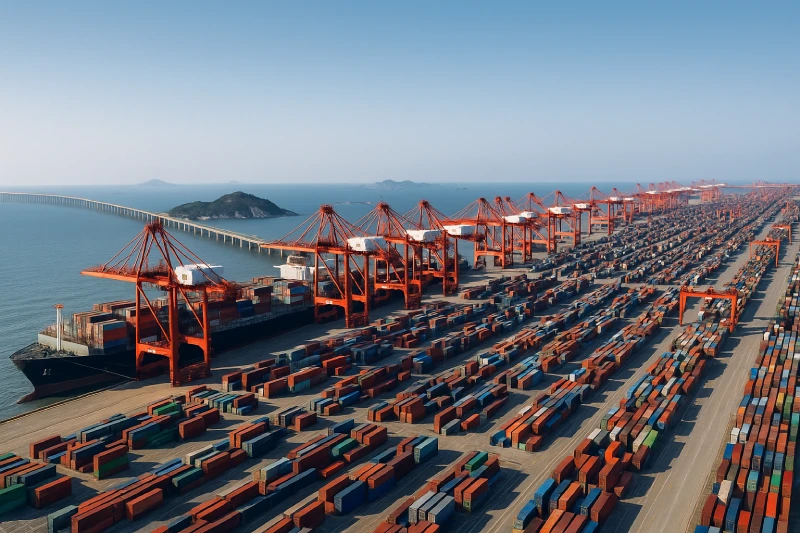
Shanghai Port is the world’s busiest and most advanced container port, serving as the main gateway for China’s international trade. Located at the mouth of the Yangtze River on the East China Sea, it handles over 47 million TEUs of cargo every year.
The port consists of three major areas — Yangshan Deep-Water Port, Waigaoqiao, and Wusongkou — all equipped with automated terminals, bonded warehouses, and excellent road-rail connections.
From Shanghai, vessels connect to more than 500 ports in 200+ countries, covering key trade routes to the Middle East, Africa, Europe, and North America. Typical sea freight transit times range from 15 to 35 days, depending on the destination.
Shanghai Port supports multiple modes — FCL, LCL, Ro-Ro, Bulk, and Air Freight — making it China’s most efficient and reliable export hub for global shipments.
Overview of Shanghai Port + Location Map
Shanghai Port is strategically located at the mouth of the Yangtze River, where China’s longest inland waterway meets the East China Sea. As the largest and busiest port in the world, it plays a critical role in connecting China’s manufacturing powerhouse—the Yangtze River Delta—with every major global market.
The port covers multiple functional areas, including Yangshan Deep-Water Port, Waigaoqiao Port Area, and Wusongkou Port, with a total coastline exceeding 30 kilometers. Together, these port zones handle containerized, bulk, and Ro-Ro cargo, supported by world-class logistics infrastructure and advanced digital operations.
In 2024, Shanghai Port handled over 47 million TEUs, maintaining its top global ranking for more than a decade. Its success is driven by state-of-the-art automation, extensive international shipping routes, and its proximity to major industrial hubs like Suzhou, Kunshan, and Hangzhou.
For exporters, Shanghai Port offers unmatched access to global supply chains, frequent vessel departures, and efficient multimodal transport via highway, railway, and inland barge networks. This makes it the preferred port of export for countless manufacturers and freight forwarders across China.
Port Terminals and Facilities
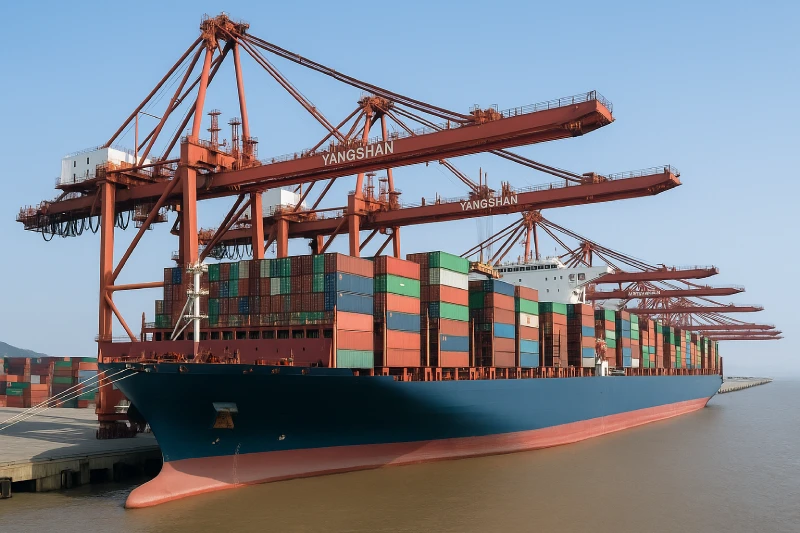
Shanghai Port is made up of three main operating zones — Yangshan Deep-Water Port, Waigaoqiao Port Area, and Wusongkou Port — each serving a unique function within the port’s massive logistics ecosystem. Together they form a fully integrated network that handles every type of cargo, from containers and bulk goods to vehicles and cruise liners.
Yangshan Deep-Water Port
Located on a group of offshore islands linked to the mainland by the 32-km Donghai Bridge, Yangshan is one of the world’s most advanced automated container ports. It can accommodate ultra-large vessels (24,000 TEU+) and features unmanned cranes, intelligent stacking systems, and real-time tracking technologies. The port operates 24/7 and handles the majority of Shanghai’s container throughput.
Waigaoqiao Port Area
Situated closer to the urban Pudong district, Waigaoqiao is the largest bonded logistics zone in China. It focuses on container operations, Ro-Ro shipping, warehousing, and customs services. Its proximity to manufacturing centers and the Shanghai Free Trade Zone makes it ideal for exporters who require fast clearance and consolidation.
Wusongkou Port
Located at the confluence of the Huangpu and Yangtze Rivers, Wusongkou serves mainly small cargo vessels, domestic trade, and cruise ships. It connects inland waterways with international routes, supporting feeder services for northern and central China.
| Terminal | Main Function | Key Features |
|---|---|---|
| Yangshan | Deep-water container handling | Automated cranes, large-vessel capacity |
| Waigaoqiao | Container & Ro-Ro operations | Bonded warehouses, FTZ location |
| Wusongkou | River & feeder cargo | Domestic & cruise terminal link |
Main Export Commodities
Shanghai Port handles an extraordinary range of export commodities, reflecting the industrial strength of the Yangtze River Delta, one of China’s most advanced manufacturing regions. The port serves as the main export gateway for both heavy industry and high-tech manufacturing, efficiently supporting FCL, LCL, and Ro-Ro shipments to every major global destination.
The leading export categories include:
- Machinery and Equipment – CNC machines, industrial tools, and factory components.
- Electronics and Electrical Appliances – semiconductors, smartphones, laptops, and household devices.
- Automotive Parts and Vehicles – engines, brake systems, tires, and new-energy vehicles.
- Textiles and Garments – fabrics, apparel, and footwear from nearby Suzhou and Hangzhou factories.
- Chemical and Plastic Products – resins, paints, coatings, and raw materials.
- Steel, Metals, and Building Materials – structural steel, fasteners, and aluminum components.
These exports are supported by Shanghai’s extensive logistics ecosystem, which includes bonded warehouses, inland consolidation hubs, and specialized terminals for hazardous or oversized cargo. The port’s digital customs platform enables fast clearance and traceability, reducing dwell time for export containers.
| Top 5 Export Categories | Typical Mode |
|---|---|
| Machinery & Equipment | FCL / LCL |
| Electronics | Air / LCL |
| Auto Parts | FCL / Ro-Ro |
| Textiles | LCL |
| Chemicals & Plastics | Bulk / FCL |
Shanghai Port’s diversified export profile and efficient logistics chain make it the most reliable export hub for manufacturers across Eastern China.
Key Trade Routes & Global Destinations
Shanghai Port maintains one of the widest global route networks of any seaport in the world. With more than 500 international connections across over 200 countries, it serves as China’s primary gateway for both eastbound and westbound maritime trade. Major ocean carriers—including COSCO, Maersk, MSC, CMA CGM, and Hapag-Lloyd—operate frequent weekly sailings to all major continents.
1. Middle East Routes
Regular liner services connect Shanghai with Jebel Ali (UAE), Dammam (Saudi Arabia), and Doha (Qatar). These routes are favored for machinery, construction materials, and consumer goods, with average transit times of 17–25 days.
2. Africa Routes
Shanghai’s vessels sail to Mombasa (Kenya), Dar es Salaam (Tanzania), and Lagos (Nigeria). Typical shipments include auto parts, electronics, and textiles, taking 25–35 days depending on destination.
3. Europe Routes
Key European gateways such as Rotterdam, Hamburg, and Antwerp receive regular direct services. Transit time averages 28–35 days, carrying high-value goods like machinery, vehicles, and chemicals.
4. North America Routes
Fast trans-Pacific services link Shanghai with Los Angeles, Long Beach, and Vancouver, averaging 16–20 days. These routes are essential for electronics, e-commerce, and retail supply chains.
Shanghai Port’s dense route coverage and vessel frequency ensure exporters enjoy short lead times, stable schedules, and competitive freight rates, solidifying its position as China’s leading global shipping hub.
Transit Time Table (China → Regions)
Transit times from Shanghai Port vary depending on the destination, vessel schedule, and chosen carrier. In general, the port offers some of the fastest and most consistent sailing times among all Chinese export gateways. Thanks to its advanced scheduling systems and high vessel frequency, shippers can enjoy reliable delivery windows for both FCL and LCL shipments.
Below is an estimated overview of average ocean freight transit times from Shanghai to major global regions:
| Destination Region | Main Port of Arrival | Average Transit Time (Days) | Typical Shipping Mode |
|---|---|---|---|
| Middle East | Jebel Ali (UAE), Dammam (SA) | 17 – 25 | FCL / LCL |
| East Africa | Mombasa (KE), Dar es Salaam (TZ) | 25 – 30 | FCL / LCL |
| West Africa | Lagos (NG), Tema (GH) | 35 – 40 | FCL / Ro-Ro |
| Europe | Rotterdam (NL), Hamburg (DE), Antwerp (BE) | 28 – 35 | FCL / LCL |
| North America | Los Angeles (US), Long Beach (US), Vancouver (CA) | 16 – 20 | FCL / LCL |
| Southeast Asia | Singapore (SG), Port Klang (MY), Bangkok (TH) | 5 – 10 | LCL / FCL |
| Australia & New Zealand | Sydney (AU), Auckland (NZ) | 12 – 18 | FCL / LCL |
Transit times may vary slightly depending on the carrier, route frequency, weather, and customs clearance speed. Air or express shipments from Shanghai can shorten total lead time to under five days.
With regular weekly sailings and dependable schedules, Shanghai Port remains one of the most efficient departure points for international ocean freight from China.
Advantages of Shanghai Port vs Other Chinese Ports
Among China’s numerous export gateways, Shanghai Port consistently ranks as the most competitive in terms of efficiency, route density, and logistics integration. While ports like Ningbo, Shenzhen, and Qingdao each hold regional importance, Shanghai stands apart as the country’s true international hub.
1. Strategic Location and Connectivity
Situated at the center of the Yangtze River Delta, Shanghai is surrounded by China’s largest manufacturing cluster. It connects seamlessly to inland cities via highways, railways, and river barges—reducing trucking time and cost for exporters across Jiangsu, Zhejiang, and Anhui provinces.
2. Global Route Coverage
Shanghai maintains the widest international network of any Chinese port, linking to over 500 ports in 200+ countries. Daily departures to the Middle East, Africa, Europe, and North America ensure unmatched schedule flexibility and faster cargo turnover.
3. Advanced Automation and Digital Systems
The Yangshan Deep-Water Port features one of the world’s first fully automated terminals, utilizing unmanned cranes, AI scheduling, and paperless customs processes. This technological edge translates into shorter dwell times and higher operational accuracy.
4. Comparison Snapshot
| Port | Key Strength | Limitations |
|---|---|---|
| Shanghai | Largest route network, automation, FTZ access | Occasional congestion during peak season |
| Ningbo-Zhoushan | High bulk cargo capacity | Limited air–sea multimodal links |
| Shenzhen (Yantian) | Strong export to US markets | Farther from Yangtze manufacturing base |
| Qingdao | Northern China hub | Smaller trade volume, fewer global routes |
Overall, Shanghai Port’s combination of scale, technology, and geographic advantage makes it the preferred departure point for international freight forwarders and exporters seeking reliability and speed.
Nearby Manufacturing & Industrial Hubs
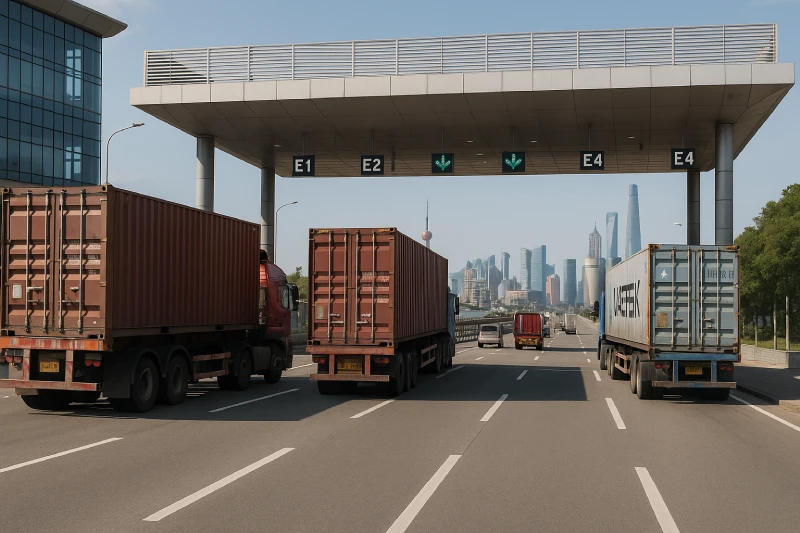
One of Shanghai Port’s greatest advantages lies in its proximity to the Yangtze River Delta (YRD) — China’s most productive and export-oriented industrial region. Within a 200-kilometer radius, exporters have access to hundreds of high-tech and traditional manufacturing clusters, all seamlessly connected to the port through expressways, rail corridors, and inland waterways.
Key Industrial Cities Around Shanghai
- Suzhou & Kunshan (Jiangsu Province): electronics, semiconductors, precision machinery, and packaging.
- Wuxi & Changzhou: automotive components, solar panels, and heavy machinery.
- Hangzhou & Jiaxing (Zhejiang Province): textiles, fashion, e-commerce products, and household appliances.
- Nantong & Taicang: steel structures, equipment manufacturing, and bulk cargo exports.
These cities serve as collection and consolidation hubs for FCL and LCL shipments routed through Shanghai Port. Many factories operate bonded warehouses or cooperate with logistics parks within the Shanghai Free Trade Zone, enabling faster customs clearance and cross-border processing.
The region’s dense supply-chain ecosystem means shorter inland transit times — often under four hours by truck from factory to terminal — significantly improving delivery efficiency.
For global shippers, this integration of manufacturing power and port accessibility makes the Yangtze River Delta a top choice for sourcing, assembly, and export via Shanghai Port.
Best Shipping Modes: FCL / LCL / Ro-Ro / Bulk / Air
Shanghai Port supports a complete range of international shipping modes, making it suitable for almost every cargo type — from small consumer goods to heavy industrial machinery. Choosing the right mode of transport is key to balancing cost, speed, and reliability for your exports.
1. FCL (Full Container Load)
Best for large, regular shipments or single consignments that require dedicated containers.
- Ideal for: machinery, furniture, auto parts, and bulk product orders.
- Benefits: lower cost per unit, enhanced cargo security, fixed departure schedules.
2. LCL (Less than Container Load)
Suitable for small-volume or mixed cargo, allowing multiple exporters to share one container.
- Ideal for: electronics, textiles, small equipment.
- Benefits: flexible booking, cost-sharing, convenient for SMEs.
3. Ro-Ro (Roll-on/Roll-off)
Used for vehicles, heavy machinery, and wheeled equipment.
- Operated mainly through Waigaoqiao and Yangshan terminals.
- Benefits: safer handling, no container loading required.
4. Bulk & Breakbulk Cargo
For raw materials, steel products, or oversized equipment.
- Dedicated terminals handle heavy lift and project cargo with specialized cranes.
5. Air Freight (via Shanghai Pudong Airport)
Perfect for urgent shipments or high-value goods.
- Typical transit time: 3–5 days worldwide.
- Winsail offers combined sea + air logistics solutions to optimize both cost and speed.
With all these options integrated into a single logistics ecosystem, Shanghai Port remains China’s most versatile export hub, connecting seamlessly with Winsail’s FCL, LCL, Ro-Ro, and Air Freight service networks.
Freight Examples – Real Winsail Logistics Cases
To illustrate the efficiency of Shanghai Port and Pudong Airport as export gateways, here are two real shipping cases managed by Winsail Logistics, showing both sea and air freight performance.
Ocean Freight (LCL) – Medical Devices from Shanghai to Jebel Ali
Winsail Logistics completed an ocean LCL shipment from Shanghai Port to Jebel Ali (UAE), transporting 4.18 CBM of medical devices safely.
Handled by HAL carrier, the shipment arrived in 20 days, supported by professional packing, reliable tracking, and smooth customs clearance.
Air Freight – Brake Discs from Shanghai to Dubai
An urgent automotive parts shipment was arranged via air freight from Shanghai to Dubai.
A total of 349 KGS of brake discs were shipped with carrier CA, reaching the destination within 1 day.
This project demonstrates Winsail’s ability to handle time-sensitive cargo with speed, safety, and reliable coordination.
FAQs
1. Is Shanghai Port open 24 hours a day?
Yes. Shanghai Port operates 24/7, year-round, including weekends and public holidays. Continuous operations across its terminals ensure vessels can be loaded, unloaded, and cleared efficiently, reducing waiting time during peak seasons.
2. How can I book a container shipment from Shanghai Port?
You can book directly through your freight forwarder or shipping agent. Winsail Logistics provides FCL, LCL, and Ro-Ro booking services, cargo consolidation, and customs documentation — making it easy to schedule your export from any factory in Eastern China.
3. What is the nearest airport to Shanghai Port?
Shanghai Pudong International Airport (PVG) is approximately 30 km from the port’s Waigaoqiao terminal. It serves as a major gateway for air freight and sea-air combined logistics solutions.
4. Can I ship DDP or door-to-door from Shanghai?
Yes. Winsail offers complete DDP (Delivered Duty Paid) and door-to-door logistics from Shanghai to major global destinations, covering pickup, export customs, sea or air transport, import clearance, and final delivery.
5. Does Shanghai Port handle vehicles or oversized cargo?
Absolutely. The Waigaoqiao and Yangshan terminals are equipped for Ro-Ro and breakbulk cargo, suitable for vehicles, heavy machinery, and project shipments.
Ready to ship from Shanghai Port?
👉 Contact Winsail Logistics today for a free, fast quotation and expert guidance on the most efficient shipping route for your cargo.
Our dedicated team ensures on-time delivery, competitive rates, and seamless customs handling — from China to anywhere in the world.
