

Why Global Importers Need Reliable Logistics for Auto Parts from China
China is the world’s largest source of automotive spare parts, which means buyers across the globe depend heavily on consistent, safe, and cost-effective logistics to move these components from Chinese factories to their destination markets. But auto parts are one of the most challenging categories to ship—mixing fragile items like headlights, bulky exterior panels, and dense components such as brake discs, all sourced from multiple suppliers and locations.
Moving these parts efficiently requires more than just booking freight. It involves proper consolidation, reinforced packaging, accurate HS classification, and tight coordination across factories, warehouses, carriers, and customs authorities. Without the right logistics partner, shipments can easily encounter damage, delays, or unnecessary costs.
That’s why importers, distributors, and repair shops worldwide rely on Winsail Logistics. We specialize in handling auto parts shipments of all sizes, offering safe packaging solutions, multi-supplier consolidation, flexible sea/air freight options, and smooth customs processing to ensure your parts arrive intact, on time, and at the best possible cost.
Shipping Methods for Auto Parts
Auto parts can be shipped from China through several different transportation methods, each suitable for specific product types, volumes, and delivery requirements. Because the category includes both lightweight electrical components and extremely heavy or fragile items, choosing the right method is one of the most important decisions in the logistics process.
1. LCL (Less than Container Load)
LCL is the most commonly used solution for auto parts importers, especially those sourcing from multiple suppliers. It allows small and medium-size shipments to be consolidated into one container, reducing cost while maintaining flexibility. LCL is ideal for mixed SKUs, cartons of fast-moving spare parts, and orders that do not fill a full container.
2. FCL (Full Container Load)
FCL is preferred by wholesalers and large distributors that purchase parts in bulk. Shipping by full container reduces handling risks, speeds up customs clearance, and provides better protection for fragile items such as headlights, bumpers, and body panels. It also offers the most stable cost structure for long-term import programs.
3. Air Freight
Air freight is widely used for high-value, urgent, or small-volume parts such as sensors, electronic modules, ignition coils, and critical OEM components. For businesses that need to minimize downtime in workshops or keep inventory moving fast, air freight offers unbeatable transit time.
4. Express Shipping (DHL/UPS/FedEx)
Express services are ideal for samples, prototype parts, or extremely time-sensitive deliveries. Many importers use express to test new suppliers or ship low-volume aftermarket items while waiting for bulk shipments to arrive by sea.
With a combination of LCL, FCL, air freight, and express options, Winsail Logistics designs flexible and cost-effective transportation plans tailored to the specific needs of auto parts importers worldwide.
Transit Time from China
Transit time for shipping auto parts from China varies depending on the destination region, chosen shipping method, and seasonal shipping conditions. Sea freight remains the most cost-effective option for bulk orders, while air freight is preferred for urgent or high-value components.
To the Middle East (UAE, Saudi Arabia, Qatar)
Sea freight typically takes 18–28 days, depending on the port and carrier schedule. Air freight shipments usually arrive within 3–7 days, making them ideal for fast-moving or emergency spare parts.
To Africa (Kenya, Nigeria, South Africa)
Transit times range from 25–40 days by sea, with East Africa generally being faster than West Africa. Air freight to major hubs such as Nairobi or Lagos takes about 4–8 days.
To the United States and Canada
Auto parts shipped by sea require around 18–30 days, depending on whether the destination is the West Coast or East Coast. Air freight deliveries take 3–6 days, offering a reliable solution for time-sensitive items.
To Europe (UK, Germany, Netherlands)
Typical sea freight transit times fall between 25–35 days, while air freight shipments arrive in 3–7 days.
These reference timelines help importers plan inventory cycles, supply chain responsiveness, and replenishment strategies more efficiently.
Shipping Cost Factors
Shipping auto parts from China involves several cost variables, and understanding these factors helps importers accurately estimate their landed cost and choose the most economical shipping method. Because auto parts vary widely in size, weight, material, and packaging, the logistics cost structure can be very different even for shipments with the same CBM.
1. Volume & Dimensional Weight
Products such as bumpers, headlights, and body panels take up large space but weigh very little. These are charged based on dimensional weight, especially for air freight. In contrast, items like brake discs and suspension components are heavy and dense, affecting both freight rate and handling cost.
2. Packaging & Protection Level
Fragile items require reinforced packaging—double cartons, foam padding, corner protectors, or wooden frames. Enhanced packaging increases the carton size, which directly impacts CBM-based shipping fees, especially in LCL shipments.
3. Shipping Method Selection
Air freight costs are driven by volume weight, fuel surcharge, and route capacity, while sea freight depends on CBM (LCL) or full-container rates (FCL). Express couriers use their own dimensional weight formulas, which must be considered when shipping larger but lighter items.
4. Consolidation & Supplier Count
Importers sourcing from multiple suppliers may incur additional consolidation, sorting, and labeling fees. These services significantly reduce mistakes at destination but should be included in the total landed cost planning.
5. Destination Port Charges
Customs fees, handling charges, and local delivery costs vary widely by country, impacting the overall cost especially for Africa, Latin America, and the Middle East.
By evaluating these factors early, buyers can optimize packaging, choose the right shipping mode, and avoid unexpected costs.
Packaging & Handling Requirements for Auto Parts
Proper packaging is one of the most critical steps when shipping auto parts from China. The category includes a mix of fragile, heavy, irregular-shaped, and electronic components, all of which require different handling methods. Good packaging not only reduces damage rates but also lowers disputes, returns, and insurance issues at destination.
1. Fragile Items (Headlights, Taillights, Mirrors, Glass)
Lighting assemblies and mirror components are among the most frequently damaged auto parts during transit. They should be packed using double-layer cartons, thick foam inserts, bubble wrapping, corner protectors, and firm internal dividers. For bulk shipments, outer cartons should be reinforced or palletized to prevent crushing during LCL consolidation.
2. Heavy Parts (Brake Discs, Suspensions, Rotors)
These components require solid inner boxes, anti-shock padding, and extra-strong tape sealing. For shipments containing multiple heavy pieces, exporters should palletize cartons to ensure safer loading and unloading.
3. Electronic Components (Sensors, Control Modules, Coils)
Electronics must be protected with anti-static bags, moisture-proof packaging, and sealed polyfoam boxes. Temperature and humidity changes during transit can affect sensitive components, especially when shipping long distances by sea.
4. Large or Irregular Parts (Bumpers, Fenders, Body Panels)
Because these items are lightweight but occupy large space, packaging should focus on shape protection—using molded foam, stretch film, and fitted cartons that maintain structure. Poor packaging easily leads to deformation.
5. Multi-SKU Shipments
When importing from multiple suppliers, each carton should include clear labels, SKU lists, supplier codes, and carton numbers, making consolidation and customs clearance much smoother.
By preparing each type of auto part with the right packaging standard, importers can significantly reduce breakage risk and ensure a smoother logistics process.
HS Codes & Customs Notes for Auto Parts
Auto parts fall under a wide range of HS Codes, and choosing the correct one is essential for smooth customs clearance and accurate duty calculation. Because the category includes mechanical components, electrical modules, body parts, filters, and safety-related items, shipments often contain multiple codes within the same order.
1. Common HS Codes for Auto Parts
- 8708.x — General automotive parts and accessories
- 8511.x — Electrical components (ignition coils, starters, alternators)
- 8409.x — Engine-related parts
- 7007.x — Safety glass, windshields
- 8536 / 8537 — Switches, relays, control modules
- 9026 / 9029 — Sensors and measurement devices
Accurate coding reduces the risk of delays, especially when shipping mixed SKUs through LCL consolidation.
2. Compliance Requirements by Product Type
- Lighting assemblies may require E-mark in Europe
- Electrical items may fall under CE compliance
- Fluid-based products (oils, additives) require MSDS and may face restrictions in air freight
- Safety-related components (airbags, seatbelt modules) can have import limitations depending on destination country
3. Customs Notes for Different Regions
- Middle East (Saudi, UAE): Products may need SABER/SASO certification depending on category
- USA: Strict requirements on EPA-related components
- EU: More rigorous checks on electrical and lighting compliance
Providing the correct HS Codes, packing lists, and compliance documents upfront ensures that your auto parts clear customs efficiently and avoid unnecessary delays.
Popular Auto Parts We Ship
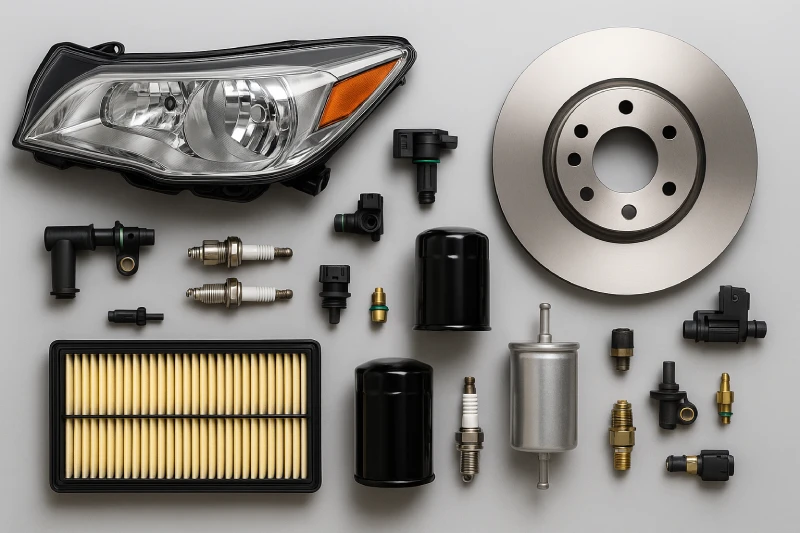
Auto parts represent one of the most diverse product categories in international logistics, and Winsail Logistics routinely handles shipments ranging from small electrical components to large exterior body parts. Our experience covers all major automotive systems, allowing us to provide precise handling, consolidation, and packaging solutions for a wide variety of spare parts.
1. Engine & Mechanical Components
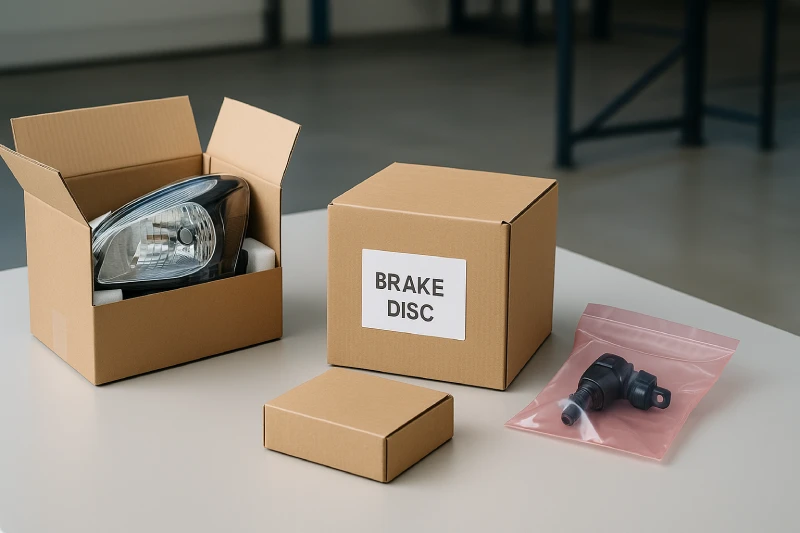
This includes pistons, crankshafts, camshafts, engine mounts, gaskets, timing kits, water pumps, and other core mechanical parts. These items require stable packaging and careful moisture protection during long sea voyages.
2. Brake & Suspension Parts
Brake pads, brake discs, rotors, shock absorbers, ball joints, and control arms are common in both wholesale and aftermarket shipments. Because many of these items are dense and heavy, reinforced cartons and palletization are essential.
3. Electrical & Sensor Components
Ignition coils, ECUs, alternators, starters, oxygen sensors, MAP sensors, and wiring harnesses. These parts must be packed with anti-static bags and moisture-proof materials.
4. Body Parts & Exterior Components
Bumpers, fenders, grilles, mirrors, headlights, and taillights are among the most frequently shipped fragile items. Proper padding and double cartons help minimize breakage risk.
5. Filters & Fast-Moving Service Items
Oil filters, air filters, fuel filters, spark plugs, belts, and hoses—small, lightweight products ideal for LCL and air freight consolidation.
With extensive experience across these categories, Winsail Logistics ensures that every type of auto part is packed, loaded, and shipped using the most reliable and cost-efficient method.
Route & Port Recommendations for Auto Parts
Choosing the right origin and destination ports can significantly improve shipping efficiency, reduce transit time, and lower the total logistics cost for auto parts importers. Because many suppliers cluster in specific regions in China, aligning the shipment route with these production hubs is essential.
1. Recommended Origin Ports in China
- Guangzhou / Shenzhen (South China): Ideal for lighting, sensors, and Japanese car–compatible spare parts produced in Guangdong.
- Ningbo / Shanghai (East China): Best for engine parts, suspension components, and electrical items manufactured in Zhejiang and Jiangsu.
- Tianjin / Qingdao (North China): Suitable for heavy mechanical components and truck parts.
These ports offer frequent sailings, stable container availability, and competitive rates for both LCL and FCL shipments.
2. Recommended Destination Ports
- Middle East: Jebel Ali (UAE), Dammam (Saudi)—fast clearance and strong distribution networks.
- Africa: Mombasa (Kenya), Durban (South Africa), Apapa/Tin Can (Nigeria).
- USA: Los Angeles/Long Beach for West Coast; New York/New Jersey for East Coast importers.
- Europe: Rotterdam, Hamburg, Felixstowe—major logistics hubs for auto parts re-distribution.
Selecting the most strategic port pairings helps importers achieve faster delivery, smoother customs clearance, and better cost control.
Country-Specific Notes
Different regions have unique demand patterns, brand preferences, and customs requirements for auto parts. Understanding these distinctions helps importers plan inventory, compliance documents, and shipping methods more accurately.
1. Middle East (UAE, Saudi Arabia, Qatar)
The Middle East is one of the largest markets for Japanese car–compatible spare parts, especially for Toyota, Nissan, Mitsubishi, and Lexus. Many importers focus on fast-moving items such as brake pads, filters, suspension components, and lighting assemblies. Saudi Arabia may require SABER/SASO certification for specific categories, while the UAE is more flexible but still expects accurate labeling and documentation.
2. Africa (Kenya, Nigeria, Ghana, South Africa)
Africa is a price-sensitive market where high-value Japanese and Korean car parts coexist with cost-effective Chinese aftermarket alternatives. Many African buyers ship LCL consolidations from multiple suppliers, making SKU labeling and reinforced packaging extremely important. Nigeria and Kenya often have higher destination charges and longer clearance times, so accurate paperwork is essential.
3. United States & Canada
North American importers place strong emphasis on quality consistency and compliance. Certain components related to emissions or engine systems may fall under EPA regulations. Air freight is widely used for urgent workshop replenishment, while sea freight handles bulk stock shipments.
4. Europe (UK, Germany, Netherlands)
Europe requires stricter compliance, especially for lighting assemblies that may need E-mark certification. Packaging quality is also scrutinized due to carrier handling standards. Rotterdam and Hamburg serve as major redistribution hubs for EU-wide deliveries.
By understanding each region’s expectations, Winsail helps auto parts importers reduce compliance issues, shorten clearance times, and optimize their logistics strategy.
Compliance & Certificates for Auto Parts
Auto parts may require specific compliance documents depending on the product category and destination market. Preparing the correct certificates in advance helps prevent customs delays, inspections, or penalties, especially when shipping mixed SKUs.
1. Product-Specific Certifications
- E-mark (ECE Regulation) — Required for lighting assemblies imported into many European countries, including headlights, taillights, and signal lamps.
- CE Marking — Applies to certain electrical or electronic auto parts such as switches, controllers, and diagnostic devices.
- MSDS — Mandatory for fluid-based products (lubricants, additives) and essential for determining air freight eligibility.
2. Export & Origin Documents
- Certificate of Origin / Form E — Required by many countries to access preferential duty rates.
- Commercial Invoice & Packing List — Must list each auto part with accurate HS Codes and descriptions.
- Test Reports (if applicable) — Some countries request additional safety or performance test results for electrical components.
3. Country-Specific Requirements
- Saudi Arabia: Some items may require SABER/SASO certification prior to shipment.
- United States: Components linked to emissions or engine performance could fall under EPA oversight.
Proper documentation ensures your auto parts clear customs smoothly and comply with local regulations.
Risk Control & Insurance for Auto Parts
Auto parts shipments face a unique combination of risks due to their wide variation in size, fragility, and weight. Proper risk management is essential to minimize cargo damage, loss, or delays—especially when shipping mixed SKUs or fragile components through LCL consolidation.
1. Fragile Item Protection
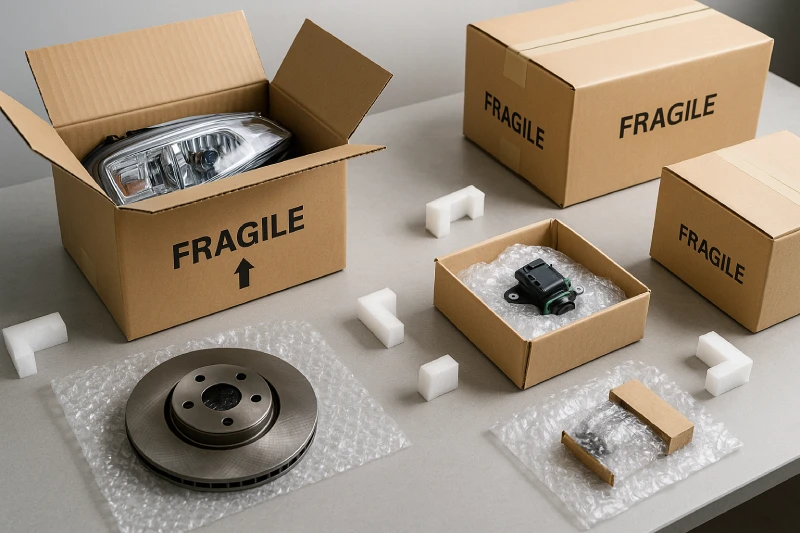
Lighting assemblies, mirrors, and plastic exterior parts have higher breakage rates than most commodities. Shipments should always include double cartons, internal dividers, foam padding, and palletization to prevent crushing during stacking and handling.
2. Heavy and Dense Components
Brake discs, rotors, and suspension parts can damage other cargo if not packed correctly. Reinforced cartons and secure strapping reduce movement inside containers and prevent cartons from collapsing under weight.
3. LCL Consolidation Risks
In LCL shipments, cargo may be placed under heavier items or handled multiple times at the consolidation warehouse. Strengthened packaging, “Do Not Stack” labeling, and palletizing are highly recommended for high-value or fragile SKUs.
4. Moisture & Environmental Risks
Long sea voyages can expose cargo to humidity fluctuations. Desiccant packs, moisture-proof bags, and sealed inner packaging help protect electronic and steel components from corrosion.
5. Cargo Insurance (All-Risk)
Given the mixed nature of auto parts shipments, All-Risk cargo insurance is strongly recommended. It provides financial protection against damage, loss, pilferage, or handling-related incidents throughout the entire transport chain.
With professional packaging standards and comprehensive insurance coverage, Winsail Logistics helps importers reduce risk and maintain consistent delivery quality.
Winsail Auto Parts Shipping Solutions
Shipping auto parts requires more than basic freight forwarding — it demands precise handling, strict packaging standards, and efficient multi-supplier coordination. Winsail Logistics provides a comprehensive, end-to-end solution designed specifically for the complex nature of the auto parts industry.
1. Multi-Supplier Consolidation & Warehouse Sorting
We collect goods from multiple factories, verify quantities, label each carton by SKU, and consolidate everything into a single, well-organized shipment. This significantly reduces destination handling costs and confusion for your warehouse team.
2. Professional Packaging & Reinforcement
Our team ensures fragile items such as headlights and mirrors are double-boxed, while heavy components are placed in reinforced cartons or palletized for safe transport.
3. Flexible Shipping Options
Whether you need LCL, FCL, air freight, or express delivery, we design shipping plans that balance speed and cost based on your inventory strategy and market demand.
4. Documentation & Customs Support
We assist with HS Code accuracy, CO/Form E, E-mark or CE requirements, MSDS verification, and destination-specific compliance.
5. Global Door-to-Door Delivery
For selected regions, we provide DDP solutions to simplify customs clearance and final delivery.
With Winsail’s specialized auto parts logistics service, you can expect safer shipments, faster replenishment, and smoother supply chain operations.
Tips to Reduce Issues, Delays & Costs
Importing auto parts involves many moving pieces, especially when working with multiple suppliers or handling fragile and heavy components. The following tips help reduce common problems and keep your logistics process efficient:
1. Confirm Product Details Early
Clarify HS Codes, packaging requirements, and whether any items contain liquids, batteries, or electronics that may face air freight restrictions.
2. Strengthen Packaging for Fragile Items
Headlights, mirrors, and exterior panels should always use reinforced cartons and foam padding to minimize breakage in LCL shipments.
3. Group SKUs and Label Clearly
Provide suppliers with a unified labeling format to avoid confusion during consolidation and customs clearance.
4. Choose the Right Shipping Mode
Use air freight for urgent or high-value components, and rely on LCL or FCL for routine stock replenishment.
5. Plan for Destination Charges
Some regions—especially Africa and the Middle East—have higher port and clearance fees, so budgeting ahead prevents unexpected costs.
Applying these steps ensures a smoother, faster, and more cost-effective shipping experience.
FAQs
1. What is the best shipping method for auto parts?
There is no single “best” method—your choice depends on volume, urgency, and product type. LCL works well for mixed SKUs and small replenishments, while FCL is ideal for bulk wholesale orders.
High-value or urgent items such as sensors or ignition modules are better shipped by air freight, and samples can be sent via express.
2. How can I reduce the risk of damage to headlights or mirrors?
Fragile components should always be packed using double cartons, internal dividers, and thick foam padding.
For larger shipments, palletizing fragile cartons prevents them from being crushed during consolidation or stacking at warehouses.
3. Can Winsail handle shipments from multiple auto parts suppliers?
Yes. We specialize in multi-supplier consolidation and can receive, label, sort, and combine goods from different factories into one well-organized shipment.
This process reduces destination handling costs and avoids confusion when unloading or stocking inventory.
4. Are any auto parts restricted or sensitive for shipping?
Items containing liquids, chemicals, airbags, or batteries may face specific export controls or air freight restrictions.
Providing product details early helps us determine whether MSDS, special declarations, or alternative shipping methods are required.
5. How long does customs clearance usually take for auto parts?
Clearance time varies by country, product type, and documentation accuracy.
Most regions clear standard auto parts within a few days when HS Codes and paperwork are correct, while countries with stricter regulations (such as Saudi Arabia or the U.S.) may require additional inspection time.
