
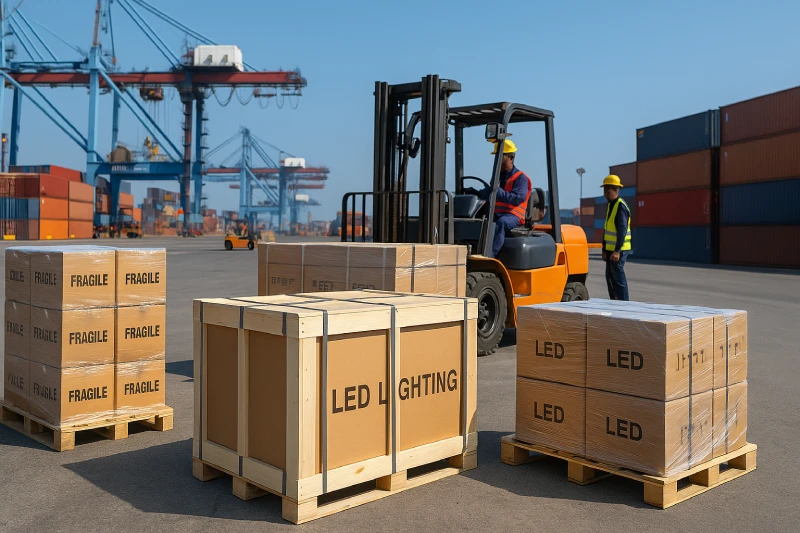
Logistics Overview of LED Lighting
Shipping LED lighting from China requires careful planning because this category combines fragility, irregular dimensions, and electronics sensitivity, making it one of the more damage-prone cargo types in international freight. Most LED products—whether panels, tubes, strips, downlights, high-bays, or floodlights—are lightweight but highly susceptible to impact, vibration, and moisture, which makes packaging and handling a central part of the logistics strategy.
Another challenge is dimensional variability. LED shipments often include mixed SKUs, with some cartons being long and slender (LED tubes), while others are wide and flat (LED panel lights) or bulky and asymmetrical (high-bays and floodlights). This variety complicates pallet stacking, container space allocation, and consolidation planning. LED drivers and control units add another layer of sensitivity, as they contain electronic components that can fail if exposed to humidity or physical shock.
LED lighting also falls under multiple compliance and documentation requirements, especially for the EU, US, and Middle East. Importers may need to provide RoHS, CE, UL/ETL, SASO, or SONCAP certificates to ensure smooth customs clearance. Missing or inaccurate documentation can lead to inspections, delays, or additional testing at destination ports.
Global shipping patterns for LED lighting vary by region. The Middle East and Africa often receive large project-based orders for construction and infrastructure, requiring reliable FCL solutions. The US and EU markets tend to demand consistent quality, strong packaging, and strict compliance for commercial lighting projects. Latin America and Southeast Asia frequently import mixed SKUs in LCL shipments, which increases the need for proper palletization and protective materials.
Because LED lighting is both fragile and dimensionally inefficient, choosing the right shipping method, packaging specification, and compliance documentation is essential. A logistics partner experienced with lighting cargo helps prevent breakage, minimize claims, and reduce avoidable delays from port inspections or improper loading.
Shipping Methods
LED lighting can be shipped from China through several transportation modes, and the best option depends on shipment volume, urgency, fragility level, and destination market requirements. Because most LED products are lightweight but take up significant space, choosing the correct mode can greatly influence both cost efficiency and cargo protection.
FCL (Full Container Load) is ideal for bulk orders or project shipments where all cartons come from the same supplier. Using an entire container reduces handling, minimizes stacking pressure from other cargo, and allows optimized placement of fragile items like panel lights and tubes. FCL also offers better protection against moisture and impact.
LCL (Less-than-Container Load) is commonly used when importers purchase smaller quantities or mixed SKUs from multiple suppliers. However, because LCL involves consolidation with other shippers’ cargo, it requires reinforced packaging and extra inner protection to prevent crushing or vibration damage. Carton quality and pallet height control are critical for fragile LED items.
Air Freight is suitable for urgent commercial installations, hotel project deadlines, or time-sensitive replacement parts such as drivers, COB modules, or high-bay fixtures. Air freight reduces transit time significantly but is influenced by dimensional weight, especially for LED panels and bulky fixtures. Proper cushioning and moisture control remain important due to the rougher handling common in air cargo terminals.
Express Courier (DHL, FedEx, UPS) is preferred for small quantities of LED strips, drivers, accessories, and high-value samples. Express offers the fastest transit but is the most expensive per kilogram. Cartons must be compact and sturdy to avoid shape deformation during conveyer-based sorting.
For rare cases involving oversized lighting fixtures, stage lighting equipment, or extra-long LED bars, OOG or Breakbulk shipment may be required, although this is uncommon. These moves demand custom-built crates, designated lifting points, and advance coordination with carriers to ensure safe handling and loading.
Selecting the correct shipping method ensures that LED lighting arrives without damage, avoids unnecessary freight costs, and supports smoother customs clearance at destination.
Transit Time
Transit times for LED lighting shipments vary depending on the destination region, chosen mode of transport, and carrier schedule. Because LED lighting is frequently used for construction, hospitality, commercial retrofits, and infrastructure projects, accurate time planning is essential to avoid installation delays or project downtime.
Sea Freight to North America generally takes 15–35 days, depending on whether the cargo moves through West Coast or East Coast ports. Routing through Los Angeles or Long Beach provides the fastest turnaround, while East Coast ports such as New York or Savannah require longer transit via the Panama Canal.
Sea Freight to Europe typically ranges from 20–40 days, with Rotterdam, Hamburg, and Antwerp serving as the most common entry points for LED lighting shipments. These routes offer stable schedules and reliable connections for inland delivery across the EU.
Middle East destinations, especially the UAE and Saudi Arabia, take approximately 12–25 days by sea from South China ports. LED lighting for construction and commercial projects is frequently imported into Jebel Ali, Dammam, and Riyadh distribution hubs.
Africa-bound shipments vary significantly, ranging from 20–45 days, depending on the port. East Africa routes to Mombasa or Dar es Salaam tend to be faster, while West Africa routes to Lagos, Tema, or Abidjan require longer transit and more schedule variability.
For urgent shipments, Air Freight offers delivery in 3–8 days worldwide, including customs clearance and ground handling time. This option is often used for time-critical lighting components such as LED drivers, controllers, and replacement fixtures.
Express courier services deliver most small LED shipments within 3–7 days, making them suitable for samples, accessories, or low-volume orders where speed is a priority.
Overall, LED lighting importers should balance project timelines, cargo fragility, and freight cost when selecting the appropriate transit time and transportation mode.
Shipping Cost Factors
Shipping costs for LED lighting depend heavily on how the cargo is packed, how much space it occupies, and which transportation mode is selected. Because most LED fixtures are lightweight but take up substantial volume, dimensional weight is often a more critical cost driver than actual weight, especially for air freight and express shipments.
One of the largest contributors to cost is cargo volume (CBM). LED panel lights, tube lights, and high-bay fixtures tend to occupy significant space due to their shape and protective packaging. Even small increases in carton size—often needed for foam padding or corner protectors—can noticeably influence LCL or FCL calculations. For air freight, the chargeable weight is calculated based on volume, which can substantially increase the cost of shipping bulky fixtures.
Packaging upgrades directly influence cost as well. Double-wall cartons, EPE foam, reinforced edges, custom crates, and moisture-proof materials add protection but also contribute to both weight and volume. For fragile cargo like LED lighting, these upgrades are often necessary to reduce damage risk but must be balanced with budget considerations.
Origin and destination port choices affect the final freight rate. Major LED manufacturing hubs—Shenzhen, Guangzhou, Zhongshan, and Ningbo—offer competitive rates and frequent vessel schedules. Shipping to regions with fewer direct services, such as smaller African or Latin American ports, may require transshipment, which increases both time and cost.
Additional cost factors include customs documentation, such as RoHS or UL certificates for destination markets that require compliance records. Incomplete or inaccurate documentation can lead to inspections, re-testing, or storage fees at the port of arrival. Seasonal fluctuations—especially around Q4 holiday demand or peak construction periods—also influence freight pricing.
Finally, insurance and risk-mitigation services may add to the total cost, but they are strongly recommended for fragile cargo such as LED lights. All-risk cargo insurance, humidity monitoring devices, or pallet-level shock indicators can help prevent disputes and reduce financial losses in the event of damage.
Understanding these cost components helps importers plan budgets more accurately and choose the most efficient logistics strategy for LED lighting shipments.
Packaging & Handling Requirements
LED lighting is highly vulnerable to breakage, moisture, and vibration damage, making proper packaging one of the most important elements of a successful shipment. Most LED fixtures contain delicate lenses, aluminum housings, PCB boards, and drivers. These components can fail even from minor impact, so packaging must be engineered to maintain stability throughout the entire transport journey—from factory to warehouse, to port, to vessel, and finally to the end destination.

For standard LED products such as downlights, bulbs, and small fixtures, double-wall corrugated cartons with EPE foam inserts are the baseline requirement. Inner boxes should separate individual units to prevent internal collision. Cartons should be kept at consistent dimensions where possible to allow even stacking and reduce crushing pressure.
Large or flat products such as LED panels, troffers, and long tube lights require more advanced protection. These items bend easily and cannot withstand vertical pressure. Exporters should use reinforced wooden crates or A-frame stands with foam linings to prevent panel deformation. Proper labeling—“Do Not Stack,” “Fragile,” or “Handle With Care”—helps prevent mishandling during LCL consolidation or warehouse operations.
Humidity control is another critical factor. LED drivers and internal circuits can be affected by moisture, especially during long sea voyages. Using sealed plastic bags, desiccant packs, and humidity indicator cards reduces the risk of corrosion or PCB failure. This is particularly important for shipments routed through regions with high temperature fluctuations or long transshipment times.
Cartons should be palletized using stretch film, corner protectors, and strapping to maintain stability. Proper pallet height—usually 1.4 m–1.6 m for fragile lighting goods—helps ensure safe handling and improves container loading efficiency. Mixed-SKU shipments must include clear outer labeling and detailed packing lists to support accurate customs declaration and improve warehouse receiving efficiency.
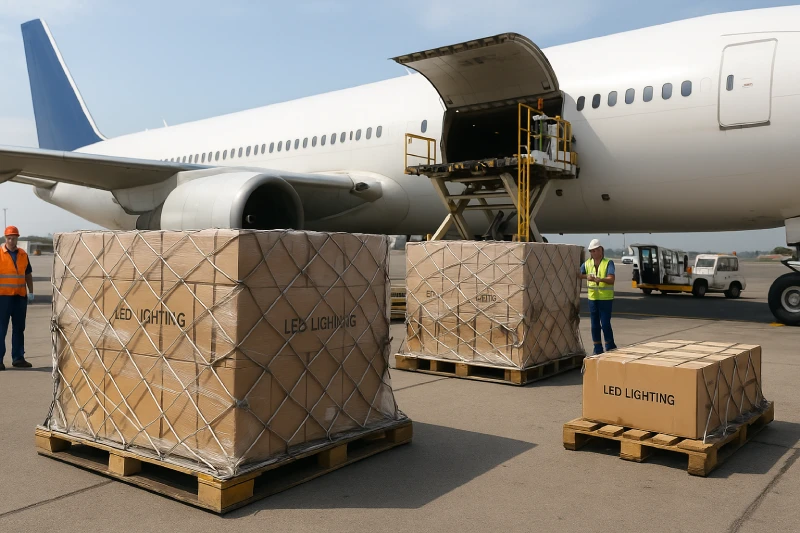
For air freight and express shipments, additional vibration absorption materials are recommended because air-cargo terminals involve more mechanical handling, sorting conveyors, and higher frequency movements. Shock-absorbing foam, thicker outer cartons, and tighter inner padding help prevent internal parts from loosening.
Overall, the correct packaging strategy significantly reduces breakage risk, minimizes claims, and ensures LED lighting arrives in stable condition. Proper handling instructions and well-structured pallets are essential to maintaining product integrity throughout the supply chain.
HS Codes & Customs Notes
LED lighting products fall under several HS codes depending on their type and electrical components, and accurate classification is essential for smooth customs clearance. Incorrect HS code usage may lead to reclassification, inspection delays, higher duties, or compliance checks—especially in markets with strict electrical and environmental regulations.
Most complete LED fixtures, including panel lights, downlights, ceiling lamps, floodlights, and outdoor luminaires, are commonly classified under HS Code 9405.10 / 9405.40 / 9405.60. These categories cover lamps and lighting fittings designed for both indoor and outdoor use. Because the lighting industry covers a wide range of designs and configurations, importers should verify the correct subheading based on fixture type and material composition.
LED power supplies, drivers, and control units often fall under HS Code 8504.40, which applies to static converters. These components are treated as separate electrical parts and may carry different duty rates. Shipments that mix fixtures with drivers must be declared accurately with itemized descriptions to avoid customs discrepancies.
In many markets, LED products must comply with environmental and electrical safety standards. The EU requires CE and RoHS, confirming the product’s safety and the absence of restricted substances. The US and Canada often require UL or ETL certification for electrical safety. The Middle East, particularly Saudi Arabia, may request SASO or SALEEM documentation during import inspection. African markets like Nigeria may expect SONCAP for regulated electrical items.
Customs authorities may also request product specification sheets, power consumption details, and materials breakdown for verification. Incomplete documentation increases the risk of inspection, which may result in demurrage, storage fees, or re-testing at destination.
For LCL shipments, customs may inspect cartons individually, making consistent labeling and clear packing lists critical. Importers should ensure that HS codes, descriptions, and certificate numbers match exactly across all commercial documents to avoid unnecessary clearance issues.
Popular LED Items We Ship
LED lighting shipments often include a wide range of product types, each with unique packing and handling challenges. The goal of this section is not to highlight product benefits, but to explain how different LED items influence packaging, consolidation, and transport planning.
LED Panel Lights
These large, flat fixtures are highly vulnerable to bending and edge deformation. Because panels cannot tolerate stacking pressure, they typically require reinforced outer cartons or wooden crates. Their dimensions also create high CBM, which affects both sea and air freight costs.
LED Tube Lights
Tube lights are long, slender, and fragile. They require strong inner protection, often using foam sleeves or thick cardboard tubes. Their irregular length makes container loading more difficult and increases the risk of breakage if not properly braced.
LED Bulbs and Downlights
Although smaller, these items are delicate and prone to impact damage. They often ship in high quantities, meaning proper inner boxes and foam separation are essential to avoid carton-level vibration damage during LCL consolidation.
High-Bay, Floodlight, and Outdoor Fixtures
These units are bulky, heavy at the base, and irregularly shaped. They require strategic palletization and careful placement to avoid collisions inside the container. Some high-output fixtures include sensitive drivers that need extra moisture control.
LED Strips and Flexible Light Products
These products are compact but sensitive to moisture and static electricity. They are often shipped in mixed-SKU cartons, raising the need for accurate labeling and detailed packing lists to support smooth customs clearance.
LED Drivers, Transformers, and Control Units
Although small, these electronics require anti-static protection and reliable moisture barriers. Mislabeling or mixing drivers with lighting fixtures without proper itemization can lead to customs queries and delays.
Understanding the specific logistics traits of each LED item helps importers choose the right packaging, shipping method, and consolidation plan to reduce damage and optimize freight costs.
Route & Port Recommendations
Choosing the right shipping route and origin port plays a major role in cost, transit stability, and handling quality for LED lighting shipments. Because lighting cargo is fragile and often bulky, importers benefit from routes with reliable schedules and ports known for efficient container movement.
China Origin Ports
Most LED lighting exporters operate in South China—especially Shenzhen, Guangzhou, Zhongshan, and Foshan—making Yantian, Shekou, Nansha, and Huangpu the most efficient departure ports. For manufacturers located in Zhejiang or Jiangsu, Ningbo and Shanghai provide strong alternatives with competitive rates and wide carrier coverage. These ports offer high sailing frequency, reducing the risk of long waiting times or rollovers.
Routes to North America
For the U.S. West Coast, routes from Yantian or Nansha to Los Angeles and Long Beach provide the fastest and most consistent schedules. East Coast shipments usually move via the Panama Canal toward New York, Savannah, or Norfolk, providing broader inland access but longer transit times. Canada-bound shipments typically enter through Vancouver or Prince Rupert for quick rail connections.
Routes to Europe
Ningbo and Shanghai provide excellent connections to Rotterdam, Hamburg, and Antwerp, which serve as major distribution hubs for LED lighting imported into the EU. These ports offer stable sailing frequencies and strong inland logistics, reducing delivery time for construction and commercial projects.
Routes to the Middle East
For GCC markets, especially the UAE and Saudi Arabia, shipments routed from Shenzhen or Guangzhou to Jebel Ali, Dammam, or King Abdulaziz Port are the most reliable. These destinations are frequently used for large LED lighting orders associated with infrastructure, retail, and hotel developments.
Routes to Africa
East Africa shipments typically move through Mombasa or Dar es Salaam, with smoother schedules and shorter transit times. West Africa routes to Lagos, Tema, and Abidjan can take longer and may involve transshipment. Proper packaging is especially important for these routes due to rougher handling environments.
Air Freight Routes
Major LED production hubs are near major international airports like Shenzhen (SZX), Guangzhou (CAN), Hong Kong (HKG), and Shanghai (PVG). These airports offer frequent air cargo connections for urgent lighting parts and project deadlines.
Selecting efficient ports and stable routes ensures predictable delivery, reduced cargo handling, and lower risk of damage for fragile LED lighting products.
Compliance & Certification Notes
LED lighting products are subject to strict compliance requirements in many international markets, primarily due to their electrical components, energy efficiency considerations, and environmental impact. Ensuring the correct certificates and documentation accompany each shipment is essential for avoiding customs delays, re-testing procedures, and potential fines.
European Union (EU)
Most LED lights entering the EU must comply with CE marking for electrical safety and RoHS (Restriction of Hazardous Substances). RoHS compliance ensures that the lighting units do not contain restricted materials such as mercury, lead, or certain flame retardants. Customs authorities may request supporting test reports, product datasheets, or declarations of conformity during clearance.
United States & Canada
The US market frequently requires UL or ETL certification for LED fixtures, panel lights, downlights, and other electrical luminaires. These certifications confirm that products meet electrical safety standards and are suitable for commercial or residential installations. While not every shipment is physically inspected, missing UL/ETL documentation increases the likelihood of customs questions or marketplace restrictions for importers selling through retail or e-commerce channels.
Middle East (Saudi Arabia, UAE, Qatar)
Saudi Arabia enforces SASO / SALEEM certification for regulated electrical items, including LED lighting. Importers must provide a Product Certificate of Conformity (PCoC) and Shipment Certificate of Conformity (SCoC). For the UAE and Qatar, local standards bodies may request safety test reports or energy-efficiency documentation depending on the product type.
Africa
Markets such as Nigeria, Kenya, and Ghana often require SONCAP, PVOC, or CoC documentation for electrical goods. These certificates ensure that imported lights meet local safety standards and are not counterfeit or substandard.
Customs Documentation Expectations
Most customs authorities require:
- Accurate HS codes and descriptions
- Electrical specifications (voltage, wattage, material composition)
- Product datasheets or catalog references
- Certification numbers and issuing agencies
- Manufacturer details and origin declarations
Any mismatch between the commercial invoice, packing list, bill of lading, and certification documents may trigger inspection, which can result in storage fees, demurrage, or mandatory testing at destination.
Ensuring that all compliance documents are aligned and complete helps importers prevent clearance issues and maintain stable supply schedules for project-based LED lighting orders.
Loading Methods & Damage Prevention
Because LED lighting products are fragile, lightweight, and dimensionally sensitive, proper loading techniques are essential to prevent bending, cracking, and electronic failure during transit. Damage often occurs not during the ocean voyage, but during domestic trucking, warehouse transfers, and container handling, making loading discipline a critical part of the logistics plan.
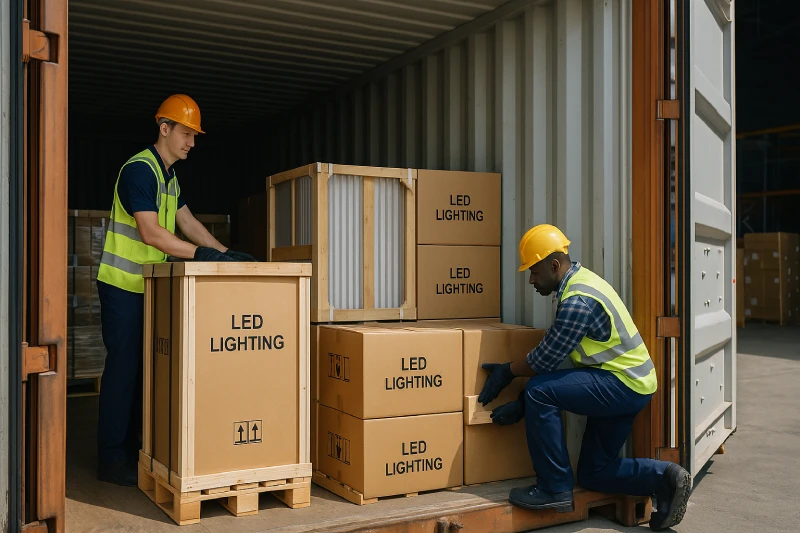
Container Loading for LED Panels and Troffers
Flat LED panels require a loading method that minimizes vertical pressure. They should be positioned vertically or semi-vertically inside reinforced wooden crates or packed in tightly fitted A-frame structures. When loaded horizontally, only a single layer should be used, with stiff cardboard or plywood sheets added to distribute surface pressure. Empty spaces inside the container must be filled with foam blocks or dunnage to avoid shifting.
Loading for LED Tube Lights
LED tubes are long and fragile, making them prone to snapping if they flex during transit. Pallets must be reinforced with corner guards and bracing bars, and tubes should be arranged in fully supported inner boxes. When loading into a container, tubes should be positioned along the container walls or floor where movement is minimal. Avoid stacking anything on top of tube-light pallets.
Loading for Bulky Fixtures (High-Bays, Floodlights, Wall Packs)
Large fixtures often have heavy bases and sensitive optical components. They are best placed on lower pallet tiers to maintain stability and reduce tipping risks. These units should be wrapped with thick stretch film and strapped tightly to the pallet. During container loading, heavier pallets should be placed at the bottom, with lighter or flat-carton products on top.
Blocking and Bracing
LED cargo must be immobilized using wooden beams, air bags, or foam wedges, especially in FCL scenarios. Even minor container movement at sea can lead to carton collapse if the cargo is poorly secured. Blocking and bracing also prevent high-bay fixtures from shifting and damaging adjacent items.
Humidity and Heat Protection
Because LED drivers and PCB boards react negatively to moisture, it is important to add desiccants, silica gel packets, and humidity indicator cards inside cartons and crates. In humid climates or long-transit routes, lining the container floor with kraft paper or moisture barriers helps reduce condensation exposure.
Air Freight Loading Considerations
Air shipments involve more conveyor handling and multiple loading cycles. LED cartons should be reinforced with stronger outer boxes, and shock-absorption materials should be used to reduce vibration. Fragile labels must be visible, and pallets should not exceed standard airport handling heights.
Final Inspection Before Sealing the Container
A final pre-loading inspection ensures:
- Pallets are stable and evenly distributed
- No empty gaps where cargo can shift
- Labels are visible and readable
- Moisture-proof materials are properly placed
- High-risk items are positioned securely
Proper loading and preventive measures significantly reduce breakage, protect electronic components, and ensure that LED lighting reaches the destination in stable working condition.
Risk Control & Insurance
LED lighting shipments carry a higher risk profile than many other general cargo types due to their fragility, dimensional characteristics, and sensitivity to moisture and vibration. Effective risk control strategies are essential to minimize disputes, avoid delays, and protect the importer’s financial exposure.
All-Risk Marine Cargo Insurance
Because LED lighting is prone to breakage, All-Risk coverage is strongly recommended for both FCL and LCL shipments. This type of insurance provides broader protection than basic coverage and helps compensate for damages resulting from impact, crushing, or water exposure during transit. Importers should ensure the insured value reflects both product costs and freight charges to avoid undercoverage.
Pre-Shipment Packaging Inspection
A factory- or warehouse-level inspection focused on packaging quality dramatically reduces claims. Inspectors verify carton strength, foam thickness, stacking limits, pallet stability, and moisture-proof measures. Photos taken during inspection serve as essential evidence for insurance claims if damage occurs later in the journey.
Moisture and Condensation Control
LED drivers and PCB boards are vulnerable to moisture. Using desiccants, humidity indicator cards, and sealed plastic bags reduces the risk of internal corrosion. Containers traveling through regions with large temperature swings, or during winter-to-summer transitions, should be lined with kraft paper or anti-moisture materials.
Shock and Tilt Monitoring Devices
For higher-value shipments or fragile panel lights, adding shock sensors, tilt indicators, or impact labels provides additional oversight. These devices discourage mishandling and help importers identify when damage may have occurred during trucking, air handling, or consolidation.
Route & Seasonal Risk Assessment
Certain routes—such as transshipment-heavy lanes to West Africa or South America—expose cargo to more handling points. Seasonal peak months also increase the likelihood of rolling or delayed vessels. Importers should plan ahead during holiday periods and avoid last-minute shipments when project deadlines are inflexible.
Supplier Packaging Compliance
Many LED suppliers ship with packaging designed for domestic distribution rather than export-level stress. Winsail can work with suppliers to upgrade packaging specifications, verify pallet designs, and ensure cartons meet export standards before consolidation.
Documentation Accuracy
Misaligned HS codes, missing certificates, or inconsistent descriptions increase the risk of customs inspection. Maintaining clear paperwork and synchronized documents significantly lowers clearance-related delays.
By applying these preventive measures and choosing the right insurance coverage, importers can reduce financial exposure, minimize operational disruptions, and maintain stable supply for LED lighting projects.
FAQ
Are LED lighting products considered fragile cargo during international shipping?
Yes. LED panels, tube lights, bulbs, and drivers are highly sensitive to impact, vibration, and moisture. Even small shocks can damage internal components, making reinforced export packaging essential for both FCL and LCL shipments.
What is the safest shipping method for LED lighting?
FCL is generally the safest because the cargo is handled less frequently and not mixed with other shippers’ goods. LCL is also suitable but requires stronger packaging, while air freight is preferred for urgent or high-value shipments that need faster delivery.
How can I reduce breakage when shipping LED panel lights or tubes?
Use double-wall cartons, thick foam inserts, edge protectors, and reinforced crates or A-frames. Ensure the cargo is loaded vertically or semi-vertically, fill all container gaps with dunnage, and avoid stacking heavy items on top.
Do LED lighting shipments require special compliance documents?
Many markets require certifications such as CE/RoHS (EU), UL/ETL (USA/Canada), SASO/SALEEM (Saudi Arabia), or SONCAP (Nigeria). Providing accurate certificates and synchronized documentation helps prevent customs delays and re-inspection.
Why is moisture control important when shipping LED lighting?
LED drivers, PCB boards, and connectors can corrode or malfunction when exposed to moisture during long transit periods. Desiccants, sealed inner bags, and humidity indicator cards help protect sensitive components.
Can Winsail handle shipments with mixed SKUs from multiple LED suppliers?
Yes. Winsail can consolidate cargo from different factories, re-pack fragile items, standardize pallet height, and produce detailed packing lists to ensure smooth customs clearance and lower damage risk.
How do shipping costs for LED lighting compare with other products?
LED lighting tends to have high dimensional weight and large CBM relative to actual weight. This makes packaging efficiency and pallet planning critical for controlling sea freight and air freight costs.
