
An LCL shipment from China to Nigeria can generate two very different freight bills.
The first is usually paid for the China-side consolidation and ocean transport. The second may appear after the shared container reaches Lagos and the cargo is deconsolidated for individual release. This second bill can include CFS or deconsolidation handling, documentation, cargo release-related charges, storage where applicable, customs-clearance services and final delivery.
That is why a low ocean LCL rate per CBM does not automatically mean a low landed logistics cost.
LCL is different from FCL because your shipment is only one part of a shared container. The master container must arrive, move through the destination process, be opened, and have each house shipment identified and released separately. Those additional physical and administrative steps create destination costs that do not behave like a simple container freight rate.
There is also no reliable universal figure such as “Nigeria CFS charges are US$X per CBM.” The applicable amount depends on the deconsolidator, approved tariff, charging basis, shipment characteristics, storage time and services actually performed.
Last verified: October 3, 2026.
What Are LCL Destination Charges in Nigeria?
LCL destination charges are the local costs associated with separating, handling, documenting and releasing your individual shipment after a consolidated container arrives in Nigeria.
They are separate from the ocean freight paid to move the consolidated container from China.
A useful way to budget an LCL shipment is to separate the cost into five stages:
| Cost Stage | What It Covers | Typical Party Involved |
|---|---|---|
| China origin | Pickup, export handling, consolidation and origin CFS | China forwarder / consolidator |
| Ocean freight | International LCL transport | Carrier / NVOCC / forwarder |
| Nigeria destination | Deconsolidation, handling, documentation and storage if incurred | Deconsolidator / CFS / destination agent |
| Customs | Import declaration, duties/taxes and broker services | NCS / customs broker |
| Delivery | Trucking from release point to consignee | Local transporter |
Government duties and taxes should therefore not be mixed into a CFS handling rate unless the quotation clearly states that customs costs are included.
The Nigerian Ports Authority describes terminal handling, storage and examination as distinct operational stages involving terminal operators, shipping agents and customs authorities. That is another reason importers should avoid treating every amount payable after arrival as one generic “port fee.”
For a broader view of the full route and available shipping methods, see Shipping from China to Nigeria.
How an LCL Shipment Is Released After Arrival
Understanding the physical flow makes the destination invoice easier to understand.
A typical China-to-Nigeria LCL shipment moves through the following sequence:
Vessel arrival → master container discharge → movement to the designated facility → deconsolidation/devanning → identification of each HBL shipment → customs and regulatory release → destination payment/release → cargo pickup or final delivery
Unlike FCL cargo, the importer is normally not taking possession of the entire container. The shared container has to be opened and individual shipments separated.
Your cargo therefore cannot necessarily be collected immediately when the vessel arrives in Lagos.
First, the container may need to be transferred or positioned for deconsolidation. The deconsolidator must identify the cargo against its house documentation, complete the relevant handling and release procedures, and coordinate with the consignee or clearing agent.
This distinction matters when comparing transit time as well as cost. Vessel arrival is not the same as cargo availability for LCL pickup.
CFS and Deconsolidation Charges
CFS and deconsolidation charges are at the center of most Nigeria LCL destination-cost questions.
A Container Freight Station or comparable deconsolidation facility performs the physical and administrative work required to separate groupage cargo and make individual shipments available for clearance and release.
Depending on the applicable tariff and service arrangement, the charging basis can be linked to the shipment itself, cargo measurement, cargo characteristics, handling requirements or the length of time the cargo remains at the facility.
| Charge Component | Possible Charging Basis | What to Verify |
|---|---|---|
| Handling / deconsolidation | Shipment, CBM/W-M or another approved basis | Rate, minimum, measured quantity |
| Documentation | Per shipment / HBL | Exact service and tariff reference |
| Storage | Time and cargo quantity/basis | Free period and first chargeable day |
| Stamp duty or statutory item | As applicable | Legal or tariff basis |
| Customs-broker service | Per entry or agreed service | Whether separately contracted |
| Delivery | Vehicle, distance, weight or cargo type | Exact delivery address and scope |
The important word here is applicable.
Do not accept a quotation simply because it contains familiar freight terminology. Ask which company is billing the amount, which service was performed, which unit is being used and which tariff or commercial agreement supports the charge.
There is no defensible basis for publishing one permanent “Lagos CFS rate per CBM” across all shipments.
Calculation framework:
measurement-based charge = verified chargeable units × applicable tariff
The difficulty is often not the multiplication. It is establishing the correct chargeable units and the correct applicable tariff.
Pro Tip: Ask for the Nigerian destination deconsolidator or CFS before your cargo is loaded in China. “Destination charges payable locally” is not enough information for serious landed-cost budgeting.
What Should an LCL Destination Invoice Contain?
A destination invoice should make it possible for the importer to understand what was charged, why it was charged and how the amount was calculated.
This issue has received specific regulatory attention in Nigeria.
In an October–December 2025 complaints publication, the then Nigerian Shippers’ Council examined a dispute involving groupage cargo and a Nigerian deconsolidating company. The Council stated in that case that its approved tariff nomenclatures for deconsolidators were limited to Storage, Documentation, Handling and Stamp Duty. It also objected to unitemized and unapproved local charges in the dispute.
Source: Nigerian Shippers’ Council complaint newsletter, October–December 2025
That case should not be interpreted as a universal price list. It is useful because it demonstrates the regulatory expectation that local groupage charges should be transparent and tied to recognizable, approved services.
There has also been an important institutional change since that publication: in 2026 the Nigerian Shippers’ Council transitioned into the Nigerian Ports Economic Regulatory Agency, or NPERA, which now has a broader statutory mandate covering port tariffs and charges, licensing, service standards and commercial dispute resolution.
For a current shipment, therefore, verify the current NPERA position and provider-specific approved tariff, rather than assuming a historical dispute ruling is a permanent tariff schedule.
LCL Invoice Audit Checklist
Before paying, your invoice should allow you to identify:
- the Nigerian deconsolidator, CFS or billing provider;
- shipment/HBL or cargo reference;
- each charge as a separate line rather than an unexplained lump sum;
- the charging unit—shipment, CBM, W/M, day or another basis;
- the cargo quantity or measurement used;
- applicable rate and tariff reference;
- storage start date and number of chargeable days, if storage applies;
- relevant tax or statutory basis;
- payment status and cargo-release requirement.
If a line item cannot be connected to a service, tariff, measurement or contractual basis, ask for clarification before treating it as a valid destination cost.
CBM Remeasurement at Destination
One of the most important LCL billing risks is disagreement over cargo volume.
During a China-to-Nigeria shipment, several measurements may exist:
Supplier measurement → China warehouse measurement → consolidator measurement → destination measurement or independent survey
They are not automatically identical.
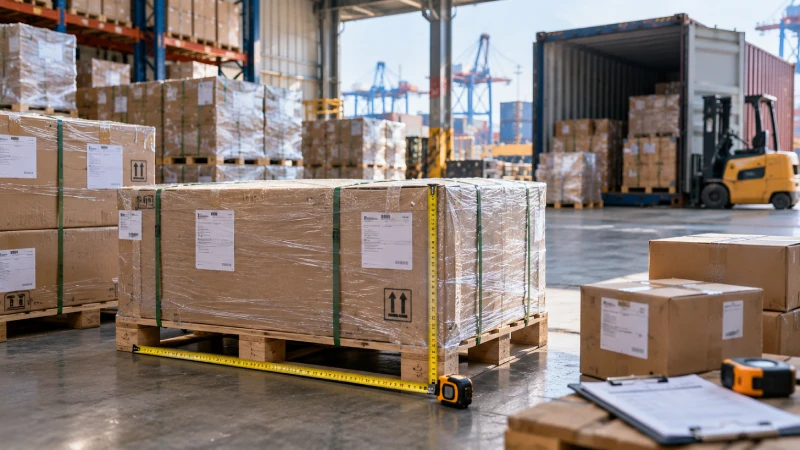
Carton dimensions supplied by a factory can be estimates. Packaging can change before export. Palletization may increase external dimensions. Different parties may also record measurements at different stages.
For that reason, importers should retain:
- supplier packing lists;
- carton dimensions;
- pallet dimensions after final packing;
- China warehouse measurement records;
- photos showing final packed cargo;
- HBL and freight invoice;
- destination remeasurement evidence where disputed.
A real 2026 Nigerian regulatory case illustrates why this matters.
NPERA reported a dispute in which six LCL packages had been billed using 1.10 CBM, while a joint physical survey later measured the cargo at 0.75 CBM, a difference of 0.35 CBM. Importantly, NPERA also noted that the survey itself did not establish the contractual rating methodology behind the original charge; that still required clarification between the parties.
Source: NPERA probe into disputed LCL cargo volume
This should not be read as evidence that large CBM discrepancies are normal in Nigeria. It demonstrates something more useful: if an importer challenges a measurement, physical dimensions, packing documents and a documented rating method matter.
Pro Tip: Keep the final China warehouse measurement report. If a destination invoice later uses a materially different CBM, you have an objective record for comparison.
LCL Storage: When Delay Becomes Expensive
Storage can turn an otherwise manageable destination invoice into a much larger bill.
However, LCL warehouse or CFS storage should not be confused with FCL container demurrage, detention or terminal-storage rules.
They are different cost mechanisms.
For an LCL shipment, ask the destination provider four questions before the cargo arrives:
- When does the free-storage period begin?
- How many free days apply to this shipment?
- What event starts paid storage?
- Is the rate flat, daily or escalating under the applicable tariff?
Do not assume that storage starts on the vessel-arrival date. Equally, do not assume the importer has unlimited free time while customs formalities are being completed.
The applicable facility and tariff determine the actual rule.
Operationally, storage exposure can increase when Form M or PAAR documentation is incomplete, when cargo requires additional regulatory action, when customs clearance is delayed, when the consignee is not prepared to pay destination charges, or when trucking is not arranged promptly after release.
A useful planning timeline is:
Arrival → deconsolidation → cargo available → applicable free period → first chargeable storage day → cargo release → pickup
Ask for those dates in writing when storage appears on an invoice.
Customs, PAAR and SONCAP Can Affect LCL Release
CFS charges and customs requirements are separate, but customs readiness directly affects how quickly your cargo can leave the destination facility.
Nigeria Customs Service identifies Form M as a mandatory part of the import process and describes the Pre-Arrival Assessment Report (PAAR) as a mandatory clearance document used in the assessment of imported goods. NCS also uses the Single Goods Declaration for the customs declaration and release process.
Source: Nigeria Customs Service
For SON-regulated products, the Standards Organisation of Nigeria states that SONCAP is a pre-shipment conformity-assessment process. The Product Certificate is connected with Form M processing, while the SONCAP Certificate is required for customs clearance of SONCAP-regulated goods.
Source: Standards Organisation of Nigeria — SONCAP
For LCL importers, the practical lesson is simple: compliance should be checked before the shipment leaves China, not after the container arrives in Lagos.
Before shipment, confirm whether the importer has the required documentation and whether the product falls within SONCAP or another regulatory regime.
Missing documentation does not merely create a paperwork problem. It can delay cargo release while local storage and other time-sensitive costs continue to develop.
LCL Destination Charges vs Ocean Freight per CBM
One of the biggest misunderstandings in groupage shipping is assuming the advertised ocean rate per CBM represents the entire LCL cost.
It does not.
The complete cost chain is:
China CFS / Origin → Ocean LCL Freight → Nigeria CFS / Destination → Customs Clearance → Final Delivery
Use Shipping Cost per CBM from China to Nigeria to understand the ocean-freight pricing side of the shipment. The destination CFS invoice belongs to a separate stage in the logistics chain.
A useful calculation framework is:
LCL destination logistics = applicable CFS/handling + documentation/release + storage if incurred + customs-broker service + delivery
Notice what is not included in that formula: an invented fixed Nigeria CFS rate.
Why Can the Destination Invoice Be Higher Than the Ocean Freight?
Because ocean transport is only one service.
A low international LCL rate can coexist with fixed destination documentation, deconsolidation work, minimum charges, storage, customs-broker services and inland delivery.
This is especially important for very small shipments. When a fixed charge is spread across only 0.5 or 1 CBM, the effective destination cost per CBM can appear much higher than it would for a larger LCL shipment.
That does not automatically mean the invoice is wrong. It means the importer should examine the charging structure, not compare two unrelated line items.
How to Check an LCL Invoice Before Paying
A proper invoice review starts with evidence rather than simply negotiating the total amount.
Use the following audit structure:
| Invoice Question | Evidence to Request |
|---|---|
| Who issued the invoice? | Legal/provider identity |
| What service is being charged? | Itemized nomenclature |
| What tariff applies? | Current tariff/reference |
| What unit is used? | Shipment, CBM, W/M, day, etc. |
| What cargo measurement is used? | Measurement sheet |
| Is storage included? | Availability/free-time/charge dates |
| Is tax added? | Applicable tax basis |
| Has the cargo been released? | Release status / outstanding conditions |
If the billed CBM differs from your China-side documentation, request the destination measurement method and physical dimensions.
If storage is charged, ask for the first chargeable date.
If the invoice is presented as a lump sum, request an itemized breakdown.
If a charge name is unclear, ask for the underlying approved tariff or contractual basis.
If a genuine commercial dispute cannot be resolved with the provider, Nigeria’s port regulator maintains complaints-handling mechanisms. The Port Service Support Portal was established to allow port users to submit and track complaints involving business-to-business port service problems, while NPERA continues to operate complaint-resolution functions following the 2026 institutional transition.
Source: Port Service Support Portal
Keep the HBL, invoices, packing list, payment evidence, measurement records and correspondence together. NPERA’s 2026 CBM case specifically highlighted the value of commercial invoices, packing lists, house bills and physical survey reports when supporting a freight-billing dispute.

Information to Request Before Shipping LCL from China
The easiest destination-charge dispute to solve is the one prevented before loading.
Before confirming an LCL booking from China to Nigeria, request the following information from your freight forwarder:
- Nigerian destination CFS or deconsolidator;
- destination agent identity;
- estimated destination-charge structure;
- whether charges use CBM, W/M, shipment minimums or another basis;
- minimum applicable charges;
- current storage/free-time policy;
- customs-clearance responsibility;
- whether duties and taxes are excluded;
- final-delivery cost if door delivery is required.
Ask for this before you compare two freight quotations.
A quote showing a cheaper China-to-Lagos ocean rate may ultimately cost more if the destination side is unclear.
For importers regularly moving groupage cargo from China, the more useful comparison is therefore not:
“Who has the lowest ocean rate?”
It is:
“What will I pay from the China consolidation warehouse until the cargo is released and delivered in Nigeria, and which charges remain payable locally?”
Plan the Destination Cost Before the Container Sails
LCL can be an efficient way to ship smaller commercial cargo from China to Nigeria, but it should never be booked using the ocean rate alone.
Before loading, identify the destination deconsolidator, understand how local charges will be calculated, confirm the measurement basis and check storage rules. At the same time, make sure Form M, PAAR and any applicable SONCAP requirements are being handled early enough to avoid unnecessary release delays.
When the cargo reaches Nigeria, review the destination invoice line by line rather than judging it only by the final total.
The objective is not to assume every local charge is excessive. It is to make every charge identifiable, measurable and verifiable.
FAQ
What LCL destination charges are payable in Nigeria?
They can include applicable deconsolidation or handling, documentation, storage where incurred, customs-broker services and delivery. Government duties and taxes should be treated separately from commercial CFS charges unless explicitly included in the service scope.
What is a deconsolidation or CFS handling fee?
It covers work associated with receiving the consolidated container, separating groupage shipments, identifying individual cargo and preparing it for the destination release process. The exact billing basis depends on the provider and applicable tariff.
Are LCL destination charges based on CBM?
Some can be measurement-dependent, but not every destination charge is necessarily billed per CBM. Documentation may be shipment-based, storage may depend on time, and other items can follow different approved bases.
Can my LCL cargo be remeasured after arriving in Nigeria?
Yes. Cargo measurements can be checked or disputed when there is a valid reason. Keep packing records, China warehouse measurements and supporting shipment documents so any discrepancy can be reviewed objectively.
When does LCL storage start in Lagos?
There is no universal start date that should be assumed for every CFS. Request the facility's current free-period rules, cargo-availability date and first chargeable storage date for your specific shipment.
Why are Nigerian LCL destination charges separate from ocean freight?
Ocean freight covers the international transport leg. Destination deconsolidation, local handling, documentation, customs clearance and delivery happen after arrival and may involve separate services and providers.
What information should appear on a groupage invoice?
The invoice should clearly identify the provider, shipment reference, individual charge lines, rate basis, quantity or measured CBM, storage dates where relevant, applicable taxes and the amount required for release.
How can I verify an unclear LCL destination charge?
Ask for an itemized invoice, provider identity, applicable tariff, charge nomenclature, rate basis, measurement evidence and storage dates. Preserve all shipment records and escalate a genuine unresolved port-service billing dispute through the relevant Nigerian regulatory complaints mechanism where appropriate.
