
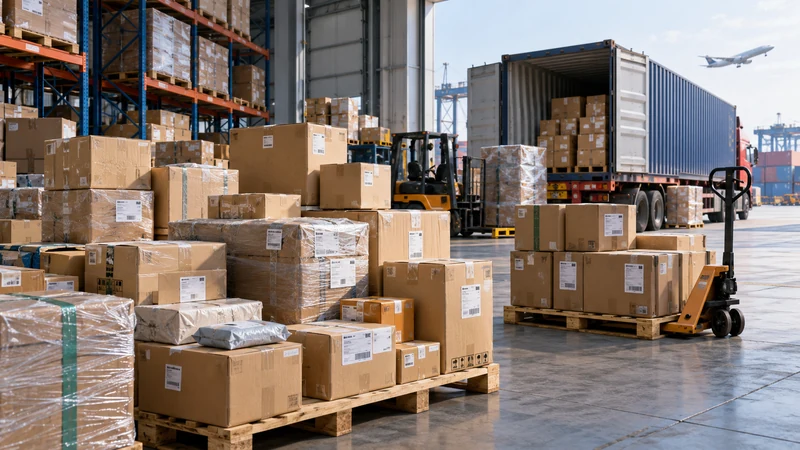
Buying products on Alibaba or 1688 is only the first half of the process.
For a Nigerian importer, the second half is making sure those products can move from the supplier, through a China warehouse or export handoff, onto an international shipment, and eventually through Nigerian import procedures without creating avoidable compliance or documentation problems.
Alibaba.com and 1688.com also operate very differently.
Alibaba.com is designed for global B2B trade and provides sourcing, transaction, supply-chain and logistics-related services to buyers and sellers worldwide. 1688.com, by contrast, is officially positioned by Alibaba Group as a Chinese domestic wholesale marketplace. That distinction affects how Nigerian buyers should think about supplier communication, payment, domestic delivery, export documentation and international freight. Alibaba Group
For many 1688 purchases—and for some Alibaba purchases from multiple suppliers—the practical logistics structure is therefore:
Supplier → China warehouse → receiving and consolidation → export preparation → international freight → Nigeria clearance and delivery
Winsail Logistics operates on the logistics side of this chain. Purchasing products, paying suppliers in RMB or acting as a sourcing agent should be confirmed separately before relying on those services.
The most important principle is simple:
Do not treat “the supplier can sell it to me” as proof that “I can legally and efficiently import it into Nigeria.”
Before paying the seller, understand the cargo, its import requirements and how it will leave China.
Alibaba vs 1688 for a Nigerian Importer
Both platforms can connect Nigerian buyers with Chinese suppliers, but the logistics experience can be very different.
| Factor | Alibaba.com | 1688.com |
|---|---|---|
| Market orientation | International B2B trade | China domestic wholesale |
| Supplier communication | Usually more export-oriented | Often focused on Chinese domestic buyers |
| International shipping | Supplier or platform options may be available for eligible orders | China-side warehouse and onward logistics are often needed |
| Trade Assurance | Available for qualifying Alibaba.com transactions | Different transaction and protection model |
| Export documentation | Export suppliers are often more familiar with requirements | Extra coordination may be required |
| China warehouse use | Useful for consolidation or independent forwarding | Often central to the logistics workflow |
| Best suited to | Buyers wanting export-ready supplier coordination | Buyers comfortable managing a more China-domestic purchasing workflow |
This does not mean that 1688 is automatically cheaper than Alibaba.
The final landed cost depends on much more than the product price: domestic Chinese freight, warehouse handling, repacking, consolidation, export documentation, international freight, Nigerian duties, regulatory requirements and destination delivery can all affect the result.
A low marketplace price can become expensive if the product is difficult to export or import.
Before Ordering: Check Whether the Product Can Be Imported into Nigeria
The best time to discover an import problem is before you pay the supplier, not after twenty cartons have arrived at a warehouse in Guangzhou, Shenzhen, Yiwu or another Chinese city.
Start with the exact product rather than the marketplace listing title.
You should know:
- what the product actually is;
- its material and intended use;
- model or specification where relevant;
- whether it contains batteries, liquids, magnets, chemicals or other transport-sensitive components;
- its likely HS classification;
- whether Nigeria prohibits or restricts the product;
- whether SON requirements may apply;
- whether NAFDAC regulation may apply;
- whether another Nigerian authority is involved.
Nigeria Customs provides tariff and import-control information by HS classification, including items subject to import prohibition. Nigeria Customs Service
For products covered by the Standards Organisation of Nigeria, SONCAP is a pre-shipment conformity-assessment process. SON states that regulated products must satisfy the applicable conformity requirements before shipment, and the relevant certification documents are tied into Form M and Customs clearance procedures. Standards Organisation of Nigeria
NAFDAC separately regulates categories including food, drugs, cosmetics, medical devices and chemicals, with registration and import/export regulatory services applying according to the product. NAFDAC
A Simple Pre-Order Decision Tree
1. Identify the product precisely.
Do not use descriptions such as “machine,” “accessory,” “beauty item” or “electronic product” if a more precise description is available.
2. Review the HS classification and Nigerian import controls.
Confirm whether the product is prohibited, restricted or subject to additional regulatory requirements.
3. Check the relevant regulator.
Depending on the product, this may involve SON, NAFDAC or another competent authority.
4. Check transport restrictions.
Batteries, chemicals, liquids, powders, aerosols and other cargo may require additional transport review.
5. Confirm documentation before payment or production.
If certificates, manufacturer details, test reports or specific commercial documentation will be needed, determine whether the seller can provide them.
Only then should you finalize the purchasing and freight plan.
For the wider import sequence, see How to Import Goods from China to Nigeria.
How an Alibaba Order Can Move from China to Nigeria
Alibaba suppliers are generally more accustomed to international buyers, but you still need to define where the supplier’s responsibility ends.
A typical workflow looks like this:
- Shortlist the supplier.
- Confirm product specifications or samples.
- Establish the Alibaba.com order and Trade Assurance terms where applicable.
- Agree the Incoterm and delivery point.
- Complete production.
- Arrange inspection where separately contracted.
- Handover the cargo to the selected logistics provider.
- Complete export and international transportation.
- Complete Nigerian import procedures and final delivery according to the agreed service scope.
The important step is number four.
If the supplier quotes EXW, the buyer may need to arrange pickup from the factory.
If the supplier agrees to deliver to a nominated China warehouse, determine who pays the domestic freight and whether delivery charges are prepaid.
If the supplier provides an international freight option, determine exactly what the price includes.
A statement such as “shipping to Nigeria included” is not specific enough for a commercial shipment.
Ask:
- Is it airport, seaport or door delivery?
- Who is responsible for Nigerian Customs clearance?
- Are duties and taxes included?
- Are terminal or destination charges included?
- Is cargo insurance included?
- What happens if Nigerian compliance documents are missing?
- Which party controls the shipping documents?
The answer can change the real landed cost substantially.
What Alibaba Trade Assurance Does—and What It Does Not Do
Alibaba.com’s Trade Assurance can provide important transaction protection.
Alibaba describes Trade Assurance as covering purchasing stages such as secure payment, defined money-back protections, shipping/logistics services and certain after-sales protections. The transaction depends on the Alibaba.com order and payment framework and the terms agreed through the platform. Alibaba Trade Assurance
That protection is useful.
But importers should not confuse purchase protection with import compliance.
Trade Assurance does not automatically determine:
- whether your product may be imported into Nigeria;
- the correct Nigerian HS classification;
- whether SONCAP applies;
- whether NAFDAC registration or permits apply;
- whether a lithium battery shipment satisfies carrier requirements;
- whether your commercial documents are sufficient;
- whether Nigerian Customs will release the shipment;
- whether duties and destination charges were included in a supplier’s freight offer.
For example, a supplier can manufacture exactly what you ordered and still provide a product that requires documentation you did not arrange before shipment.
That is not primarily a product-quality dispute. It is an import-planning problem.
Keep the two responsibilities separate.
Alibaba.com Logistics vs an Independent Freight Forwarder
Alibaba.com also provides logistics services for eligible orders and routes. Its official logistics pages describe route selection, pricing, tracking and delivery-related services, subject to the applicable order and service terms. Alibaba.com Shipping and Logistics
That does not mean Alibaba logistics or an independent freight forwarder is automatically better.
The right choice depends on the shipment.
| Factor | Supplier / Platform Shipping | Independent Freight Forwarder | Question to Ask |
|---|---|---|---|
| One supplier | Often convenient | Also practical | Who controls pickup and documents? |
| Multiple suppliers | May require separate shipments | Consolidation may be easier | Can all orders go to one warehouse? |
| Special cargo | Depends on service eligibility | Cargo-specific routing may be possible | Has the exact cargo been reviewed? |
| Quote scope | Platform/supplier specific | Can be structured around your route | What charges are excluded? |
| Nigeria clearance | Must verify | Depends on forwarder’s service | Who handles clearance locally? |
| Door delivery | May be available on some orders | Can be arranged where supported | Is it DAP, DDP or another arrangement? |
| Regulatory coordination | Not automatically included | May be coordinated operationally | Who checks documents before departure? |
If you buy twenty identical cartons from one export-experienced Alibaba supplier, the supplier’s shipping option may be perfectly workable.
If you buy from five factories, need warehouse consolidation and have mixed cargo categories, an independent China warehouse and freight plan may give you more operational control.
For a broader comparison of forwarder capabilities, see How to Choose a Freight Forwarder from China to Nigeria.
How Shipping 1688 Orders to Nigeria Usually Works
1688 requires a different mindset.
Alibaba Group describes 1688.com as China’s leading integrated domestic wholesale marketplace. Nigerian buyers therefore should not assume that every 1688 seller has an export department, accepts foreign buyers through the same processes as Alibaba.com, produces export documents or can ship directly to Nigeria. Alibaba Group
A practical workflow is often:
1688 seller
↓
Domestic delivery within China
↓
Designated China warehouse
↓
Receiving and parcel check-in
↓
Consolidation and cargo review
↓
Export document preparation
↓
Sea, air or express shipment
↓
Nigeria import clearance
↓
Final delivery where arranged
The domestic seller may only need to know where to send the cartons in China.
The international freight forwarder then takes over after the cargo enters the export logistics chain.
This separation is one reason the China warehouse address and shipment references need to be correct.
Who Pays the 1688 Supplier?
Freight forwarding and supplier payment are two separate services.
Possible purchasing arrangements include:
- the buyer using a supported payment method or payment channel;
- a separate sourcing or payment agent;
- a mutually agreed payment method accepted by the supplier.
Do not assume that a freight forwarder automatically purchases products or remits RMB to sellers.
For Winsail Logistics specifically, buyers should confirm separately whether any purchasing, sourcing or supplier-payment service is available before relying on it.
If a separate purchasing agent is involved, document the responsibility split clearly:
Purchasing agent: order placement and supplier payment.
Supplier: manufacture and domestic dispatch.
Warehouse / forwarder: receiving, consolidation and freight preparation.
Nigerian importer: import documentation, regulatory responsibility and other obligations according to the agreed shipping structure.
This separation becomes important if a parcel is missing, a specification is wrong or a payment dispute occurs.
What China Warehouse Address Should I Give the Supplier?
Do not simply send a street address copied from a chat message.
A usable warehouse instruction may include:
- consignee or customer reference;
- warehouse name;
- complete address;
- contact telephone number;
- shipment or customer ID;
- shipping mark;
- supplier name;
- expected carton quantity;
- parcel or domestic tracking number where available;
- restricted-cargo instructions.
For example, two buyers can send cartons to the same warehouse building. The warehouse needs a reliable reference to identify which cartons belong to which customer and shipment.
This becomes even more important when ten or twenty suppliers are delivering during the same week.
Before the supplier dispatches, send the warehouse instructions in the exact format provided by your logistics provider.
Combining Multiple Alibaba and 1688 Suppliers
One supplier does not need to equal one international shipment.
Suppose you are buying:
- cartons from an Alibaba packaging supplier;
- small accessories from two 1688 sellers;
- spare parts from another Alibaba factory.
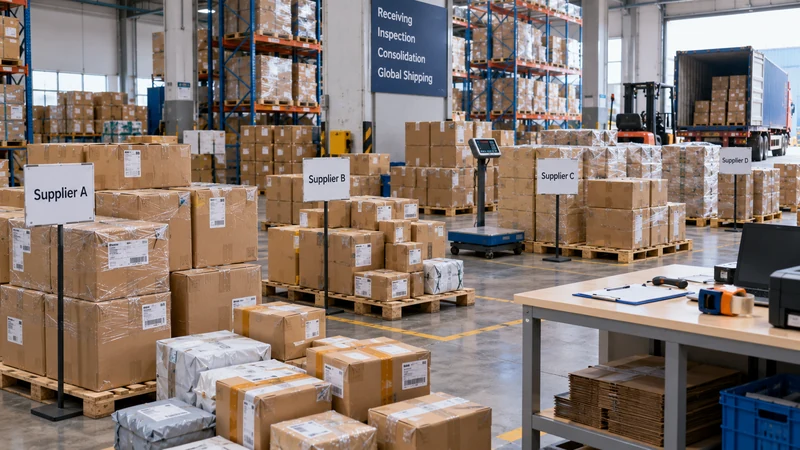
Instead of shipping four international consignments independently, all suppliers may be instructed to deliver to one China warehouse.
The warehouse can receive the cargo and prepare it for one planned international shipment when operationally appropriate.
Potential advantages include:
- reducing repeated international minimum charges;
- improving LCL or air-freight shipment planning;
- combining small supplier orders into a commercially useful shipment;
- measuring the final actual CBM and weight;
- coordinating documents before international departure.
However, consolidation also creates risks.
The Last Supplier Can Delay Everybody
If four suppliers arrive on Monday but supplier five is two weeks late, the entire consolidated shipment may wait unless you decide to close the batch without it.
Mixed Cargo May Have Different Compliance Requirements
Furniture accessories and lithium-powered electronics should not automatically be treated as one homogeneous shipment.
Each cargo type still needs the appropriate regulatory and transport review.
Documents Become More Complex
Five marketplace orders may involve five invoices, different product descriptions and several manufacturers.
International freight documents need to describe the cargo accurately and consistently.
For more detail on warehouse receiving, supplier coordination and shipment closing, see China to Nigeria Cargo Consolidation.
Domestic Chinese Packaging May Not Be Export Packaging
This issue deserves particular attention with domestic-market suppliers.
A carton strong enough for a courier trip from Foshan to a Guangzhou warehouse is not automatically suitable for:
- repeated warehouse handling;
- palletization;
- container loading;
- an ocean voyage;
- destination terminal handling;
- trucking inside Nigeria.
Before international shipment, check for:
- weak or damaged cartons;
- insufficient internal protection;
- fragile products;
- moisture exposure;
- unnecessary empty space;
- unsuitable wooden packaging;
- missing shipping marks;
- loose individual parcels that should be consolidated.
Repacking is not always necessary.
But the decision should be based on the condition of the actual shipment—not an assumption that the seller’s domestic packaging is export-ready.
Build the Commercial Export Documentation Properly
Your Alibaba order page or 1688 purchase history is not automatically the complete customs documentation package for an international commercial shipment.
Depending on the transaction and cargo, the shipment may need coordination around:
- commercial invoice;
- packing list;
- seller or manufacturer information;
- accurate product descriptions;
- quantities;
- values;
- country-of-origin information where required;
- HS classification review;
- certificates or permits;
- transport-related declarations.
Avoid vague marketplace descriptions.
For example:
Poor description:
“Accessories”
Better description:
“Stainless-steel kitchen cabinet handles”
Or:
Poor description:
“Electronic item”
Better description:
“Rechargeable handheld barcode scanner with lithium-ion battery”
Accurate descriptions help the parties involved understand what is actually being shipped and identify regulatory or dangerous-goods issues before departure.
Choose Sea, Air or Express After the Warehouse Measures the Final Cargo
Marketplace listings often show estimated product weight or unit dimensions.
Do not build your final international freight budget solely from those numbers.
After all supplier parcels arrive, obtain the final:
- carton quantity;
- gross weight;
- carton dimensions;
- total volume in CBM;
- packaging condition;
- cargo classification;
- battery or dangerous-goods status where applicable.
Those figures should drive the freight decision.
Express
Often useful for smaller, urgent shipments where the commodity is accepted by the courier and the destination service fits the import requirement.
Air Freight
Suitable when transit time matters but the shipment is too large or expensive for typical courier handling.
Airfreight pricing also depends heavily on chargeable weight, so carton dimensions matter.
Sea LCL
Useful when the cargo does not fill a container and transit speed is less important.
LCL should be evaluated using the final CBM and destination cost structure.
Sea FCL
More relevant when the shipment is large enough to justify container use or when cargo handling requirements make a dedicated container preferable.
The best method cannot be selected from product price alone.
For route-level planning, transit options and service comparisons, see Shipping from China to Nigeria.
Nigeria Import Readiness Before Releasing the Cargo from China
Do not tell the warehouse to ship simply because the final supplier carton has arrived.
Before international release, verify that the Nigerian side is ready.
Nigeria Customs identifies Form M as part of the import procedure and uses the Pre-Arrival Assessment Report, or PAAR, in the import and duty-assessment process. Nigeria Customs Service
For SONCAP-regulated products, SON states that relevant Product Certificates support Form M processing and that the SONCAP Certificate is used in the Customs-clearance process. Standards Organisation of Nigeria
Before shipment, therefore, confirm as applicable:
- who the Nigerian importer is;
- the correct product classification;
- whether Form M requirements apply;
- whether SONCAP documentation applies;
- whether NAFDAC requirements apply;
- whether another regulator is involved;
- whether the commercial invoice and packing list are consistent;
- whether the consignee details are correct;
- whether destination delivery has been defined;
- whether any required certificate must be completed before shipment.
A warehouse full of completed supplier orders is not automatically a shipment that is ready to depart.

Example: Three Marketplace Orders, One China Warehouse
Consider a hypothetical Nigerian distributor ordering:
Supplier A – Alibaba.com
5 CBM of retail packaging.
Supplier B – 1688.com
Several cartons of small accessories.
Supplier C – Alibaba.com
Rechargeable electronic devices.
The three suppliers may operate under completely different domestic terms.
Supplier A might provide export-standard cartons.
Supplier B may only deliver through a domestic Chinese courier.
Supplier C’s products may require a battery and transport review before air or sea acceptance.
A structured warehouse process would therefore assign each supplier a separate shipment reference.
As the cargo arrives, the warehouse records:
- supplier;
- number of cartons;
- weight;
- measurements;
- visible carton condition;
- domestic tracking information.
The buyer and logistics team can then reconcile the shipment.
If Supplier C’s documentation or battery information is incomplete, the importer does not have to blindly release all three product categories simply because the cartons are physically in one warehouse.
The batch can be closed only when the commercial documents, cargo information and shipping plan have been reconciled.
This is the real value of planning the handoff between marketplace procurement and freight.
Checklist: Before Placing an Alibaba or 1688 Order
Before sending money:
- Confirm the exact product specification.
- Ask for estimated packed carton dimensions and gross weight.
- Identify any battery, liquid, chemical, powder or other sensitive component.
- Review Nigerian import eligibility.
- Check the likely HS classification.
- Determine whether SON, NAFDAC or another regulator may apply.
- Confirm which certificates or manufacturer documents may be needed.
- Agree the supplier’s delivery responsibility.
- Confirm whether cargo goes directly for export or first to a China warehouse.
- Keep purchase protection, supplier payment and freight contracts clearly separated.
Pro Tip: Ask for the final packed carton estimate and exact specification, not only dimensions displayed on the product page.
Checklist: Before the Supplier Sends Cargo to the China Warehouse
Give the supplier:
- the exact warehouse address;
- warehouse contact;
- your consignee/reference ID;
- required shipping marks;
- any supplier-specific reference;
- expected carton count;
- instructions for sending the domestic tracking number.
Ask the supplier to confirm:
- dispatch date;
- courier or trucking company;
- tracking number;
- carton quantity;
- actual gross weight if available.
For sensitive products, confirm acceptance with the logistics provider before dispatching them to the warehouse.
Checklist: Before International Shipment
Before releasing the shipment:
- Confirm all expected suppliers have arrived.
- Reconcile carton quantities.
- Review final weight and dimensions.
- Inspect packaging condition where the agreed service includes this.
- Decide whether repacking is necessary.
- Recheck the cargo description.
- Reconcile invoices and packing lists.
- Review regulatory documentation.
- Confirm Nigerian importer information.
- Confirm any required SONCAP, NAFDAC or other documentation.
- Confirm the freight mode.
- Confirm the Incoterm or service scope.
- Understand destination charges.
- Confirm whether final delivery is included.
Only then should the international shipment be closed and dispatched.
Common Mistakes When Shipping Alibaba and 1688 Orders to Nigeria
Assuming the Alibaba Product Price Includes Delivery to Nigeria
A marketplace price may be product-only, EXW, FOB or associated with another delivery arrangement.
Confirm the terms.
Thinking Trade Assurance Guarantees Nigerian Customs Clearance
It does not replace Nigerian import regulation, Customs requirements or product-specific compliance.
Giving a 1688 Seller a Nigerian Address
Because 1688 is primarily a domestic Chinese wholesale platform, do not assume the seller can arrange international delivery.
A nominated China warehouse may be needed.
Forgetting the Warehouse Reference
An address without a customer or shipment reference can create identification delays when several buyers use the same facility.
Mixing Purchasing-Agent and Freight-Forwarder Responsibilities
When something goes wrong, you need to know who was responsible for buying, paying, receiving, inspecting and transporting the goods.
Sending Domestic Packaging Directly into International Freight
Check whether the cartons are suitable for the international journey.
Consolidating Regulated Cargo Before Screening It
Do not discover after consolidation that one product category requires documentation that should have been arranged earlier.
Copying Marketplace Listing Titles onto Commercial Invoices
Use accurate commercial descriptions that explain what the goods actually are.
FAQ
Does Alibaba ship directly to Nigeria?
Some Alibaba suppliers or eligible Alibaba.com logistics services may provide international shipping options. Availability depends on the order, product, seller and route, so verify the exact service scope before purchase.
Does 1688 ship directly to Nigeria?
Do not assume it does. 1688 is primarily a Chinese domestic wholesale marketplace, so many Nigerian buyers use a nominated China warehouse and arrange international freight separately.
What is the main difference between Alibaba and 1688 for Nigerian buyers?
Alibaba.com is designed around global B2B trade, while 1688 focuses mainly on China's domestic wholesale market. A 1688 order may therefore require more coordination around domestic delivery, warehousing, payment and export documentation.
Can I send several Alibaba and 1688 orders to one China warehouse?
Yes, where the warehouse accepts multi-supplier receiving. Each supplier shipment should use the correct customer or shipment reference so cartons can be identified and consolidated correctly.
Does Alibaba Trade Assurance cover Nigerian Customs problems?
No. Trade Assurance is not a substitute for Nigerian import compliance, product classification, SONCAP, NAFDAC requirements or Customs clearance.
Should I use my supplier’s shipping or my own freight forwarder?
Compare the complete service scope. Supplier shipping may suit a straightforward single-supplier order, while an independent forwarder may be more practical when you have multiple suppliers, need consolidation or want one coordinated China warehouse plan.
Can Winsail pay my 1688 supplier?
Do not assume supplier-payment or purchasing services are included with freight forwarding. Confirm directly with Winsail whether purchasing or RMB-payment assistance is available for the specific transaction.
When should I arrange Nigerian compliance documents?
As early as possible, preferably before payment or production when the product may be regulated. Some conformity and import procedures must be completed before international shipment.
From Marketplace Order to a Shipment Ready for Nigeria
Alibaba and 1688 make finding Chinese suppliers easier.
They do not remove the need for logistics planning.
For a Nigerian importer, the important transition occurs between placing the order and releasing the cargo for international shipment.
That transition may involve:
supplier coordination → China domestic delivery → warehouse receiving → consolidation → cargo screening → documentation → final measurement → freight selection → Nigerian import readiness
Handle those steps in the correct order and marketplace purchasing becomes much easier to scale.
Skip them and even a successful supplier transaction can turn into an expensive logistics problem.
If you are working with several Alibaba or 1688 suppliers, provide the supplier locations, product descriptions, expected carton quantities, weight or dimensions, and Nigerian destination before the cargo is released.
Platform and regulatory information checked: October 5, 2026. Alibaba.com services, marketplace features, freight availability, carrier acceptance and Nigerian regulatory requirements can change. Product-specific requirements should be verified before ordering and again before international shipment.
