
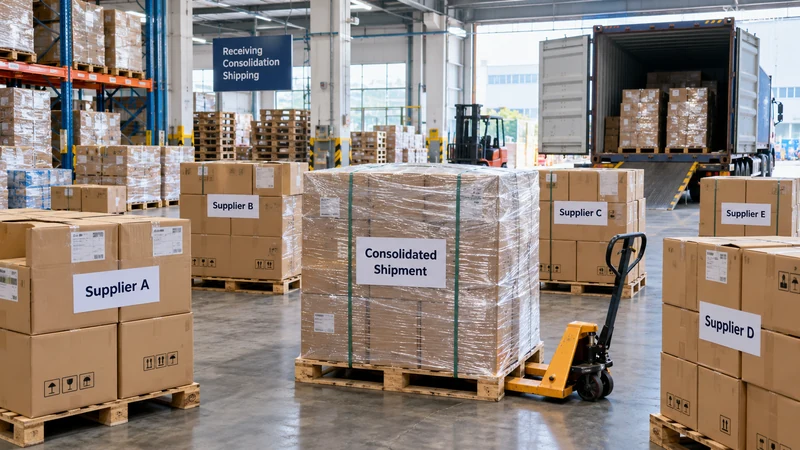
China to Nigeria cargo consolidation can reduce duplicated domestic transport, simplify shipment coordination and make small orders easier to ship together. But consolidation only works when every supplier delivery is identifiable, checked and included in the correct shipment batch.
The biggest risk is not whether five suppliers can send goods to one warehouse. They can.
The real questions are:
- Did all five suppliers actually deliver?
- Did the warehouse identify every carton correctly?
- Does the received quantity match what you expected?
- Has any supplier sent restricted or special cargo?
- Should the cartons be repacked?
- What are the final CBM and gross weight?
- Should the batch move by LCL, FCL or air?
- Should you wait for a late supplier or close the shipment now?
That is why China warehouse consolidation is a control process, not simply putting several boxes together.
For Nigerian importers buying from several factories, Alibaba sellers, 1688 suppliers or wholesalers in China, a good consolidation workflow creates one clear record from supplier dispatch to final shipment release.
Quick Answer: To consolidate cargo from multiple Chinese suppliers for Nigeria, first create a supplier delivery register and give every supplier a unique warehouse reference. The China warehouse should record arrivals, identify discrepancies, complete any agreed inspection or repacking, measure the final packed cargo, check product compatibility and documentation, and only then close the shipment for LCL, FCL or air freight.
How Multi-Supplier Consolidation Works
A well-controlled consolidation shipment normally follows this sequence:
Create shipment batch
→ Issue supplier references
→ Suppliers dispatch cargo within China
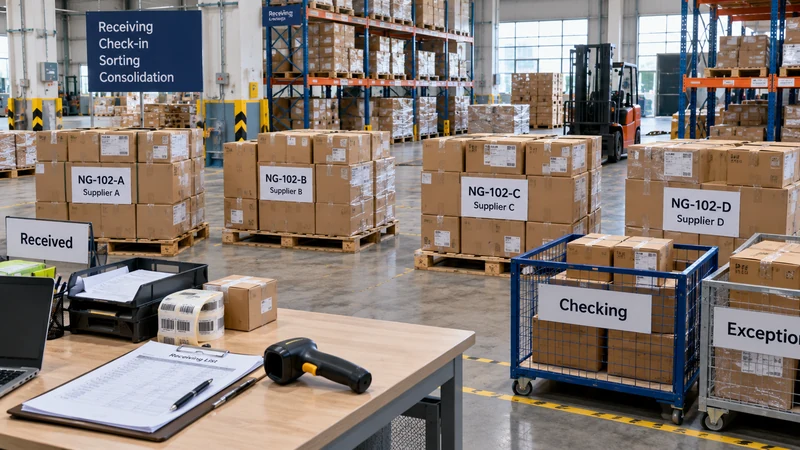
→ Warehouse receives and identifies cartons
→ Shortages and discrepancies are resolved
→ Approved repacking or palletizing is completed
→ Final dimensions, CBM and weight are recorded
→ Cargo compatibility and compliance are reviewed
→ LCL, FCL or air plan is confirmed
→ Shipment cut-off is approved
→ Cargo enters the international transport stage
The important point is that you should not treat the cargo as ready simply because several suppliers say they have shipped.
Your consolidated shipment should only move forward when the physical warehouse record, supplier order record and commercial document record agree.
Plan a Consolidation Batch
Before instructing suppliers to dispatch, prepare one batch record showing which orders are supposed to join the shipment. This gives the importer, warehouse and freight forwarder one common reference when goods begin arriving from different Chinese cities.
Step 1 — Build a Supplier Delivery Register
Start before the first carton reaches the warehouse.
Create a supplier delivery register covering every order intended for the consolidated shipment.
A practical register may contain:
| Field | What to Record |
|---|---|
| Supplier | Factory, trading company or seller name |
| PO / Order Number | Your purchase order or platform order reference |
| Product | Clear product description |
| Expected Cartons | Number of cartons, crates, pallets or pieces expected |
| Tracking | Domestic courier or truck reference |
| Expected Arrival | Estimated China warehouse delivery date |
| Receiving Reference | Unique code assigned to that supplier/order |
| Special Cargo | Battery, liquid, chemical, magnetic, fragile, high-value or other special handling |
For example, instead of telling all five suppliers to write only “JL Nigeria” on their cartons, assign references such as:
- NG-102-A — Supplier A
- NG-102-B — Supplier B
- NG-102-C — Supplier C
- NG-102-D — Supplier D
- NG-102-E — Supplier E
The reference should tie back to the actual purchase order.
Pro Tip: Give each supplier a unique receiving reference linked to the purchase order, not merely the buyer’s name.
This becomes especially useful when several Nigerian customers or several orders from the same importer are being handled in the same China warehouse.
Step 2 — Give Every Supplier the Correct Warehouse Instructions
Every supplier should receive the same standardized delivery instructions before dispatch.
The instruction sheet should normally confirm:
- China warehouse delivery address
- consignee or receiving contact
- telephone number
- unique receiving reference
- required carton shipping mark
- number of cartons expected
- domestic tracking or truck details
- warehouse delivery hours
- whether advance delivery notice is required
- restrictions on batteries, liquids, chemicals or other special cargo
- any packing or labeling requirements
Why “The Supplier Said It Was Delivered” Is Not Enough
Domestic courier tracking may show delivered, but that does not automatically mean the cargo has been matched to your consolidation batch.
Possible problems include:
- the supplier forgot the shipping mark;
- the courier delivered under a different sender name;
- only part of a split shipment arrived;
- the delivery contains fewer cartons than expected;
- another buyer’s goods were sent with yours;
- a parcel arrived without any recognizable order reference.
The operational question is therefore not:
“Did the courier deliver something?”
It is:
“Has the warehouse matched the physical cargo to the correct supplier, order and expected carton count?”
Supplier Instruction Checklist
Before each supplier ships, confirm:
- Correct warehouse address sent
- Receiving reference issued
- Carton mark confirmed
- Expected carton quantity recorded
- Domestic tracking requested
- Special cargo declared
- Delivery timing confirmed
- Supplier knows not to change cargo without notice
Step 3 — Warehouse Receiving and Check-In
One of the most common consolidation misunderstandings is assuming that warehouse receiving automatically includes product inspection.
It does not.
Receiving and quality control are different services.
The exact service scope should be agreed before suppliers dispatch their goods.
| Receiving Level | Typical Scope | What It Does Not Automatically Confirm |
|---|---|---|
| Level A: Receipt Only | Record that packages arrived | Carton quantity accuracy, condition or product quality |
| Level B: Carton Check | Count cartons and check visible exterior condition | Internal quantity or product specification |
| Level C: Open / Count / Photo Check | Open agreed cartons, count selected items and provide photos | Formal manufacturing-quality acceptance |
| Level D: Formal QC Inspection | Inspection against an agreed QC specification | Should not be assumed to be included in ordinary warehouse receiving |
A warehouse employee signing for six cartons does not mean:
- each carton contains the correct SKU;
- color and size are correct;
- electrical specifications match the purchase order;
- the product works;
- the factory met your quality standard.
If you need these checks, arrange the appropriate inspection level separately.
This is particularly important when consolidating orders from suppliers you have never used before.
Step 4 — Resolve Shortages Before Consolidating
Do not wait until the cargo is being loaded to investigate discrepancies.
Each exception should be recorded when the goods arrive.
Common Receiving Exceptions
Fewer cartons than expected
Check whether the supplier made a partial delivery, whether another tracking number exists, or whether cartons are still in transit.
Damaged outer carton
Photograph visible damage and decide whether the carton needs reinforcement, opening or supplier confirmation.
Wrong shipping mark
Relabel only after the cargo has been positively matched with the correct purchase order.
Unknown parcel
Move it into an unidentified-cargo status rather than guessing which batch it belongs to.
Duplicate delivery
Check tracking numbers and supplier records before adding the cargo to the batch.
Supplier split shipment
Record each part separately until the full expected quantity has been received or the importer approves shipment without the remaining portion.
Warehouse Receiving Checklist
Before marking an order as complete:
- Supplier identified
- PO/order identified
- Receiving reference matched
- Expected cartons compared with received cartons
- Exterior condition recorded where included
- Domestic tracking matched
- Split deliveries identified
- Unknown packages isolated
- Special cargo declaration checked
- Exceptions reported before shipment release
A simple received / missing / exception / complete status can prevent a small receiving problem from becoming an international freight problem.
Step 5 — Repack Only When It Creates Measurable Value
Repacking can be useful, but it should not be automatic.
The objective is not to make every shipment smaller at any cost. The objective is to create a packing format that is safer or more economical for international transport.
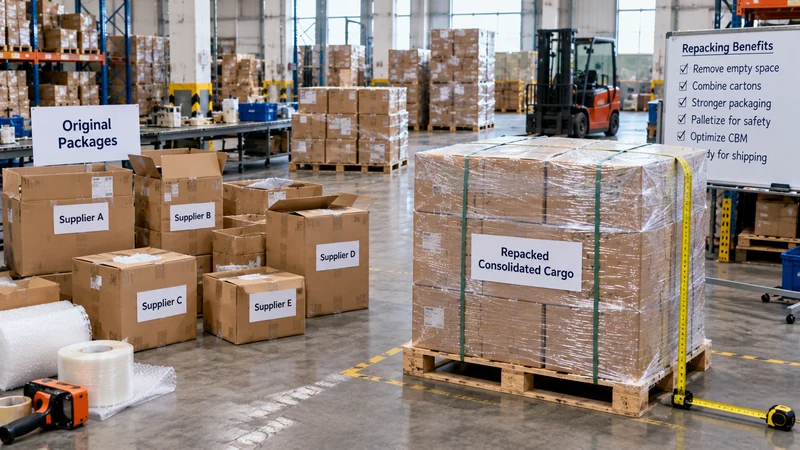
Possible reasons to repack include:
- removing unnecessary supplier outer cartons;
- combining compatible small packages;
- strengthening weak cartons;
- reducing excessive empty space;
- replacing damaged packaging;
- improving shipment labels;
- palletizing loose cartons;
- building a crate for fragile or vulnerable cargo.
Repacking Decision Matrix
| Current Packaging | Main Risk | Possible Action | Likely CBM Effect | Approval |
|---|---|---|---|---|
| Large carton with heavy empty space | Paying for dead cube | Repack into smaller carton | May reduce CBM | Recommended |
| Weak export carton | Damage | Reinforce or replace carton | May increase slightly | Recommended |
| Many small compatible cartons | Handling loss | Combine where practical | May reduce package count | Usually required |
| Fragile machinery | Damage | Crate or palletize | May increase CBM | Required before work |
| Strong factory carton | Low | Keep original packaging | Little/no change | Usually no repack needed |
Repacking does not always reduce CBM.
Adding corner protection, pallets, export crates or stronger outer packaging can actually increase the shipment dimensions.
That can still be the correct decision if it significantly reduces cargo-damage risk.
For this reason, repacking should normally be based on an agreed objective and, where appropriate, importer approval.
Step 6 — Measure the Final Cargo After Repacking
Do not make the final international freight decision from supplier estimates if the cargo will still be consolidated or repacked.
Measure it again after the final packing configuration is complete.
The final cargo record should include:
- total packages;
- final packed dimensions;
- total CBM;
- gross weight;
- chargeable air weight where relevant;
- pallet or crate dimensions;
- whether the cargo is stackable;
- oversized or irregular packages.
For rectangular cargo, volume is generally calculated from packed dimensions:
CBM = Length × Width × Height × Number of Packages
using dimensions converted into metres.
For air freight, volumetric or chargeable weight may become more important than CBM alone.
Why Final Measurement Matters
Imagine five suppliers originally report:
- 12 cartons;
- 8 cartons;
- 4 cartons;
- 6 cartons;
- 10 cartons.
You do not necessarily finish with 40 cartons.
After receiving and approved repacking, the batch may contain a different number of packages and a different total CBM.
That final packed figure, not the early supplier estimate, should feed into the freight comparison.
Once the final volume, weight, packaging and cargo characteristics are known, the forwarder can make a much more meaningful comparison between LCL shipping from China to Nigeria, FCL shipping from China to Nigeria and any air-freight split.
Step 7 — Check Product Compatibility Before Putting Everything Together
Different products can often be shipped in the same consolidated batch, but “different products” does not mean “anything can be mixed together.”
Special cargo should be identified before the shipment closes.
Review items such as:
- dangerous goods;
- lithium batteries;
- battery-powered equipment;
- liquids;
- chemicals;
- aerosols;
- magnetic materials;
- food products;
- cosmetics;
- medical products;
- fragile goods;
- high-value cargo;
- oversized or unusually heavy packages.
One problematic SKU from one supplier can affect the routing, packing, carrier acceptance or timing of the entire consolidation.
Batteries Are a Good Example
Lithium batteries are subject to specific classification, packing, marking, documentation and transport requirements. For air cargo, requirements differ according to battery chemistry, configuration and other characteristics.
For ocean freight, dangerous goods are subject to the IMDG framework, including requirements related to classification, packing, container transport, stowage and segregation of incompatible substances.
Therefore, a supplier should not simply send batteries, chemicals or other potentially regulated products into a general consolidation warehouse without prior declaration.
Carrier acceptance must be checked for the actual cargo.
Step 8 — Create the Export and Customs Document Set
A multi-supplier shipment requires more document discipline, not less.
Do not turn several supplier descriptions into a vague declaration such as:
“mixed goods”
and assume that is sufficient.
The shipment record should preserve the actual commodity information for the products being shipped.
Depending on the cargo and shipment, records may need to identify:
- actual product description;
- SKU or model;
- quantity;
- unit and total value;
- gross and net weight where applicable;
- HS classification;
- supplier or exporter information;
- regulatory status;
- dangerous-goods details where applicable;
- certificates or permits required for regulated products.
Accurate commodity classification remains important even when several product types travel together in one consolidated shipment.
For products regulated under SONCAP, conformity requirements may need to be completed before shipment, depending on the product and applicable Nigerian rules.
This is another reason consolidation planning should happen before cargo release, not after everything has already left China.
One Invoice or Multiple Invoices?
Buying from five suppliers does not mean you should erase the five underlying commercial transactions.
Keep the original supplier order and invoice records.
The final export and shipping document structure depends on the trading arrangement, exporter of record, customs requirements and freight setup. Your forwarder or customs professional should coordinate the final document package without losing accurate product descriptions, quantities and declared values.
For Nigeria-specific paperwork, see Documents Required to Import from China to Nigeria.
Step 9 — Decide LCL vs FCL vs Air After All Cargo Is Known
Do not decide that a multi-supplier shipment “must be LCL” simply because each supplier order is small.
Consolidation may turn several small orders into a substantial shipment.
After receiving and final packing, compare the actual logistics options.
LCL
LCL is often practical when the consolidated cargo remains well below a full container and the importer wants to pay for shared container space.
The real LCL decision should consider more than the headline ocean freight rate. Origin handling, consolidation charges, destination LCL charges and the characteristics of the cargo also matter.
For the mechanics and cost structure of shared-container shipping, see LCL Shipping from China to Nigeria.
FCL
As the consolidated volume increases, compare the total LCL shipment cost with the total FCL shipment cost.
There is no universal CBM number at which FCL automatically becomes cheaper.
Origin, destination, container availability, local charges, cargo density, handling requirements and current freight conditions can all affect the crossover.
For full-container planning, see FCL Shipping from China to Nigeria.
Air Freight
You do not have to send every SKU in the same mode.
If one product is urgently needed for stock replenishment while the rest can wait, a split strategy may make more business sense:
urgent cartons → air freight
remaining consolidated cargo → sea freight
The objective is to optimize the supply chain, not simply maximize the number of cartons travelling together.
Step 10 — Establish a Shipment Cut-Off
Every consolidation batch needs a point at which receiving stops and the shipment closes.
Without a cut-off, one late supplier can keep the entire batch in the warehouse indefinitely.
There are three basic choices:
- Wait for all suppliers
- Ship the cargo already received
- Move the late supplier into the next batch
The right decision depends on the business situation.
Wait vs Ship Decision
| Missing Supplier | Business Urgency | Warehouse Impact | Freight Impact | Possible Action |
|---|---|---|---|---|
| Arriving shortly | Low | Acceptable | Waiting may avoid second shipment | Wait |
| Major delay | High | Increasing | Current batch already economical | Ship current batch |
| Small late order | Medium | Moderate | Separate shipment may face minimum charges | Compare both options |
| Critical SKU late | High | Acceptable | Shipping without it may cause stockout | Consider waiting |
| Compliance issue unresolved | Any | Secondary | Cannot safely include yet | Hold affected cargo or split batch |
Example: Five Suppliers, One Is Ten Days Late
Consider a Nigerian retailer purchasing from five Chinese suppliers.
Suppliers A, B, C and D have delivered all expected cartons.
Supplier E reports that production is delayed and needs another ten days.
There is no automatic correct answer.
The importer and forwarder should compare:
If you wait
- Will important inventory run out in Nigeria?
- Will warehouse storage increase?
- Will the next sailing or flight be missed?
- Does including Supplier E materially improve freight economics?
If you ship now
- Will a second shipment face minimum freight or handling charges?
- Is Supplier E’s cargo large enough to justify its own shipment?
- Can Supplier E join the next purchasing batch?
- Are any of Supplier E’s SKUs urgently needed?
The decision should be based on the commercial consequences rather than the idea that a consolidation must always contain every original supplier.
Multi-Supplier Consolidation Cost Structure
Cargo consolidation may reduce duplicated logistics costs, but consolidation itself is not free.
Potential cost components can include:
- supplier-to-warehouse domestic transportation;
- factory pickup;
- warehouse receiving;
- storage;
- carton counting;
- photography;
- opening and checking;
- formal inspection;
- relabeling;
- repacking materials;
- repacking labor;
- palletizing;
- crating;
- export documentation;
- origin customs handling;
- international freight.
Not every shipment uses every service.
A useful consolidation quotation should therefore distinguish between:
what is included, what is optional, and what is charged only when required.
For example, do not assume that ordinary warehouse receiving automatically includes opening every carton, checking every piece, photographing every SKU and repacking the shipment.
The exact warehouse service scope, receiving charges, storage policy, inspection options, repacking services, pallet/crating availability and supplier pickup arrangements should be confirmed for your shipment before dispatching cargo.
Final Consolidation Release Checklist
Before the batch is released for international transport, reconcile the physical cargo with the shipment records.
- All intended suppliers listed
- Received suppliers marked complete
- Late suppliers identified
- Missing cartons resolved or approved
- Unknown cargo resolved
- Damaged packaging handled
- Repacking approved and completed where needed
- Final package count recorded
- Final dimensions recorded
- Final CBM calculated
- Final gross weight recorded
- Special cargo identified
- DG / battery acceptance checked where applicable
- Product descriptions confirmed
- Commercial records reconciled
- HS classifications reviewed
- Nigeria compliance requirements checked
- LCL / FCL / air plan confirmed
- Shipment cut-off approved
- Cargo formally released for booking/export
Pro Tip: Do not release a consolidated batch until the warehouse receiving register and commercial-document list reconcile.
That one control point can prevent many of the most expensive consolidation errors.
Common China to Nigeria Cargo Consolidation Mistakes
1. Sending Every Supplier the Same Buyer Name Only
The warehouse receives several similar cartons but cannot reliably identify which order they belong to.
Better: use a unique reference for every supplier/order.
2. Allowing Unidentified Parcels Into the Shipment
An unknown carton should be investigated before consolidation, not guessed.
3. Assuming Warehouse Receipt Means QC Passed
Receiving confirms logistics events. Product inspection verifies the goods themselves.
These are not the same service.
4. Closing the Shipment Before Checking Late Suppliers
A batch can leave China while the importer still believes an outstanding supplier was included.
Use a receiving register before shipment release.
5. Repacking Without Approval
Reducing packaging may expose fragile products, remove useful factory markings or affect warranty and resale presentation.
Repack for a defined reason.
6. Measuring Before Final Repacking
Freight comparisons based on old carton dimensions may no longer be accurate after consolidation.
Measure the final configuration.
7. Mixing Special Cargo Into General Cargo Without Review
A battery, liquid or chemical product can change the acceptance requirements for the batch.
Declare special cargo before it reaches the consolidation stage.
8. Declaring Everything as “Mixed Goods”
Consolidation combines logistics movements. It does not remove the need for accurate product records.
When Does China Warehouse Consolidation Make Sense?
Multi-supplier consolidation is particularly useful for Nigerian importers who:
- buy from several factories in different Chinese cities;
- place smaller orders that are inefficient to ship separately;
- purchase several product categories for one retail business;
- source components from several manufacturers;
- combine Alibaba and 1688 purchases;
- replenish inventory regularly;
- want one controlled China receiving point;
- need final cargo measurements before choosing the international shipping mode.
It is less about the number of suppliers and more about whether coordinating them through one shipment batch improves visibility, cost control and shipping efficiency.
For the complete international transport options after the cargo leaves the warehouse, see Shipping from China to Nigeria.
For the wider purchasing-to-clearance workflow, see How to Import Goods from China to Nigeria.
If you are consolidating marketplace purchases, see Shipping Alibaba & 1688 Orders from China to Nigeria.
If you are still selecting a logistics partner, see How to Choose a Freight Forwarder from China to Nigeria.
FAQ
What is cargo consolidation?
Cargo consolidation means bringing goods from multiple suppliers or orders to a common China warehouse, identifying and checking the received packages, resolving discrepancies and preparing them as one coordinated international shipment or shipment batch. It is different from LCL itself because multi-supplier consolidation happens before the international transport leg.
Can I combine Alibaba and 1688 suppliers in one shipment?
Yes. Goods purchased from Alibaba, 1688 and other Chinese suppliers can potentially be routed to the same consolidation warehouse. Each supplier should receive the correct warehouse address, unique receiving reference and cargo instructions, while restricted or special cargo must be declared in advance.
How do I know all supplier cartons arrived?
Maintain an expected delivery register and reconcile it against warehouse receiving records. For every supplier, compare the expected carton count, actual received carton count, domestic tracking number and receiving reference rather than relying only on the supplier saying the order was delivered.
Does cargo consolidation include quality inspection?
Not automatically. Standard receiving may only confirm arrival. Depending on the agreed service, the warehouse may count cartons, check visible damage, take photos or open selected packages. Formal product-quality inspection should be separately defined if required.
Can a warehouse repack my goods to reduce CBM?
Repacking may reduce CBM when supplier packaging contains excessive empty space or unnecessary outer cartons. However, pallets, stronger cartons, cushioning or crates can increase CBM while improving cargo protection, so repacking should be based on measurable value rather than assumed savings.
Can batteries and general goods be consolidated?
Potentially, but batteries cannot simply be treated as ordinary cargo because they are packed with general merchandise. Battery type, configuration, rating, packaging and transport mode may affect classification and carrier acceptance, so the actual specifications and route should be reviewed before consolidation.
When should consolidated cargo use FCL instead of LCL?
There is no universal FCL crossover volume. After all supplier cargo has arrived and final packing is complete, compare total LCL costs with total FCL costs using the actual CBM, weight, origin charges, destination charges and cargo-handling requirements.
What happens if one supplier is late?
You can wait, ship the current batch without that supplier, or move the late cargo into the next consolidation. Compare inventory urgency, expected delay, warehouse implications, sailing or flight schedule, minimum freight charges and the cost of a second shipment before deciding.
Send Your Supplier List and Cargo Details
If you are buying from several Chinese factories for shipment to Nigeria, start the consolidation plan before the suppliers begin sending cartons.
Prepare:
- supplier names;
- purchase-order references;
- product descriptions;
- expected carton quantities;
- estimated dimensions and weights;
- supplier locations;
- expected completion dates;
- battery, liquid, chemical or other special-cargo details;
- required delivery destination in Nigeria.
Winsail Logistics can coordinate China-origin freight planning, supplier cargo collection or receiving, consolidation and the following international transport stage according to the confirmed cargo and service requirements.
The goal is simple:
Know what should arrive. Know what actually arrived. Resolve the difference. Measure the final cargo. Then ship the right batch.
