

Furniture is usually a space problem before it is a weight problem.
A shipment of sofas, wardrobes, office desks or hotel furniture may not be especially heavy, but large cartons can consume container space quickly. That means the biggest logistics savings often come from better packaging, knock-down design, nesting and loading—not simply from negotiating a few dollars off the ocean freight rate.
When shipping furniture from China to Nigeria, buyers should therefore look beyond the headline freight price. The real questions are:
- How many cubic metres will the export packaging occupy?
- Can the furniture be shipped flat-pack or partially knocked down?
- Is LCL still economical after destination handling?
- Would a 20GP, 40GP or 40HQ provide better usable space?
- Can cartons withstand consolidation and terminal handling?
- Does the shipment contain solid wood or regulated plant-derived material?
- Are wooden pallets, crates or dunnage compliant with applicable wood-packaging rules?
- How will the furniture be protected from condensation during sea freight?
For wholesalers, hotel projects, office fit-outs, developers and furniture retailers, getting these decisions right before production is often more valuable than trying to optimize freight after the furniture has already been packed.
If you are still comparing the overall route, customs process and shipping options, start with our shipping from China to Nigeria guide.
Can Furniture Be Imported into Nigeria?
Do not treat “furniture” as one regulatory category.
Before shipping, the importer and freight forwarder should screen the actual product according to its material, condition, HS classification and intended use.
A shipment may contain very different products, including:
- upholstered sofas
- wooden wardrobes
- metal office desks
- plastic chairs
- mattresses and bed frames
- hotel room furniture
- cabinets with glass doors
- engineered-wood panels
- solid-wood tables
- mixed furniture sets with electrical components
These products may not have identical customs or conformity requirements.
Check the Exact HS Code
Furniture commonly falls within HS Chapter 94, but classification depends on what the item actually is, its construction, function and sometimes its component materials.
Do not use one HS code for an entire project simply because every item is described commercially as “furniture.”
A hotel shipment containing beds, upholstered seating, lamps, mirrors and fitted cabinetry, for example, may require several classifications.
The Nigerian importer should also check the current Nigeria Customs Service tariff and import-prohibition resources before ordering. Regulatory status should be confirmed against the exact product and HS code rather than assumed from a general furniture description.
New and Used Furniture Should Be Treated Separately
Always state clearly whether the furniture is new, used, refurbished or project surplus.
SON’s public guidance distinguishes some used products from the normal SONCAP offshore certification route, but an offshore-certification exemption does not automatically mean an item is outside SON regulation. Used or refurbished goods therefore require case-specific checking rather than assuming they follow the same process as new commercial furniture.
Confirm SON / SONCAP Requirements Before Shipment
The Standards Organisation of Nigeria describes SONCAP as the pre-shipment conformity programme for SON-regulated imported products. For goods falling within the programme, the Product Certificate is linked to Form M processing and the SONCAP Certificate is used as part of Nigerian import clearance.
For a furniture shipment, confirm requirements using the actual HS code, product specifications and intended import route rather than assuming every chair, cabinet or furniture component has identical certification treatment.
This check should happen before the cargo leaves China, not after it reaches Lagos.
LCL vs FCL for Furniture
For furniture, the LCL-versus-FCL decision is mainly a question of volume, handling exposure and total landed logistics cost.
There is no universal CBM number at which every furniture shipment should move from LCL to FCL.
LCL Furniture Shipping
LCL can work well when:
- the order is relatively small
- several suppliers are being consolidated
- the buyer does not have enough cargo for a dedicated container
- the furniture is strongly packed
- the shipment can tolerate additional warehouse handling
With LCL, your furniture shares container space with other cargo.
That normally introduces more handling points. Goods may be received at a consolidation warehouse, handled during container loading, unloaded at the destination CFS and moved again before final release.
For fragile furniture, those additional movements matter.
LCL can also become expensive for bulky products because freight is normally driven heavily by chargeable volume. Large lightweight cartons consume space even when their gross weight is modest.
Destination CFS, documentation, handling and local delivery costs should therefore be included when comparing LCL with FCL. For smaller consolidated orders, see how LCL consolidation services from China work.
FCL Furniture Shipping
FCL becomes attractive when the furniture volume is large enough to make efficient use of a container.
Its main operational advantages include:
- fewer cargo-handling points
- greater control over loading
- easier separation of furniture SKUs
- more freedom to optimize container space
- reduced exposure to unrelated cargo
- better suitability for large retail or project orders
FCL does not automatically eliminate damage risk. Poor loading can still cause cartons to collapse, shift or rub against each other during transport.
The key advantage is that the loading plan can be designed specifically around your furniture. Buyers comparing dedicated containers can also review our FCL shipping from China guide.
| Method | Best For | Main Advantage | Main Concern |
|---|---|---|---|
| LCL | Small furniture orders | No need to fill a container | More handling and potentially high destination costs |
| 20GP | Smaller dedicated shipments | FCL control at lower overall cube | Limited volume for bulky furniture |
| 40GP | Medium-to-large FCL orders | Much more floor and cube capacity | May still cube out quickly with tall bulky cartons |
| 40HQ | High-volume furniture | Extra height and strong cube efficiency | Requires careful loading plan to use the space effectively |
Why 40HQ Is Commonly Compared for Bulky Furniture
Furniture often reaches a container’s space limit long before its maximum weight.
That is why the 40HQ is frequently compared when shipping furniture from China to Nigeria.
A typical 40HQ offers roughly 76 m³ of internal geometric volume, although the amount of commercial furniture CBM that can actually be loaded will be lower and varies substantially.
Door dimensions, carton shapes, unusable gaps, fragile surfaces, stacking limits and loading sequence all reduce practical utilization.
For that reason, asking:
“How many sofas fit in a 40HQ?”
usually does not produce a reliable answer.
Two sofas that look almost identical in a showroom can have completely different export-packing volumes.
Before planning a container, ask the supplier for:
- number of cartons
- packed dimensions of every carton
- total export CBM
- gross weight
- stackability
- knock-down status
- pallet dimensions if used
- crate dimensions if used
- restrictions on orientation
Pro Tip
Ask the furniture supplier for the export packing CBM, not the showroom product dimensions.
Freight is planned around the packed cargo that enters the container.
A dining table measuring 2 metres long when assembled might occupy far less space if the legs are removed and the top is packed vertically with proper protection. The reverse is also possible: decorative packaging, foam, crates or non-stackable components can make the shipping volume much larger than expected.
For a more detailed explanation of volume-based pricing, see shipping cost per CBM from China to Nigeria.
Flat-Pack and Knock-Down Furniture Can Reduce Shipping CBM
For many furniture categories, packaging design is one of the strongest freight-cost levers available.
Knock-down or flat-pack designs can:
- reduce total CBM
- improve container utilization
- reduce empty space around products
- make cartons easier to stack
- allow more units per shipment
- reduce movement inside the container
Common candidates include:
- office desks
- tables
- wardrobes
- shelving systems
- cabinets
- bed frames
- chairs designed for nesting
- modular hotel furniture
But flat-pack shipping also creates new risks.
Panels have exposed edges. Hardware can be lost. Decorative surfaces can rub against each other. Assembly mistakes can become a problem at the destination.
Knock-Down Savings Factors
| Factor | Potential Effect on Freight | Operational Tradeoff |
|---|---|---|
| Removable legs | Reduces wasted vertical space | Assembly required |
| Flat cabinet panels | Strong CBM reduction | Edge and corner protection becomes critical |
| Nesting chairs | Improves density | Surfaces need abrasion protection |
| Modular components | Better container loading | More SKU control required |
| Sofa compression | May reduce volume for suitable designs | Not safe for every foam, frame or upholstery construction |
| Removing unnecessary pallets | Reduces packaging cube | Only if cartons can be handled safely without them |
Do not compress furniture simply because the volume can be reduced. Excessive compression can deform upholstery, damage foam or place stress on internal frames.
Packaging changes should be approved by the furniture manufacturer.

Furniture Damage Risks During Shipping
Furniture is particularly vulnerable because cosmetic damage can make an otherwise functional product commercially unacceptable.
The most common risks include:
Abrasion
Painted surfaces, leather, fabric and laminated panels can become scratched when cartons or components move against each other.
Use foam sheets, non-abrasive wrapping and separators between finished surfaces.
Crushed Corners
Wardrobes, cabinets, desks and flat-pack panels often suffer damage at carton edges.
Corner boards and reinforced carton construction can provide much more protection than adding another thin layer of plastic film.
Upholstery Contamination
Sofas and upholstered chairs should be protected against dust, moisture and contact with dirty warehouse floors or other cargo.
Outer packaging should remain intact throughout consolidation and unloading.
Glass Breakage
Glass tabletops, cabinet doors and mirrors need packaging designed specifically for fragile components.
Depending on value and handling exposure, this may require foam protection, rigid reinforcement or custom crating.
Hardware Loss
Screws, brackets, handles and assembly tools should be packed in sealed, clearly identified bags.
For project furniture, loose hardware should be linked to the corresponding room, SKU or furniture package.
Moisture and Container Condensation
Ocean containers experience major temperature and humidity changes during international transport.
When warm humid air cools inside a container, condensation can form on internal surfaces and potentially drip onto cargo. Furniture containing wood-based boards, fabric, leather or other moisture-sensitive materials may then develop:
- mold
- staining
- swelling
- veneer separation
- corrosion on metal hardware
- packaging deterioration
- unpleasant odor
Moisture management should start before container loading.
Use Dry Cargo and Packaging
Do not load furniture, timber components, pallets or cartons that are already damp.
A desiccant cannot compensate for large amounts of moisture trapped inside wet wood or wet packaging.
Use Container Desiccants Appropriately
Desiccants can help manage humidity during sea freight, particularly on long routes or where the cargo contains moisture-sensitive materials.
The quantity and placement should reflect the container size, route, season, cargo characteristics and packaging configuration.
Add Moisture Barriers Where Needed
Sensitive furniture can benefit from sealed inner protection, moisture-resistant wrapping or protective bags.
However, completely sealing materials while moisture is already trapped inside can create its own problems.
Keep Cargo Away from Container Walls Where Practical
Direct contact with container walls can increase exposure to condensation and temperature changes.
Loading plans should also avoid unstable gaps that allow furniture cartons to shift during transit.
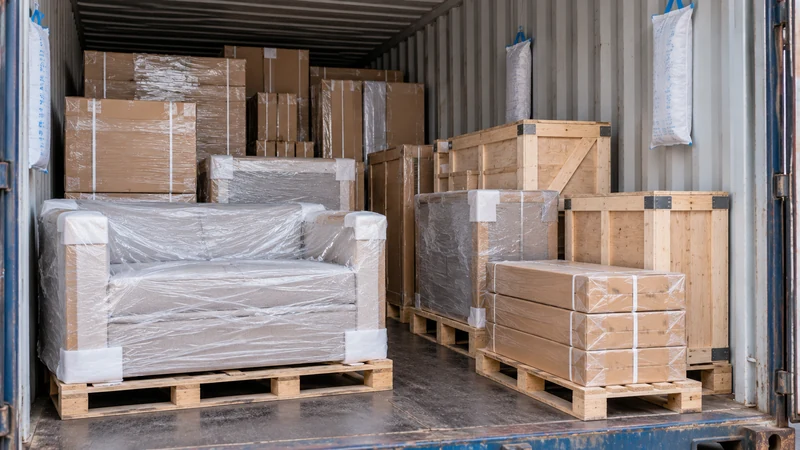
Solid Wood Furniture vs Solid Wood Packaging: They Are Not the Same Compliance Question
This distinction is important.
A wooden dining table and the wooden pallet underneath that table are not automatically regulated in exactly the same way.
Question 1: Is the Pallet, Crate or Dunnage Made from Raw Solid Wood?
If yes, wood-packaging regulations need to be checked.
Nigeria Agricultural Quarantine Service states that international movement of wood packaging materials—including pallets, crates and dunnage—is subject to quarantine inspection and certification in compliance with ISPM 15.
ISPM 15 is the international phytosanitary standard covering wood packaging made from raw wood used in international trade. The IPPC notes that the standard covers items such as dunnage while excluding processed wood packaging that has been manufactured in a way that removes the relevant pest risk, such as plywood.
Where regulated solid-wood packaging is used, verify that the packaging has received the applicable approved treatment and carries the required authorized ISPM 15 marking.
Question 2: Is the Packaging Made from Processed Wood?
Packaging made entirely from materials such as plywood or similar processed wood may fall outside the raw-wood packaging scope described by ISPM 15.
However, mixed construction should be checked carefully. A plywood crate may still contain raw solid-wood runners, blocks or supports.
Question 3: Is the Furniture Itself Made from Solid Wood or Other Plant-Derived Material?
Now the question changes from wood packaging to the commodity itself.
NAQS is responsible for phytosanitary controls affecting plants, plant products, regulated articles and wood products. Requirements can depend on the species, processing, treatment and condition of the material.
Do not assume that an IPPC mark on the pallet automatically satisfies any phytosanitary requirement that may apply to the furniture commodity.
Equally, do not assume every finished wooden furniture product automatically requires the same phytosanitary documentation.
The importer should confirm the requirement for the exact product with NAQS or the relevant Nigerian clearance party before shipment.
Wood-Compliance Decision Tree
Is there wood in the shipment?
→ No
Proceed with normal product, customs and packaging checks.
→ Yes — only wooden pallet/crate/dunnage
Determine whether it is regulated raw solid-wood packaging.
→ Raw solid wood
Check ISPM 15 treatment, authorized marking and Nigerian quarantine requirements.
→ Processed wood such as plywood
Confirm whether it falls outside the ISPM 15 raw-wood packaging scope.
→ The furniture itself contains solid wood or another plant-derived material
Separately verify whether the commodity triggers NAQS phytosanitary requirements.
→ Furniture plus solid-wood packaging
Check the commodity and the packaging independently.
LCL Furniture Needs Stronger Handling Protection
A carton suitable for factory-to-showroom domestic trucking may not be suitable for international LCL freight.
LCL furniture can pass through several handling environments:
Supplier → China consolidation warehouse → CFS → container → destination CFS → customs release → truck → final warehouse
Every transfer increases the opportunity for impact, dragging, stacking pressure or contamination.
For LCL shipments, consider:
- heavier export cartons
- reinforced corners
- foam protection around finished surfaces
- stronger carton strapping
- rigid protection for glass
- palletization for suitable cargo
- custom crates for premium or fragile pieces
Pallets and crates add cost and CBM, so they should not be applied automatically.
For inexpensive flat-pack chairs, a crate may cost more than the damage risk justifies. For a high-value stone-top hotel console or decorative glass cabinet, stronger rigid packing may be worthwhile.
Packaging should match cargo value and handling risk.
Furniture Type vs Recommended Packing Approach
| Furniture Type | Typical Risk | Packing Focus |
|---|---|---|
| Flat-pack cabinets | Edge crushing | Corner boards, foam and strong cartons |
| Sofas | Dirt, moisture, compression damage | Protective bag, outer wrapping and controlled stacking |
| Office desks | Panel scratches and corner impact | Separate panels and protected edges |
| Dining tables | Surface abrasion and leg damage | Remove legs where designed, surface protection |
| Glass furniture | Breakage | Rigid protection or suitable crate |
| Chairs | Scratches and wasted space | Nesting where designed, separators |
| Hotel casegoods | SKU confusion and cosmetic damage | Strong cartons plus room/package labels |
| Solid-wood furniture | Moisture and possible phytosanitary questions | Dry material, moisture control and regulatory screening |
Shipping Hotel and Project Furniture to Nigeria
Project furniture requires more planning than ordinary retail replenishment.
A hotel, office or residential development may involve hundreds of similar cartons that must eventually be delivered to different rooms, floors or installation zones.
The logistics plan should therefore preserve the installation sequence.
Useful controls include:
- room numbers
- floor numbers
- project-zone codes
- SKU numbers
- carton sequence numbers
- package counts
- packing lists by room or area
- loading plans
- delivery batches
For example:
Tower A – Floor 05 – Room 0508 – Bedside Table – Carton 1/2
is much more useful on site than:
Wooden Furniture – Carton 187
Plan Phased Deliveries
A construction site may not be ready to receive an entire 40HQ at once.
Before shipment, confirm:
- whether the site has unloading space
- whether a container truck can access the location
- whether forklifts or labour are available
- whether the furniture must first go to a warehouse
- whether floors or rooms are ready for installation
- how long cargo may need to remain in storage
For deliveries from Lagos-area ports to Lagos or Ogun projects, final-mile planning can materially affect total cost. The same applies to furniture moving inland to Abuja or other Nigerian destinations.
If the shipment requires clearance plus final delivery, review door-to-door shipping from China when defining the service scope.
Costs Beyond the Ocean Freight Rate
A furniture buyer comparing two freight quotations should compare the same scope.
The ocean rate alone does not represent the full logistics cost.
China-Side Consolidation
When products come from Foshan, Guangzhou, Shenzhen, Dongguan, Zhejiang or multiple manufacturing areas, cargo may first need to be collected and consolidated.
Multiple suppliers can create extra pickup, warehouse and handling costs.
Export Packing
Custom crates, stronger cartons, moisture protection and reinforced corners add cost—but may reduce claims and replacement expenses later.
Wood-Packaging Compliance
If regulated solid-wood pallets, crates or dunnage are used, compliant treatment and packaging controls may create additional cost.
LCL CFS Charges
LCL cargo may incur consolidation and destination handling that would not apply in the same way to an FCL shipment.
Nigerian Customs and Regulatory Costs
The importer needs to budget for applicable duties, taxes, customs processing and product-specific regulatory requirements according to the correct HS code and customs value.
Form M and PAAR are important parts of the Nigerian import and customs-clearance process. The exact documentation path should be coordinated with the importer, authorized dealer bank and clearance parties before shipment.
Project Delivery
Moving a container from the port to a warehouse is different from delivering furniture to multiple project locations.
Budget separately for:
- truck delivery
- container positioning
- unloading
- labour
- forklift or crane where required
- warehouse handling
- storage
- phased dispatch
For a broader comparison of LCL and FCL ocean transport on this route, see sea freight from China to Nigeria.
Furniture Import and Shipping Compliance Checklist
Before booking shipping furniture from China to Nigeria, confirm:
- Product material: solid wood, engineered wood, metal, plastic, upholstery, glass or mixed construction.
- Exact HS classification: do not classify the shipment only as “furniture.”
- New or used status: regulatory treatment may differ.
- NCS import eligibility: check the current tariff and prohibition/restriction database.
- SON / SONCAP: verify applicability using the product and HS code.
- NAQS: check whether plant, wood or other regulated material triggers quarantine requirements.
- Solid-wood packaging: ensure applicable pallets, crates and dunnage meet ISPM 15 requirements.
- Form M: prepare the Nigerian import process before shipment as applicable.
- PAAR: coordinate the documentation required for customs clearance.
- Packing list: ensure descriptions, quantities, carton numbers and materials are consistent across documents.
Regulatory requirements can change and should be confirmed for the specific shipment before cargo is dispatched.
Furniture Packaging Checklist
Before loading, check whether the shipment needs:
- knock-down packing where the furniture is designed for it
- protective foam
- corner boards
- surface separators
- reinforced export cartons
- moisture-resistant wrapping
- container desiccants
- carton labels
- SKU labels
- hardware bags
- room or project numbering
- glass protection
- custom crating
- palletization where justified
- ISPM 15-compliant solid-wood packaging where applicable
A packaging decision should consider both damage risk and CBM impact.
Adding an oversized wooden crate around every piece may reduce damage exposure while increasing freight cost dramatically. Removing every pallet may save CBM while making handling unsafe.
The best solution balances both.
What Information Is Needed to Compare LCL, 20GP, 40GP and 40HQ?
A freight forwarder cannot make a reliable furniture loading recommendation from a product name or purchase value alone.
Prepare:
- complete product list
- total carton quantity
- packed carton dimensions
- total CBM
- gross weight
- furniture material
- solid-wood details where applicable
- knock-down or assembled status
- stackability
- pallet or crate dimensions
- packaging material
- glass or fragile components
- number and location of suppliers
- pickup cities in China
- Nigerian port
- final delivery destination
For multi-supplier projects, sending each supplier’s packing list separately can also help identify inefficient cartons before consolidation.
Final Recommendation
When shipping furniture from China to Nigeria, focus first on how the cargo occupies space.
For a small commercial order, LCL may provide the flexibility you need, but the furniture should be packed for repeated handling and the total destination charges should be considered.
For larger orders, a dedicated 20GP, 40GP or particularly a 40HQ furniture container can provide better control and more efficient use of space.
But container selection should never be based only on the number of sofas, tables or cabinets.
Use the actual export packing CBM, carton dimensions, stackability and knock-down configuration to build the loading plan.
Then check the other risks that are easy to overlook: moisture, carton strength, glass, hardware, solid wood, wooden packaging and Nigerian import documentation.
For bulky furniture, reducing wasted cubic metres by improving packaging can sometimes produce more meaningful savings than reducing the freight rate itself.
Check Furniture CBM
Send the product list, carton quantities and export packing dimensions first. These figures make it possible to compare the real space requirement instead of estimating from showroom dimensions.
Compare LCL vs 40HQ
For higher-volume orders, compare the all-in LCL logistics cost against a dedicated-container loading plan rather than using a fixed CBM crossover point.
The right choice depends on how efficiently the furniture can actually be packed and loaded.
FAQ
Is LCL suitable for furniture from China to Nigeria?
Yes. LCL can work for small furniture orders, samples and multi-supplier consolidations. Furniture cartons should be strong enough for additional warehouse and CFS handling, and bulky low-density cargo should be evaluated on total CBM and destination charges.
When should I use a 40HQ for furniture?
Consider a 40HQ when the order has enough volume to benefit from a dedicated container and the additional height improves loading efficiency. There is no universal CBM or item-count threshold; compare packed dimensions and total landed cost against LCL, 20GP and 40GP options.
How can I reduce furniture shipping CBM?
Use knock-down construction where the product is designed for it, remove detachable components, nest compatible items, improve carton dimensions and eliminate unnecessary empty packaging space without compromising protection.
Does wooden furniture need phytosanitary documents in Nigeria?
Not every finished wooden furniture product should automatically be treated the same way. Requirements can depend on the material, processing and product classification, so solid-wood furniture or similar products should be screened for shipment-specific NAQS requirements before export.
Do wooden pallets require ISPM 15?
Raw solid-wood pallets, crates and dunnage used in international trade fall within the type of wood packaging controlled by ISPM 15. Applicable treatment, marking and Nigerian quarantine requirements should be confirmed before shipment.
How can I prevent mold during sea freight?
Start with dry furniture and dry packaging. Depending on the cargo, use suitable moisture barriers, container desiccants and a loading plan that limits unnecessary exposure to container-wall condensation.
Should sofas and cabinets be palletized?
Not automatically. Pallets can improve handling and protection but also consume CBM. Strong export cartons may be more efficient for some flat-pack furniture, while premium, fragile or irregular pieces may justify pallets or crates.
Official Regulatory References
- Nigeria Customs Service — tariff classification, customs procedures and import restrictions.
- Standards Organisation of Nigeria SONCAP FAQ — SONCAP and product conformity requirements.
- Nigeria Agricultural Quarantine Service FAQ — plant, wood and quarantine requirements.
- International Plant Protection Convention ISPM resources — ISPM 15 requirements for regulated wood packaging material.
Always confirm requirements against the exact furniture material, HS code, new/used status and packaging configuration before shipment.
