
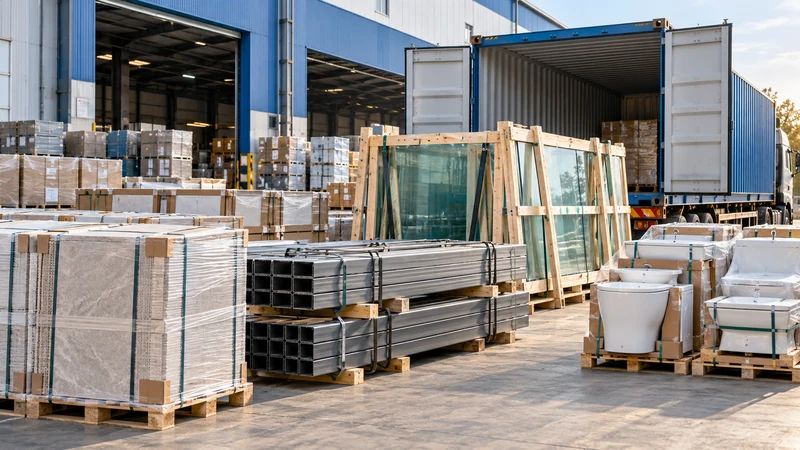
Importing construction materials from China to Tanzania involves more than arranging ocean freight. Ceramic tiles, steel products, glass panels, sanitary ware, doors, and other building supplies have different weight, packaging, handling, and unloading requirements.
For contractors, property developers, and building-material distributors, the main challenge is often combining these products into a shipment without exceeding transport limits, damaging fragile goods, or creating problems at the construction site.
Successful shipping building materials from China to Tanzania begins with accurate cargo specifications, a practical container loading plan, product-specific import checks, and a clear destination delivery arrangement.
For a broader overview of available routes and transportation services, see our shipping from China to Tanzania guide.
Quick Answer
Shipping construction materials from China to Tanzania requires matching container capacity with cargo weight, dimensions, and handling risks. Dense products such as tiles and steel need careful weight distribution, while glass and sanitary ware require protective packaging and secure separation. Importers should also verify applicable TBS requirements, coordinate multiple suppliers, and confirm that the destination site can safely receive and unload the shipment.
Operational Data Note — Reviewed October 2026
Container specifications, cargo securing requirements, product conformity procedures, and import documentation have been reviewed against published guidance. Actual payload, equipment acceptance, road restrictions, certification obligations, and unloading arrangements depend on the specific shipment. Confirm these details before finalizing loading or delivery instructions.
1. Understand the Loading Challenges of Different Building Materials
Construction materials create different shipping risks depending on their density, shape, fragility, and packaging.
A container filled with ceramic tiles may reach its practical weight limit before all the available space is used. A shipment of doors, lightweight panels, and bathroom fixtures may occupy most of the available volume while remaining relatively light.
Mixed construction shipments introduce another challenge: products that are individually suitable for container transportation may not be suitable for loading directly beside one another.
Heavy Materials: Ceramic Tiles, Steel, and Stone
Ceramic tiles, reinforcing steel bars, structural steel, and natural stone are relatively dense products.
Their main shipping considerations include:
- Container payload: Total cargo weight must remain within the applicable equipment and transport limits.
- Concentrated floor loading: Heavy pallets or crates can place excessive pressure on a small area of the container floor.
- Weight distribution: Cargo must be positioned to avoid unsafe concentrations and instability.
- Handling equipment: Heavy pallets and steel bundles may require forklifts, cranes, or other suitable lifting equipment.
- Cargo movement: Dense materials require appropriate restraints to prevent shifting during handling and transportation.
For example, a shipment containing ceramic tiles and steel profiles may appear to fit comfortably inside a 20ft container by volume. However, the combined gross weight, floor-loading pattern, and destination trucking restrictions may make the proposed arrangement unsuitable.
The correct decision requires a verified loading plan, not a CBM calculation alone.
Bulky and Fragile Materials: Glass, Doors, and Sanitary Ware
Glass panels, assembled doors, windows, bathroom cabinets, and ceramic sanitary fixtures have different limitations.
These products may occupy considerable space because they cannot be stacked freely or require additional protective packaging.
Glass panels need suitable support and protection against movement, bending, and impact. Ceramic toilets and washbasins require packaging that prevents movement inside the carton and protects vulnerable edges.
Doors and finished panels may need protection against moisture, surface abrasion, and deformation.
Loading these products alongside heavy steel or tile pallets requires suitable physical separation and independent cargo securing.
Long and Irregularly Shaped Materials
Steel pipes, aluminium profiles, structural sections, and large stone slabs may create loading difficulties even when their total weight is acceptable.
Before selecting equipment, confirm the longest package dimensions, lifting points, loading orientation, center of gravity, and whether the item can pass safely through a standard container doorway.
Unusual lengths or dimensions may require specialized equipment or a different packing arrangement.
The most useful starting point is a product-level loading risk assessment.
Building Material Loading and Damage Prevention Matrix
| Material category | Main loading constraint | Recommended protection approach | Pre-loading inspection |
|---|---|---|---|
| Ceramic and porcelain tiles | High density, pallet weight, stacking limits | Suitable rated pallets, edge protection, stable packaging | Gross weight, pallet integrity, carton condition |
| Steel bars, pipes, and sections | Concentrated weight, length, movement | Approved restraints, suitable supports, corrosion protection | Bundle weight, lifting points, securing arrangement |
| Glass panels and glazing | Fragility, support geometry, lifting restrictions | Suitable engineered crates or frames, edge protection | Crate condition, support points, restraints |
| Ceramic sanitary ware | Irregular shapes, limited stacking | Protective internal packaging, secure separation | Model labels, carton strength, visible damage |
| Doors and building panels | Large volume, bending, moisture sensitivity | Protective wrapping, appropriate supports, surface protection | Dimensions, packaging condition, moisture exposure |
| Stone slabs | High weight, cracking and tipping risks | Purpose-designed supports and approved lifting arrangements | Crate strength, weight distribution, handling method |
These are general handling considerations. The final packaging and loading arrangement must follow the actual product specifications and applicable transport requirements.
2. Calculate Container Weight and Load Distribution Before Booking
Choosing the right container requires checking three separate constraints: available space, permitted cargo weight, and the ability to distribute and secure the load safely.
A container can have sufficient internal volume but still be unsuitable because of its weight rating, floor strength, concentrated loads, or road transport restrictions.
Calculate the Total Gross Cargo Weight
Ask every supplier to provide the gross weight of each packed unit, including its pallet, crate, or other primary packaging.
Calculate:
Total Cargo Gross Weight = Sum of (Package Quantity × Gross Weight per Package)
Then account for any additional dunnage, bracing, securing materials, and container tare when determining packed-container gross mass.
Packed Container Gross Mass = Cargo and Packaging Mass + Additional Securing Materials + Container Tare
For mixed construction cargo, the manifest should identify weight by supplier, product, and package.
A packing list that shows only total CBM is not sufficient for safe container planning.
Check the Actual Container and Transport Limits
Before confirming a 20GP, 40GP, or 40HC container, verify:
- The container’s maximum permitted gross mass and actual tare.
- The available payload under the confirmed equipment and carrier arrangements.
- Floor-loading restrictions and concentrated-load requirements.
- Loading and unloading equipment limitations.
- Applicable vehicle and axle-load restrictions.
- Any additional route or handling limitations at the destination.
The lowest applicable operational limit may determine how much cargo can be transported.
For example, a container may meet its equipment weight rating but exceed the permitted limits for the truck and route required to reach an inland construction site.
Similarly, a heavy steel package may require load-spreading arrangements even if the overall container weight remains acceptable.
Use a Container Load Feasibility Worksheet
A practical load worksheet should connect supplier data with the loading decision.
| Information required | Source | Why it matters |
|---|---|---|
| Supplier and product reference | Purchase order and supplier records | Identifies each cargo unit |
| Number of packages | Final packing list | Confirms shipment quantity |
| Gross weight per package | Supplier measurements | Establishes actual cargo mass |
| Package dimensions | Supplier packing specification | Determines usable space and loading orientation |
| Stacking limitations | Manufacturer or packaging specification | Prevents unsuitable stacking |
| Planned loading position | Container load plan | Supports distribution and securing review |
| Handling and lifting requirements | Package markings and lifting plan | Confirms equipment suitability |
| Final acceptance status | Responsible loading and transport parties | Records whether the arrangement is approved |
For multi-supplier shipments, reconcile every supplier’s figures before preparing the final container loading plan.
Distribute Heavy Cargo and Secure It Correctly
Heavy cargo generally needs suitable low-level support and a balanced arrangement, but its final position must be determined by the actual load distribution and securing plan.
Avoid relying on fragile cartons or sanitary ware to restrain heavy pallets.
Dense goods may require load-spreading supports, blocking, bracing, lashing, or other appropriately designed securing arrangements.
The IMO/ILO/UNECE CTU Code provides internationally recognized guidance on packing and securing cargo transport units across sea and inland transportation.
A completed container also requires an accurate Verified Gross Mass (VGM) under applicable SOLAS requirements. The shipper is responsible for providing the VGM, which must be established using an authorized verification method.
Pro Tip — Check Weight Before Volume
Before choosing a container, request gross kilograms per pallet, external package dimensions, and stacking limitations from every supplier. A shipment that fits by CBM may still require a different loading arrangement or additional containers.
3. Protect Tiles, Glass, Steel, and Sanitary Ware During Transportation
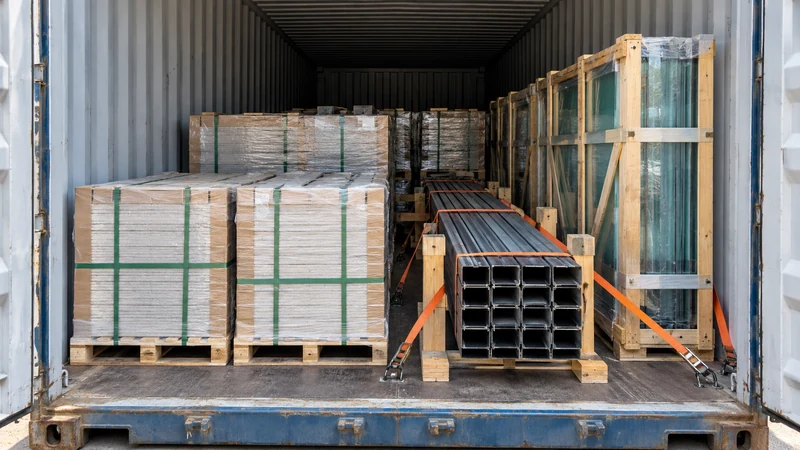
Construction materials can suffer damage during factory loading, terminal handling, ocean transportation, inland trucking, and final unloading.
Effective protection starts with identifying the product’s most likely failure points.
Ceramic Tiles: Prevent Cracking and Pallet Collapse
Ceramic and porcelain tiles are heavy but vulnerable to edge impacts and excessive pressure.
Packing should provide sufficient support for the intended handling and stacking arrangement.
Important precautions include using suitable pallets, maintaining stable carton alignment, protecting exposed corners, and preventing packages from shifting.
Importers should request confirmation of pallet gross weight, package stacking limitations, and any special handling instructions.
Before container loading, inspect cartons for visible crushing, torn packaging, unstable pallets, or signs of previous impact.
For large-format tiles, the supplier may need a more specialized support system than that used for smaller standard cartons.
Glass Panels and Stone Slabs: Control Support and Movement
Glass and stone products require careful attention to support geometry and movement.
Suitable A-frame arrangements or engineered crates may be appropriate for certain products, but the support system must match the dimensions, weight, and characteristics of the actual cargo.
Protect vulnerable edges and surfaces, confirm the lifting method, and ensure that the packed products are secured independently.
Do not assume that an A-frame is automatically suitable for every glass shipment.
The frame itself, its connection to the cargo transport unit, and the intended unloading equipment must be assessed.
Glass packages should not be positioned where adjacent steel or heavy pallets could strike or crush them during transportation.
Steel Materials: Prevent Corrosion, Abrasion, and Movement
Steel bars, pipes, sections, and fabricated metal products present risks involving both mass and surface condition.
Moisture exposure can lead to corrosion, while unrestrained metal sections may shift or damage adjacent cargo.
Depending on the product specification, appropriate protection may include corrosion-resistant wrapping, separators, suitable supports, and approved restraints.
Sharp steel edges should not directly contact fragile packaging or vulnerable container surfaces.
For long profiles and structural sections, confirm that support locations and lifting methods will not cause bending or deformation.
Moisture-Sensitive Doors, Boards, and Panels
Wood-based panels, finished doors, gypsum products, and some interior building materials may be vulnerable to moisture or condensation.
The packing plan should consider:
- Whether products are sufficiently dry before packing.
- The suitability of moisture barriers and protective wrapping.
- Whether desiccants are appropriate for the shipment.
- Protection against floor moisture and water ingress.
- Storage and inspection conditions before loading.
Avoid sealing already damp products in impermeable packaging, as this can trap moisture and create additional damage risks.
The empty container should also be checked for visible water ingress, unsuitable floor condition, or other defects before loading.
Check Wooden Pallets and Crates
Solid-wood pallets, crates, and dunnage may be subject to the phytosanitary treatment and marking requirements of ISPM 15.
However, the standard contains exemptions for certain categories of wood packaging, including some processed-wood materials.
Ask suppliers to identify the packaging materials used and provide applicable treatment or marking evidence. Confirm the specific requirements for the shipment rather than assuming every wooden or wood-based package needs identical treatment.
4. Consolidate Building Materials from Multiple Chinese Suppliers
A construction project may source ceramic tiles from one factory, sanitary ware from another, and doors, lighting accessories, or steel products from additional suppliers.
These products may be ready at different times, use different packaging methods, and require different loading equipment.
Without a coordinated cargo manifest and loading sequence, the consolidation process can introduce quantity discrepancies, unsuitable stacking, and unnecessary handling.
Standardize the Supplier Packing Information
Before suppliers dispatch their goods, request a common set of information.
Each supplier should provide the product description, SKU or model number, purchase order reference, number of packages, packed dimensions, gross weight, handling instructions, and expected cargo readiness.
For regulated or technically specified materials, obtain the relevant product specifications and compliance documents at the same stage.
Package markings should identify the corresponding product or purchase order.
A consolidated manifest should make it possible to trace each pallet or crate back to its supplier.
Check Compatibility Before Mixed Container Loading
Combining suppliers does not mean every available item should be loaded into one container.
The loading plan must consider both efficient space use and cargo compatibility.
Examples of potential conflicts include heavy tile pallets beside unsupported glass crates, sharp steel profiles beside finished panels, and moisture-sensitive products beside inadequately protected cargo.
Different materials may require physical separation, purpose-designed supports, protective barriers, or separate loading arrangements.
Construction chemicals such as adhesives, sealants, or coatings require additional screening before being accepted into a mixed shipment.
If the original packaging is inadequate, suitable repacking or reinforcement should be arranged before container stuffing.
Document the Loading Process with Verifiable Evidence
A multi-supplier shipment should have a traceable record from dispatch through final container sealing.
| Evidence stage | Records to collect | Purpose |
|---|---|---|
| Supplier dispatch | Package labels, counts, dimensions, gross weights | Establish supplier-level cargo details |
| Consolidation receipt | Receiving photos, quantity check, damage notes | Identify discrepancies before loading |
| Container loading | Cargo positions, stacking, separation, securing photos | Document the loading arrangement |
| Final verification | Reconciled packing list, container number, seal number | Confirm shipment identity |
| Destination handover | Package condition, shortages, damage observations | Support receipt and exception records |
Photographs should show enough detail to identify cargo units, including visible package markings where practical.
Record damaged packages, discrepancies, repacking work, and any adjustments to the approved loading plan.
Photographs are useful evidence but do not replace a proper cargo securing assessment or professional inspection when one is necessary.
Coordinate the Loading Sequence
Where goods are brought together at a suitable consolidation location, the loading sequence should be planned before the container arrives.
Heavy cargo may need to be loaded earlier to establish a safe arrangement, while fragile items may require dedicated protected positions.
However, the final sequence must reflect weight distribution, access, securing requirements, and the intended unloading process.
For example, materials needed first at the destination may not always be suitable for loading nearest the container doors. Safety and cargo compatibility take priority, and unloading sequence should be resolved through the overall plan.
Plan Building Materials Shipping
Preparing a mixed construction-material shipment? Contact Winsail Logistics with your supplier locations, product list, package dimensions, gross weights, and Tanzania delivery destination.
These details help establish what cargo consolidation, container loading, and destination delivery arrangements need to be evaluated.
5. Verify Tanzania HS Codes, TBS Requirements, and Import Eligibility
Building materials do not share one customs classification or one conformity procedure.
Ceramic tiles, steel bars, glass panels, bathroom fixtures, doors, adhesives, and coatings are classified according to their individual product characteristics.
Importers should complete product-specific checks before approving shipment.
Identify the Correct HS Code for Each Product
The Harmonized System classification depends on what the goods actually are, how they are manufactured, and the relevant tariff provisions.
For example, ceramic tiles may fall within HS heading 6907, while glass products are generally considered within Chapter 70. Steel classification can differ significantly between reinforcing bars, pipes, and fabricated structural products.
Bathroom products may also be classified differently depending on their material and function.
These are classification starting points, not definitive Tanzania import codes.
For each SKU, obtain:
- A precise commercial product description.
- Material composition and manufacturing details.
- Technical specifications and relevant dimensions.
- Intended use where classification depends on function.
- Supplier product literature and proposed HS classification.
The Tanzanian importer and qualified clearing agent should confirm the applicable tariff code against the current EAC/Tanzania tariff provisions.
Generic invoice descriptions such as “building materials” or “bathroom accessories” may be insufficient to support accurate classification.
Check Whether TBS PVoC Applies
The Tanzania Bureau of Standards (TBS) administers a Pre-shipment Verification of Conformity (PVoC) programme for specified categories of imported goods.
For products covered by the programme, the applicable conformity procedure and Certificate of Conformity (CoC) requirements must be addressed before shipment.
Not every construction product is automatically subject to the same CoC requirement.
The correct approach is to check the individual product against the current regulated HS list, relevant technical standards, programme procedures, and available exemptions.
TBS publishes official PVoC guidance and regulated-product information, including an HS-code list and a summarized procedure updated in August 2026.
For example, ceramic tile products and certain steel materials may be covered by relevant Tanzania standards, but the existence of a product standard alone does not establish the certification obligation for every shipment.
Prepare a Product-Level Compliance Checklist
| Product information | What to verify | Responsible review |
|---|---|---|
| Product description and specification | Accurate commercial identification | Importer and supplier |
| Tanzania HS code | Correct tariff classification | Importer and qualified CFA |
| Applicable TBS standard | Product-specific technical requirements | Supplier and compliance reviewer |
| PVoC coverage | Current regulated HS scope | TBS guidance / responsible reviewer |
| CoC or exemption procedure | Required documents and applicable pathway | Responsible certification party |
| Additional permit or restriction | Product-specific import controls | Importer and relevant authority |
For a mixed shipment, complete the review separately for each relevant product category.
Do not assume that a certificate issued for one type of construction material automatically covers a different product.
Check Construction Chemicals and Restricted Products
Adhesives, sealants, paints, waterproofing compounds, and other chemical preparations require closer examination.
Some may be ordinary general cargo, while others may have hazardous characteristics or require special transport or import controls.
Obtain the applicable Safety Data Sheet (SDS), product composition, intended use, and packaging specification.
Check whether dangerous-goods classification, carrier acceptance, additional permits, or product restrictions apply.
These controls cannot be determined solely from the commercial description “construction materials.”
Coordinate Customs Documents Before Arrival
For commercial imports into mainland Tanzania, the importer is generally required to appoint a licensed Clearing and Forwarding Agent (CFA).
Import documentation is processed through the Tanzania Customs Integrated System (TANCIS).
The official Tanzania import procedure identifies commercial invoices, packing lists, transport documents, agent authorization, and applicable permits among the supporting documents.
Product descriptions and quantities should remain consistent across the commercial invoice, supplier records, consolidated packing list, and applicable conformity documentation.
The importer should also confirm the legally responsible party for import declaration, duty and tax payment, and customs release.
Mainland Tanzania and Zanzibar should not be treated as identical compliance destinations. Zanzibar-bound products require a separate review of applicable Zanzibar Bureau of Standards (ZBS) procedures and other entry requirements.
6. Choose a Shipping Setup That Matches the Material Mix
Full container load (FCL) shipping can provide greater control over how heavy and fragile construction materials are arranged and secured.
However, an entire container is not automatically the best option for every order.
The decision depends on cargo dimensions, weight, packaging, handling requirements, and whether the shipment can be safely combined.
When to Evaluate a 20ft Container
A 20GP container may be worth evaluating for relatively dense and compact cargo, such as palletized ceramic tiles or certain steel products.
The key checks are total weight, concentrated loads, cargo distribution, and inland transport feasibility.
It should not be selected simply because the products are heavy.
When to Evaluate a 40ft or High-Cube Container
A 40GP or 40HC container may be suitable for bulky products such as doors, finished panels, bathroom cabinets, or certain mixed construction shipments.
The additional space can accommodate some larger packaging configurations, but it does not mean the container has proportionally greater cargo weight capacity.
The higher internal clearance of a high-cube container is useful only when the product dimensions and loading method justify it.
When to Consider LCL or Specialized Equipment
LCL may be appropriate for smaller, well-protected consignments that do not justify an entire container.
However, additional cargo handling during consolidation and deconsolidation must be considered, particularly for glass, ceramics, and other fragile products.
Long steel sections, oversized stone slabs, or unusually shaped construction components may require open-top, flat-rack, or other specialized arrangements, subject to carrier approval.
| Cargo profile | Shipping option to evaluate | Main decision factor |
|---|---|---|
| Heavy, compact tile pallets | 20GP FCL | Weight, floor loading, securement |
| Bulky bathroom products and doors | 40GP / 40HC FCL | Volume, dimensions, stacking |
| Small, properly protected hardware shipment | LCL | Handling exposure and chargeable volume |
| Large glass or long steel sections | Standard or specialized equipment | Dimensions, lifting and restraint feasibility |
| Mixed heavy and fragile construction goods | FCL with reviewed loading plan | Compatibility and load distribution |
For a broader comparison of ocean transport arrangements, see our sea freight from China to Tanzania guide.
For standard container booking, stuffing, shipping documentation, and container release procedures, consult our FCL shipping from China to Tanzania guide.
7. Plan Inland Delivery and Unloading at the Construction Site

For construction projects, arriving at Dar es Salaam Port does not mean the shipment can immediately reach the building site.
The final delivery may involve inland trucking to Dar es Salaam construction areas or destinations such as Dodoma, Morogoro, Arusha, Mwanza, or other project locations.
Road access, unloading arrangements, and the receiving site’s condition need to be confirmed in advance.
Check Road Access Before Dispatching the Truck
A construction site may have restricted access, unfinished road surfaces, limited turning space, or ground conditions unsuitable for a loaded container vehicle.
Before scheduling delivery, confirm:
- The exact delivery address and accessible unloading point.
- Road width, turning space, and gate clearance.
- Bridges, vehicle restrictions, and any applicable axle-load limits.
- Ground conditions at the intended stopping and unloading positions.
- Site opening hours and receiving arrangements.
- Whether the container can remain on the truck during unloading.
- Whether an alternative vehicle or intermediate cargo transfer is necessary.
Conditions can change during construction, particularly after roadworks or heavy rainfall.
Obtain current site information from the receiving contractor rather than relying exclusively on a map or address.
Match the Unloading Method to the Materials
Different cargo types require different unloading arrangements.
Palletized tiles: Confirm forklift capacity, access to the packages, and safe operating conditions. The lifting equipment must be suitable for the pallet weight and actual unloading position.
Steel bars and structural sections: Verify lifting points, bundle stability, suitable lifting accessories, and the available crane or other handling equipment.
Glass panels and stone slabs: Confirm that the receiving team can handle the product’s frame or crate safely using appropriate lifting and support arrangements.
Sanitary ware and finished products: Arrange controlled unloading that protects fragile surfaces and avoids unnecessary stacking or impacts.
The equipment’s rated capacity alone is not sufficient. Its operating configuration, lifting reach, ground conditions, and safe working procedures must also be appropriate.
Confirm Who Is Responsible for Unloading
A door-to-door shipping quotation does not automatically include unloading at the construction site.
Before accepting the arrangement, clarify who will provide the forklift or crane, unloading labor, site supervision, and the necessary handling equipment.
The contract should also address waiting time, unsuccessful delivery attempts, and responsibility for the empty container after unloading.
Under Incoterms 2020, DAP generally requires the seller to deliver the goods ready for unloading at the named destination, without making unloading the seller’s standard obligation.
Under DPU, the seller’s delivery obligation includes unloading at the named place.
DDP concerns the seller’s import clearance and duty-related responsibilities in addition to delivery obligations. A DDP arrangement must also be legally workable for the importer and seller concerned. It should not be treated as synonymous with ordinary door-to-door freight.
The named delivery location and specific service inclusions should be stated clearly in the commercial and transportation agreements.
Pro Tip — Confirm the Actual Unloading Position
Before the truck leaves the port or inland depot, ask the site manager to confirm the unloading position, ground condition, lifting equipment, vehicle access, and receiving personnel. This can prevent avoidable delivery failures and unsafe handling.
8. Complete the Pre-Shipment and Delivery Checklist
The final stage of planning is verifying that loading, documents, and destination arrangements are consistent.
A construction-material shipment should pass three practical checkpoints.
Before Container Loading
Confirm that every supplier has submitted a final packing list with accurate product descriptions, package counts, dimensions, and gross weights.
Check that the container selection, cargo securing plan, protective packaging, and handling equipment are suitable.
Resolve applicable TBS, import eligibility, and certification questions before shipment. Where a pre-shipment conformity procedure is required, complete it in accordance with that procedure.
Supplier readiness should not be treated as confirmation that the cargo is ready for export.
Before Container Departure
Reconcile the loaded cargo against the consolidated packing list.
Check the container number, seal number, final quantities, loading records, securing evidence, and any discrepancies.
Ensure that the VGM and transport documentation are prepared through the appropriate parties.
Confirm that the Tanzanian importer and licensed clearing agent have the information needed for import processing.
At Construction-Site Delivery
The receiving party should check package counts and visible condition before completing the delivery handover.
Any visible damage, shortage, or discrepancy should be recorded promptly, supported by photographs where appropriate.
Retain the delivery receipt, exception records, supplier packing information, and relevant insurance documents.
If cargo insurance applies, follow the policy’s notification, evidence, and claims procedures.
The objective is to maintain a traceable record from the Chinese supplier to the receiving construction site.
Plan Building Materials Shipping with Winsail Logistics
Shipping building materials from China to Tanzania requires coordinating several decisions before the cargo leaves the factory.
Container weight and space must be assessed together. Fragile materials need suitable protection, multiple suppliers need consistent documentation, and the receiving site must be prepared for the actual delivery and unloading requirements.
Winsail Logistics can review your shipment information and discuss available transportation arrangements based on the cargo and destination requirements.
Plan Building Materials Shipping
To prepare an effective enquiry, provide your material list, supplier locations, package dimensions, gross weights, destination city, and construction-site unloading information.
The more complete the shipment data, the easier it is to identify the loading, compliance, and delivery arrangements that require confirmation.
Important Shipping and Compliance Notice
This guide provides general cargo preparation, transportation, and import planning information for commercial construction materials entering mainland Tanzania.
Actual container acceptance, cargo securing requirements, HS classification, conformity certification, customs procedures, inland transport restrictions, and unloading arrangements depend on the shipment and applicable rules. Final requirements should be confirmed with the responsible carrier, qualified loading specialists, Tanzanian importer or licensed clearing agent, and relevant authorities before shipment.
FAQ
Can I combine ceramic tiles, glass panels, and sanitary ware in one container?
Yes, these products may be combined when their weights, dimensions, packaging, and handling requirements are compatible. Heavy tile pallets must not expose glass or sanitary ware to crushing, impact, or uncontrolled movement. The load plan should address separation, weight distribution, restraints, and unloading sequence, based on the actual cargo.
What if my Chinese supplier provides CBM but no gross pallet weights?
Request the packed gross weight of each pallet or crate, together with package counts, dimensions, and stacking limits. CBM measures volume but does not establish cargo mass or floor-loading requirements. The final packed-container VGM must still be obtained using an authorized method.
Do all construction materials require a TBS Certificate of Conformity?
No single CoC requirement should be assumed for every construction material. PVoC obligations depend on the current regulated scope, the product's HS classification, applicable standards, and any exemptions. Ceramic tiles, glass, steel, sanitary fixtures, and other goods must be checked individually before shipment.
Can a container truck deliver directly to an unfinished construction site in Tanzania?
Direct delivery may be possible if the road, vehicle configuration, site entrance, ground conditions, and unloading facilities are suitable. Narrow roads, turning restrictions, weak ground, or missing unloading equipment may require an approved alternative delivery point or cargo transfer arrangement.
Who pays for the crane, forklift, and unloading at the construction site?
Responsibility depends on the agreed delivery terms and service scope. Door-to-door shipping does not automatically include unloading equipment or labor. The parties should agree who provides and pays for the crane, forklift, labor, waiting time, and any additional site handling before shipment.
