
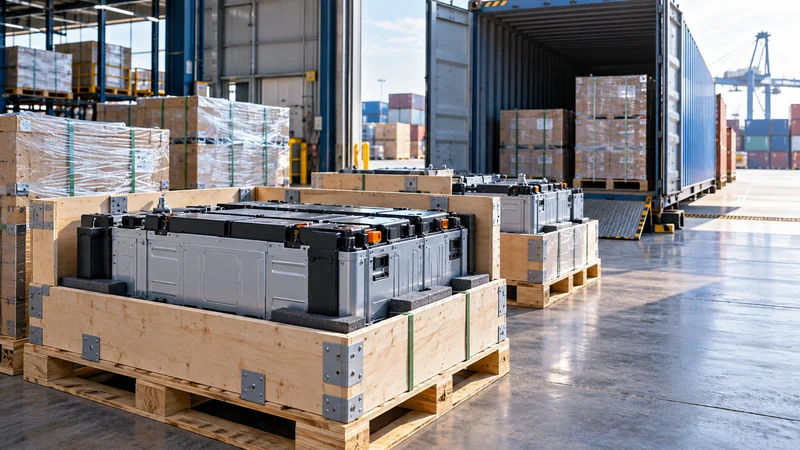
Shipping lithium batteries from China to Tanzania requires more preparation than arranging ordinary commercial cargo. Whether you import rechargeable battery packs, power banks, lithium batteries for electronic devices, or energy storage systems, the first question is not how much freight will cost. It is whether your specific battery shipment can meet the applicable transport requirements and be accepted by the carrier.
Lithium batteries present fire and thermal-runaway risks during transportation. Their classification, packaging, documentation, and acceptance conditions depend on battery chemistry, design, capacity, shipping configuration, and transport mode.
This guide explains how Tanzania importers can identify the relevant requirements, prepare battery documentation, compare air and sea freight restrictions, and arrange an acceptance review before shipping.
Quick Answer: Can You Ship Lithium Batteries from China to Tanzania?
Shipping lithium batteries from China to Tanzania is possible when the specific cargo meets applicable safety, documentation, packaging, and carrier requirements. The battery chemistry and shipping configuration determine the UN classification and transport restrictions. Importers should prepare model-matched UN38.3 evidence, battery specifications, and relevant declarations, then check airline or shipping-line acceptance and Tanzania import compliance. A freight quotation alone does not confirm that the batteries are approved for transport.
Data Note — October 2026: This guide references the IATA Dangerous Goods Regulations (67th Edition, 2026), the IMDG Code incorporating Amendment 42-24, and published Tanzania Bureau of Standards (TBS) and import procedures. Requirements may differ by battery type, packing instruction, carrier, route, and importing jurisdiction. Classification and acceptance must be confirmed for the actual shipment by appropriately qualified personnel and the relevant carrier.
1. Identify the Lithium Battery Type and Shipping Configuration
Correct classification is the starting point for lithium battery shipping. A product described commercially as a “rechargeable battery,” “battery module,” or “power supply” does not provide enough information to determine its transport requirements.
The supplier must identify both the battery chemistry and how the batteries will be presented for transportation.
Lithium-Ion vs Lithium-Metal Batteries
The two main lithium battery categories used in transport classification are:
Lithium-ion batteries are generally rechargeable batteries. They include lithium-polymer and lithium iron phosphate (LiFePO4) technologies and are commonly used in laptops, power banks, industrial equipment, and energy storage systems.
Lithium-metal batteries generally contain lithium metal or lithium alloy and are often non-rechargeable. They are used in certain electronic instruments, sensors, medical devices, and other specialized applications.
These categories have different UN entries and may have different aircraft restrictions, packaging instructions, and technical limits.
For lithium-ion batteries, the watt-hour (Wh) rating is an important technical parameter. It can generally be cross-checked using:
Watt-hours (Wh) = Nominal Voltage (V) × Rated Capacity (Ah)
For lithium-metal batteries, lithium content is an important classification parameter.
The manufacturer’s rated specifications should always be used when preparing the transport documents. A calculated value is useful for checking consistency but does not replace official product specifications.
Standalone Batteries vs Batteries Packed with or Contained in Equipment
The physical shipping arrangement can change the UN classification even when the underlying battery is identical.
There are three main configurations:
- Standalone batteries: Cells or batteries shipped separately, without the equipment they are designed to power.
- Batteries packed with equipment: Batteries packed in the same package as compatible equipment but not installed in it.
- Batteries contained in equipment: Batteries installed inside the equipment they power.
The following table summarizes the main classifications.
| Battery Configuration | Lithium-Ion UN Number | Lithium-Metal UN Number | Air Packing Instruction |
|---|---|---|---|
| Batteries shipped alone | UN3480 | UN3090 | PI965 / PI968 |
| Batteries packed with equipment | UN3481 | UN3091 | PI966 / PI969 |
| Batteries contained in equipment | UN3481 | UN3091 | PI967 / PI970 |
These are classification references, not shipment approvals. The applicable packing-instruction section, special provisions, and carrier conditions must also be established.
For example, a replacement lithium-ion battery shipped separately from an electronic device is generally classified as UN3480. If the battery is genuinely packed with the equipment it is designed to power, UN3481 packed with equipment may apply.
However, placing a battery beside a charger, cable, or power adapter does not automatically make it a battery packed with equipment.
The distinction is particularly important for power banks, spare batteries, and consumer electronics accessories.
Battery Form, Documentation and Potential Shipping Restrictions
| Battery Form | Typical Products | Information Required | Potential Transport Restrictions |
|---|---|---|---|
| Standalone lithium-ion | Battery packs, replacement batteries, power banks | UN38.3 evidence, Wh rating, SOC, net battery weight, packaging details | Air cargo restrictions, SOC limits, carrier approval |
| Lithium-ion packed with equipment | Equipment and separate compatible battery | Battery model, equipment details, Wh rating, quantity, SOC | PI966 requirements, applicable SOC restrictions |
| Lithium-ion contained in equipment | Laptops, electronic instruments, powered tools | Battery specifications, installed configuration, quantity | PI967 provisions, packaging and operator requirements |
| Standalone lithium-metal | Primary lithium batteries | Lithium content, test evidence, net weight | Strict aircraft restrictions and carrier acceptance |
| Lithium-metal with/in equipment | Devices containing primary lithium cells | Battery specifications, equipment configuration | PI969/970 requirements and conditional exceptions |
| Lithium-powered vehicles | Certain electric vehicles and industrial vehicles | Vehicle type, battery specifications, condition | Dedicated vehicle classifications and carrier restrictions |
| Used or damaged batteries | Returned, defective or recycling-bound batteries | Condition report, battery details, intended purpose | Additional restrictions or transport prohibition |
Important: A battery qualifying for a conditional exception under one transport regulation is not automatically accepted as ordinary cargo. No battery shipment should be described as universally “non-DG” without confirming the exact applicable conditions.
Special Cases: Energy Storage Batteries and Battery-Powered Vehicles
Importers of solar energy storage batteries should pay particular attention to the distinction between a standalone battery module and a complete energy storage product.
A lithium battery module shipped as a separate product may fall under UN3480, even when the importer intends to install it into a solar storage system after arrival.
A finished device containing installed batteries requires a different assessment. The supplier must provide enough technical information to determine whether the product genuinely qualifies as equipment containing batteries.
Battery-powered vehicles also require separate consideration. Depending on the vehicle and battery chemistry, classifications such as UN3556 for lithium-ion battery-powered vehicles or UN3557 for lithium-metal battery-powered vehicles may apply.
Used batteries, batteries recalled for safety reasons, and batteries showing signs of damage must not be treated as normal new batteries. Their condition may substantially restrict or prevent transportation.
2. What Battery Documents Must Be Ready Before Booking?
Incomplete or inconsistent battery documentation is a common reason that a shipment cannot proceed to carrier acceptance.
Importers should request the technical information from their Chinese supplier before the goods are delivered to a freight warehouse.
Battery Specifications: Wh, Net Weight and State of Charge
A useful battery specification file should identify:
- Battery manufacturer and exact model number.
- Cell manufacturer and model, where relevant.
- Battery chemistry and configuration.
- Nominal voltage and rated capacity.
- Watt-hour rating for lithium-ion batteries.
- Lithium content for lithium-metal batteries, where applicable.
- Number of batteries or cells per package.
- Net mass of batteries per package.
- Gross package weight and dimensions.
- State of charge (SOC), where relevant.
- Battery condition and available product photographs.
Net battery weight and gross carton weight are different measurements.
For example, a carton containing several battery modules, protective packaging, and accessories has a gross weight that includes all those materials. The net battery mass identifies the weight of the relevant batteries themselves.
Accurate quantities and weights are necessary because the applicable packing instructions and dangerous-goods declarations may impose package-specific limits.
UN38.3 Test Summary vs Full Test Report
UN38.3 refers to transport testing requirements under the UN Manual of Tests and Criteria.
The tests address hazards associated with transporting lithium cells and batteries, including conditions related to altitude, temperature, vibration, shock, and other specified tests.
For battery types subject to these requirements, manufacturers and subsequent distributors must make the relevant UN38.3 test summary available.
A test summary normally contains identifying information about the battery type, manufacturer, testing organization, test report references, and confirmation of testing against the applicable requirements.
It should not be confused with the full laboratory test report.
Importers should check that the summary can be matched to the battery actually being shipped, including its manufacturer, model, and relevant technical characteristics.
A supplier providing a report for a different battery model does not establish compliance for the product in the shipment.
The test summary does not automatically expire after a fixed number of years. However, material design changes may require reassessment or additional testing.
Under IATA guidance, a copy does not necessarily have to accompany every shipment, although a State, airline, or other operator may require one. The document must be accessible when required.
Pro Tip — Verify the Exact Battery Model
Before accepting a supplier’s test documentation, compare the battery model, rated capacity, manufacturer details, and physical markings against the UN38.3 evidence. If the documents refer to a different battery type, resolve the discrepancy before requesting carrier approval.
Is an MSDS or SDS Enough?
A Safety Data Sheet (SDS), sometimes called an MSDS, provides information about material hazards and handling precautions.
However, an SDS is not a substitute for the relevant UN38.3 evidence, correct transport classification, or required dangerous-goods documentation.
The IATA DGR does not universally require an SDS for lithium battery articles offered for transportation. Nevertheless, individual carriers and other parties in the supply chain may request an SDS or additional technical documentation as part of their acceptance procedures.
Importers should therefore prepare the available SDS but avoid assuming that possessing one is sufficient to ship.
Battery Shipping Document Checklist
| Document or Evidence | Main Responsible Party | What Must Be Verified |
|---|---|---|
| Battery specification sheet | Manufacturer / Supplier | Correct chemistry, model, capacity, and weight |
| UN38.3 test summary | Manufacturer / Distributor | Applicable tested battery type and accessible evidence |
| Full UN38.3 test report | Manufacturer / Testing organization | Available when specifically required |
| SDS / MSDS | Manufacturer / Supplier | Consistent product details; provided when requested |
| SOC information | Manufacturer / Shipper | Compliance with applicable air restrictions |
| Transport classification | Shipper / Qualified specialist | Correct UN entry and applicable provisions |
| Packaging information | Shipper / Packer | Package design, quantities, protection and marks |
| Dangerous-goods declaration | Qualified shipper / Authorized signatory | Required where the applicable regulations specify |
| Commercial invoice and packing list | Exporter / Importer | Consistent description, quantity, and weight |
| TBS conformity documentation | Importer / Authorized conformity-assessment provider | Required only where the actual product falls within the applicable programme |
Not every document is universally mandatory for every battery shipment. The exact requirements depend on the battery classification, transport mode, applicable regulatory provisions, and carrier conditions.

3. Can Lithium Batteries Be Shipped by Air from China to Tanzania?
Air freight may be considered for certain lithium battery shipments, but regulatory compliance alone does not mean that an airline will accept the cargo.
The shipment must satisfy the relevant air dangerous-goods provisions, and the operating airline must accept the exact battery configuration and routing.
IATA DGR Classification and Aircraft Restrictions
The IATA Dangerous Goods Regulations provide a framework for classification, packing, marking, labelling, documentation, and handling of dangerous goods by air.
For lithium batteries, the applicable packing instruction depends on whether the batteries are shipped alone, packed with equipment, or contained in equipment.
Standalone lithium-ion batteries under UN3480 are ordinarily restricted to cargo aircraft, subject to the specific regulatory approval provisions.
Standalone lithium-metal batteries under UN3090 are also generally forbidden as cargo on passenger aircraft except under applicable special approval or exemption provisions.
Other battery configurations may have different aircraft and package restrictions.
This means that an importer cannot determine air eligibility solely from the battery’s size or declared value.
A small shipment of replacement batteries may face different restrictions from a similar battery already installed in equipment.
State of Charge Requirements for Air Transport in 2026
State of charge is particularly important for lithium-ion batteries.
The requirements are not identical for all battery configurations.
| Battery Presentation | Relevant Air Provision | 2026 SOC Treatment |
|---|---|---|
| Standalone lithium-ion batteries | UN3480 / PI965 | Maximum 30% SOC under ordinary applicable provisions; higher SOC requires the specified approvals |
| Lithium-ion batteries packed with equipment | UN3481 / PI966 Section I | Maximum 30% SOC; higher SOC requires the specified State approvals |
| Lithium-ion batteries packed with equipment | UN3481 / PI966 Section II | Batteries or cells exceeding 2.7 Wh are subject to the maximum 30% SOC requirement, with the specified approval route for higher SOC |
| Lithium-ion batteries contained in equipment | UN3481 / PI967 | Reduced SOC is recommended in IATA’s 2026 guidance rather than universally mandatory under this provision |
For batteries contained in equipment under PI967, the guidance recommends a maximum 30% SOC or an indicated battery capacity not exceeding 25%.
A recommendation should not be confused with a mandatory requirement. However, individual airlines may impose stricter acceptance conditions.
Likewise, batteries above an applicable SOC limit cannot simply be shipped by declaring a higher charge. Relevant State approvals and written conditions must be satisfied where such a route is available.
Importers should obtain SOC information from the battery manufacturer and verify the applicable rule for their exact product.
For regulatory details, refer to the IATA Battery Guidance Document for 2026.
Airline, Transit and Destination Acceptance
For lithium battery air freight to Tanzania, the proposed route may involve several separate acceptance decisions.
These can include:
- Acceptance by the airline operating the departure flight.
- Compliance with the relevant State and operator variations.
- Acceptance through any connecting airport or transfer carrier.
- Dangerous-goods handling capability at the relevant facilities.
- Acceptance and import arrangements at the Tanzania destination.
Dar es Salaam’s Julius Nyerere International Airport (DAR) and Kilimanjaro International Airport (JRO) are relevant airports for Tanzania import planning. However, their use for general air cargo does not establish lithium battery acceptance on a specific route.
The actual operating airline, transit arrangement, handling provider, and destination conditions must be confirmed.
Courier restrictions are also important. A carrier may offer regular parcel delivery to Tanzania without offering the corresponding dangerous-goods service.
For example, destination-specific courier dangerous-goods service guides may exclude Tanzania from particular standard services. Such restrictions must be checked with the individual courier and cannot be generalized across all airlines.
Importers considering ordinary commercial air freight can also review our air freight from China to Tanzania guide. Battery shipments require an additional specialist acceptance assessment beyond the general air freight process.
When Air Freight May Not Be Available
Air freight may be unsuitable or unavailable when:
- The battery type cannot be correctly identified.
- Required UN38.3 evidence is unavailable.
- The shipment does not meet the applicable packing instruction.
- SOC exceeds an applicable limit without the required approvals.
- The operating airline does not accept the relevant classification.
- The proposed transit or destination handling arrangement cannot support the shipment.
- The battery is damaged or defective in a way that creates a dangerous heat, fire, or short-circuit risk.
Lithium batteries identified as safety-defective, with the potential for dangerous heat generation, fire, or short circuit, are forbidden for air transport under the applicable provisions. Repacking them does not automatically remove that prohibition.
If a shipment fails an air acceptance review, the next step is to identify why. Sea freight may be evaluated separately where legally permissible, but it is not an automatic alternative for prohibited or unsafe cargo.
4. How Does Sea Freight Acceptance Work for Lithium Batteries?
Sea freight is another potential transport option for lithium batteries, including certain commercial battery packs and industrial energy storage products.
However, these goods must still be evaluated under the maritime dangerous-goods framework and the acceptance requirements of the relevant shipping line.
IMDG Code Requirements
The International Maritime Dangerous Goods Code (IMDG Code) governs the transport of dangerous goods in packaged form by sea.
The consolidated IMDG Code incorporating Amendment 42-24 became mandatory on January 1, 2026.
The Code addresses classification, packaging, marking, labelling, documentation, stowage, segregation, and other transport requirements.
A properly classified battery shipment must be assessed against its applicable UN entry, Dangerous Goods List provisions, and any relevant special provisions.
The International Maritime Organization’s 2026 regulatory update confirms the effective date of Amendment 42-24.
Does IMDG Special Provision 188 Mean Batteries Are Non-DG?
Special Provision 188 provides conditional relief from certain dangerous-goods requirements for qualifying lithium cells and batteries.
However, the relief applies only when the shipment meets the relevant conditions.
Those conditions can involve battery specifications, UN38.3 compliance, protection against short circuits, appropriate packaging, and other applicable requirements.
A shipment that qualifies under SP188 should not automatically be described as ordinary general cargo.
Shipping lines may require battery cargo to be disclosed and approved even when particular regulatory relief applies.
For example, in an advisory issued through its India office on October 7, 2026, CMA CGM required disclosure of lithium-ion battery cargo, including shipments covered by SP188, and instructed customers to obtain the relevant approval before container gate-in.
That advisory illustrates the importance of checking carrier-specific requirements. Its applicability to a particular China-origin booking must be confirmed with the relevant carrier office.
Importers should never conceal batteries inside a general cargo description or assume that a supplier’s “non-DG” statement guarantees shipping-line acceptance.
FCL vs LCL for Lithium Battery Cargo
A Full Container Load (FCL) and a Less than Container Load (LCL) are different cargo arrangements. Neither automatically changes the dangerous-goods classification.
FCL shipping may be considered when the importer has a larger volume of batteries or a shipment requiring dedicated container planning.
Carrier approval, correct packaging, container loading, and relevant dangerous-goods documentation may still be required.
LCL shipping involves consolidation with cargo from other shippers. For battery shipments, acceptance can depend on the shipping line, consolidator, container freight station, cargo compatibility, and applicable stowage restrictions.
An LCL operator accepting general electronics does not necessarily accept standalone lithium batteries.
Before choosing FCL or LCL, confirm whether the actual battery classification can be accommodated throughout the proposed route.
China Export and Dar es Salaam Handling
A China-to-Tanzania sea shipment may involve origin handling, vessel loading, transshipment, discharge, and destination release.
Battery acceptance should cover the operational chain rather than only the first loading port.
Importers should confirm:
- Whether the shipping line accepts the cargo classification.
- Whether the proposed loading and transshipment arrangements allow the shipment.
- Which documents must be submitted before the booking cut-off.
- Whether additional packaging or container documentation is required.
- Whether the destination terminal and handling arrangements are suitable.
- Whether the Tanzania importer has the necessary clearance documentation.
A confirmed general-cargo sailing or container rate is not evidence that the same service will accept lithium batteries.
Pro Tip — Obtain Written Acceptance Before Cargo Handover
Request a written carrier decision for the actual cargo description, UN classification, packaging, and routing before delivering the shipment to the export warehouse or terminal. A preliminary freight quotation is not dangerous-goods acceptance.
5. Packaging, Marks, Labels and Dangerous Goods Declarations
Proper packaging helps prevent short circuits, unintended activation, physical damage, and other transport hazards.
The correct packaging method depends on the battery type, applicable packing instruction, and transport mode.
Protecting Cells, Terminals and Equipment
For relevant battery configurations, packaging requirements may address:
- Protection against short circuits and contact with conductive materials.
- Secure placement of batteries within inner and outer packaging.
- Protection from movement and physical damage.
- Prevention of unintended equipment activation.
- Appropriate package strength and protection.
- Quantity and net-mass limits where applicable.
- Correct handling of overpacks and consolidated packages.
Batteries installed in equipment may require protection against accidental activation and damage during transportation.
Standalone batteries may require different internal packaging and terminal-protection arrangements.
Importers should ensure that packaging is reviewed against the applicable regulation, rather than using a generic carton design without confirming its suitability.
Lithium Battery Marks and Class 9 Labels
Battery packages may require different forms of hazard communication.
These can include lithium battery marks, Class 9 lithium battery hazard labels, Cargo Aircraft Only labels, UN numbers, proper shipping names, and other transport markings.
The requirements are not identical for every shipment.
For example, certain qualifying shipments under applicable Section II provisions have different marking requirements from fully regulated Section I shipments.
Some contained-in-equipment shipments may qualify for specific marking exceptions when the stated conditions are satisfied.
A package should not display every possible dangerous-goods label simply as a precaution. It must carry the marks and labels required for its correct classification and packing instruction.
Incorrect labels can create documentation conflicts and cause acceptance problems.
Air vs Sea Packaging and Declaration Checks
| Requirement | Air Freight | Sea Freight |
|---|---|---|
| Main regulations | IATA DGR / applicable ICAO provisions | IMDG Code |
| Packing requirements | Applicable IATA packing instruction | Applicable IMDG packing provisions |
| Package marks and labels | Determined by classification and packing-instruction section | Determined by IMDG classification and special provisions |
| Dangerous-goods declaration | Required for applicable regulated shipments | Required according to applicable maritime provisions |
| Container packing certification | Not generally the same process as sea container certification | Required where applicable |
| Carrier acceptance | Airline and routing-specific | Shipping-line, route and terminal-specific |
For applicable fully regulated air shipments, the shipper’s dangerous-goods declaration must be prepared and signed in accordance with the relevant requirements by appropriately qualified personnel.
Maritime shipments may require a dangerous-goods transport document and, where applicable, container or vehicle packing certification.
The commercial invoice and packing list do not replace these documents.

6. Tanzania Import Requirements: TBS, TRA and Local Handling
Transport compliance is only one part of importing lithium batteries into Tanzania.
An airline or shipping line may accept a shipment for transport while the importer still needs to satisfy separate customs, standards, and product-specific import requirements.
Do Lithium Batteries Require TBS PVoC and a CoC?
The Tanzania Bureau of Standards (TBS) administers a Pre-shipment Verification of Conformity (PVoC) programme for regulated imported products.
For products within the programme, conformity assessment is intended to verify compliance with applicable standards before shipment.
A Certificate of Conformity (CoC) may be required as part of the import process.
However, the correct determination depends on the actual product, HS classification, and current regulated-product scope.
Lithium battery products may include:
- Primary lithium cells.
- Rechargeable lithium-ion accumulators.
- Battery modules and packs.
- Batteries integrated into electrical equipment.
- Finished products containing lithium batteries.
These products should not automatically be assigned the same HS code or conformity treatment.
Before shipping, the Tanzania importer should check the applicable HS classification against the current TBS regulated-products list and confirm whether PVoC, a CoC, or another conformity route applies.
The TBS Pre-shipment Verification of Conformity programme provides official programme information and references to regulated HS codes and exemptions.
Important: UN38.3 and a TBS CoC serve different purposes. UN38.3 concerns transport testing, while TBS conformity assessment concerns applicable product standards and import compliance. One does not replace the other.
TRA Customs Clearance and TANCIS
Tanzania’s import procedures generally require the importer to appoint a licensed Clearing and Forwarding Agent (CFA).
The agent handles the relevant customs declarations through the Tanzania Customs Integrated System (TANCIS).
For battery shipments, the importer should prepare:
- Commercial invoice with an accurate product description.
- Packing list showing quantities, dimensions, and weights.
- Bill of Lading or Air Waybill.
- Correct HS classification.
- Applicable conformity and import-permit documentation.
- Importer and consignee information.
- Authorization for the licensed clearing agent.
- Additional product-specific documentation where required.
The product description used for customs clearance should be consistent with the actual goods and should not contradict the transport documentation.
Customs may assess the declared classification and value, request supporting evidence, or conduct inspections.
Import duties, VAT, and other applicable charges depend on the actual HS classification, customs value, prevailing legislation, and any relevant relief or additional requirements.
There is no universal import-duty rate that should be quoted for every product described as a lithium battery.
For the complete declaration and cargo-release workflow, see our guide to customs clearance in Tanzania.
Mainland Tanzania vs Zanzibar
Importers should also distinguish Mainland Tanzania from Zanzibar.
Mainland imports may fall within the TBS regulatory framework, while Zanzibar operates its own standards and conformity-assessment arrangements through the Zanzibar Bureau of Standards (ZBS).
A shipment destined for Zanzibar should therefore undergo a separate review of the relevant conformity requirements, entry arrangements, and applicable customs procedures.
Do not assume that a conformity document issued for one procedure automatically satisfies every requirement of the other jurisdiction.
Used Batteries and Recycling Cargo
Used batteries require additional attention because their physical condition and intended purpose can affect both transport classification and import controls.
A working second-hand battery, a defective battery returned for repair, and a battery sent for recycling are not necessarily treated alike.
Importers should disclose the battery’s condition and intended use before arranging transport.
Batteries classified as waste or destined for disposal or recovery may be subject to additional environmental and cross-border movement controls.
Do not proceed on the assumption that ordinary commercial import documents are sufficient for such cargo.
7. From Document Review to Carrier Acceptance: A Five-Step Process
A structured pre-booking review can identify missing evidence and transport restrictions before cargo is delivered to the export warehouse.
Step 1: Collect the Battery Information
Ask the Chinese manufacturer for the exact battery specification sheet, product photographs, available UN38.3 evidence, and packaging information.
Confirm the battery model, chemistry, rated capacity, quantity, condition, SOC where applicable, and shipping configuration.
Do not proceed with a classification based only on a commercial product name.
Step 2: Confirm the Dangerous-Goods Classification
Have appropriately qualified personnel determine the applicable UN entry, proper shipping name, packing instruction or maritime provisions, and any relevant exceptions.
If the shipment includes batteries with equipment or battery-powered vehicles, make sure the actual physical arrangement is assessed.
Where the classification remains uncertain, obtain clarification before requesting a final booking.
Step 3: Review Tanzania Import Compliance
Ask the Tanzania importer or appointed licensed CFA to check the intended HS classification and applicable product conformity requirements.
Confirm whether TBS or other competent-authority documentation is required and whether it must be arranged before export.
Keep transport documentation and customs requirements separate, while ensuring that the information is consistent.
Step 4: Request Carrier Acceptance
Submit the confirmed classification and supporting information to the proposed airline or shipping line.
The review should cover the specific operating carrier, transport mode, routing, packaging, and any State or operator restrictions.
The carrier may approve the shipment subject to conditions, request additional evidence, or decline acceptance.
A different route may be assessed if it is lawful and operationally suitable, but alternative availability should never be assumed.
Step 5: Confirm the Booking Before Handover
Once the carrier has issued the relevant acceptance or booking instructions, check that the physical shipment matches the approved information.
Confirm the final package count, battery models, marks, labels, documents, and cargo-ready condition.
Do not change the battery configuration, packaging or quantity after approval without determining whether renewed review is required.
What If the Shipment Is Not Ready?
| Review Outcome | What It Means | Recommended Action |
|---|---|---|
| More information required | Technical data or documents are incomplete | Request missing manufacturer evidence |
| Specialist review required | Classification, condition, or packaging requires further assessment | Refer to qualified DG personnel and the relevant carrier |
| Carrier approval pending | The shipment has been submitted but not accepted | Do not treat a quotation or submission as approval |
| Written acceptance obtained | The relevant carrier has accepted the specified shipment subject to its conditions | Verify compliance with those conditions before handover |
Check Battery Freight Acceptance
Have your battery specifications, UN38.3 evidence, and proposed Tanzania destination reviewed before arranging cargo handover in China. Winsail Logistics can assess the information provided and help coordinate a shipment-specific freight feasibility inquiry, subject to applicable regulations and carrier acceptance.
8. What to Include in a Lithium Battery Freight Inquiry
A meaningful freight assessment requires more than the total cargo weight and destination.
The following information helps identify the transport requirements and determine which carrier arrangements may be considered.
Battery Freight Inquiry Checklist
| Information | Details to Provide |
|---|---|
| China origin | Supplier location, pickup city, and proposed export point |
| Tanzania destination | Arrival location and final delivery city |
| Product description | Commercial product name and intended use |
| Battery identification | Manufacturer, model, chemistry, and UN number if verified |
| Battery specification | Voltage, capacity, Wh rating or applicable lithium content |
| Shipping configuration | Standalone, packed with equipment, or contained in equipment |
| Battery condition | New, used, repaired, defective, or other relevant condition |
| Quantity | Number of cells or batteries per package and total shipment |
| Weight and dimensions | Battery net mass, gross package weight, and package dimensions |
| State of charge | SOC information where relevant |
| Technical documents | UN38.3 evidence, SDS if available, specifications, and photographs |
| Shipping preference | Air or sea freight, if preferred |
| Cargo readiness | Expected factory-ready date and packaging status |
Importers do not need to guess an unknown UN number. If classification has not yet been professionally confirmed, provide the manufacturer’s technical information and clearly identify the classification as pending.
What Determines Lithium Battery Freight Costs?
Lithium battery shipping costs depend on more than chargeable weight or container volume.
Possible cost components include:
- Classification and specialist documentation review, where applicable.
- Origin packaging and dangerous-goods handling.
- Air or ocean freight.
- Carrier-specific dangerous-goods charges.
- Terminal, warehouse, and handling charges.
- Customs clearance and applicable conformity procedures.
- Import duties and taxes.
- Inland transportation and destination delivery, where available.
Some battery shipments may require additional services or approvals that are not included in general-cargo freight quotations.
Without confirmed classification, packaging details, the proposed carrier, and the actual route, a fixed rate may be misleading.
Door-to-Door Shipping Is Not Automatically DDP
Door-to-door describes a delivery arrangement. It does not by itself establish who is responsible for import customs clearance or taxes.
DDP, or Delivered Duty Paid, is an Incoterms 2020 rule under which the seller assumes contractual responsibility for import clearance and applicable import duties and taxes.
For Tanzania imports, a DDP arrangement must also be legally workable, with the actual importing entity, licensed clearing agent, regulatory approvals, and payment responsibilities properly established.
Importers should not assume that a battery shipment qualifies for DDP simply because a service provider offers delivery to the consignee’s address.
Before accepting a door-to-door quotation, confirm what is included and who will complete the import formalities.
Check Battery Freight Acceptance
Importing lithium batteries, battery modules, or battery-powered equipment from China to Tanzania?
Share your supplier’s battery specifications, available test evidence, cargo quantities, packaging details, and intended destination with Winsail Logistics.
We can review the submitted shipment information and help assess potential freight arrangements before booking. Final eligibility depends on the applicable regulations, qualified dangerous-goods assessment, and written acceptance by the relevant carrier.
FAQ
Can lithium batteries shipped under IMDG Special Provision 188 travel as ordinary LCL cargo?
Not automatically. SP188 provides conditional relief from certain IMDG requirements when the specified conditions are met. However, the shipping line and LCL consolidator may still require disclosure, supporting documents, and approval. Some consolidators may not accept the particular battery configuration at all. Confirm the applicable classification and obtain acceptance for the actual LCL service before handing over the goods.
Is a power bank shipped with a charger classified as a battery packed with equipment?
Generally, no. Under IATA's classification guidance, packaging a lithium-ion battery with only a charger, adapter, or cable does not make it a battery packed with equipment. The equipment must be the device that the battery is designed to power. A power bank shipped with charging accessories may therefore remain classified as a standalone lithium-ion battery under UN3480. The complete product configuration must be reviewed.
Can I send standalone lithium-ion batteries to Dar es Salaam by express courier?
Only if the courier accepts the specific dangerous-goods classification, shipment configuration, and destination service under applicable regulations. Standalone lithium-ion batteries under UN3480 face strict aircraft restrictions, and many standard international parcel services do not accept them. A courier's ability to deliver ordinary parcels to Tanzania does not confirm lithium battery acceptance. Request service-specific confirmation before booking.
Can I use an old UN38.3 test summary if the battery model or capacity has changed?
Not without checking whether the evidence still applies to the current battery type. A UN38.3 test summary does not have a universal fixed expiration date, but changes in battery design or specifications may require reassessment or retesting. Ask the manufacturer to confirm that the actual battery model is covered by valid testing evidence. Do not submit an unrelated test report simply because the battery chemistry is similar.
Does a Tanzania TBS Certificate of Conformity replace lithium battery dangerous-goods documents?
No. A TBS Certificate of Conformity, where required, addresses applicable product conformity requirements for importation. It does not replace transport classification, UN38.3 evidence, packaging compliance, or dangerous-goods declarations required by the relevant transport regulations. Importers must check transport compliance and Tanzania import requirements separately. The applicable TBS or ZBS procedure depends on the product, HS classification, and importing jurisdiction.
Final Pre-Shipment Reminder
Before shipping lithium batteries from China to Tanzania, confirm four essential points:
- The product has been correctly classified using its actual battery chemistry, configuration, capacity, and condition.
- The technical documentation is consistent with the batteries and packaging presented for transportation.
- The airline or shipping line has accepted the specific shipment under the applicable regulatory and operational conditions.
- The Tanzania importer has confirmed the applicable customs and product-conformity requirements before dispatch.
The safest starting point is not choosing between air and sea freight. It is establishing whether the exact battery shipment can satisfy the relevant transport and import requirements.
For broader route planning, see our shipping from China to Tanzania guide.
Regulatory and Service Disclaimer: This article provides general shipping-planning information and does not constitute a formal dangerous-goods classification, transport certification, regulatory approval, or guarantee of carrier acceptance. Final requirements must be confirmed against the regulations in force, the shipment’s actual characteristics, applicable competent-authority conditions, and the operating carrier’s requirements. Winsail Logistics does not guarantee the availability of a particular lithium battery transport route or customs-clearance outcome.
