

Air freight from China to Tanzania is suitable for urgent spare parts, commercial samples, and inventory that cannot wait for ocean shipping. Guangzhou (CAN), Shenzhen (SZX), and Shanghai (PVG) are potential departure gateways, while Dar es Salaam (DAR) and Kilimanjaro (JRO) serve different delivery areas. The best route depends on available cargo space, shipment restrictions, and customs arrangements. Importers should compare quotes by chargeable weight and included services—not simply the advertised price per kilogram.
Data Note — October 2026: Airport and airline information was reviewed in October 2026. Published routes do not guarantee cargo space or direct service for a specific shipment. Freight rates, flight connections, handling charges, and delivery arrangements require confirmation before booking. Weight calculations below are illustrative, not carrier quotations.
Is Commercial Air Freight the Right Choice for Your Shipment?
Commercial air freight is worth considering when the financial consequences of delayed delivery exceed the additional transportation cost. This often applies to production-critical components, urgent replacement parts, and inventory needed to fulfill existing customer orders.
However, air freight is not always the fastest door-to-door option. Express couriers may provide simpler arrangements for small parcels, while sea freight generally offers better unit economics for larger shipments with flexible deadlines.
Air Freight vs Express Courier vs Sea Freight
| Shipping Method | Best-Fit Cargo | Billing Consideration | Customs & Delivery | Main Risk | Best Next Action |
|---|---|---|---|---|---|
| Commercial Air Freight | Urgent commercial goods and compact, higher-value cargo | Actual or volumetric weight, minimum charges, and surcharges | Import clearance and collection depend on the agreed service | Cargo capacity, connections, and airport release | Compare airport-to-airport and delivered quotations |
| Express Courier | Samples, documents, and eligible small parcels | Courier dimensional weight and service tariffs | Integrated delivery services, subject to import requirements | Size restrictions, customs exceptions, and surcharges | Obtain a full door-delivery quotation |
| Sea Freight | Large, heavy, or nonurgent commercial shipments | LCL weight/measurement or FCL container charges | Port clearance and inland delivery arrangements required | Longer lead times and port-related delays | Compare total landed cost |
There is no universal weight threshold at which air freight becomes cheaper than express. A compact shipment can have very different costs from a bulky shipment with the same gross weight.
Consider two practical situations:
- Urgent industrial spare parts: A Tanzanian factory needs replacement components to restart equipment. Commercial air freight may be justified if the cargo can be booked and released promptly.
- Small product samples: A buyer needs a few lightweight items for evaluation. Express courier may be easier if its delivered price and customs arrangements are suitable.
For broader comparisons, see our best shipping methods from China to Tanzania guide.
When Air Freight May Not Be the Fastest Door-to-Door Option
Air transportation reduces the international movement time, but it does not eliminate ground operations.
A shipment may still require supplier pickup, export screening, a connecting flight, import declaration, terminal release, and local transportation. Missing a cargo acceptance cutoff can also mean waiting for another available flight.
Before choosing air freight, ask for a realistic timeline from cargo readiness to final collection—not just the scheduled flying time.
Which Airports and Airline Routes Work for China–Tanzania Air Cargo?
Choosing the departure and arrival airports is one of the most important decisions when arranging air freight from China to Tanzania.
The closest airport to the supplier is not always the best departure point. Likewise, the airport nearest to the final consignee may not offer the most practical international cargo connection.
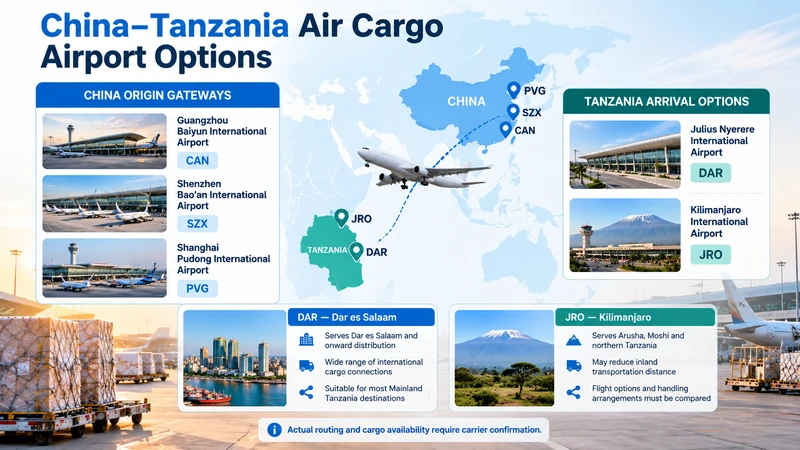
Guangzhou (CAN), Shenzhen (SZX), and Shanghai (PVG)
Three major Chinese airports are worth evaluating:
Guangzhou Baiyun International Airport (CAN)
Guangzhou is a useful starting point for shipments originating in Guangzhou, Foshan, Dongguan, and other South China manufacturing locations.
Air Tanzania lists Guangzhou in its published international network. Nevertheless, a published passenger route does not establish that suitable cargo capacity is available on the requested departure date.
Shenzhen Bao’an International Airport (SZX)
Shenzhen is convenient for suppliers in Shenzhen and the surrounding Pearl River Delta manufacturing region.
For some shipments, transferring cargo to another Chinese airport may provide a better connection. This decision should consider inland trucking, cargo acceptance deadlines, freight cost, and the actual confirmed itinerary.
Shanghai Pudong International Airport (PVG)
Shanghai is a practical gateway to evaluate for shipments originating in Shanghai, Jiangsu, Zhejiang, and other East China production areas.
Importers should compare available airline routings rather than assume a direct PVG–Tanzania cargo service.
When requesting a quotation, provide the factory or warehouse address instead of selecting the export airport in advance. This allows the routing to be evaluated against the actual cargo requirements.
Dar es Salaam (DAR) vs Kilimanjaro (JRO)
Tanzania has two important international airport options to investigate for commercial cargo.
Julius Nyerere International Airport (DAR) serves Dar es Salaam and is a key gateway for international cargo entering Mainland Tanzania.
Kilimanjaro International Airport (JRO) is located in northern Tanzania and has cargo handling, warehousing, weighing, screening, and import/export documentation facilities. It may be an appropriate arrival option for businesses serving Arusha, Moshi, and nearby locations.
However, JRO should not automatically be considered cheaper or faster for northern Tanzania. Flight connections, available cargo services, customs arrangements, and local transportation must all be compared.
| Airport Option | Potential Delivery Area | Key Advantage to Evaluate | What Must Be Confirmed |
|---|---|---|---|
| CAN → DAR | Dar es Salaam and onward destinations | South China origin access and published airline network options | Commercial cargo acceptance, flight connection, space, and arrival handling |
| SZX → DAR | Dar es Salaam and onward destinations | Convenient access to Shenzhen suppliers | Bookable routing, transfers, cargo restrictions, and total cost |
| PVG → DAR | Dar es Salaam and onward destinations | Access to East China manufacturing regions | Current carrier routing, available capacity, and connection time |
| China → JRO | Arusha, Moshi, and northern Tanzania | Potentially shorter inland delivery after release | Suitable flight connection, cargo handling, clearance, and local transport |
This is an airport-selection matrix, not a live flight schedule. No daily frequency or direct cargo service is implied.
Direct Flights, Transit Hubs, and Bookable Cargo Space
An airline operating a route does not necessarily mean it can accept every shipment.
Commercial cargo availability depends on several factors:
- Aircraft type and remaining cargo capacity.
- Shipment dimensions, weight, and packaging.
- Dangerous-goods or temperature-control requirements.
- Cargo space at connecting airports.
- Booking cutoff times and shipment documentation.
A direct passenger service may offer belly-cargo capacity, but that capacity can be restricted. A connecting cargo itinerary may sometimes be more practical than waiting for a suitable direct uplift.
Before booking, confirm the departure airport, destination airport, operating carrier, planned transfer points, cargo acceptance status, and expected arrival.
How Is Air Freight Chargeable Weight Calculated?
Air freight quotations frequently use a price per chargeable kilogram. Understanding chargeable weight is essential because the airline may bill more than the cargo’s actual gross weight.
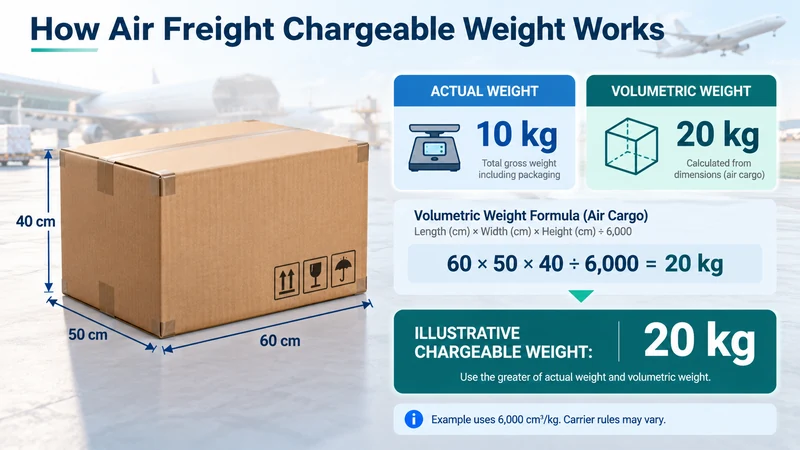
Actual Weight vs Volumetric Weight
Actual gross weight is the weight of the cargo, including its packaging.
Volumetric weight, also called dimensional weight, reflects how much aircraft space the shipment occupies.
A commonly used illustrative air cargo calculation is:
Volumetric Weight (kg) = Length (cm) × Width (cm) × Height (cm) ÷ 6,000
The provisional chargeable weight is generally the greater of actual gross weight and volumetric weight, subject to the carrier’s tariff, rounding rules, and minimum charges.
The divisor of 6,000 is not universal. The final billing method must be confirmed for the quoted air freight service.
Worked Examples: Bulky vs Dense Cargo
| Cargo Example | Carton Dimensions | Actual Gross Weight | Volumetric Weight | Illustrative Chargeable Weight |
|---|---|---|---|---|
| Bulky spare-parts carton | 60 × 50 × 40 cm | 10 kg | 20 kg | 20 kg |
| Dense metal components | 40 × 30 × 20 cm | 8 kg | 4 kg | 8 kg |
| Heavy machinery component | 80 × 40 × 30 cm | 25 kg | 16 kg | 25 kg |
All calculations use the illustrative 6,000 cm³/kg divisor, without carrier-specific rounding or minimum charges.
For the first carton:
60 × 50 × 40 = 120,000 cm³
120,000 ÷ 6,000 = 20 kg
Although the carton physically weighs only 10 kg, its illustrative billing weight is 20 kg.
If an importer ships ten identical cartons, the total actual gross weight is 100 kg, while the calculated volumetric weight is 200 kg. The provisional billing weight would therefore be 200 kg before any carrier-specific adjustments.
This is why carton dimensions matter as much as total gross weight.
For multiple packages, ensure the forwarder knows the dimensions of each package. Oversized pallets, added protective packaging, and carrier remeasurement can change the final chargeable weight.
What Is Included in a Per-Kilogram Air Freight Quote?
Two quotations showing the same price per kilogram may cover different services.
A commercial air freight quotation can contain:
- China origin charges: Supplier pickup, export handling, security screening, and documentation where applicable.
- International air freight: The quoted airline transportation charge, together with applicable carrier surcharges.
- Tanzania arrival handling: Terminal, warehouse, and cargo-release charges according to the handling operator.
- Import clearance: Customs-agent fees, applicable duties, taxes, permits, or inspection expenses.
- Final delivery: Transport from the airport to the consignee’s warehouse or business address, if requested.
A freight-only quotation should not be compared directly with an airport-to-door quotation unless the missing destination expenses have been added.
For a broader breakdown of freight charges and landed-cost considerations, read shipping cost from China to Tanzania.
What Determines Air Cargo Transit Time and Delivery Reliability?
The scheduled flight duration is only one part of the shipment timeline.
Commercial air cargo passes through several operational milestones before the consignee can collect the goods.
Before Departure: Cargo Readiness and Booking
The process begins when the supplier confirms that the cargo is packed and ready.
The forwarder must then arrange the applicable pickup, export documentation, airline booking, screening, and terminal delivery.
Cargo may miss its planned flight if it reaches the terminal after the acceptance cutoff or if required documentation is incomplete.
Special cargo may need additional review before airline acceptance.
During Air Transit: Direct Services and Connections
Once accepted and booked, cargo moves according to the confirmed airline itinerary.
Connections introduce potential uncertainties, including:
- Delayed arrival at a transfer airport.
- Missed onward flight connections.
- Limited available cargo space.
- Airline offloading or rebooking.
- Changes to handling or aircraft arrangements.
A confirmed booking provides a planned movement, not an absolute delivery guarantee.
Importers shipping production-critical goods should ask what happens if the original flight is delayed or the cargo is moved to a later service.
After Arrival: Customs Release and Delivery
The following milestones should be tracked separately:
| Shipping Stage | What It Means | Main Dependency |
|---|---|---|
| 1. Cargo Ready | Supplier has completed packing | Factory preparation |
| 2. Export Acceptance | Cargo accepted for the airline movement | Screening and documents |
| 3. Flight Uplift | Cargo loaded and transported | Available airline capacity |
| 4. Tanzania Arrival | Aircraft and shipment reach the arrival airport | Actual itinerary |
| 5. Customs & Terminal Release | Cargo cleared and authorized for collection | Documentation, assessment, payments, and handling |
| 6. Collection or Delivery | Cargo handed over or transported inland | Release documents and local arrangements |
A shipment that has landed at DAR is not necessarily available for immediate pickup.
For broader end-to-end timing comparisons, see how long shipping from China to Tanzania takes.
How Do You Clear and Collect Air Cargo in Tanzania?
Import clearance should be planned before the shipment leaves China.
The Tanzania Revenue Authority (TRA) administers customs procedures through the Tanzania Customs Integrated System (TANCIS). Under its published import procedures, importers are required to appoint a licensed Clearing and Forwarding Agent (CFA) to handle customs clearance.
The process may begin before cargo arrival when the required documents and information are available.
Before Shipping: Importer, Clearing Agent, and Documents
The importer should establish who will act as the legal consignee or importer and which licensed agent will process the customs declaration.
Commonly relevant documents include:
| Document | Purpose |
|---|---|
| Commercial Invoice | Product description, quantity, transaction value, and seller/buyer information |
| Packing List | Package count, contents, weights, and dimensions |
| Air Waybill (AWB) | Air transport shipment information |
| Agent Authorization | Authorizes the appointed clearing agent to act for the importer |
| Applicable Import Permits or Certificates | Supports compliance for regulated products, where required |
The exact documentation requirements depend on the shipment and goods classification.
The importer should also verify the HS code, declared value, and applicable product rules before departure.
For example, some imported products fall under the Tanzania Bureau of Standards (TBS) Pre-shipment Verification of Conformity (PVoC) programme. Goods within the regulated scope may require a Certificate of Conformity before shipment. This is not a universal requirement for every air freight consignment.
The official TRA import procedures explain the use of licensed agents and TANCIS.
After Arrival: Customs Release and Airport Collection
The following is a practical overview of a commercial air cargo import process:
Step 1 — Confirm cargo arrival and availability
The arrival notification, Air Waybill information, and terminal handling arrangements are checked.
Step 2 — Complete the customs declaration
The licensed clearing agent submits the necessary information and supporting documents through the applicable customs system.
Step 3 — Resolve customs assessment and controls
Applicable duties and taxes are assessed. Inspection, permit verification, or additional documentation may be required depending on the consignment.
Step 4 — Obtain customs and terminal release
After the relevant requirements are satisfied, the importer or agent completes the necessary terminal payment and cargo-release formalities.
Step 5 — Collect and deliver the cargo
The authorized party arranges physical collection with the required release documents and gate-pass procedures, where applicable.
The exact sequence and payment arrangements depend on the airport, handling operator, and customs requirements.
Delays may result in storage charges, so the consignee should understand when the applicable free-storage period ends.
Pro Tip — Prepare Clearance Before Arrival: Appoint your Tanzanian clearing agent and check the consignee details, invoice, packing list, and applicable permits before the shipment departs China. Early document review can help prevent avoidable delays after landing.
Airport Collection vs Door-to-Door Delivery
Airport-to-airport freight generally ends at the specified airport under the agreed freight service. It does not automatically include import clearance, terminal charges, or transportation to the buyer’s premises.
An airport-to-door arrangement may include additional services, but its exact scope must be confirmed.
Door-to-door shipping is not the same as DDP.
Under DAP (Delivered at Place), the seller generally arranges transportation to the named destination, while the buyer handles import clearance and related duties and taxes.
Under DDP (Delivered Duty Paid), the seller assumes import-clearance and applicable duty/tax responsibilities under the agreed Incoterms rule. The seller must be legally able to fulfill those obligations in the destination country.
Hiring a freight forwarder does not automatically transfer the seller’s or buyer’s legal responsibilities to the forwarder.
For more detail, review our Tanzania customs clearance requirements.
This section concerns Mainland Tanzania airport imports. Zanzibar-bound shipments may involve additional or different standards and procedural requirements, which should be checked separately.
Can You Ship Batteries and Other Restricted Goods by Air?
Not every product that can be shipped by sea can be accepted as ordinary air cargo.
Lithium batteries, certain chemicals, liquids, and other regulated materials may require special classification, documentation, packaging, or airline approval.
These checks must be completed before the shipment is booked.
Batteries Shipped Alone, Packed With Equipment, or Contained in Equipment
For air transport, battery configuration matters.
The following descriptions are not interchangeable:
- Batteries shipped alone: Batteries transported without the equipment they power.
- Batteries packed with equipment: Batteries included in the shipment but packaged separately from the device.
- Batteries contained in equipment: Batteries installed inside the device they power.
Lithium-ion batteries, lithium-metal batteries, and sodium-ion batteries may fall under different regulatory classifications and packing instructions.
Depending on the shipment, the shipper may need to provide battery chemistry, watt-hour rating or other technical specifications, applicable UN 38.3 test information, packaging details, state-of-charge information, and the required dangerous-goods documentation.
Some batteries are subject to passenger-aircraft restrictions or cargo-aircraft-only requirements. Damaged or defective batteries may be subject to particularly stringent prohibitions or restrictions.
The applicable rules are detailed in the IATA 2026 Battery Guidance, which references the 67th Edition of the IATA Dangerous Goods Regulations.
Airline Acceptance and Tanzania Import Compliance Are Separate Checks
A shipment must satisfy both aviation transport requirements and applicable destination import requirements.
An airline may decline cargo even when the supplier considers it properly packed. Conversely, airline acceptance does not establish that the goods have obtained every permit or conformity document required for import into Tanzania.
Before booking restricted cargo, confirm:
- Accurate product identification and composition.
- Dangerous-goods classification, if applicable.
- Required packaging, marks, labels, and documents.
- Acceptance by the actual operating airline.
- Any specific transit-airport restrictions.
- Relevant Tanzania import permits or conformity obligations.
Pro Tip — Disclose Battery Details Before Booking: If your products contain rechargeable batteries, provide the specifications and packing configuration when requesting the quotation. Do not describe battery-containing equipment simply as general cargo without allowing the forwarder and airline to assess it.
What Information Do You Need for an Accurate Air Freight Quote?
A useful air freight quotation begins with complete shipment details.
Providing only the product name and estimated gross weight often leads to an incomplete quotation that may change after packing or airline acceptance.
Prepare Your Cargo Details
Send the following information:
- Product: Clear commercial description, intended use, and HS code if known.
- Quantity: Total cartons, crates, or pallets.
- Dimensions: External length, width, and height of each package.
- Weight: Gross weight per package and total gross weight.
- Value: Invoice value and currency.
- Pickup: Supplier address or collection location in China.
- Timing: Cargo-ready date and required arrival or delivery deadline.
- Restrictions: Batteries, chemicals, liquids, magnetic materials, temperature-sensitive goods, or other special characteristics.
Where goods are not fully packed, state clearly that the dimensions and weights are estimates.
Confirm the Destination and Service Scope
The forwarder also needs the destination city, consignee details, and the intended delivery arrangement.
When comparing quotations, request confirmation of:
- Proposed origin and destination airports.
- Airline routing and any transfer points.
- Chargeable weight and applicable calculation method.
- Origin charges and export arrangements.
- International freight and carrier surcharges.
- Destination terminal handling and customs-agent charges.
- Whether duties, taxes, or permits are included or excluded.
- Airport collection or final delivery arrangements.
- Booking status, quotation validity, and any applicable exclusions.
For example, an importer in Arusha should not automatically request JRO without considering available flights and terminal costs. A DAR arrival followed by inland delivery may be worth comparing.
Similarly, a supplier based in Shenzhen does not necessarily mean SZX is the best available departure airport.
For a broader overview of sea, air, express, customs, and delivery options, see our shipping from China to Tanzania guide.
FAQ
Can air cargo fly directly from Guangzhou to Dar es Salaam?
Air Tanzania includes Guangzhou in its published international network. However, a passenger service or published destination does not automatically confirm that commercial cargo space is available for a particular shipment. Ask for the actual airline routing, uplift availability, and cargo acceptance confirmation before making delivery commitments.
Should I choose DAR or JRO if my shipment is going to Arusha?
JRO may reduce the inland transportation distance for an Arusha-bound shipment, but the best choice depends on available international cargo connections, terminal handling, customs arrangements, and total delivery cost. Compare both airport options using the same cargo-ready date and service scope.
Can my chargeable weight change after the airline receives my cargo?
Yes. Cargo may be reweighed or remeasured after acceptance. Additional packaging, pallet dimensions, airline rounding rules, or minimum charge requirements may also affect the billable weight. Accurate final packing information helps reduce quotation differences.
Who is authorized to collect my goods after they arrive at DAR?
The consignee or an authorized representative must complete the applicable customs and terminal-release formalities. A licensed clearing agent handles customs declarations, while physical collection requires the relevant release documents and compliance with the cargo handler’s procedures.
Can I ship electronics containing rechargeable lithium batteries?
Potentially, but acceptance depends on battery chemistry, configuration, technical specifications, packaging, documentation, and the operating airline’s requirements. Batteries installed in equipment may be subject to different rules from batteries shipped separately. Confirm the applicable IATA requirements and airline acceptance before dispatch.
Does an airport-to-door quotation include import duties and VAT?
Not automatically. Airport-to-door describes a transport service scope, while the responsibility for import clearance, duties, and taxes depends on the agreed contract and Incoterms. Ask for a written breakdown identifying the importer, clearing agent, taxes, terminal charges, and final delivery responsibilities.
What happens if my shipment misses a connecting flight or is offloaded?
The carrier or forwarder must determine the next available movement and provide an updated estimate. Depending on the booking terms and circumstances, rebooking, terminal storage, or additional handling arrangements may be necessary. For urgent shipments, request communication procedures and available alternatives before confirming the booking.
