

The UAE is one of the largest trading hubs in the Middle East, and China remains its biggest sourcing partner for everything from electronics and machinery to furniture, building materials, fashion products, and consumer goods. For SMEs, distributors, and first-time importers, importing from China to UAE can offer excellent profit opportunities — but only if the process is managed correctly.
Many businesses underestimate the complexity behind supplier verification, shipping arrangements, customs clearance, VAT calculations, and local delivery. A small mistake in documentation or logistics planning can lead to unexpected delays, extra charges, or even cargo seizure.
This guide explains the complete importing process step by step, helping UAE businesses understand how to source products safely, manage shipping efficiently, reduce hidden costs, and avoid common importing mistakes.
How Importing from China to UAE Works
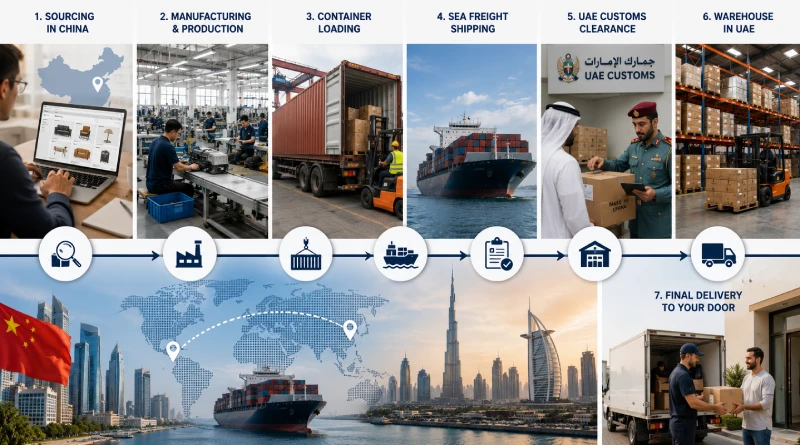
Importing from China to UAE usually follows a structured process:
- Find and verify suppliers
- Negotiate pricing and payment terms
- Confirm shipping method and Incoterms
- Arrange production and inspection
- Book freight transportation
- Complete export and import customs clearance
- Pay duties and VAT
- Arrange final delivery in UAE
Several parties are involved throughout the process, including manufacturers, freight forwarders, customs brokers, shipping lines, and UAE customs authorities.
For most imports, the full timeline ranges between 7–35 days depending on the shipping method. Air freight is faster but more expensive, while sea freight is more economical for larger cargo volumes.
Common products imported from China into UAE include:
- Consumer electronics
- LED lighting
- Furniture
- Building materials
- Auto parts
- Fashion products
- Machinery and industrial equipment
For SMEs and new importers, understanding this workflow early helps prevent expensive surprises later.
Step 1: Finding Reliable Suppliers in China
Choosing the right supplier is the most important part of the entire importing process. A good supplier improves product quality, delivery stability, and long-term profitability. A bad supplier can create delays, defects, and financial losses.
Where UAE Importers Usually Source Products
Most businesses begin sourcing through platforms such as:
- Alibaba
- Made-in-China
- Global Sources
- Canton Fair
- Yiwu wholesale market
- Direct factory referrals
While online platforms are convenient, they should never be treated as the only verification method.
How to Verify a Chinese Supplier
Before placing large orders, importers should confirm:
Business Registration
Ask for a valid Chinese business license and check whether the company legally exports products.
Factory vs Trading Company
Factories often provide lower pricing and better production control, while trading companies may offer broader product sourcing and easier communication.
Product Certifications
Depending on the product type, suppliers may need certifications such as CE, RoHS, or other compliance documents relevant to UAE regulations.
Sample Testing
Always order samples before bulk production. Many SMEs skip this step to save money, then face quality problems after full shipment arrival.
Common Red Flags
Avoid suppliers that:
- Offer pricing far below market average
- Refuse inspections
- Push for full payment upfront
- Communicate inconsistently
- Cannot provide export documentation
Practical Example
A small Dubai electronics retailer importing LED products may initially choose the cheapest supplier online. However, after requesting samples, they may discover inconsistent brightness quality and poor packaging standards. Spending slightly more on a verified supplier often reduces long-term losses significantly.
Step 2: Understanding UAE Import Requirements
Before importing products into UAE, businesses must understand local customs and licensing requirements.
Do You Need an Import License in UAE?
In most cases, yes.
Businesses importing goods commercially usually require:
- A UAE trade license
- Importer code registration
- Customs registration
Requirements vary depending on whether the company operates in:
- Mainland UAE
- Free zones
- E-commerce structures
Some free zone companies can import goods only within the free zone unless additional permissions are obtained.
Key Import Documents Required
Typical import documentation includes:
- Commercial invoice
- Packing list
- Bill of lading or airway bill
- Certificate of origin
- Import permits (if applicable)
Incorrect or incomplete documentation is one of the main reasons shipments are delayed.
Products That Require Additional Approval
Some product categories face stricter UAE regulations, including:
- Cosmetics
- Food products
- Medical products
- Wireless communication devices
- Chemicals
- Children’s products
For example, electronics with wireless functionality may require additional telecom approvals before customs release.
UAE Labeling Requirements
Some imported products require:
- Arabic labeling
- Country-of-origin markings
- Safety instructions
- Product composition disclosure
Ignoring labeling requirements can result in customs holds or relabeling costs inside UAE.
Step 3: Choosing the Right Shipping Method
The best shipping method depends on cargo size, urgency, product type, and budget.
Air Freight
Air freight is ideal for:
- High-value cargo
- Urgent shipments
- Small-to-medium volume orders
Typical transit time from China to UAE is around 3–7 days.
However, air freight costs significantly more than sea freight.
Sea Freight
Sea freight is the most common solution for bulk cargo.
Two main options exist:
FCL (Full Container Load)
Best for larger shipments where the importer uses an entire container.
Advantages:
- Lower cost per unit
- Faster handling
- Lower damage risk
LCL (Less than Container Load)
Suitable for SMEs importing smaller cargo volumes.
Advantages:
- Lower upfront shipping cost
- No need to fill a full container
Disadvantages:
- Longer consolidation times
- Higher handling risk
- Additional destination charges
Sea freight transit from China to UAE usually takes 18–30 days depending on the departure port and UAE destination.
Express Courier
Courier services like DHL, UPS, and FedEx are suitable for:
- Samples
- Small packages
- Urgent e-commerce orders
However, costs rise quickly for larger shipments.
Choosing the Right Freight Forwarder
A reliable freight forwarder should provide:
- Clear pricing transparency
- UAE customs experience
- DDP shipping capability
- Cargo tracking support
- Strong communication
Many SMEs make the mistake of choosing forwarders based only on the lowest quote, without understanding what services are excluded.
Step 4: Understanding Import Duties, VAT, and Hidden Costs
Many first-time importers focus only on product cost and freight pricing. In reality, total landed cost includes many additional charges.
UAE Import Duty
Most products imported into UAE are subject to:
- 5% import duty
The duty calculation is usually based on CIF value (cost + insurance + freight).
Some products may qualify for exemptions depending on trade agreements or product categories.
UAE VAT
Imported goods are also generally subject to:
- 5% VAT
VAT applies to the combined value of:
- Product value
- Shipping cost
- Insurance
- Import duty
Hidden Costs Many Importers Ignore
Unexpected costs often include:
- Port handling fees
- Customs inspection charges
- Storage fees
- Demurrage charges
- Documentation fees
- Last-mile delivery costs
- Currency exchange fluctuations
For LCL shipments especially, destination charges in UAE can sometimes surprise inexperienced importers.
Why Cheap Freight Quotes Become Expensive
Some freight forwarders advertise extremely low shipping rates but exclude:
- Customs clearance
- Destination handling
- Delivery fees
- VAT
- Documentation costs
Always request a complete landed cost breakdown before confirming shipment.
SME Example
A UAE furniture importer may initially receive a low sea freight quote from Shenzhen to Dubai. After arrival, additional warehouse handling, customs, and delivery charges increase the actual total cost by 25–40%.
Step 5: UAE Customs Clearance Process
Customs clearance is one of the most sensitive stages in importing.
The process usually includes:
- Document submission
- Cargo declaration
- Customs inspection (if required)
- Duty and VAT payment
- Cargo release
Common Causes of Customs Delays
Incorrect HS Codes
Wrong product classification can trigger customs disputes or penalties.
Missing Documentation
Even one missing certificate may delay shipment release.
Underdeclared Cargo Value
Attempting to reduce taxes through undervaluation can create serious customs issues.
Restricted Products
Some goods require special approvals before importation.
How Freight Forwarders Help
Experienced freight forwarders often assist with:
- Customs documentation
- HS code verification
- Duty estimation
- Cargo release coordination
- Delivery scheduling
For first-time importers, professional customs support significantly reduces risk.
Step 6: Final Delivery and Warehousing in UAE
After customs clearance, cargo proceeds to final delivery.
Delivery Options
Cargo may be delivered to:
- Warehouses
- Retail stores
- Distribution centers
- Amazon FBA facilities
- Construction sites
Warehousing Options
Businesses importing regularly often use:
- Dubai mainland warehouses
- Free zone warehouses
- Shared storage facilities
Proper inventory planning is important because UAE storage fees can become expensive during peak seasons.
Many SMEs underestimate how quickly storage and demurrage fees accumulate when cargo is not collected promptly.
When DDP Shipping from China to UAE Makes Sense
DDP (Delivered Duty Paid) shipping is becoming increasingly popular among SMEs and first-time importers.
Under DDP shipping, the freight forwarder typically handles:
- Export procedures
- Freight transportation
- UAE customs clearance
- Duties and VAT
- Final delivery
This creates a simpler “door-to-door” importing experience.
When DDP Is Most Useful
DDP shipping works especially well for:
- First-time importers
- SMEs without customs expertise
- Small and medium shipments
- E-commerce sellers
- Businesses without UAE customs staff
Advantages of DDP
Simplified Cost Planning
Importers know the approximate total landed cost upfront.
Reduced Operational Complexity
Businesses avoid coordinating multiple service providers.
Faster Operational Execution
Experienced DDP forwarders already understand UAE import procedures.
When DDP May Not Be Ideal
For very large importers with their own customs teams and warehouse systems, FOB or CIF structures may provide more control and lower long-term costs.
Common Importing Mistakes UAE Businesses Should Avoid
Many importing problems are preventable.
Choosing Suppliers Based Only on Price
The cheapest supplier often creates the highest long-term risk.
Ignoring Compliance Requirements
Missing certifications or labeling issues can delay cargo release.
Underestimating Total Landed Cost
Freight is only one part of the total importing expense.
Skipping Product Inspection
Quality issues discovered after arrival are expensive to resolve.
Choosing the Wrong Incoterm
Many beginners misunderstand FOB, CIF, and DDP responsibilities.
Poor Communication
Delayed responses between suppliers, freight forwarders, and customs agents often create avoidable delays.
Lack of Shipping Planning During Peak Seasons
Chinese New Year and major shopping seasons can significantly affect production and freight schedules.
Beginner-Friendly Import Framework for UAE SMEs
For first-time importers, the safest approach is to simplify operations as much as possible.
Recommended Framework
Step 1 — Start Small
Avoid placing oversized first orders.
Step 2 — Verify Suppliers Carefully
Focus on reliability rather than lowest pricing.
Step 3 — Use DDP Shipping Initially
DDP reduces operational complexity for beginners.
Step 4 — Prepare Documents Early
Never wait until cargo departure to organize customs paperwork.
Step 5 — Track Total Landed Cost
Monitor all logistics, customs, and delivery expenses.
Step 6 — Build Long-Term Relationships
Reliable suppliers and freight partners become major competitive advantages over time.
Example
A startup importing home accessories into Dubai may begin with a small DDP shipment to test product demand before scaling into larger sea freight container orders later.
Conclusion
Importing from China to UAE offers significant opportunities for SMEs, distributors, and growing businesses. However, successful importing requires much more than simply finding cheap products online.
Businesses must carefully manage supplier sourcing, shipping arrangements, customs clearance, VAT calculations, compliance requirements, and final delivery planning.
For first-time importers especially, working with experienced freight forwarders and verified suppliers can dramatically reduce operational risk. DDP shipping is often the easiest entry point because it simplifies customs procedures and provides clearer cost visibility.
The businesses that succeed long term are usually the ones that prioritize reliability, planning, and logistics transparency — not just the lowest product price.
