
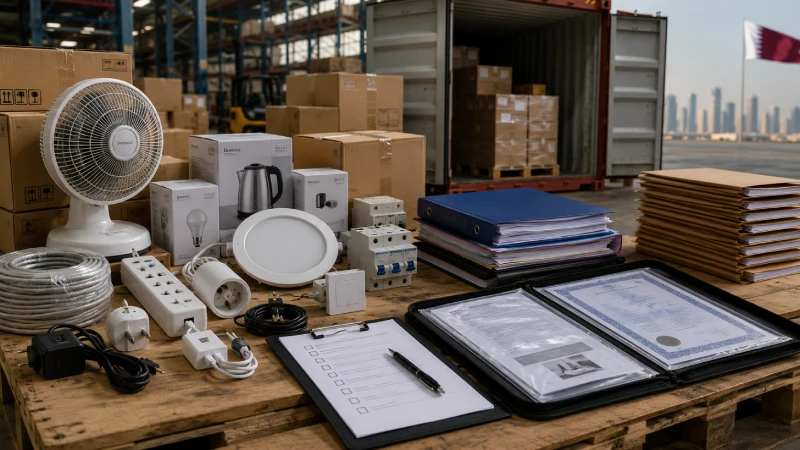
For importers planning regular procurement through Shipping from China to Qatar, electrical products require more preparation than ordinary cargo. The freight route may be simple, but the compliance risk can be much higher. A shipment of appliances, fans, lighting products, chargers, electrical accessories, or battery-powered devices can be delayed if the product certificate is missing, the invoice description is too vague, the label does not match the certificate, or customs requests additional technical documents.
This article focuses on compliance management before shipping. Instead of only asking “How much is the freight cost?”, Qatar importers should also ask: Is this product regulated? Are the model numbers consistent? Do the labels show the correct electrical rating? Can the customs broker understand the product clearly from the documents? These questions often decide whether the shipment clears smoothly or becomes stuck in document correction.
Why Electrical Products Need Compliance Planning Before Shipment
Electrical products are different from many general consumer goods because they may involve product safety, voltage compatibility, fire risk, electromagnetic performance, plug type, and end-user safety. Qatar importers may buy from multiple Chinese suppliers, combine different SKUs in one shipment, and use one freight forwarder to consolidate the cargo. This makes document control even more important.
For example, if a shipment includes electric irons, exhaust fans, hair dryers, LED lights, cables, adapters, and switches, the customs declaration should not simply describe the cargo as “electrical goods.” Each product type may have a different HS code, different risk level, different certificate requirement, and different inspection concern. A vague description may save a little time when preparing the invoice, but it can create major delays during customs clearance.
Before arranging Sea Freight from China to Qatar or air freight, the importer should first confirm product category, documentation, labeling, and certification readiness.
Quick Compliance Checklist Before Shipping Electrical Products
Before booking cargo space, importers should check the following items:
| Compliance Item | Why It Matters |
|---|---|
| Product category | Determines whether the product may be regulated |
| HS code | Affects customs declaration, duties, and inspection risk |
| Certificate of Conformity | May be required for certain regulated electrical products |
| Test reports | Help prove product safety or standard compliance |
| Commercial invoice | Must clearly describe the goods |
| Packing list | Must match carton quantity, weight, and SKU details |
| Certificate of origin | Commonly required for customs documentation |
| Product labels | Must match model, origin, and electrical specifications |
| Carton marks | Help customs and warehouse teams identify goods |
| Battery documents | Needed for battery-powered or rechargeable products |
The key point is consistency. The product name, model number, brand, quantity, country of origin, voltage, and wattage should match across the invoice, packing list, certificate, label, photos, and technical datasheet.
Which Electrical Products Usually Need More Attention?
Not all electrical products face the same compliance risk. Some items are more likely to attract customs or conformity review because they connect directly to consumer safety.
Higher-risk products may include household electrical appliances, electric irons, hair dryers, exhaust fans, power adapters, chargers, LED lighting products, electrical tools, extension sockets, power strips, rechargeable products, and goods with heating elements. These products may involve voltage, overheating, insulation, plug compatibility, and user safety issues.
Industrial electrical products can also require careful documentation. Control panels, switches, cables, sensors, spare parts, and electrical accessories may not always need the same certification process as consumer appliances, but they still need accurate descriptions, itemized packing lists, technical specifications, and clear model identification.
If you are shipping many SKUs in one container, FCL Shipping from China to Qatar can offer better cargo control, but it does not remove compliance responsibility. The bigger the shipment, the more important the document structure becomes.
Start with Product Classification, Not Freight Pricing
Many importers begin by asking for a freight quote. For electrical products, this is not enough. The first step should be product classification.
A freight forwarder needs to know what the product actually is, not only its weight and volume. “Electrical accessories” is too general. “220–240V wall switch, plastic housing, for indoor building installation” is much clearer. “Appliance spare parts” is vague. “Replacement heating element for electric oven, stainless steel, 230V” gives customs and the broker more useful information.
Good classification should include:
- product name
- product function
- model number
- brand, if applicable
- voltage and frequency
- wattage or power rating
- material or housing type
- intended use
- HS code suggestion
- whether the product contains a battery
For mixed shipments, the packing list should separate products by SKU or category. This is especially important for LCL Shipping from China to Qatar, where cargo may be consolidated with other shipments. Clear itemization helps reduce questions during customs review.
Confirm Certification and Conformity Requirements Early
Some electrical products imported into Qatar may require conformity evidence, such as a Certificate of Conformity, test report, or other product compliance documents. The exact requirement depends on product category, applicable standards, and current regulatory interpretation. Importers should confirm this with the Qatar importer of record, customs broker, certification body, or relevant authority before shipment.
A common mistake is assuming that one certificate can cover all products in a shipment. In reality, certificates often apply to specific models, brands, product types, or technical specifications. If the certificate shows one model number but the commercial invoice lists another, customs may question whether the certificate applies to the actual goods.
Importers should check:
- Does this product category require conformity documents?
- Does the certificate cover the exact model being shipped?
- Is the certificate still valid?
- Does the test report match the product specification?
- Are brand, manufacturer, and model details consistent?
- Are all SKUs covered, or only part of the shipment?
- Is the product label consistent with the certificate?
For products that may fall under GCC electrical safety requirements, importers should also confirm whether Gulf conformity marking or related compliance evidence is required. This should be checked before production or export packing, not after the cargo arrives in Qatar.
Product Labeling: A Small Detail That Can Cause Big Delays
Labeling is one of the most common sources of avoidable compliance problems. Once goods are packed, loaded, and shipped, correcting labels becomes expensive. If the issue is found after arrival, relabeling can delay customs clearance, warehouse release, or market distribution.
Electrical product labels should be reviewed before mass production and before final packing. Depending on the product, the label may need to show:
- brand name
- model number
- country of origin
- voltage
- frequency
- wattage or power rating
- safety warnings
- manufacturer information
- importer information, if required
- certification mark, if applicable
- product barcode or SKU
- Arabic or English information, where required
The most important rule is that the label should match the documents. If the label says model “HD-300” but the certificate says “HD-300A” and the invoice says “Hair Dryer 300 Series,” the importer may face additional questions. These small differences can create unnecessary delays.
Carton marks also matter. For large shipments, cartons should show product name, model, carton number, quantity, gross weight, net weight, and origin marking where appropriate. Clear carton marking makes inspection faster and reduces warehouse confusion.
Prepare Customs Documents That Tell the Same Story
For Qatar customs clearance, import documents must be accurate and consistent. The most common documents include commercial invoice, packing list, bill of lading or air waybill, certificate of origin, and any product-specific certificates or test reports required for the cargo.
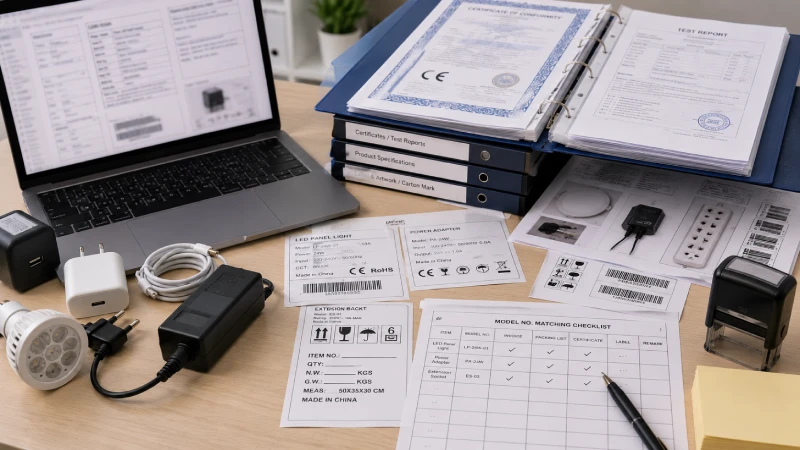
The commercial invoice should not only show price and quantity. It should describe the goods clearly enough for customs to understand the product. For electrical products, useful invoice details may include model number, voltage, wattage, product type, brand, quantity, unit value, total value, HS code, country of origin, and packaging information.
A strong document set should answer four basic questions:
- What exactly is the product?
- Who manufactured or supplied it?
- Where is it from?
- Which model, quantity, and technical rating are being imported?
If the answers are clear and consistent across all documents, the customs broker can prepare a more accurate declaration. If the answers are unclear, even a fast shipping route cannot prevent clearance delays.
Prepare for Customs Inspection Before the Cargo Arrives
Customs inspection is not always avoidable. However, importers can prepare for it. Electrical products may be selected for inspection due to product category, value, HS code, mixed SKUs, certification requirements, or document inconsistency.
Before shipment, importers should prepare a simple inspection support file that includes product photos, catalog pages, technical datasheets, label artwork, certificate copies, test reports, invoice, packing list, and SKU list. For high-value or mixed cargo, this file can help the consignee or broker answer customs questions quickly.
For example, if customs asks whether an item is a household fan, industrial ventilation part, or spare component, a technical datasheet and product photo can reduce confusion. If customs asks whether the certificate applies to the shipped model, matching model numbers across the label, invoice, and certificate can prevent back-and-forth communication.
This is especially useful for importers using DDP Shipping from China to Qatar. DDP can simplify logistics coordination, but it should not be used to hide unclear product compliance. Electrical products still need proper documentation before departure.
Special Attention for Battery-Powered Electrical Products
Battery-powered and rechargeable electrical products need additional planning. The issue is not only Qatar customs compliance. Airlines, shipping lines, warehouses, and carriers may also require battery-related transport documents.
Depending on the product and battery type, documents may include MSDS, UN38.3 test summary, battery declaration, watt-hour rating, lithium battery handling information, and product safety details. Products with built-in lithium batteries, spare batteries, power banks, rechargeable tools, wireless devices, and battery-powered appliances should be identified before booking.
For urgent samples, Air Freight from China to Qatar may be attractive, but battery restrictions can make air freight more complicated. If battery documents are incomplete, the cargo may be rejected before departure. Importers should never wait until the last minute to confirm battery shipping requirements.
Air, LCL, FCL, or DDP: Choose Based on Compliance Readiness
The best shipping method for electrical products depends not only on cost and transit time, but also on document readiness.
Air freight is suitable for urgent samples, spare parts, and high-value products, but it gives the importer less time to correct documents before arrival. LCL is useful for smaller shipments, but mixed cargo and consolidation can increase documentation complexity. FCL gives better cargo control and is often better for larger appliance or electrical product shipments. DDP may be convenient for some importers, but only when the cargo description, certification status, and documents are clear.
A practical rule is simple: the faster the shipping method, the earlier the compliance check should happen. If the documents are incomplete, fast transport only moves the problem to Qatar faster.
Common Compliance Problems and How to Avoid Them
| Problem | Possible Delay | Prevention |
|---|---|---|
| Vague invoice description | Customs asks for clarification | Use specific product names and model numbers |
| Wrong HS code | Declaration correction or inspection | Confirm classification before booking |
| Missing certificate | Clearance delay for regulated products | Check requirements before shipment |
| Certificate-model mismatch | Certificate may not be accepted | Match model numbers across all files |
| Label inconsistency | Compliance questions | Review label artwork before packing |
| Missing origin marking | Customs or market access issue | Confirm origin label and COO |
| Mixed SKUs not itemized | Slow inspection | Prepare detailed SKU packing list |
| Missing battery documents | Carrier rejection or delay | Prepare MSDS / UN38.3 where applicable |
Most of these problems are preventable. The importer does not need to wait until cargo arrives to discover them.
How Winsail Helps Importers Reduce Compliance-Related Shipping Delays
Winsail does not replace the importer’s legal responsibility or official certification authority. However, we can help importers manage the logistics side of compliance before the shipment leaves China.
Our team can coordinate with suppliers, review shipping documents, check whether product descriptions are clear, help organize mixed SKUs, advise on carton marking, separate cargo by product category, and coordinate with Qatar-side partners when needed. For electrical products, this preparation can reduce avoidable delays caused by unclear documentation, inconsistent model numbers, missing packing details, or poor supplier communication.
FAQs
Do all electrical products shipped to Qatar need a Certificate of Conformity?
Not all products have the same requirement. Some regulated electrical products may require conformity documents, while others may only need standard customs documents. Importers should confirm requirements based on product category before shipment.
What documents are usually needed?
Common documents include commercial invoice, packing list, bill of lading or air waybill, certificate of origin, and product-specific certificates or test reports when required.
Why does the model number matter?
The model number connects the physical product to the invoice, packing list, label, certificate, and test report. If the model numbers do not match, customs or certification reviewers may question whether the documents apply to the shipment.
Can I ship first and prepare certificates later?
This is risky. If the product is regulated and the certificate is required for clearance, preparing documents after arrival may lead to storage charges, inspection delays, or shipment hold.
Is DDP suitable for electrical products?
DDP may be suitable for some shipments, but only after product category and document requirements are reviewed. Electrical products with unclear compliance status should not be shipped blindly under DDP.
Are battery-powered products harder to ship?
Yes. Battery-powered products may require additional transport documents and carrier approval. This is especially important for air freight and express shipments.
Final Thoughts
Shipping electrical products from China to Qatar is not only a freight decision. It is a compliance management process. Importers should confirm product classification, certification status, document consistency, label accuracy, and inspection readiness before cargo departure.
The best way to avoid delays is to solve compliance issues while the goods are still in China. With clear documents, accurate labels, supplier cooperation, and the right shipping plan, Qatar importers can reduce customs problems and move electrical products more reliably from factory to final destination.
Need help preparing your shipment? Send Winsail your product list, model details, packing information, and available certificates. We can help review the logistics documents and recommend the most suitable air, sea, LCL, FCL, or DDP shipping solution for your electrical products.
