
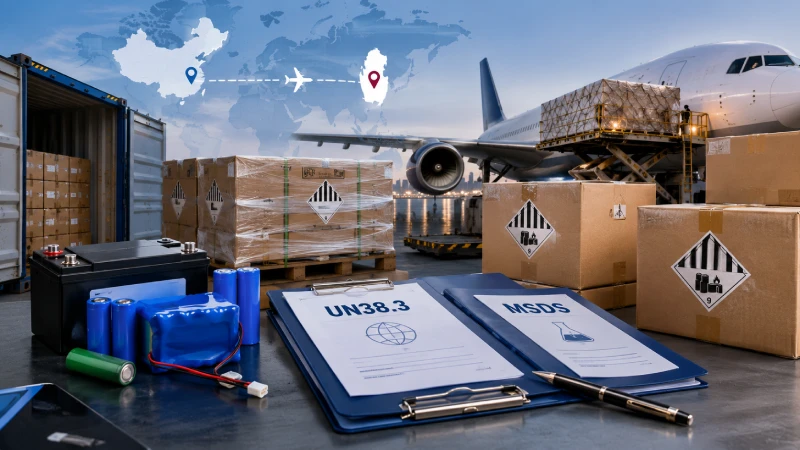
Importing lithium batteries from China to Qatar is not the same as shipping ordinary electronics or general cargo. Before comparing freight rates or transit time, importers must first confirm whether the battery shipment can legally move under international dangerous goods rules. For a broader route overview, you can first review Shipping from China to Qatar, then use this guide to understand the lithium battery compliance checks required before booking.
Lithium batteries are widely used in power banks, laptops, mobile devices, power tools, electric scooters, solar energy storage systems, medical devices, and industrial equipment. Because they may create fire and thermal runaway risks during transport, carriers, airlines, ports, warehouses, and customs authorities apply stricter controls. A missing UN38.3 test summary, mismatched MSDS, wrong UN number, incorrect label, or vague invoice description can cause cargo rejection before departure or customs delays after arrival in Qatar.
This guide explains how Qatar importers can reduce regulatory risk when shipping lithium batteries from China.
Can Lithium Batteries Be Shipped from China to Qatar?
Yes, lithium batteries can be shipped from China to Qatar, but only when the cargo is correctly classified, documented, packed, labeled, and accepted by the carrier. The key point is that lithium batteries are not treated as simple commercial goods. They are usually regulated as dangerous goods, and the rules depend on the battery chemistry, watt-hour rating, lithium content, packaging method, transport mode, and whether the battery is shipped alone or inside equipment.
For example, a laptop with a battery installed is not reviewed in the same way as a carton of standalone power banks. A solar storage battery is not handled like a small Bluetooth speaker. The compliance path changes according to the exact battery condition.
Common lithium battery classifications include:
| Battery Situation | Common UN Number | Main Compliance Concern |
|---|---|---|
| Lithium ion batteries shipped alone | UN3480 | Strict carrier approval and air restrictions |
| Lithium ion batteries packed with equipment | UN3481 | Packaging separation and document consistency |
| Lithium ion batteries contained in equipment | UN3481 | Device protection and correct declaration |
| Lithium metal batteries shipped alone | UN3090 | Higher sensitivity and carrier review |
| Lithium metal batteries packed with or contained in equipment | UN3091 | Correct classification and labeling |
Importers should confirm this classification before pickup from the Chinese supplier. If the wrong UN number is used at the booking stage, the shipment may be stopped later even if the freight rate has already been confirmed.
Why Lithium Battery Shipping Is a Compliance Decision
Many importers first ask, “How much does it cost to ship lithium batteries to Qatar?” A better first question is, “Can this shipment be accepted by the airline, shipping line, warehouse, and Qatar customs?”
Lithium battery cargo can fail at several points. The forwarder may reject the booking if documents are incomplete. The airline may refuse the cargo if the battery type is not accepted on the chosen route. The DG warehouse may stop the shipment if labels or packaging do not match the declaration. Qatar customs may ask for clarification if the invoice hides the battery content or uses a vague description such as “accessories” or “electronics.”
This is why lithium battery logistics should begin with document review, not price comparison. If your shipment includes electronics with built-in batteries, you may also need to coordinate this page with Shipping Electronics from China to Qatar so the product description, HS code, and battery declaration remain consistent.
UN38.3: The First Document Importers Should Check
UN38.3 is one of the most important documents for lithium battery transport. It shows that the battery has passed transport safety testing under the UN Manual of Tests and Criteria. In practical logistics, many airlines, shipping lines, and freight forwarders will not accept lithium battery cargo without a matching UN38.3 test summary or report.
Importers should not simply ask the supplier, “Do you have UN38.3?” They should check whether the document actually matches the shipment.
Before booking, review these points:
| UN38.3 Checkpoint | Why It Matters |
|---|---|
| Battery model number | Must match the actual battery or product |
| Manufacturer name | Should be consistent with the supplier or battery maker |
| Battery type | Lithium ion and lithium metal are different |
| Capacity / Wh rating | Affects transport classification |
| Test summary availability | Often required for carrier review |
| Document consistency | Must match MSDS, invoice, and product description |
A common problem is that the supplier provides a generic UN38.3 document for a different battery model. This may look acceptable during early communication but fail during carrier review. For importers, the safest approach is to ask for UN38.3, MSDS, battery specification sheet, product photos, and packing photos before confirming the shipping plan.
MSDS/SDS Is Important, But It Is Not Enough
The MSDS or SDS helps carriers and customs understand the battery’s chemical composition, hazard information, emergency handling measures, and storage precautions. However, MSDS alone does not prove that the battery can be shipped. It supports the compliance review but does not replace UN38.3, correct classification, packaging, labeling, or carrier approval.
For lithium battery shipments from China to Qatar, the MSDS should match the exact battery model. It should not be borrowed from another product line or another supplier. The battery model, voltage, capacity, and chemical type should align with the commercial invoice, packing list, UN38.3 document, and booking details.
A reliable document set may include:
| Document | Purpose |
|---|---|
| UN38.3 test summary/report | Confirms transport testing status |
| MSDS/SDS | Explains hazards and handling requirements |
| Battery specification sheet | Shows model, voltage, capacity, and Wh rating |
| Commercial invoice | Used for customs value and product declaration |
| Packing list | Shows carton count, weight, and package details |
| Certificate of origin | Commonly required for Qatar import clearance |
| DG declaration | Required for certain regulated DG shipments |
| Air waybill or bill of lading | Must align with declared cargo information |
For general battery cargo beyond lithium-specific rules, importers can also refer to Shipping Batteries from China to Qatar.
Packaging Regulations: Prevent Short Circuit, Movement, and Damage
Lithium battery packaging is not only about protecting the product. It is part of regulatory compliance. Packages must help prevent short circuit, accidental activation, crushing, vibration damage, and movement inside the carton.
Each battery should be protected from contact with conductive materials. Terminals may need insulation. Inner packaging should prevent batteries from touching each other. Outer cartons should be strong enough for international handling. If batteries are packed with equipment, the equipment and batteries should be arranged so that movement does not damage the battery during transport.
Key packaging controls include:
- Protect battery terminals from short circuit.
- Use inner packaging or separators where required.
- Avoid loose batteries inside cartons.
- Use strong outer cartons suitable for international transport.
- Apply correct lithium battery marks and Class 9 labels where required.
- Mark overpacks correctly when cartons are consolidated.
- Make sure package weight matches the declared documents.
One of the most common mistakes is preparing the documents correctly but ignoring the packaging. If the DG warehouse finds missing lithium battery marks, wrong UN labels, damaged cartons, or inconsistent package counts, the cargo may be delayed or rejected before export.
Air Freight Restrictions for Lithium Batteries to Qatar
Air freight from China to Qatar is attractive because it is fast, but lithium battery air transport has strict acceptance rules. Not every airline, flight, or aircraft type can accept every lithium battery shipment. Standalone batteries are usually more difficult than batteries contained in equipment. Large-capacity batteries, e-bike batteries, scooter batteries, power banks, and energy storage batteries often require deeper review.
If speed is critical, you should not promise delivery to your customer until the airline has accepted the booking. The forwarder may need to submit UN38.3, MSDS, battery specs, packing details, and shipper information for pre-approval.
Typical air freight difficulty levels:
| Cargo Type | Air Freight Difficulty | Reason |
|---|---|---|
| Laptops with installed batteries | Medium | Easier than standalone batteries but still needs declaration |
| Power banks | High | Often treated as standalone lithium battery products |
| Battery packs | High | Requires strict DG review |
| E-bike batteries | High | Higher capacity and stronger restrictions |
| Solar storage batteries | Very high | Heavy, high-capacity, and compliance-sensitive |
| Small devices with button cells | Lower | May be simpler if limits are met |
For urgent shipments, review Air Freight from China to Qatar together with the battery documents before deciding whether air transport is realistic.
Sea Freight May Be Better for Larger Lithium Battery Shipments
Sea freight is often more practical for larger lithium battery shipments, especially when the cargo is heavy, high-capacity, or not urgently needed. However, sea freight does not mean “no dangerous goods rules.” Lithium battery cargo still requires correct classification, MSDS, UN38.3, packaging, labeling, and shipping line acceptance.
For larger shipments, FCL can provide better control because the cargo is not mixed with other importers’ goods. For smaller volumes, LCL may be possible, but co-loading restrictions and DG acceptance must be checked first. Some LCL warehouses may refuse certain battery cargo, especially standalone batteries or high-risk products.
Sea freight is usually suitable for:
- Commercial battery stock
- Energy storage products
- Battery-powered equipment
- Larger electronics shipments
- Non-urgent replenishment orders
- Cargo requiring more controlled loading
Importers comparing container or LCL options can review Sea Freight from China to Qatar before deciding how to move lithium battery cargo.
Qatar Customs Compliance: Do Not Hide the Battery
For Qatar import clearance, consistency is critical. The commercial invoice, packing list, certificate of origin, transport document, HS code, and product description should all align. If the cargo contains lithium batteries, the description should not hide that fact.
A vague invoice description such as “parts,” “accessories,” or “electronics” can create problems if customs or the carrier later identifies lithium batteries inside the shipment. The importer should work with the Chinese supplier, freight forwarder, and Qatar customs broker before departure to ensure the declaration is accurate.
Common customs risks include:
| Risk | Possible Result |
|---|---|
| Battery not mentioned on invoice | Customs questions or clearance delay |
| Wrong HS code | Reclassification or duty review |
| Missing certificate of origin | Import clearance issue |
| MSDS does not match product | DG review rejection |
| UN number mismatch | Carrier or customs hold |
| Product description too vague | Additional inspection request |
If the importer wants a delivered solution, DDP Shipping from China to Qatar may be discussed case by case. However, lithium battery DDP shipping should never be treated as a shortcut around compliance. The cargo still needs proper classification, documents, packaging, and destination-side coordination.
Compliance Workflow Before Shipping
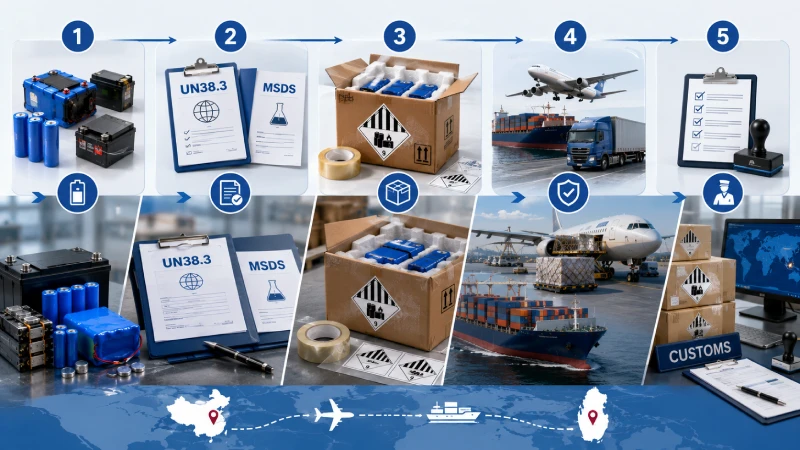
A safe lithium battery shipment should follow a structured workflow before cargo leaves the factory.
- Confirm whether the battery is lithium ion or lithium metal.
- Confirm whether it is shipped alone, packed with equipment, or contained in equipment.
- Identify the correct UN number.
- Collect UN38.3, MSDS, and battery specification sheet.
- Check Wh rating, voltage, capacity, and model consistency.
- Review packaging, labels, and carton marks.
- Send documents to the forwarder for DG pre-check.
- Confirm airline or shipping line acceptance.
- Prepare invoice, packing list, certificate of origin, and transport documents.
- Arrange pickup only after compliance approval.
This workflow helps avoid one of the most expensive mistakes in lithium battery shipping: collecting cargo first and discovering later that the carrier will not accept it.
Common Reasons Lithium Battery Shipments Are Rejected
Lithium battery shipments from China to Qatar are often delayed or rejected for preventable reasons. The most common include missing UN38.3, mismatched MSDS, wrong UN number, incorrect lithium battery mark, no DG declaration when required, poor carton condition, batteries packed loosely, excessive state of charge for air transport, or airline refusal for the specific battery category.
Another common issue is supplier misunderstanding. Some factories are experienced in production but not in international dangerous goods shipping. They may provide product invoices but fail to prepare transport documents. Importers should not wait until the goods are ready for pickup. Compliance documents should be reviewed before the shipment is packed.
How Winsail Logistics Helps Reduce Compliance Risk
Winsail Logistics helps Qatar importers review lithium battery shipments before booking. The goal is not only to move the cargo, but to prevent regulatory violations, carrier rejection, customs delays, and unexpected return costs.
Our team can help check UN38.3, MSDS, battery specifications, packaging photos, labels, transport mode feasibility, airline or shipping line acceptance, and Qatar-side document consistency. For importers shipping electronics, power tools, batteries, solar products, or battery-powered equipment, this early review can save significant time and cost.
Before arranging pickup from your Chinese supplier, send your battery documents and cargo details to Winsail Logistics. We will help you evaluate whether air freight, sea freight, FCL, LCL, or a customized DG solution is more suitable for your shipment to Qatar.
FAQs
Can lithium batteries be shipped from China to Qatar?
Yes. They can be shipped if they are correctly classified, documented, packaged, labeled, and accepted by the carrier.
Is UN38.3 required?
For most commercial lithium battery shipments, UN38.3 is one of the most important documents requested by carriers and forwarders.
Is MSDS enough for lithium battery shipping?
No. MSDS is important, but it does not replace UN38.3, correct labels, packaging, DG declaration, or carrier approval.
Can lithium batteries be shipped by air?
Some lithium battery shipments can move by air, but airline restrictions are strict. Acceptance depends on battery type, configuration, capacity, packaging, and documentation.
Is sea freight easier?
Sea freight may be more practical for larger shipments, but it still requires dangerous goods compliance and shipping line approval.
Can lithium batteries be shipped DDP to Qatar?
It may be possible in some cases, but it requires case-by-case review. DDP does not remove the need for correct battery compliance.
What should importers check before shipping?
Importers should check UN number, UN38.3, MSDS, Wh rating, battery model, packaging, labels, invoice description, and Qatar customs documents before pickup.
What is the biggest mistake importers make?
The biggest mistake is treating lithium batteries as ordinary electronics. Lithium battery cargo should be reviewed as regulated cargo before any freight booking is confirmed.
