
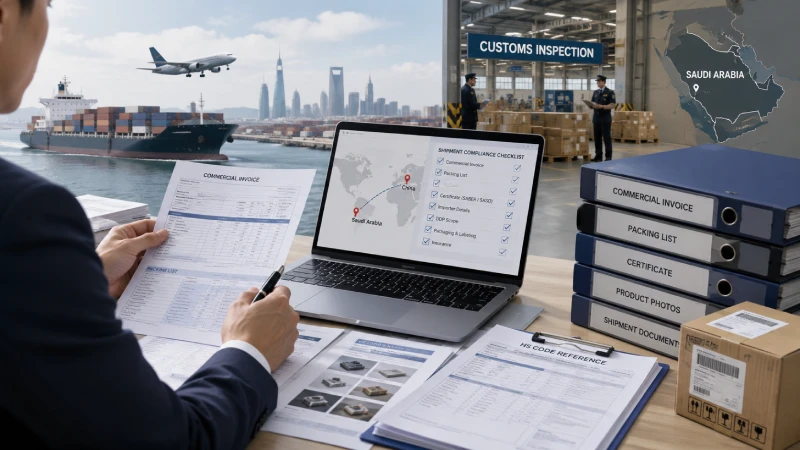
If you are planning shipping from China to Saudi Arabia, customs delay prevention should begin before the cargo leaves the supplier’s warehouse in China. Many delays at Saudi customs are not caused by the port, airport, or customs broker alone. They often start earlier: unclear product descriptions, inconsistent invoice details, wrong HS codes, missing SABER certificates, unconfirmed importer responsibility, or DDP terms that were accepted without checking whether the shipment is actually suitable for DDP handling.
Saudi Arabia is a high-potential import market, but it is also a market where documentation, product compliance, and importer responsibility matter. A shipment may move smoothly when cargo details are clear and complete. The same shipment may face customs questions, inspection, storage charges, or correction requests when the documents do not match the actual goods.
This guide is not a generic customs clearance article. It focuses on practical risk prevention. If you are worried about delays, or if you have already experienced problems with Saudi customs inspection, SABER, HS codes, or DDP scope, the key question is simple: what can be checked before the shipment leaves China?
Why Saudi Customs Delays Happen
Customs delays usually happen when Saudi-side parties cannot clearly verify what the cargo is, who is responsible for the import, whether the product is allowed, and whether the documents support the declaration.
The most common causes include:
| Risk Area | What Usually Goes Wrong | Possible Result |
|---|---|---|
| Invoice and packing list mismatch | Quantity, weight, carton count, model, or value does not match | Customs query or document correction |
| Vague product description | Goods are described as “parts,” “accessories,” or “samples” | HS code doubt or compliance review |
| Wrong HS code | Code does not match the actual goods | Duty, certificate, or permit issue |
| Missing SABER or SASO documents | Product requires certification but it was not prepared | Clearance hold or shipment delay |
| Unclear importer responsibility | Importer, broker, or consignee role is not confirmed | Clearance cannot proceed smoothly |
| Unclear DDP terms | Duty, VAT, certificate, or delivery responsibility is not defined | Cost disputes and delay risk |
| Poor packaging or palletization | Cartons are mixed, unmarked, or difficult to inspect | Slower inspection or cargo confusion |
| Regulated product risk | Product needs extra approval or technical documents | Additional review before release |
A normal inspection is not always a problem. Customs authorities may inspect cargo as part of standard control. The real problem is avoidable delay: when an inspection or document review finds information gaps that should have been corrected before shipping.
Invoice and Packing List Mismatch: A Small Error Can Cause a Big Delay
One of the fastest ways to create customs questions is inconsistent information between the commercial invoice, packing list, bill of lading or airway bill, certificates, and actual cargo.
For example, the invoice may show 120 cartons, while the packing list shows 128 cartons. The invoice may describe the cargo as “LED accessories,” but the packing list lists “LED drivers.” The supplier may provide one gross weight for booking, while the final warehouse measurement shows a different total weight. These differences may look small, but they can create doubts during customs declaration.
Before shipping, importers should check:
- Product name
- Model number
- Brand information, if applicable
- Quantity
- Carton count
- Gross weight and net weight
- CBM
- Unit value and total value
- Consignee and importer details
- Country of origin
- Certificate details, if required
A complete Saudi Arabia import documents checklist is useful, but completeness is not enough. The details must also match. A shipment with all required documents can still be delayed if those documents tell different stories.
Vague Product Descriptions Create HS Code and Compliance Problems
A vague product description is another common delay trigger. Descriptions such as “machine parts,” “accessories,” “hardware,” “tools,” “samples,” or “electrical items” are often too broad for customs, certificate review, or HS code confirmation.
A better product description should explain what the item is, what it is made of, how it is used, and whether it is a finished product, component, spare part, or sample.
For example, “machine accessories” is too broad. A clearer description would be: “stainless steel conveyor spare parts for packaging machine, non-electric, model XX.”
For electrical cargo, “LED parts” may be too vague. A clearer description would be: “LED power driver for indoor lighting fixture, model XX, with input and output specifications listed on product label.”
Clear product descriptions support smoother Saudi Arabia customs clearance because they help the importer, customs broker, and compliance parties understand the cargo before declaration. They also help identify whether the shipment may need SABER, special labeling, technical documents, or additional permits.
Before pickup in China, ask the supplier to provide product photos, labels, model lists, datasheets, and clear item descriptions. This is especially important for mixed cargo, electrical goods, auto parts, machinery parts, building materials, and products with brand or certification requirements.
HS Code Problems: Do Not Choose the Code Only for Lower Duty
HS code problems are not only tax problems. They can affect customs duty, VAT calculation, product compliance, inspection risk, SABER requirements, and whether the product is treated as regulated.
Some suppliers may suggest an HS code based on previous exports or the lowest duty direction. But the supplier’s suggested code may not match the Saudi importer’s declaration requirement. In some cases, the same product may need more detailed classification depending on material, function, voltage, use case, or product category.
Common HS code risk scenarios include:
- Electrical goods declared as general accessories
- Furniture hardware declared as generic metal parts
- Auto parts grouped under one broad code
- Machinery and spare parts mixed without item separation
- Building materials declared without material details
- Samples declared too generally even when they have commercial traits
The goal should not be “find the lowest duty code.” The goal should be “use a defensible code that matches the actual product and supporting documents.”
Winsail can help review product information from a logistics risk perspective and coordinate with the importer or broker, but final HS classification should be confirmed by the Saudi importer, customs broker, or relevant authority.
Missing SABER or SASO Certificates Can Stop a Shipment
For many product categories, Saudi compliance requirements must be checked before shipping. SABER-related issues are especially risky because they may not be easy to solve after cargo arrives.
The key question is not only “Do I need SABER?” The better questions are:
- Is the product regulated or unregulated?
- Does the certificate cover the actual product model?
- Does the product label match the certificate details?
- Are all models in the shipment covered?
- Is a Product Certificate required?
- Is a Shipment Certificate required?
- Is the importer ready to handle the SABER process?
- Are technical files, test reports, or product photos needed?
A common mistake is assuming that a certificate for a similar product is enough. Another mistake is preparing the certificate after the cargo has already arrived. If the model, brand, quantity, invoice value, or product description does not match, the shipment may face extra review.
For regulated cargo, the need for a SABER certificate for Saudi imports should be checked before the supplier loads the goods. This is especially important for electrical products, construction materials, machinery-related items, lighting products, consumer goods, and other categories that may fall under Saudi technical regulations.
Importer, Broker, and DDP Responsibility Must Be Confirmed Before Shipping
Many customs delays are not only document problems. They are responsibility problems.
Before the cargo leaves China, every party should know who is responsible for import declaration, certificate preparation, duty and VAT payment, customs broker appointment, permit handling, storage charges, and final delivery.
This becomes even more important when the buyer requests DDP shipping from China to Saudi Arabia. DDP is attractive because it sounds simple: the seller or forwarder handles the shipment to the final destination. But in real logistics, DDP must be checked carefully.
Before accepting DDP terms, confirm:
- Who is the importer of record?
- Are duty and VAT included?
- Are SABER or other certificates included?
- Who handles product compliance issues?
- Who pays inspection, storage, or demurrage if documents are wrong?
- Is final delivery to warehouse, project site, or business address?
- Does the cargo type support DDP handling?
- Is the product regulated, restricted, oversized, or high-risk?
DDP should not be treated as a shortcut around Saudi compliance. For some products, DDP may be possible. For others, it may require more preparation or may not be suitable. A DDP feasibility check before shipment helps avoid unrealistic promises and unexpected costs after arrival.
Packaging, Palletization, and Inspection Risks
Customs delay is not always caused by documents. Physical cargo presentation can also affect inspection efficiency.
If cartons are loose, unmarked, mixed, or difficult to identify, customs inspection may take longer. If the packing list says one carton sequence but the cargo is loaded randomly, it becomes harder to verify. If regulated and non-regulated products are mixed in the same cartons, the inspection may become more complicated.
Importers should ask suppliers to prepare inspection-friendly cargo:
- Use clear carton marks
- Match carton numbers with the packing list
- Separate different SKUs
- Keep regulated products clearly identified
- Avoid hiding small accessories inside unrelated cartons
- Use strong export packaging
- Prepare product photos and packing photos
- Confirm palletization requirements when applicable
- Make the cargo easy to count, identify, and inspect
Good packaging reduces damage risk, but it also reduces communication risk. When cargo is easy to identify, the broker and customs parties can compare the physical goods with the documents more efficiently.
Regulated Products Need Extra Review Before Booking
Some products should never be shipped to Saudi Arabia without a compliance check. These may include electrical and electronic goods, auto parts, machinery components, construction materials, chemicals, batteries, cosmetics, food-contact products, telecom-related goods, medical-related goods, and other controlled categories.
The risk is not only whether the cargo can move by sea or air. The bigger question is whether the product can be imported under the planned documentation and importer arrangement.
Regulated product risk may affect:
- HS code selection
- Import permits
- SABER or other certification
- Labeling requirements
- Technical files
- Product photos and datasheets
- Air freight acceptance
- DDP feasibility
- Customs inspection probability
This is why customs clearance support should start before booking. If the cargo has regulatory sensitivity, Winsail can help ask the right questions early and coordinate with the supplier, importer, and Saudi-side parties before the shipment becomes difficult to correct.
Pre-Shipment Checklist Before Cargo Leaves China
The best time to prevent customs delay is before cargo pickup. Once the goods have left China, some problems become slower and more expensive to fix.
Use this checklist before booking or loading:
| Check Item | Why It Matters | Who Should Confirm |
|---|---|---|
| Product description | Avoid vague declaration and HS code confusion | Supplier, importer, forwarder |
| HS code direction | Affects duty, certificate, and inspection risk | Importer and broker |
| Invoice and packing list | Prevent document mismatch | Supplier and forwarder |
| SABER or SASO need | Avoid certification delay after arrival | Importer and compliance party |
| Importer of record | Ensures clearance responsibility is clear | Buyer and broker |
| DDP scope | Prevent duty, VAT, and responsibility disputes | Buyer and forwarder |
| Packaging and marks | Supports easier inspection | Supplier and warehouse |
| Product photos and labels | Helps broker verify cargo details | Supplier |
| Final delivery address | Avoid destination delivery confusion | Buyer and forwarder |
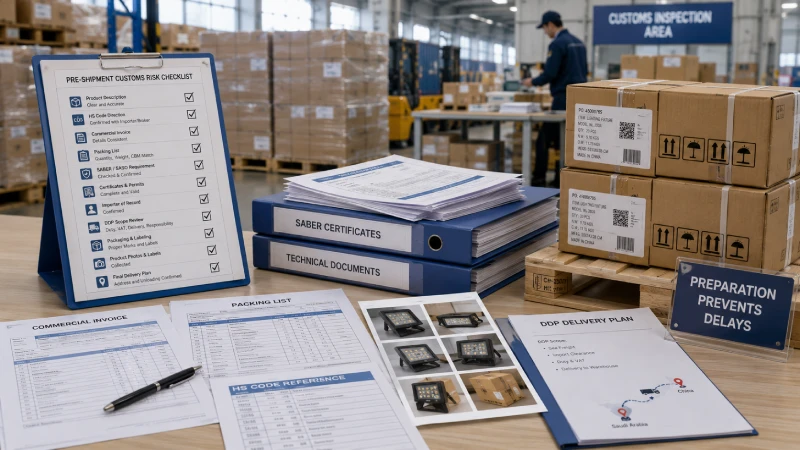
Do not wait until the container arrives at Jeddah, Dammam, Riyadh, or another Saudi entry point to discover a missing certificate or unclear cargo description. If a document needs correction, it is usually easier to fix before departure.
How Winsail Helps Reduce Avoidable Customs Delay Risks
Winsail Logistics helps importers reduce avoidable delay risks by moving customs readiness earlier in the shipment process. We do not promise guaranteed customs release, because final clearance depends on Saudi authorities, importer eligibility, product compliance, document accuracy, and inspection results. But many practical problems can be identified before the cargo leaves China.
Winsail can support importers through:
- Commercial invoice and packing list review
- Supplier coordination before pickup
- Product description clarification
- Cargo photo and label collection
- HS code risk discussion with importer or broker
- SABER and regulated product risk reminders
- Routing advice for sea freight, air freight, LCL, FCL, or DDP
- DDP feasibility check before confirming terms
- Coordination between supplier, buyer, and Saudi-side parties
- Final delivery planning for warehouse, business address, or project site
For example, if a supplier provides a vague invoice, Winsail can ask for a clearer product description before booking. If the cargo includes mixed models, Winsail can request a model breakdown and packing details. If DDP is requested for a regulated product, Winsail can check whether the scope is realistic before accepting the shipment.
This practical pre-shipment review helps reduce avoidable questions, correction requests, and responsibility disputes.
What If Your Shipment Is Already Delayed?
If your shipment is already delayed in Saudi Arabia, the first step is to identify the exact reason for the hold. Do not send random revised documents without understanding the customs query.
Ask the broker or responsible party:
- What is the official hold reason?
- Is the issue related to documents, HS code, certificate, permit, inspection, or payment?
- Which document or data field is being questioned?
- Does the cargo match the invoice and packing list?
- Is the importer authorized and ready to proceed?
- Is SABER or another certificate missing or inconsistent?
- Are storage or demurrage charges already accumulating?
For cargo already under customs review, the importer and licensed customs broker usually play a central role. The solution may require document correction, certificate submission, clarification letters, product evidence, or coordination with the relevant authority.
Winsail can assist with communication and shipment background review when the cargo was arranged through our service, but the best strategy is still prevention before shipping.
Final Advice: Treat Customs Readiness as Part of Shipping Planning
Avoiding customs delays in Saudi Arabia is not about luck. It is about preparation.
Before cargo leaves China, importers should confirm the product description, HS code direction, invoice and packing list consistency, SABER or SASO needs, importer responsibility, broker arrangement, DDP scope, packaging condition, and final delivery plan.
The earlier these points are checked, the easier they are to correct. Once the cargo arrives in Saudi Arabia, every missing detail can become more expensive and time-sensitive.
If you are preparing your next shipment, Winsail Logistics can help review your documents, coordinate with Chinese suppliers, advise on routing, check DDP feasibility, and provide practical customs clearance support before the goods leave China.
Customs release can never be guaranteed by any freight forwarder. But avoidable delays can often be reduced when the shipment is reviewed carefully before departure.
FAQ
Why do shipments get delayed at Saudi customs?
Shipments may be delayed because of document mismatch, vague product descriptions, wrong HS codes, missing SABER or SASO certificates, unclear importer responsibility, DDP scope issues, packaging problems, or regulated product requirements.
Can wrong invoice or packing list details delay customs clearance in Saudi Arabia?
Yes. If quantity, carton count, weight, model, value, or consignee information does not match across documents, customs or the broker may request clarification or correction before clearance can continue.
What product description should I use when shipping goods to Saudi Arabia?
Use a clear product description that includes product name, material, function, use case, model number, and whether the item is a finished product, component, spare part, or sample.
Can the wrong HS code cause a Saudi customs delay?
Yes. An incorrect or vague HS code may affect duty, VAT, certification requirements, inspection risk, and whether the product is treated as regulated.
Do all products shipped to Saudi Arabia need a SABER certificate?
Not all products require the same SABER process, but many regulated products may need SABER-related certificates. Importers should check the requirement before the cargo leaves China.
What happens if my SABER certificate does not match the product model?
If the certificate does not match the actual model, brand, label, or shipment details, the cargo may face additional review, correction requests, or clearance delay.
Is DDP shipping to Saudi Arabia always possible?
No. DDP feasibility depends on product type, documents, importer arrangement, destination delivery scope, and Saudi-side compliance requirements. It should be checked before shipment.
Who is responsible for customs clearance under DDP terms?
Responsibility depends on the agreed DDP scope. Before shipment, the buyer and forwarder should confirm who handles importer registration, broker coordination, duty, VAT, certificates, inspection, and final delivery.
Can poor packaging or palletization cause customs inspection delays?
Yes. Loose cartons, unclear marks, mixed SKUs, or hard-to-identify cargo can make inspection slower and may create mismatch concerns during customs review.
What should I check before cargo leaves China?
Check product description, HS code direction, invoice and packing list consistency, SABER or SASO requirements, importer responsibility, DDP scope, packaging, cargo photos, labels, and final delivery address.
What should I do if my shipment is already delayed in Saudi Arabia?
Ask the broker for the exact hold reason first. Then identify whether the problem is related to documents, HS code, certificate, permit, inspection, importer status, or payment before preparing corrections.
Can Winsail guarantee customs release in Saudi Arabia?
No. No freight forwarder should guarantee customs release because final clearance depends on Saudi authorities, product compliance, importer eligibility, document accuracy, and inspection results. Winsail helps reduce avoidable delay risks through pre-shipment review and coordination.
