
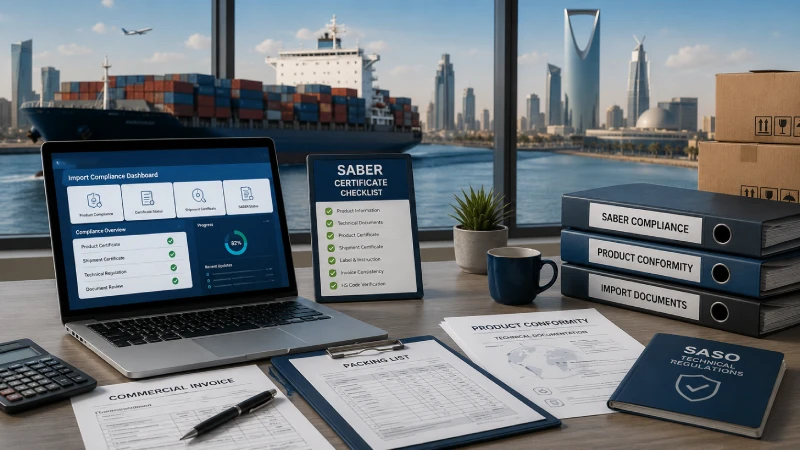
If you are planning shipping from China to Saudi Arabia, SABER should be checked before cargo leaves China, not after the shipment arrives at a Saudi port or airport. For many Saudi imports, the key question is not simply “Do I need a SABER certificate?” but “Which product conformity, shipment certificate, self-declaration, or additional approval path may apply to this product and this specific shipment?” Confirming this early can help avoid customs delays, DDP delivery problems, storage costs, and last-minute document pressure between the Chinese supplier, Saudi importer, customs broker, and freight forwarder.
SABER requirements can vary by product type, HS code, technical regulation, product use, model number, and shipment details. Winsail Logistics can help review the logistics-side document readiness before shipment, but Winsail is not SASO, not the SABER platform, and not an official certification body. Final compliance requirements should always be confirmed by the Saudi importer, SABER platform, an approved certification body, or a qualified Saudi customs broker.
What Is SABER in the Saudi Import Process?
SABER is the electronic platform used in Saudi Arabia’s product conformity and shipment certification process. In practical import communication, buyers often say “SABER certificate,” but this phrase may refer to different steps or documents, such as product registration, a Product Certificate of Conformity, a Shipment Certificate, or a self-declaration for certain non-regulated products.
SASO, the Saudi Standards, Metrology and Quality Organization, is the authority behind Saudi product conformity rules. SABER is the platform used to manage the conformity process electronically. For importers shipping from China, this means that product compliance is not only a customs-office topic. It can affect supplier documentation, product classification, freight booking, DDP feasibility, and final delivery timing.
For example, a shipment of LED lights, electronic accessories, machinery, sanitary products, building materials, or auto parts may require more detailed review than a simple general cargo shipment. Even if the cargo is physically ready in China, the shipment may still face clearance risk if SABER-related steps are incomplete.
Why SABER Matters Before Shipping from China
SABER matters because Saudi customs clearance depends not only on freight documents, but also on whether the product can be legally imported and cleared under the correct compliance path. If the Saudi importer or broker discovers after arrival that a Product Certificate, Shipment Certificate, self-declaration, or additional technical approval is missing, the shipment may be delayed.
This is especially important for importers using DDP shipping from China to Saudi Arabia. In a DDP arrangement, the buyer expects a more complete door-to-door solution, but DDP does not remove the need for accurate product classification and compliance confirmation. If SABER requirements are unclear, the forwarder may not be able to quote reliably, the broker may not be able to clear smoothly, and final delivery to Riyadh, Jeddah, Dammam, or other Saudi destinations may be affected.
SABER should therefore be reviewed before freight booking, especially for regulated or potentially regulated products. The best time to check is before the final commercial invoice and packing list are issued, because product names, model numbers, HS codes, quantities, and consignee details should match across the shipping file.
Product Certificate vs Shipment Certificate: The Practical Difference
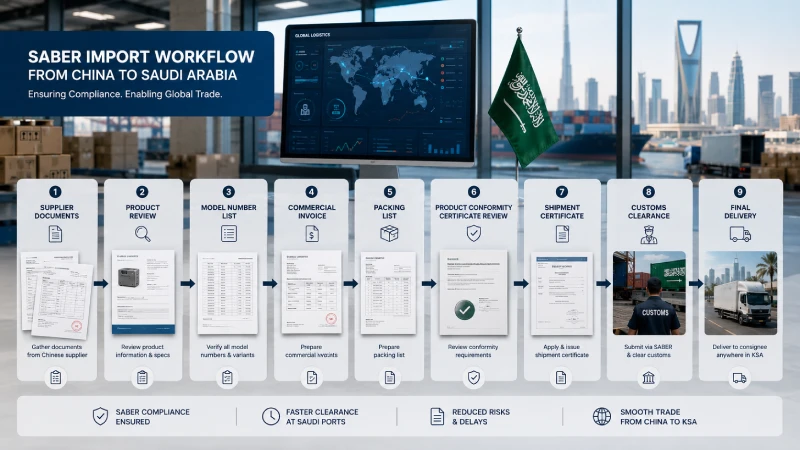
One of the most common mistakes in Saudi import planning is treating all SABER-related documents as the same. In practice, product-level approval and shipment-level approval are different.
A Product Certificate of Conformity is usually connected to the product or model. It helps confirm that the product meets applicable Saudi standards or technical regulations. A Shipment Certificate is connected to a specific shipment or consignment. It normally relates to the invoice, quantity, selected products, model details, and shipment data.
This distinction matters because a product may have a product-level certificate, but each new shipment may still need shipment-level processing. Also, if the invoice description, model number, barcode, quantity, or product data does not match the approved product information, the shipment process may slow down.
| Item | Product Certificate of Conformity | Shipment Certificate |
|---|---|---|
| Main logic | Product or model-level conformity | Specific shipment or consignment |
| Typical purpose | Confirms the product meets applicable requirements | Supports customs clearance for a shipment |
| Key data | Product type, model, standards, technical documents | Invoice, quantity, models, shipment details |
| Timing risk | May take longer if testing or review is needed | May be delayed if product or invoice data is inconsistent |
| Who should confirm | Saudi importer, SABER platform, certification body | Saudi importer, broker, SABER workflow |
For importers, the safest approach is to confirm both product-level and shipment-level requirements before the cargo is released from the Chinese supplier’s factory or warehouse.
Regulated vs Unregulated Products
SABER requirements are often connected to whether a product is regulated or unregulated under Saudi technical regulations. However, importers should not guess based only on a simple product name. The same general product category may include different models, materials, uses, voltage ratings, accessories, or safety risks.
A product described as “lights” may include LED panel lights, floodlights, strip lights, drivers, controllers, and spare parts. A product described as “machine parts” may actually include a complete production machine, an electrical control unit, lifting equipment, or spare components. A vague description can create problems for classification and certificate matching.
Unregulated does not mean “no documents.” It may still require correct product data, self-declaration, and shipment-related processing. The importer or broker should confirm the final requirement based on HS code, product description, technical regulation status, and SABER platform results.
Product Categories That Need Extra Review
Some product groups are more likely to need careful SABER review before shipping from China. This does not mean every product in these categories has the same requirement, but they should be checked carefully before booking.
LED lights and lighting products may need review because of electrical safety, labeling, power ratings, model numbers, and technical standards. If you are arranging shipping LED lights from China to Saudi Arabia, ask the supplier for datasheets, product photos, rating labels, model lists, and any available test reports before shipment.
Electronics and electrical products may also need extra attention. For shipping electronics from China to Saudi Arabia, importers should confirm voltage, plug type, accessories, RoHS-related requirements where applicable, product labels, user manuals, and model consistency.
Machinery and industrial equipment can be more complex because the difference between a complete machine, spare part, electrical cabinet, lifting device, or production-line component may affect classification and documentation. For shipping machinery from China to Saudi Arabia, technical specifications, function descriptions, nameplates, manuals, and HS code confirmation should be prepared early.
Other categories that may need additional review include building materials, sanitary products, auto parts, appliances, tools, textiles, packaging products, and products with safety, energy, labeling, or environmental requirements.
What Chinese Suppliers Should Provide
Chinese suppliers may not be responsible for issuing Saudi SABER certificates, but they are often responsible for providing the technical and commercial documents needed by the Saudi importer, broker, or certification body.
At minimum, the supplier should provide a clear commercial invoice and packing list. The product description should be specific, not generic. Instead of writing “LED light,” the invoice should identify the product type, such as LED panel light, LED floodlight, LED driver, or lighting accessory, with model numbers where available.
For technical review, the supplier should prepare product datasheets, model lists, product photos, rating labels, nameplates, user manuals, test reports, existing certificates, and material or performance information if relevant. For machinery, the supplier should provide the function, power, dimensions, operating use, manual, and product photos. For electronics, the supplier should provide voltage, wattage, plug type, accessories, labels, and model details.
| Document / Information | Why It Matters |
|---|---|
| Commercial invoice | Supports shipment value, product name, quantity, and consignee data |
| Packing list | Confirms cartons, weight, volume, and packaging details |
| Product datasheet | Helps technical review and product identification |
| Model number list | Helps match product and shipment certificate data |
| Product photos | Helps confirm appearance, label, and actual goods |
| Rating label / nameplate | Important for electrical and mechanical products |
| Test reports or certificates | May support conformity review if accepted |
| User manual | Shows intended use, safety details, and specifications |
| HS code suggestion | Useful reference, but Saudi-side confirmation is still needed |
The importer and broker should not rely only on supplier-provided HS codes. HS code suggestions from China are useful, but final Saudi import classification should be checked locally.
What the Saudi Importer or Broker Should Confirm
The Saudi importer or qualified customs broker should confirm whether the product is regulated or unregulated, whether a Product Certificate of Conformity is needed, whether a Shipment Certificate is required for the specific consignment, and whether any additional approvals, labels, or technical documents apply.
This is especially important when the buyer asks for DDP service. A freight forwarder can help organize the shipping plan, but the compliance responsibility must be clear. If the importer expects the forwarder to handle door-to-door shipping while the SABER requirement is still unknown, the quotation may be incomplete or risky.
For smoother Saudi Arabia customs clearance, the importer should confirm the SABER path before the goods leave China. The broker should also check whether invoice descriptions, HS codes, certificate data, and product models are consistent.
SABER Requirement Checklist Before Cargo Leaves China
Use the checklist below before arranging pickup, warehouse loading, or vessel/flight booking.
| Checkpoint | What to Verify | Responsible Party |
|---|---|---|
| Product name | Is the product description specific enough? | Supplier + importer |
| HS code | Has the Saudi-side HS code been checked? | Importer / broker |
| SABER classification | Is the product regulated or unregulated? | Importer / SABER / certification body |
| Product Certificate | Is product-level conformity approval required? | Importer / certification body |
| Shipment Certificate | Is shipment-level certification required? | Importer / broker |
| Extra approvals | Are labels, energy, G-Mark, RoHS, QM, or other rules relevant? | Importer / certification body |
| Supplier documents | Are datasheets, photos, labels, model lists, and reports ready? | Supplier |
| Invoice consistency | Do invoice, packing list, models, quantities, and consignee match? | Supplier + forwarder |
| DDP feasibility | Can DDP be quoted based on confirmed compliance? | Importer + forwarder + broker |
| Shipping timing | Should cargo wait until the SABER path is clear? | Importer + forwarder |
This checklist is not a replacement for official confirmation, but it helps reduce avoidable delays.
Common SABER Mistakes That Delay Shipments
The first common mistake is checking SABER only after cargo arrives in Saudi Arabia. At that point, the buyer has fewer options, and storage or delivery delays may already be building up.
The second mistake is using vague product descriptions. Terms like “accessories,” “parts,” “lighting,” “tools,” or “machine” may not be enough for classification. Saudi brokers and certification bodies usually need clear product details.
The third mistake is assuming that a freight forwarder can issue SABER certificates. Winsail can help coordinate documents and logistics planning, but official certificates must be handled through the proper SABER and conformity-assessment channels.
The fourth mistake is quoting DDP before confirming compliance feasibility. DDP service depends on both logistics and import readiness. If product conformity requirements are unclear, DDP cost, timing, and responsibility may change.
The fifth mistake is mismatch. If the certificate shows one model number, the invoice shows another, and the packing list uses a generic product name, the shipment may face unnecessary review.
How Winsail Can Help Before Shipment
Winsail Logistics helps importers reduce logistics-side risk before cargo leaves China. Our team can review whether the commercial invoice, packing list, product description, carton data, shipment volume, and destination details are ready for Saudi import coordination. We can also help remind Chinese suppliers to prepare datasheets, model lists, product photos, labels, manuals, and available test reports.
For DDP or door-to-door requests, Winsail can help discuss whether the shipment appears suitable for DDP planning based on cargo type, document readiness, and importer/broker confirmation. If the product may require SABER review, we can coordinate with the Saudi importer or broker before booking, so the shipping plan does not move ahead blindly.
However, Winsail does not issue SABER certificates, does not approve product conformity, and does not replace SASO, SABER, approved certification bodies, or Saudi customs brokers. Our role is to support freight planning, document coordination, and pre-shipment logistics review.
Final Advice for Saudi Importers
SABER should be treated as a pre-shipment planning issue, not a last-minute customs problem. Before shipping goods from China to Saudi Arabia, confirm the product classification, supplier documents, certificate logic, shipment certificate requirements, and DDP feasibility.
If your shipment includes LED lights, electronics, machinery, building materials, auto parts, appliances, or other products that may fall under Saudi technical regulations, start the review early. Ask the Chinese supplier for detailed technical documents, ask the Saudi importer or broker to confirm SABER requirements, and make sure the invoice and packing list match the final certificate path.
Planning a shipment from China to Saudi Arabia? Send Winsail your product name, invoice, packing list, product photos, HS code if available, cargo volume, weight, and destination city. We can help review the logistics-side document readiness, flag possible SABER-related coordination risks, and plan a smoother freight, customs, and delivery process before cargo leaves China.
FAQ
What is SABER for Saudi imports?
SABER is the electronic platform used in Saudi Arabia for product conformity and shipment certification workflows. It helps manage product registration, conformity assessment, self-declaration, and shipment-related certification depending on product classification.
Is SABER the same as SASO?
No. SASO is the Saudi Standards, Metrology and Quality Organization. SABER is the electronic platform used in the conformity and certification process.
Do all Saudi imports from China need SABER?
Many imported products must be processed through SABER-related workflows, but the exact requirement depends on product classification, HS code, regulation status, and shipment details. The Saudi importer or broker should confirm the final requirement.
What is the difference between a Product Certificate and a Shipment Certificate?
A Product Certificate is usually product or model-level. A Shipment Certificate is connected to a specific consignment and shipment data such as invoice, quantity, and selected products.
Can Winsail issue SABER certificates?
No. Winsail is not an official certification body and does not issue SABER certificates. Winsail can help review logistics documents, coordinate with suppliers, and support pre-shipment planning.
Should SABER be checked before or after shipping?
SABER should be checked before shipping. Waiting until cargo arrives in Saudi Arabia can increase the risk of customs delay, storage cost, and final delivery disruption.
What documents should the Chinese supplier prepare?
The supplier should prepare the invoice, packing list, product datasheet, model list, product photos, labels, manuals, test reports, and existing certificates where available.
How does SABER affect DDP shipping?
DDP shipping depends on customs and compliance readiness. If SABER requirements are unclear, DDP quotation, clearance timing, and delivery responsibility may become uncertain.
