

If you are comparing logistics options for shipping from China to Saudi Arabia, DDP can look very attractive at first. One supplier or freight partner quotes one price, arranges pickup in China, handles international freight, supports customs clearance, includes duty and VAT arrangements, and delivers the cargo to your Saudi address. For many importers, this sounds easier than managing a supplier, forwarder, customs broker, tax process, and local trucker separately. But DDP is not suitable for every product or every consignee. Before you choose DDP shipping from China to Saudi Arabia, you should understand the customs, certificate, cargo value, duty, VAT, and delivery risks that may affect the shipment.
Why DDP Is Attractive for Saudi Importers
DDP is popular because it simplifies the buying process. A Saudi importer may not want to coordinate export declaration in China, air or sea freight, Saudi customs procedures, duty payment, VAT handling, and last-mile delivery separately. With a well-managed DDP solution, the importer can focus more on purchasing, inventory planning, and sales.
This is especially useful for small and medium-sized importers, e-commerce sellers, trading companies, and buyers importing from multiple Chinese suppliers. If the cargo is standard, the product information is clear, and the documents are complete, DDP can reduce communication pressure and help the buyer understand the expected landed cost before shipment.
However, convenience should not be confused with zero risk. A professional DDP quote should be based on cargo review, not only on weight and CBM. If a forwarder offers the same DDP solution for every product without checking HS code, cargo value, certificates, or destination delivery conditions, the importer should be careful.
Why DDP Is Not Suitable for Every Product
DDP becomes risky when the cargo requires special approvals, product conformity certificates, importer-side registration, or sensitive handling. Saudi Arabia has different import requirements depending on product category, HS code, technical standard, and end use. Electrical goods, lighting products, machinery, auto parts, chemicals, cosmetics, batteries, wireless devices, food-contact goods, toys, and branded products may need additional checks before DDP can be confirmed.
For example, a shipment described only as “accessories” may include cables, chargers, small electronics, plastic items, and branded parts. Each product may have a different HS code and compliance requirement. If the forwarder only receives total carton quantity, weight, and volume, the DDP risk is much higher.
This is why Winsail does not treat DDP as a one-size-fits-all solution. The better approach is to review the product, documents, certificate status, value, shipping mode, and Saudi delivery address before confirming whether DDP is practical.
Main Customs Risks in Saudi DDP Shipments
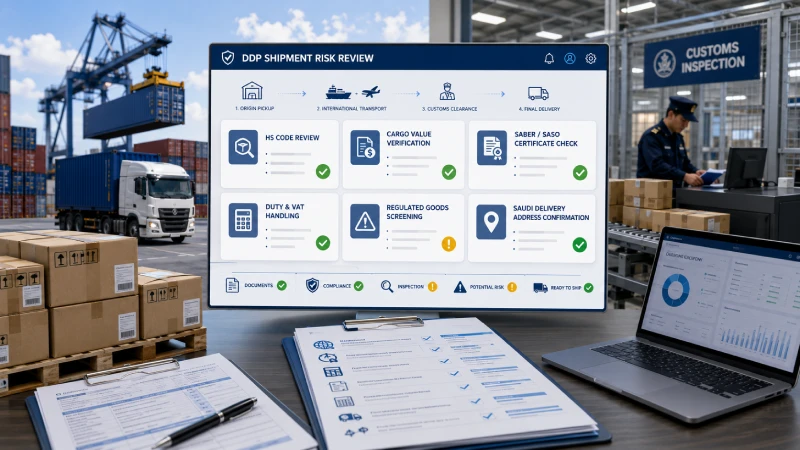
Customs risk often starts with unclear cargo information. Saudi customs clearance depends on accurate documents, reasonable HS classification, correct value declaration, and product compliance. If any part is inconsistent, the shipment may face delay, additional charges, inspection, document amendment, or even clearance rejection.
One common issue is vague product description. Terms such as “spare parts,” “tools,” “samples,” “electronics,” or “general goods” are not enough for customs-risk review. A better description should explain what the item is, what it is made of, how it is used, whether it has a brand or model, and whether it contains batteries, liquids, powders, magnets, wireless modules, or regulated components.
HS code risk is also important. The HS code affects duty rate, VAT calculation, customs control, and certificate requirements. If the Chinese supplier uses one HS code, the Saudi side uses another, and the invoice uses a vague description, the shipment may be questioned during Saudi Arabia customs clearance.
Cargo value is another sensitive point. DDP should never be treated as a way to hide duty or VAT. The commercial invoice should reflect the real transaction value, with consistent quantity, unit price, product name, model, and currency. Under-declared value may reduce the quote on paper, but it increases customs risk and may create serious problems for the importer.
| Risk Area | What Can Go Wrong | How to Reduce the Risk |
|---|---|---|
| Cargo description | Customs cannot identify the product clearly | Provide product name, photo, material, use, and model |
| HS code | Duty, VAT, or certificate requirement may be wrong | Review HS code before shipment |
| Cargo value | Value may be questioned by customs | Use accurate invoice value and consistent records |
| Mixed cargo | One restricted item delays the full shipment | Provide item-level packing list |
| Delivery address | Truck delivery may fail or cost more | Confirm full address and unloading conditions |
SABER / SASO Certificate Risks
For many Saudi imports, product conformity is a key risk area. Importers should not assume that DDP removes the need for compliance. If the product requires SABER or SASO-related documentation, this must be checked before the cargo leaves China. For regulated products, the importer may need product-level and shipment-level conformity documents, depending on the product type and applicable rules.
A common problem is certificate mismatch. The certificate may show one model, but the actual goods show another. The invoice may use a different brand name. The HS code may not match the certificate record. The packing list may include additional products that were not covered. These mismatches can create delays even if the freight itself is arranged correctly.
Another risk appears in multi-supplier consolidation. A Saudi buyer may collect goods from Yiwu, Guangzhou, Shenzhen, Ningbo, Foshan, or other Chinese cities. Most items may be simple, but one carton may contain electrical goods, lighting products, chargers, toys, or other regulated items. If these are not identified early, the entire shipment may be affected.
Before choosing DDP, importers should review whether a SABER certificate for Saudi imports is needed, who is responsible for preparing it, and whether the certificate information matches the actual cargo.
Duty and VAT Handling Risks Under DDP
DDP usually means the seller or logistics provider takes responsibility for delivering the goods to the agreed destination with customs-related costs included. But in practice, the scope must be written clearly. Does the quote include customs duty? Does it include VAT? Does it include customs declaration fees, inspection fees, certificate fees, storage, delivery appointment costs, or remote-area delivery?
If the DDP quote only says “all included” without explaining the scope, disputes may happen later. Importers should ask what is included, what is excluded, and what may change if the cargo details are different from the original declaration.
VAT is especially important. A DDP freight solution is not the same as a tax-planning strategy. Whether the Saudi importer can record, recover, or manage VAT depends on the import structure, local accounting treatment, and consignee arrangement. Winsail can support freight and customs-risk coordination, but importers should confirm tax treatment with their local accountant or tax advisor.
A professional DDP review should also check the required Saudi Arabia import documents, including commercial invoice, packing list, bill of lading or air waybill, certificate of origin if applicable, product certificates, and consignee information.
Regulated Goods and Sensitive Cargo Risks
Some cargo categories need extra review before DDP can be accepted. These include electronics, electrical products, lighting, machinery, spare parts, auto parts, batteries, liquids, powders, chemicals, cosmetics, wireless devices, branded goods, children’s products, and project equipment.
Sensitive cargo can create both transport risk and customs risk. For example, batteries may be restricted by airline rules. Liquids and powders may require additional product information. Wireless devices may need technical approval. Branded goods may require authorization or proof of authenticity. Used or refurbished goods may face different customs questions than new commercial goods.
DDP is not suitable for counterfeit goods, unclear brand goods, or cargo with incomplete product information. If the importer cannot provide a clear product list, invoice, and product photos, Winsail may recommend a different shipping structure or ask for more information before confirming feasibility.
Destination Delivery Address Risks
DDP risk does not end after customs clearance. Final delivery in Saudi Arabia can also create problems if the address and unloading conditions are unclear.
A delivery to a warehouse in Riyadh, Jeddah, or Dammam is different from delivery to a remote project site, residential address, industrial zone, marketplace warehouse, or construction location. Some addresses require appointment booking, site permits, receiver contact details, forklift availability, labor unloading, or gate access approval.
For bulky cargo, heavy machinery, furniture, building materials, or palletized goods, the importer should confirm whether the destination can receive a truck. If there is no forklift, no unloading team, or no responsible contact person, final delivery may fail even when the customs process is complete.
This is why a DDP quote should not be based only on “Saudi Arabia door delivery.” Winsail needs the full city, district, address type, receiver contact, unloading condition, and any delivery restrictions before confirming the final delivery plan.
DDP Air vs DDP Sea: Different Risk Profiles
DDP air and DDP sea have different risk patterns. Air freight from China to Saudi Arabia is faster, but it gives less time to correct documents before arrival. It is also more sensitive to cargo restrictions, dimensional weight, battery rules, airline acceptance, and urgent customs handling. DDP air may be suitable for smaller, urgent, compliant cargo, but it is not ideal for unclear or sensitive goods.
Sea freight from China to Saudi Arabia is usually better for larger or bulkier shipments. It may be more cost-effective for FCL, LCL, furniture, machinery, building materials, and commercial inventory. However, sea DDP may involve longer transit time, port handling, storage exposure, demurrage risk, mixed cargo complexity, and final truck delivery planning.
Choosing between DDP air and DDP sea should depend on cargo type, urgency, volume, value, certificate status, and delivery address. A low price should not be the only decision factor.
What Winsail Needs Before Confirming DDP
Before Winsail confirms whether DDP is suitable, the importer should provide complete cargo information. This helps reduce customs and service-scope risk before the shipment leaves China.
Winsail usually needs:
- Product name and product photos
- HS code if available
- Material, function, brand, and model
- Quantity, carton count, gross weight, and CBM
- Supplier address in China
- Commercial invoice and packing list
- Battery, liquid, powder, chemical, magnetic, or DG status
- SABER or SASO certificate status if applicable
- Destination city and full delivery address
- Consignee company details
- Required delivery timeline
- Whether insurance is needed
The more complete the information, the more accurate the DDP review will be. If the cargo is mixed, Winsail needs an item-level list, not only total cartons and weight.
When DDP Is Usually Suitable
DDP may be suitable when the cargo is standard, non-sensitive, clearly described, properly valued, and supported by complete documents. It is also more practical when certificate requirements have been checked before shipment and the final delivery address is clear.
DDP is often useful for regular commercial goods, small to medium shipments, e-commerce inventory, repeat shipments with stable product models, and buyers who want a simpler delivery process. It can also work well when the importer does not have a strong local customs team but can still provide accurate product and consignee information.
The key point is that DDP should be confirmed after cargo review, not assumed automatically.
When Other Terms May Be Safer
In some situations, DAP, CIF, CFR, port-to-port, or consignee-managed clearance may be safer than DDP.
DAP may be better when the importer wants the forwarder to manage transportation and delivery but prefers to control customs declaration, duty, and VAT locally. CIF or CFR may be suitable when the Saudi buyer already has a trusted customs broker and wants to manage clearance after arrival. Port-to-port may be better for large project cargo, regulated goods, high-value equipment, or shipments where the consignee must control import records.
Consignee-managed clearance may also be safer when the product requires special licenses, product registration, government approval, technical review, or specific tax handling. In these cases, forcing the cargo into a DDP model may create more risk than convenience.
How Winsail Helps Reduce DDP Risk
Winsail’s role is not to promise “guaranteed clearance” for every shipment. A responsible DDP strategy starts with checking whether DDP is feasible.
Winsail helps importers review cargo details, shipping mode, HS code logic, certificate risk, document readiness, duty and VAT scope, and Saudi delivery conditions. If DDP is suitable, Winsail can coordinate pickup in China, export handling, international freight, destination-side customs support, and final delivery planning. If DDP is not suitable, Winsail can recommend DAP, CIF, CFR, port-to-port, or consignee-managed clearance as a safer alternative.
This risk-aware approach protects both the importer and the shipment. A cheaper DDP quote is not always the better choice if it ignores customs, SABER, value, VAT, or address risks.
Final Checklist Before Choosing DDP to Saudi Arabia
Before accepting a DDP quote, ask these questions:
- Is the product description clear?
- Is the HS code reasonable?
- Is the invoice value accurate?
- Are SABER or SASO requirements confirmed?
- Are duty and VAT responsibilities clearly written?
- Is the destination address complete?
- Are delivery conditions confirmed?
- Are quote exclusions clearly stated?
- Has the forwarder checked whether DDP is suitable for this product?
- Would DAP, CIF, CFR, or consignee-managed clearance be safer?
DDP can be a strong solution for China-to-Saudi shipments when the cargo is suitable and the risks are reviewed early. But it should never be chosen blindly. If you are unsure whether your shipment is suitable for DDP, send Winsail your product details, invoice, packing list, cargo photos, weight, CBM, and Saudi delivery address. Winsail can help you review the practical risks before shipment and recommend the most suitable shipping plan.
FAQ
Is DDP shipping safe for Saudi Arabia imports?
DDP can be safe when the product, documents, certificates, value, and delivery address are clear. It becomes risky when the cargo is sensitive, regulated, under-declared, or poorly described.
Can all products be shipped DDP from China to Saudi Arabia?
No. Some products require special approval, certificates, licenses, or consignee-side clearance. DDP must be reviewed case by case.
Do I still need SABER for DDP shipping?
If your product falls under SABER or SASO-related requirements, DDP does not remove that obligation. Certificate requirements should be checked before shipment.
Who pays duty and VAT under DDP?
Under a DDP arrangement, duty and VAT handling should be included according to the agreed scope. However, the quote must clearly state what is included and what is excluded.
Is DDP air riskier than DDP sea?
DDP air is faster but less forgiving because there is less time to fix document or compliance issues. DDP sea is better for larger cargo but may involve port, storage, and delivery risks.
What should I send Winsail for a DDP review?
Send product name, photos, HS code if available, invoice, packing list, weight, CBM, supplier location, certificate status, and full Saudi delivery address.
