

If your cargo is moving to Jubail, Jubail Industrial City, or nearby Eastern Province industrial areas, you should not plan it as a normal Saudi city delivery. For a broader overview of routes, costs, customs, and shipping methods, you can first review our main guide on shipping from China to Saudi Arabia. This article focuses only on Jubail-bound shipments, where the real challenge is often not just ocean freight, but routing choice, customs readiness, site delivery, unloading, and project coordination.
Jubail is different from Riyadh, Jeddah, and even Dammam. It is one of Saudi Arabia’s most important industrial destinations, with large factories, petrochemical facilities, construction projects, energy-related operations, manufacturing zones, and heavy industrial buyers. Many shipments to Jubail involve machinery, steel structures, pipes, building materials, electrical equipment, industrial components, production line parts, or oversized cargo.
That means the importer’s key question is not simply: “How much does shipping from China to Saudi Arabia cost?” A better question is: “Which Saudi entry route should I use, what cargo handling risks should I prepare for, and how can the shipment reach the Jubail site without delay?”
Why Jubail Shipments Need Different Planning
Shipping to Riyadh usually means inland trucking to a commercial warehouse, distribution center, or retail-related destination. Shipping to Jeddah often serves western Saudi Arabia through a Red Sea gateway. Dammam is a major Eastern Province port and logistics hub for containerized cargo. Jubail, however, is more destination-specific and industrial.
For Jubail shipments, final delivery may involve a plant gate, construction site, industrial yard, factory expansion project, refinery-related supplier, or project contractor. The receiving location may require delivery appointment booking, driver registration, safety rules, unloading equipment, special access instructions, or coordination with a site engineer.
This is why Jubail shipments should be planned from the final delivery address backward. Before choosing a shipping method, the freight forwarder should understand the cargo size, weight, packaging, unloading method, consignee requirements, and whether the cargo will go to Jubail Commercial Port, through Dammam, or to an industrial site after customs clearance.
Main Sea Freight Routing Options from China to Jubail
For most importers, sea freight from China to Saudi Arabia is the main shipping method for Jubail-bound cargo, especially for FCL containers, building materials, machinery, heavy equipment, and industrial supplies. The most common origin ports in China may include Shanghai, Ningbo, Shenzhen, Guangzhou, Qingdao, Tianjin, Xiamen, or other ports depending on the supplier’s location.
There are two practical routing approaches.
The first option is shipping from China to Dammam, then trucking the cargo to Jubail. This is often suitable for standard FCL shipments, general industrial cargo, building materials, packed machinery, and goods that can move smoothly by container truck or flatbed after customs clearance. Dammam is usually a strong choice when container service availability, sailing frequency, and established customs handling are more important than direct arrival near Jubail.
The second option is Jubail-oriented routing, which may involve Jubail Commercial Port or industrial port arrangements depending on cargo type, carrier service, consignee requirement, and terminal capability. This can be useful for certain industrial shipments, project cargo, breakbulk cargo, or cargo linked directly to Jubail-area plants. However, direct Jubail routing should not be assumed automatically. It must be checked case by case based on sailing schedule, equipment availability, cargo size, customs process, and final delivery conditions.
Dammam vs Jubail: Which Route Should You Choose?
The best route depends on your cargo and delivery address.
Use Dammam routing when the cargo is standard containerized freight, such as 20GP, 40GP, 40HQ, or regular LCL cargo. Dammam can also be suitable when the importer already has a customs broker, warehouse, or trucking arrangement in the Eastern Province. If the cargo is not oversized and the final delivery from Dammam to Jubail is simple, Dammam may offer better flexibility.
Use Jubail-oriented routing when the cargo is linked to Jubail Industrial City, an industrial plant, a project site, or heavy cargo delivery. This option may be more relevant for oversized machinery, steel structures, project materials, plant equipment, or cargo requiring special handling. The main advantage is not always lower freight cost. The real value may be better alignment with the final industrial destination.
| Shipping Situation | Better Routing Option | Planning Note |
|---|---|---|
| Standard FCL container | Dammam + truck to Jubail | Often easier to arrange and compare |
| Machinery in wooden cases | Dammam or Jubail | Check weight, dimensions, and unloading |
| Oversized industrial cargo | Case-by-case | May need flat rack, open top, or project cargo handling |
| Building materials for project site | Dammam + delivery planning | Confirm unloading and site storage |
| Cargo for Jubail Industrial City | Dammam or Jubail | Final address and site rules decide the route |
If you are unsure which routing option is better, send the cargo dimensions, weight, China loading address, and final Jubail delivery location before booking. A small difference in routing can affect customs coordination, trucking cost, unloading preparation, and project delivery timing.
Best Shipping Methods for Jubail-Bound Cargo
FCL Shipping to Jubail
For industrial buyers, FCL shipping from China to Saudi Arabia is usually the cleanest option when cargo volume is enough for a full container. FCL reduces handling, keeps goods together, simplifies delivery planning, and gives the importer better control over documentation and cargo security.
FCL is suitable for machinery, packed industrial parts, construction materials, electrical equipment, tools, pipes, fittings, panels, and factory supplies. If the cargo is sensitive, heavy, fragile, or part of a project schedule, FCL is usually safer than mixing cargo with other shipments.
Flat Rack and Open Top Containers
Not all industrial cargo can fit inside a standard container. If the cargo is too tall, too wide, too long, or cannot be loaded through container doors, flat rack or open top containers may be required.
Flat rack containers are often used for oversized machinery, heavy frames, long steel structures, industrial platforms, tanks, or equipment with irregular dimensions. Open top containers may be used when cargo must be loaded from above by crane.
For these shipments, the forwarder must check more than freight rate. Important details include cargo drawing, lifting points, center of gravity, lashing method, over-height or over-width limits, road restrictions, port handling requirements, and delivery site access in Jubail.
Heavy Cargo, Machinery, and Project Materials
For heavy cargo and machinery, the shipping plan should be closer to project cargo shipping than normal container freight. A small mistake in package dimensions, weight distribution, or unloading responsibility can create serious delays.
Before shipment, the buyer should confirm the weight of each package, not only the total shipment weight. The forwarder also needs cargo photos, packing details, lifting diagrams, forklift pocket design, and the final delivery address. If the cargo needs a crane, low-bed trailer, side-loader, or special unloading team, this should be planned before the container leaves China.
Many project delays happen because the cargo arrives in Saudi Arabia before the site is ready to receive it. For Jubail industrial deliveries, the receiving team should confirm gate access, unloading date, equipment availability, safety requirements, and whether the container must be returned within a specific free-time period.
Jubail Industrial City Delivery Considerations
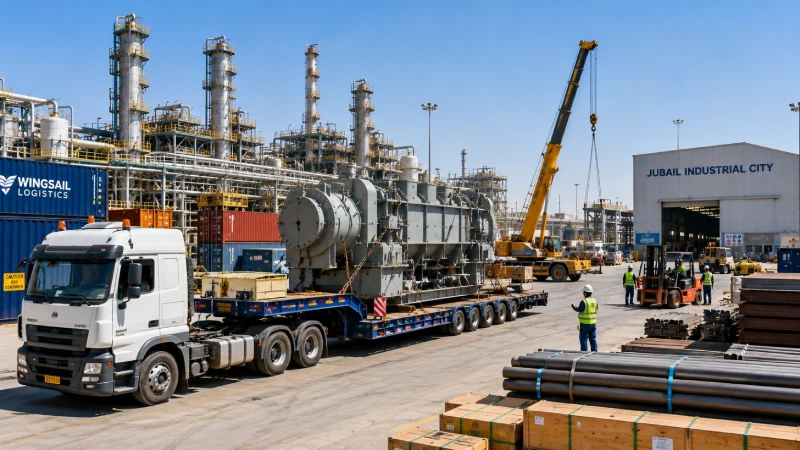
Jubail Industrial City is not a typical commercial delivery destination. Many receivers operate inside controlled industrial zones or project areas. This means delivery planning should include site-level details, not just port arrival.
The importer should confirm whether the cargo will be delivered to a factory warehouse, open yard, construction site, contractor storage area, or production facility. Each destination may have different rules. Some sites require delivery appointments. Some require driver information in advance. Some require safety induction, PPE, gate pass approval, or restricted delivery hours.
Unloading is another major issue. A freight quote may include delivery to site, but not necessarily unloading from the truck or container. For standard containers, the consignee may need a forklift or unloading team. For heavy machinery, a crane may be required. For long cargo, enough turning space and ground clearance are needed. For flat rack cargo, the unloading method must be confirmed before dispatch.
The most important rule is simple: do not separate freight planning from site planning. In Jubail, the final 30 kilometers can be more complicated than the ocean freight movement from China.
DDP Shipping to Jubail: Feasible, but Needs Careful Review
Many importers ask whether DDP shipping from China to Saudi Arabia is available for Jubail. The answer is yes, DDP may be feasible, but it depends heavily on cargo type, documentation, importer requirements, and delivery conditions.
DDP can work well for standard commercial cargo, regular FCL shipments, clear HS codes, completed documentation, and accessible delivery addresses. It is often attractive for buyers who want one logistics provider to manage export handling, ocean freight, customs clearance, duty and VAT coordination, and final delivery.
However, DDP for Jubail industrial cargo should be reviewed carefully. Machinery, regulated electrical products, oversized equipment, chemical-related equipment, dangerous goods, or project cargo may require extra checks. SABER requirements, customs valuation, product classification, and importer-of-record responsibility must be clear before quoting DDP.
A good DDP quote should state what is included and excluded. Does it include customs duty and VAT? Does it include SABER support? Does it include port charges, delivery to Jubail, unloading, crane service, waiting time, demurrage, detention, permits, or special truck arrangements? If these items are not clear, the importer may face unexpected charges after arrival.
| Jubail DDP Scenario | Feasibility | Extra Checks Needed |
|---|---|---|
| Standard FCL cargo with clear HS code | Usually feasible | Duty, VAT, delivery address |
| Machinery or production equipment | Needs review | HS code, technical documents, SABER status |
| Oversized cargo | Case-by-case | Truck type, permits, unloading plan |
| Building materials | Often feasible | Product category, packing, site access |
| Dangerous or restricted goods | Requires careful review | MSDS, permits, carrier acceptance |
Customs, SABER, and Documentation Risks
For Jubail-bound industrial shipments, Saudi Arabia customs clearance should be prepared before the cargo departs from China. Many problems start with weak documentation: vague product descriptions, wrong HS codes, incomplete invoices, inconsistent packing lists, missing technical datasheets, or unclear product models.
Industrial shipments often include multiple parts, accessories, spare parts, control units, motors, cables, panels, or mixed materials. Customs and conformity requirements may vary by product category. For some regulated products, SABER product certificates and shipment certificates may be required before clearance can proceed smoothly.
Importers should prepare a complete document package, including commercial invoice, packing list, bill of lading, HS code, product description, country of origin information, importer details, VAT number if applicable, product photos, datasheets, and SABER documents where required. For machinery and heavy cargo, lifting diagrams, equipment specifications, serial numbers, and packing photos can help reduce misunderstanding.
If the shipment includes chemical-related goods, batteries, coatings, lubricants, or other sensitive items, additional documents such as MSDS may be needed. If wooden packing is used, fumigation or wood packaging compliance should also be checked.
Local Delivery and Unloading Planning in Jubail
After customs clearance, the shipment still needs to reach the final Jubail delivery address. This stage should be planned with the same attention as the sea freight route.
For normal FCL cargo, delivery may use a container truck. For heavy cargo, a low-bed trailer or flatbed may be required. For open top or flat rack cargo, special loading and unloading coordination is often necessary. If the cargo must be unloaded at the site, the consignee should confirm whether a forklift, crane, side-loader, or labor team is available.
The delivery team should also confirm whether the truck can enter the industrial site. Some sites have gate restrictions, height limits, road access issues, or internal safety rules. For long cargo or heavy equipment, the driver may need turning space, stable ground, and a clear unloading area.
Container free time is another important factor. If the consignee cannot unload quickly, detention charges may occur. If the cargo arrives before the project site is ready, storage may be needed. For project shipments, it may be better to arrange staged delivery instead of sending all cargo to the site at once.
| Delivery Item | Why It Matters | Risk If Ignored |
|---|---|---|
| Final delivery address | Determines truck type and route | Wrong routing or failed delivery |
| Site appointment | Controls entry timing | Truck waiting charges |
| Unloading equipment | Required for heavy or oversized cargo | Cargo cannot be discharged |
| Gate access | Important for industrial zones | Delivery refusal or delay |
| Container free time | Affects final cost | Detention or demurrage charges |
| Cargo insurance | Protects high-value industrial goods | Uncovered delivery damage |
Air Freight to Jubail for Urgent Industrial Cargo
Although sea freight is the main method for large Jubail shipments, air freight can be useful when speed is more important than cost. Typical air freight cargo includes urgent spare parts, repair components, production line accessories, samples, replacement parts, or equipment needed during a plant shutdown.
In these cases, the cargo may arrive through a major Saudi airport and then move by truck to Jubail. Air freight is usually not the best option for heavy or bulky cargo, but it can protect a project timeline when downtime costs are high.
For urgent air shipments, the importer should provide accurate dimensions, gross weight, product details, and delivery deadline. If the goods are regulated, customs and SABER requirements still need to be checked.
What Information Is Needed for a Jubail Shipping Quote?
To prepare an accurate quote, Winsail Logistics needs more than a product name and destination city. For Jubail shipments, please provide:
- Supplier city and pickup address in China
- Loading port preference, if any
- Cargo name and product use
- HS code, if available
- Number of packages
- Dimensions and weight per package
- Total CBM and gross weight
- Cargo photos and packing photos
- Whether the cargo is stackable
- Whether the cargo is oversized or overweight
- Preferred shipping method: FCL, LCL, air, flat rack, open top, or breakbulk
- Final delivery address in Jubail or Jubail Industrial City
- Importer details for customs clearance
- SABER status, if applicable
- Required Incoterm: EXW, FOB, CIF, DAP, or DDP
- Whether unloading is needed at destination
- Required delivery deadline
The more complete the information, the easier it is to compare Dammam vs Jubail routing, confirm customs risks, calculate local delivery cost, and avoid unexpected charges.
How Winsail Logistics Supports China-to-Jubail Shipments
Winsail Logistics helps importers, contractors, suppliers, and project buyers plan shipments from China to Jubail with a practical, destination-focused approach. Instead of quoting only ocean freight, we review the full movement from supplier pickup to final delivery.
For standard FCL shipments, we compare port options, sailing schedules, container availability, and delivery plans to Jubail. For industrial cargo, we check package dimensions, cargo weight, loading method, unloading needs, and documentation risks. For DDP requests, we review whether the cargo type, SABER status, HS code, and consignee requirements make DDP realistic.
For heavy cargo, machinery, building materials, and project equipment, we can help plan container type, flat rack or open top feasibility, trucking mode, customs preparation, and final delivery coordination. If the cargo must reach a factory, industrial yard, or project site in Jubail, the delivery plan should be confirmed before departure from China.
Final Advice: Plan the Destination Before the Shipment Leaves China
Shipping from China to Jubail is not just an international freight task. It is a destination delivery project. The right plan should connect China pickup, sea freight routing, Saudi customs clearance, SABER preparation, inland delivery, unloading, and site readiness.
If your cargo is going to Jubail Industrial City or nearby Eastern Province industrial areas, do not make the decision based only on the cheapest ocean freight rate. A lower freight quote can become expensive if the route is wrong, the documents are incomplete, the cargo needs special handling, or the receiving site is not prepared.
Send Winsail Logistics your cargo details, supplier location, package dimensions, destination address, and delivery requirements. Our team can help you compare Dammam and Jubail routing, check DDP feasibility, prepare customs documents, and plan a safer delivery solution for your Jubail-bound shipment.
FAQ
What is the best way to ship from China to Jubail, Saudi Arabia?
For most industrial and commercial cargo, sea freight to Dammam followed by trucking to Jubail is a common option. For oversized, heavy, or project cargo, Jubail-oriented routing or special cargo handling may need to be reviewed case by case.
Should I ship to Dammam or Jubail for Jubail Industrial City delivery?
Dammam is often suitable for standard FCL and general cargo because of established container handling and trucking options. Jubail routing may be better for certain industrial cargo, project shipments, or deliveries closely tied to Jubail Industrial City.
Is DDP shipping available from China to Jubail?
Yes, DDP shipping to Jubail may be available, but it depends on cargo type, HS code, SABER requirements, customs duty, VAT, delivery address, and whether unloading or special truck arrangements are needed.
Can Winsail ship machinery and heavy cargo to Jubail?
Yes. Winsail can help plan machinery, heavy cargo, flat rack, open top, and project cargo shipments from China to Jubail, including routing, documentation, local delivery, and unloading coordination.
Do Jubail shipments require SABER certification?
Some products shipped to Jubail may require SABER product certificates and shipment certificates before customs clearance. Requirements depend on the product category, HS code, and Saudi conformity rules.
What documents are needed for shipping industrial cargo to Jubail?
Common documents include commercial invoice, packing list, bill of lading, HS code, product description, importer details, product photos, technical datasheets, SABER documents if required, and lifting or packing details for machinery.
Can flat rack or open top containers be delivered to Jubail?
Yes, flat rack and open top containers can be used for oversized or heavy cargo, but the shipment must be checked for cargo dimensions, lashing, lifting points, truck access, permits, and unloading method.
Who arranges unloading at Jubail Industrial City?
Unloading responsibility should be confirmed before shipment. It may be handled by the consignee, project contractor, site team, or forwarder as an additional service depending on the quote terms.
How long does sea freight from China to Jubail take?
Transit time depends on the origin port in China, carrier schedule, routing, customs clearance, and final delivery arrangement. Jubail-bound shipments should also allow time for port handling, customs, and site delivery planning.
What information is needed to get a shipping quote to Jubail?
You should provide supplier address, cargo name, HS code if available, package dimensions, gross weight, cargo photos, total CBM, delivery address in Jubail, SABER status, preferred Incoterm, and whether unloading is required.
