
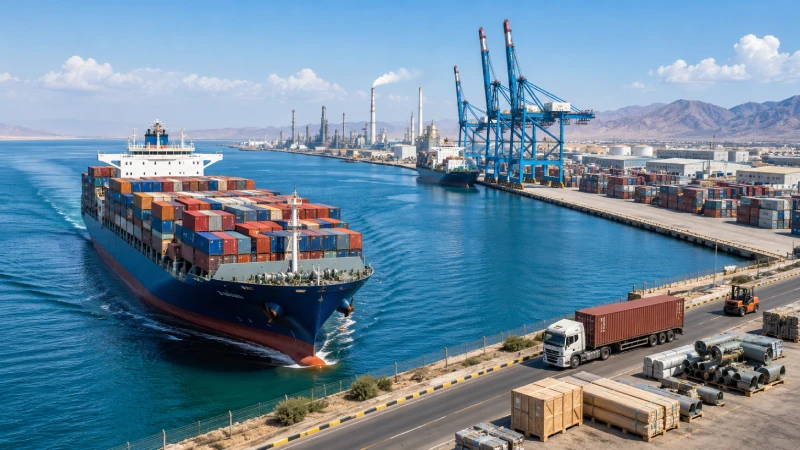
If you are planning shipping from China to Saudi Arabia and your final destination is Yanbu, the shipping decision should not be based only on the ocean freight rate to a Red Sea port. Yanbu is not just another delivery city. It is one of Saudi Arabia’s important western industrial destinations, with many shipments connected to factories, construction projects, energy-related facilities, commercial warehouses, and industrial sites. For importers handling machinery, building materials, spare parts, equipment, or heavy cargo, the real question is not only “How do I ship to Saudi Arabia?” but “How do I plan the right Red Sea route and final delivery to Yanbu?”
Unlike general cargo going to Jeddah for broad market distribution, Yanbu shipments often require more detailed planning before loading in China. Cargo size, packing method, delivery site access, unloading equipment, customs documents, SABER requirements, and DDP feasibility can all affect the final cost and delivery timeline. This guide explains how to plan China-to-Yanbu shipments more accurately and avoid common route, clearance, and site delivery problems.
Why Yanbu Is Different as a Saudi Shipping Destination
Yanbu is located on Saudi Arabia’s western Red Sea coast and is strongly connected with industrial activity. Many importers shipping to Yanbu are not simply sending cartons to a city warehouse. They may be supplying equipment to an industrial plant, delivering materials to a construction site, sending replacement parts to a factory, or moving heavy goods for an engineering project.
This makes Yanbu different from more general Saudi destinations. A shipment to Riyadh may focus heavily on inland trucking from an entry port. A shipment to Jeddah may focus on commercial distribution, warehousing, and access to the western consumer market. But a shipment to Yanbu often requires a more industrial logistics mindset.
Typical cargo shipped from China to Yanbu may include:
- Industrial machinery and production equipment
- Building materials, steel products, pipes, panels, and fittings
- Construction equipment and project materials
- Electrical equipment and control systems
- Spare parts for factories or maintenance teams
- Heavy commercial goods
- Oversized or non-standard cargo requiring special loading
Because of this, the shipping plan should begin with the final delivery point, not only the port of arrival.
Yanbu vs Jeddah: Which Route Makes More Sense?
For many importers, the first comparison is whether cargo should be routed through a Red Sea gateway serving Yanbu directly or through Jeddah with inland delivery afterward. There is no single correct answer. The best route depends on cargo type, carrier availability, customs arrangement, delivery deadline, and the final receiving site.
Yanbu routing may be more suitable when the consignee, factory, project site, or warehouse is located in Yanbu or nearby western industrial areas. This can be especially important for heavy cargo, machinery, or building materials where inland trucking distance and handling conditions may significantly affect total landed cost.
Jeddah may still be better in some situations. Jeddah often has stronger commercial shipping frequency, broader logistics infrastructure, more warehouse options, and established customs handling for many importers. If the cargo is general commercial goods or the consignee’s broker works mainly through Jeddah, routing via Jeddah may still be practical.
The right decision should compare more than port charges. Importers should consider:
| Decision Factor | Yanbu-Focused Routing | Jeddah Routing |
|---|---|---|
| Best for | Industrial sites, heavy goods, project cargo | Commercial cargo, general distribution |
| Main concern | Site delivery and unloading | Port frequency and distribution access |
| Cargo type | Machinery, materials, equipment | Retail, trading, mixed commercial goods |
| Risk factor | Delivery site readiness | Inland trucking distance to Yanbu |
| Planning priority | Port-to-site coordination | Carrier schedule and warehouse access |
For industrial cargo, the lowest ocean rate is not always the best route. A slightly better port rate can become expensive if the final delivery to Yanbu requires extra trucking, waiting time, crane rental, or site coordination.
Sea Freight from China to Yanbu and Red Sea Gateways
For most Yanbu-bound industrial cargo, sea freight is the most common option. Importers can choose FCL, LCL, or project cargo shipping depending on cargo volume, weight, dimensions, and handling requirements. If you are comparing broader Red Sea shipping options, Winsail can also support sea freight from China to Saudi Arabia for different Saudi destinations.
FCL shipping is usually suitable for medium to large shipments. A 20GP container may be used for dense cargo such as machinery parts, tiles, stone, metal fittings, or heavy building materials. A 40GP or 40HQ container may be better for lighter but bulkier goods such as panels, equipment accessories, cartons, or commercial materials.
LCL shipping can be suitable for smaller cargo volumes, especially spare parts, samples, boxed equipment, and low-volume commercial shipments. However, LCL cargo receives more handling during consolidation and deconsolidation. For industrial goods, this means packaging must be strong enough to protect the cargo during multiple handling points.
Project cargo is needed when the goods cannot fit into a standard container or require special equipment. This may include oversized machinery, long steel structures, heavy single-piece equipment, large tanks, industrial modules, or cargo requiring flat rack, open top, breakbulk, or special lifting arrangements.
Common China origins for Yanbu shipments include Shanghai, Ningbo, Shenzhen, Guangzhou, Qingdao, Tianjin, and Yiwu. The best origin port depends on supplier location, cargo type, container availability, and sailing schedule. For heavy or oversized cargo, the planning should start earlier because loading method, lashing, port handling, and trucking from the factory to the China port may require special coordination.
LCL vs FCL vs Project Cargo for Yanbu Shipments
The shipping mode should be selected based on cargo risk, not only cargo volume.
| Shipping Mode | Best For | Main Advantage | Main Risk |
|---|---|---|---|
| LCL | Spare parts, small equipment, boxed goods | Lower cost for small volumes | More handling and longer consolidation time |
| FCL | Machinery, building materials, commercial cargo | Better control and less handling | Requires enough volume or value |
| Project Cargo | Oversized, heavy, non-containerized goods | Customized loading and delivery plan | Higher planning complexity |
Choose LCL when the cargo is small, well packed, and not highly fragile. This can work well for industrial spare parts, cartons, samples, small tools, or replacement components.
Choose FCL when the cargo has higher value, higher damage risk, larger volume, or needs better loading control. For many Yanbu importers, FCL is often the safer choice because it reduces cargo handling and allows better control over packing, loading, and sealing.
Choose project cargo when the shipment exceeds standard container limits or requires special lifting and securing. For example, if a machine is too tall for a standard container, too heavy for normal forklift handling, or requires crane loading, the shipment should be planned as project cargo from the beginning.
Inland Delivery Planning to Yanbu
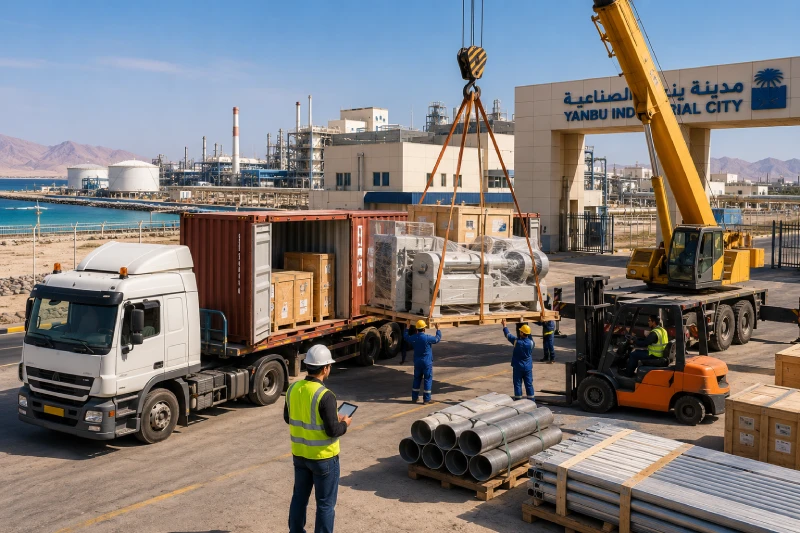
For Yanbu shipments, inland delivery planning is one of the most important parts of the logistics process. The cargo may need to be delivered to Yanbu Industrial City, a construction site, a factory warehouse, a contractor’s storage yard, or a plant maintenance area. Each delivery point may have different requirements.
Before shipment, importers should confirm:
- Exact delivery address in Yanbu
- Receiver contact person and phone number
- Site working hours
- Truck entry rules
- Gate pass or appointment requirements
- Whether forklift, crane, or unloading labor is available
- Whether the cargo can be unloaded from the side, rear, or top
- Whether the site can accept container delivery
- Whether there are road access limits for heavy trucks
Many delivery delays happen after customs clearance, not before. A container may already be released, but the truck cannot enter the site because the receiver has not prepared unloading equipment. Heavy cargo may arrive at the gate, but the site has no crane. A wooden crate may be too large for the warehouse entrance. These problems can create waiting charges, redelivery costs, and project delays.
For machinery and heavy goods, Winsail recommends confirming the unloading method before the cargo leaves China. If the cargo needs a crane, low-bed trailer, side-loader, or special truck, this should be arranged in advance.
Shipping Building Materials, Machinery, and Heavy Goods to Yanbu
Many Yanbu shipments involve industrial or construction-related cargo. This makes packaging and cargo description especially important.
For shipping building materials from China to Saudi Arabia, importers should pay close attention to weight, pallet strength, breakage risk, and loading method. Tiles, stone, panels, pipes, steel materials, sanitary ware, and fittings should be packed for long-distance sea transport and inland trucking. Heavy pallets should be clearly labeled, and fragile materials should not be loaded under heavy cargo.
For shipping machinery from China to Saudi Arabia, the packing requirements are different. Machinery may need wooden crates, moisture protection, rust prevention, shock protection, lifting marks, and center-of-gravity labels. If the machine has electronic components, vibration and humidity protection should also be considered.
For spare parts and industrial components, accuracy is especially important. A wrong HS code, unclear product description, or missing technical document can delay customs clearance. Since spare parts may be needed for factory maintenance or urgent production recovery, importers should prepare documents early and avoid vague descriptions such as “machine parts” or “metal goods” when more specific information is available.
Is DDP Shipping from China to Yanbu Feasible?
DDP can be possible for some Yanbu shipments, but it must be reviewed carefully. For suitable cargo, DDP shipping from China to Saudi Arabia can help the buyer simplify the process because the freight forwarder coordinates export, international transport, customs clearance, tax and duty handling, and delivery to the agreed destination.
However, DDP to Yanbu is not the same as DDP to a simple city address. The delivery point may be an industrial site with gate control, safety rules, unloading restrictions, or appointment requirements. This means the DDP quote must include not only customs clearance but also final delivery conditions.
DDP may work better when:
- Product classification is clear
- SABER requirements are confirmed
- Cargo is not restricted or highly regulated
- The delivery address is complete
- The receiver can assist with site entry and unloading
- Cargo dimensions and weight are accurate
- The importer understands what is included and excluded
DDP needs extra review for oversized machinery, electrical equipment, construction materials, batteries, chemicals, branded goods, and products requiring special permits or technical compliance documents.
Before confirming DDP, importers should ask whether the quote includes delivery to the site gate, warehouse unloading area, or only a reachable truck delivery point. This avoids disputes after the cargo arrives in Yanbu.
Saudi Customs, SABER, and Documentation
For Yanbu imports, customs preparation should begin before the vessel arrives in Saudi Arabia. The most common documents include commercial invoice, packing list, bill of lading, certificate of origin if required, importer details, HS code, product description, and technical documents where applicable.
Many regulated products imported into Saudi Arabia require SABER-related approval. This can involve product conformity review and shipment-level certification depending on the product category. Importers should confirm SABER requirements before cargo is shipped from China, especially for electrical products, machinery, construction materials, tools, and other regulated goods.
For Saudi Arabia customs clearance, accurate cargo information is essential. Customs brokers need clear product names, HS codes, cargo values, package details, country of origin, and supporting documents. If the invoice description is too general or the packing list does not match the actual cargo, clearance can be delayed.
For industrial cargo, it is also useful to prepare photos, technical specifications, catalogs, and product usage explanations. These can help clarify cargo classification and reduce back-and-forth communication during clearance.
Quote Details Needed for Shipping from China to Yanbu
To provide an accurate quote, Winsail needs more than the origin and destination. For Yanbu shipments, the final delivery and cargo handling details are especially important.
| Information Needed | Why It Matters |
|---|---|
| Supplier city in China | Determines pickup cost and best loading port |
| Cargo name | Helps check shipping mode and customs requirements |
| HS code | Supports customs and duty review |
| Gross weight and volume | Determines LCL, FCL, or project cargo plan |
| Package dimensions | Important for loading and trucking |
| Number of packages | Needed for quotation and documents |
| Cargo photos | Helps assess packaging and handling risk |
| Final Yanbu address | Determines inland delivery cost |
| Delivery site type | Warehouse, factory, project site, or industrial zone |
| Incoterms | Clarifies responsibility between buyer and supplier |
| SABER status | Reduces clearance risk |
| DDP requirement | Determines whether duties, tax, and delivery are included |
For machinery or project cargo, additional details are needed: single-piece weight, lifting points, center of gravity, technical drawings, loading method, unloading method, crane availability, and site access restrictions.
The more complete the information, the more accurate the quote will be. Incomplete details may result in underquoted inland delivery, missing special equipment, or delayed clearance.
Common Mistakes When Shipping Cargo to Yanbu
The first mistake is choosing the cheapest port option without checking final delivery cost. For Yanbu shipments, inland delivery can be a major part of the total logistics plan, especially for heavy cargo.
The second mistake is treating industrial cargo like normal commercial cargo. Machinery, equipment, building materials, and project cargo often require stronger packaging, better labeling, and more careful loading.
The third mistake is confirming shipment before checking SABER requirements. If the product requires SABER certification and the importer only starts after vessel arrival, clearance may be delayed.
The fourth mistake is sending vague quote details. A request such as “one machine to Yanbu” is not enough. Freight planning needs dimensions, weight, photos, cargo value, packing method, and delivery conditions.
The fifth mistake is ignoring unloading responsibility. A door delivery quote does not always mean the freight forwarder provides crane, forklift, labor, or site installation. These details must be clarified before shipment.
Work with Winsail for Shipping from China to Yanbu
Shipping from China to Yanbu requires route planning, cargo handling knowledge, customs coordination, and site delivery preparation. For industrial importers, the best solution is not always the fastest or cheapest route. It is the route that matches the cargo type, documentation status, and final delivery requirements.
Winsail Logistics can help importers arrange China pickup, supplier coordination, LCL consolidation, FCL shipping, project cargo planning, Saudi customs support, DDP feasibility review, and inland delivery to Yanbu. Whether you are importing machinery, building materials, spare parts, equipment, or commercial goods, Winsail can help you build a practical shipping plan before the cargo leaves China.
If your cargo is going to Yanbu, send Winsail your supplier location, cargo details, package dimensions, gross weight, photos, HS code, delivery address, and required shipping terms. Our team will help you compare LCL, FCL, project cargo, and DDP options based on your actual shipment.
For broader route planning, you can also review our complete guide to shipping from China to Saudi Arabia and then request a Yanbu-specific quote based on your cargo and delivery site.
FAQ
Can I ship directly from China to Yanbu, Saudi Arabia?
Yes, cargo can be arranged from China to Yanbu through suitable Red Sea routing and inland delivery planning. The best solution depends on carrier schedules, cargo type, customs requirements, and the final delivery address in Yanbu.
Is Yanbu better than Jeddah for industrial cargo?
Yanbu can be more suitable when the final destination is a factory, industrial site, project site, or warehouse in Yanbu. Jeddah may still be better when carrier frequency, warehousing, or consignee customs arrangements are stronger there.
Which shipping method is best for cargo going to Yanbu?
FCL is often suitable for larger or higher-risk industrial cargo, LCL can work for smaller spare parts or boxed goods, and project cargo is needed for oversized or heavy non-standard shipments.
Is LCL shipping suitable for Yanbu shipments?
LCL can be suitable for small, well-packed cargo such as spare parts, samples, or low-volume commercial goods. However, because LCL involves more handling, strong packaging is important.
When should I choose FCL instead of LCL for Yanbu?
Choose FCL when the cargo has higher value, larger volume, heavier weight, fragile packaging, or requires better loading control. FCL reduces handling and is often safer for industrial goods.
Can oversized machinery be shipped from China to Yanbu?
Yes, oversized machinery can be shipped using flat rack, open top, breakbulk, or project cargo solutions. Detailed dimensions, weight, drawings, and lifting information are needed before quotation.
Is DDP shipping available to Yanbu?
DDP may be available for suitable cargo, but it must be reviewed based on product category, SABER requirements, customs conditions, duty and VAT handling, and final delivery site requirements.
What documents are needed for Saudi customs clearance?
Common documents include commercial invoice, packing list, bill of lading, certificate of origin if required, HS code, importer details, product description, and SABER-related certificates where applicable.
Do I need SABER for machinery or building materials shipped to Yanbu?
Many machinery, electrical, construction, and regulated products may require SABER approval before clearance in Saudi Arabia. The requirement should be checked before shipment from China.
What cargo details are needed for a Yanbu shipping quote?
Winsail needs supplier city, cargo name, HS code if available, package dimensions, gross weight, number of packages, cargo photos, final Yanbu address, delivery site type, Incoterms, and preferred shipping terms.
