
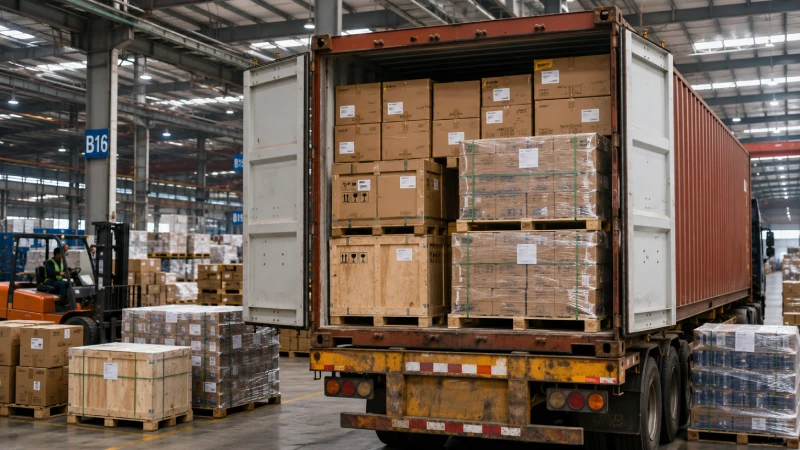
LCL shipping can be a practical option when your cargo does not fill a complete container, but the advertised ocean rate per CBM rarely represents the final amount you will pay. Before choosing LCL, review the broader Shipping from China to USA guide to understand how ocean freight, customs clearance and US delivery fit into the complete shipping plan.
For LCL cargo, the real decision is not simply whether the rate is USD 60, USD 90 or USD 120 per CBM. Importers must compare chargeable volume, minimum charges, origin warehouse fees, destination CFS charges and final delivery costs.
A shipment that appears inexpensive based on the ocean freight line alone can become much more costly after fixed charges are added. This guide explains how LCL costs are constructed and when LCL remains more economical than FCL.
Rate note: All calculation examples below are illustrative. Actual charges must be verified based on the cargo, origin, destination, sailing date and service scope.
Is LCL the Right Option for Your Shipment?
Less-than-container-load shipping allows cargo from different shippers to share one container. Instead of paying for the entire container, each shipper pays for the space or chargeable freight units used.
LCL is commonly considered for shipments between approximately 1 and 10 CBM, but volume alone should not determine the decision.
| Shipment situation | LCL suitability | Main factor to check |
|---|---|---|
| Less than 1 CBM | Conditional | Minimum freight and handling charges |
| 1–5 CBM of regular cartons | Often suitable | Full origin-to-delivery cost |
| Two or three pallets | Often suitable | Pallet dimensions and delivery access |
| 5–10 CBM | Requires comparison | LCL versus FCL total cost |
| Bulky furniture | Conditional | High chargeable volume |
| Dense machine parts | Conditional | Weight-to-measurement calculation |
| Fragile or high-value cargo | Higher risk | Extra handling and shared-container exposure |
| Several Chinese suppliers | Potentially suitable | Consolidation cost and supplier coordination |
Very small shipments may be affected by minimum charges, while larger shipments can accumulate enough per-CBM and CFS costs to make FCL more attractive.
Urgent, lightweight cargo may also justify a brief air freight comparison. However, the correct choice should be based on total cost, delivery requirements and inventory urgency, not only shipment volume.
How Chargeable CBM Is Calculated
CBM, or cubic meter, measures the space occupied by the packed cargo.
For cartons, the basic calculation is:
Length × width × height × number of cartons = total CBM
Dimensions must use the same measurement unit. When calculating in centimeters, divide the result by 1,000,000.
Example: 20 Loose Cartons
Assume each carton measures:
- 60 cm long
- 50 cm wide
- 40 cm high
- 20 cartons in total
The calculation is:
0.60 × 0.50 × 0.40 × 20 = 2.4 CBM
This is the measured volume before considering minimum charges, palletization or weight-to-measurement rules.
Palletized Versus Loose-Carton Volume
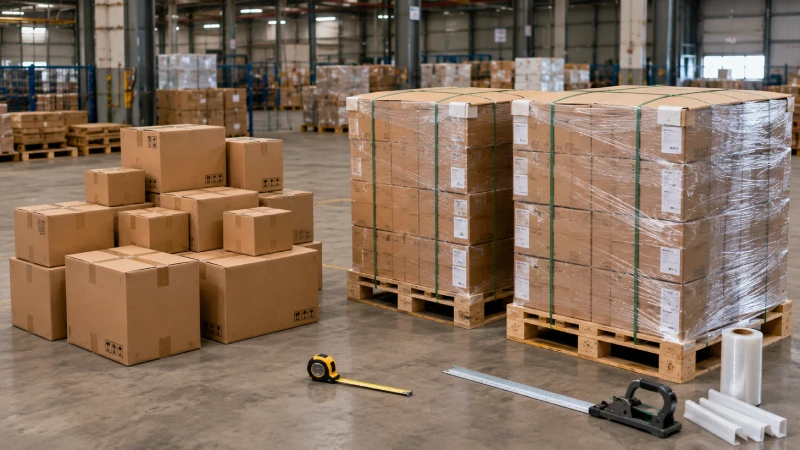
Palletizing can protect cartons and make forklift handling easier, but it often increases chargeable volume.
The CFS measures the final external pallet dimensions, including:
- The pallet base
- Total loaded height
- Protective corners
- Top boards
- Stretch wrapping
- Carton overhang
Suppose loose cartons occupy 2.4 CBM. After being arranged on two pallets, each pallet measures 1.2 × 1.0 × 1.3 meters.
The palletized volume becomes:
1.2 × 1.0 × 1.3 × 2 = 3.12 CBM
The importer would then be charged based on approximately 3.12 CBM rather than the original 2.4 CBM, subject to the quotation terms.
The additional volume does not automatically mean palletizing is a bad decision. Strong pallets can reduce loose-carton movement, simplify warehouse handling and lower the risk of individual cartons being separated.
Weight-to-Measurement Rules
LCL freight may be billed using weight or measurement, commonly abbreviated as W/M. The chargeable quantity is generally determined by comparing cargo weight with cargo volume under the applicable tariff and using the higher freight-unit result.
For example, a dense shipment occupying only 1.5 CBM may be charged at more than 1.5 freight units if its weight exceeds the quotation’s weight-to-volume conversion.
The exact conversion basis must be confirmed with the freight forwarder. It should not be assumed that every carrier, route or quotation applies the same formula. The applicable terms must be checked for the specific service.
Minimum Chargeable Volume
A shipment measuring 0.5 CBM is not necessarily billed at exactly half the cost of a 1 CBM shipment.
An LCL quotation may include:
- Minimum ocean freight
- Minimum origin CFS handling
- Minimum destination handling
- Documentation charged per shipment
- Minimum local delivery charges
This is why the effective cost per CBM is often highest for very small shipments.
What Is Included in an LCL Shipping Quote?
An LCL quote may contain four major cost groups:
- China origin charges
- Ocean freight
- US destination charges
- Customs and final delivery
The ocean freight rate is only one part of the calculation.
China Pickup and Origin Charges
Origin costs can begin before the cargo reaches the export warehouse.
Possible charges include:
- Factory pickup
- Trucking from multiple suppliers
- Warehouse receiving
- Unloading
- Measurement and weighing
- Palletization or repacking
- Labeling
- Temporary storage
- Export documentation
- Customs declaration support
- CFS handling
Pickup costs depend on supplier locations, cargo quantity, truck access and whether one or several factories are involved.
When comparing quotations, check whether the stated rate begins at the supplier, the consolidation warehouse or the Chinese port.
Ocean Freight per CBM
The ocean freight line normally covers the international movement between the nominated origin and destination points. It may be quoted per CBM, per W/M freight unit or subject to a minimum.
Ocean rates can vary according to:
- Chinese origin
- US destination CFS
- Cargo type
- Shipment density
- Direct or transshipment service
- Space availability
- Seasonal demand
- Carrier or consolidator conditions
For a broader comparison of ocean transportation options, see Sea Freight from China to USA.
US Destination CFS Charges
After the consolidated container arrives in the United States, it must be moved to a container freight station and deconsolidated.
Destination charges may include:
- Container deconsolidation
- CFS handling
- Cargo release
- Warehouse handling
- Destination documentation
- Storage after free time
- Examination-related handling
- Destination agent fees
These charges may be prepaid, included in an all-in quotation or payable by the consignee after arrival. The quote should clearly explain which arrangement applies.
US NVOCCs operating in US trades publish tariffs showing applicable rates, charges, classifications, rules and practices. Importers should therefore compare the complete quotation scope and applicable tariff conditions rather than relying on a headline ocean rate.
Customs Clearance and Delivery
Destination CFS charges should not be confused with import clearance or final-mile delivery costs.
Additional items may include:
- Customs brokerage
- Customs bond
- Importer Security Filing service
- Duties, tariffs and taxes
- CFS pickup
- Truck delivery
- Delivery appointment
- Residential surcharge
- Limited-access surcharge
- Liftgate service
- Inside delivery
Importer Security Filing applies to cargo arriving in the United States by ocean vessel. Importers should coordinate the required shipment data with their customs broker or filing provider before the applicable deadline.
Detailed paperwork requirements are covered in Documents Required to Import from China to USA.
Illustrative LCL Cost Scenarios
The following examples show how different cargo profiles affect LCL economics. They are not current market quotations.
Scenario 1: One CBM of Loose Cartons
A one-CBM shipment may appear inexpensive when calculated against the ocean rate. However, several fixed charges remain similar whether the shipment is 1 CBM or 4 CBM.
These may include:
- Export documentation
- Origin warehouse minimum
- Destination release fee
- Customs brokerage
- Final delivery minimum
If the importer expects another order soon, combining both orders may reduce the effective cost per CBM. However, delaying cargo also creates inventory and supplier-coordination risks.
Scenario 2: Two Pallets
An importer has cartons measuring 2.2 CBM before palletization. After loading them onto two export pallets, the final measured volume becomes 2.9 CBM.
The importer pays for more volume but gains:
- Better forklift handling
- Improved carton stability
- Lower risk of loose cartons being separated
- Easier warehouse receiving in the USA
The destination must also be checked. A commercial warehouse with a loading dock can normally receive pallets more easily than a residence or small office.
Where no loading dock or forklift is available, liftgate service may be required. The delivery quotation should clearly state whether this service is included.
Scenario 3: Five CBM of Consumer Products
Consider two fictional quotations for the same five-CBM shipment:
| Cost component | Quote A | Quote B |
|---|---|---|
| Ocean freight | Lower | Higher |
| China origin handling | Partially included | Included |
| Destination CFS | Payable after arrival | Included |
| Customs brokerage | Excluded | Excluded |
| Final delivery | Excluded | Included |
| Total cost visibility | Low | High |
Quote A may advertise the lower rate per CBM but result in a higher final invoice after destination and delivery charges are paid.
This is why importers should compare the total under the same service scope. Broader cost factors are explained in Shipping Cost from China to USA.
Scenario 4: Ten CBM of Furniture
Furniture often consumes substantial volume relative to its weight. Protective packaging and non-stackable pieces can further increase the chargeable space.
At 10 CBM, the importer should compare LCL against FCL because:
- Per-CBM charges have accumulated
- Origin and destination handling may be substantial
- Furniture faces repeated handling
- Non-stackability may affect the rate
- Damage exposure may be higher in a shared container
The correct choice depends on the current route and service scope, not a universal volume threshold.
When Does LCL Become More Expensive Than FCL?
There is no fixed CBM point at which every shipment should switch to FCL.
The break-even point changes according to:
- Current LCL rate
- Current FCL rate
- Cargo weight and volume
- Number of pallets
- Origin CFS charges
- Destination CFS charges
- Container delivery cost
- Unloading conditions
- Non-stackable cargo
- Cargo value
- Damage sensitivity
- Number of suppliers
The correct calculation is:
Total LCL origin-to-delivery cost versus total FCL origin-to-delivery cost
Do not compare an LCL door-delivery quotation with an FCL port-only rate.
As shipment volume increases, FCL may provide additional operational advantages. The cargo is loaded into one dedicated container and is not routinely separated at a destination CFS.
Importers approaching the break-even range should request a side-by-side comparison and review FCL Shipping from China to USA for the full-container alternative.
How CFS Handling Affects Time and Cargo Risk
LCL cargo passes through more handling points than cargo moving in a dedicated container.
At the origin CFS, the shipment is:
- Received
- Counted
- Measured
- Weighed
- Labeled
- Prepared for consolidation
If a supplier delivers late, the cargo may miss the planned consolidation or sailing.
After arrival, the container must be moved to the destination CFS, unloaded and divided into individual consignments. Cargo cannot normally be collected immediately after the vessel arrives.
Potential risks include:
- Repeated forklift handling
- Damaged cartons
- Lost or unclear labels
- Contact with mixed cargo
- Odor, moisture or dust exposure
- Deconsolidation delays
- Storage caused by late clearance
These factors do not mean LCL is unsafe. They mean packaging, labeling and timing require more attention.
Fragile, extremely valuable, moisture-sensitive or time-critical cargo may require stronger crating, cargo insurance or an FCL comparison.
For broader route timing rather than CFS-specific delays, refer to Shipping Time from China to USA.
Consolidating Cargo from Multiple Chinese Suppliers
Multi-supplier consolidation can combine products from several factories into one export shipment.
This may reduce:
- Separate international bookings
- Repeated destination releases
- Duplicate delivery arrangements
- Fragmented shipment tracking
However, consolidation creates additional origin work.
Possible charges include:
- Multiple factory pickups
- Receiving fees per supplier
- Temporary warehouse storage
- Cargo sorting
- Carton labeling
- Repacking
- Pallet building
- Document coordination
Each supplier’s cargo should be identified by purchase order, supplier name, SKU, carton count and carton marks.
A consolidation plan should also define when the shipment can proceed. If one supplier is late, the importer must decide whether to hold all cargo, ship without the delayed order or create a second shipment.
Consolidation is most effective when supplier production schedules and cargo data are confirmed before warehouse receiving begins.
How to Reduce Chargeable CBM and Prevent Extra Charges
Importers can improve LCL economics before the cargo leaves the factory.
Practical steps include:
- Remove unnecessary empty space from cartons.
- Use consistent carton dimensions.
- Avoid cartons overhanging the pallet.
- Confirm whether pallets can be stacked.
- Measure final export packaging.
- Send accurate packing lists before pickup.
- Apply clear shipping marks to every carton.
- Coordinate supplier delivery before the CFS cutoff.
- Avoid last-minute document amendments.
- Confirm fragile, oversized or restricted cargo early.
- Arrange customs clearance before arrival.
- Collect or deliver cargo before storage begins.
Packaging should not be reduced simply to lower CBM. Insufficient protection can create damage costs that exceed any freight saving.
LCL Quote Comparison Checklist
Before choosing a freight forwarder, confirm the following:
- Is charging based on CBM, weight or W/M?
- What is the minimum chargeable quantity?
- Is supplier pickup included?
- Are origin warehouse charges included?
- Is export CFS handling included?
- Are documentation charges included?
- Are US destination CFS charges included?
- Which charges are payable after arrival?
- Is customs brokerage included?
- Are duties and taxes excluded?
- Is final delivery included?
- Is the destination commercial or residential?
- Is a loading dock available?
- Is liftgate service required?
- How long is the quotation valid?
Most importantly, compare quotations with equivalent pickup, customs and delivery scopes.
Information Needed for an Accurate LCL Quote
To receive an itemized quote, provide:
- Number of cartons, crates or pallets
- Dimensions of each package type
- Total gross weight
- Total CBM
- Cargo description
- HS code, if available
- Cargo value
- Supplier locations
- Number of suppliers
- China pickup requirement
- US delivery ZIP code
- Commercial, warehouse or residential destination
- Loading dock and forklift availability
- Liftgate requirement
- Delivery appointment restrictions
- Stackable or non-stackable status
- Fragile, high-value or regulated cargo details
- Expected cargo-ready date
Providing complete information allows the freight forwarder to check the full LCL cost instead of offering only an ocean rate per CBM.
FAQ
How much does LCL shipping from China to the USA cost per CBM?
The rate depends on the Chinese origin, US destination, cargo density, commodity, sailing date and market conditions. The ocean rate per CBM should not be treated as the final cost because origin handling, destination CFS and delivery charges may be additional.
What is the minimum chargeable volume for LCL?
Minimums vary by quotation and service. Even when cargo measures less than one CBM, the freight or handling may be billed at a minimum quantity. Ask for both actual and chargeable CBM.
Is palletized LCL cargo more expensive?
Palletization can increase chargeable CBM because the pallet and total loaded dimensions are measured. However, pallets can improve stability, forklift handling and carton control.
Is LCL charged by volume or weight?
LCL may be charged using weight or measurement. Dense cargo can be billed based on weight even when the physical volume is low. Confirm the applicable conversion rule in the quotation.
What are destination CFS charges?
They are charges associated with deconsolidating, handling, storing and releasing LCL cargo after arrival. Ask whether these charges are prepaid, included or payable to the US destination agent.
Can cargo from several Chinese suppliers be consolidated?
Yes. The forwarder can coordinate pickups, warehouse receiving, labeling and consolidation. Additional costs may apply for multiple pickups, storage, sorting, repacking and supplier coordination.
When should I switch from LCL to FCL?
Request an FCL comparison when LCL volume, handling charges or cargo risk become substantial. There is no universal break-even volume because route rates, cargo density and delivery conditions vary.
Is LCL suitable for fragile goods?
It can be, but fragile cargo requires strong export packaging, clear labels and appropriate insurance. Extremely fragile or high-value goods may be better suited to crating or a dedicated-container solution.
Request a Full LCL Cost Check
The lowest ocean freight rate per CBM is not always the lowest total shipping cost.
Send Winsail Logistics your carton or pallet dimensions, gross weight, supplier locations, cargo description and US delivery ZIP code. We can review the complete cost structure, including China pickup, origin CFS handling, ocean freight, US destination charges and final delivery.
Request an itemized LCL quote and compare the full cost, not only the headline rate per CBM.
