
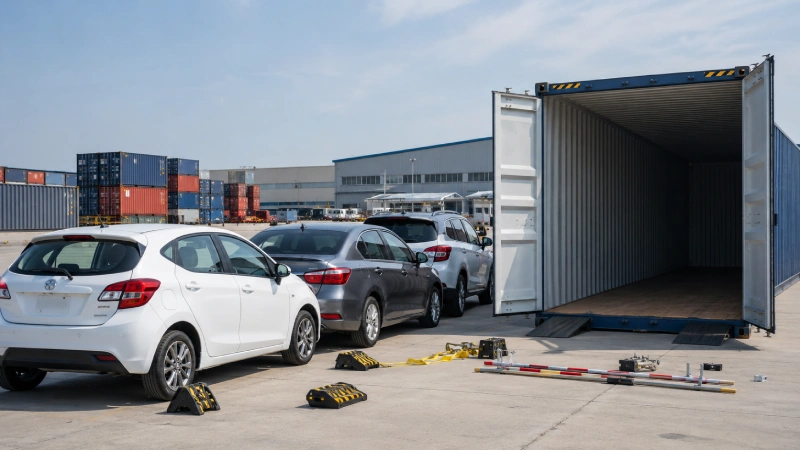
Estimating how many cars fit in a shipping container is not as simple as dividing the container length by the length of a vehicle. A workable loading plan must account for the actual vehicle dimensions, entry angle, ground clearance, weight distribution, protection space, lashing access and the loading method accepted for the shipment.
A 20ft, 40ft or 40HQ container provides the outer planning boundary. Final capacity cannot be confirmed until the exact vehicles, photographs, weights, released container and approved securing arrangement have been reviewed.
Quick Answer
There is no universal number of cars that fits in every 20ft, 40ft or 40HQ shipping container. A 20ft container is usually assessed for a smaller vehicle shipment, while 40ft and 40HQ containers may support multi-vehicle loading when the exact vehicle combination and loading system are suitable.
A 40HQ adds internal and door height, but its floor length is generally similar to a standard 40ft container. It therefore does not automatically hold more cars. Final capacity depends on each vehicle’s length, width, height, wheelbase, weight, ground clearance and condition, together with loading angles, protection space, weight distribution and an approved securing method.
Planning disclaimer: All vehicle-loading scenarios in this article are illustrative. Final capacity remains subject to the actual vehicles, released container, loading yard, ocean carrier acceptance and approved loading and securing method.
Key Takeaways
- Container dimensions provide a starting boundary, not a guaranteed vehicle count.
- Capacity should never be calculated by dividing container length by vehicle length.
- The container doorway can reject a plan that appears to fit within the internal space.
- Vehicle category alone is insufficient; exact measurements and photographs are required.
- Flat-floor loading and an approved rack or frame system are different loading methods.
- Vehicle, frame, dunnage, spare-parts and securing-material weight must all be included.
- RoRo may be more practical when container entry, unloading or securing is difficult.
Why There Is No Fixed Car Container Loading Capacity
Car container loading capacity is a geometry, handling and securing problem rather than a cubic-meter calculation. Cars are irregular shapes, and the space around them must remain usable for loading, protection, inspection and securing.
Two vehicles sold under the same model name can differ by production year, trim, wheelbase, bumper design, suspension height, roof equipment or regional body configuration. A catalogue measurement may therefore be insufficient for a final loading decision.
Workers also need access to vehicle and container securing points. A layout that fills the available floor length but blocks lashing access is not an acceptable plan.
Winsail’s guide to 20ft versus 40ft container shipping explains general equipment selection. Vehicle loading requires additional checks for door clearance, loading angle, underbody contact and the final unloading sequence.
20ft, 40ft and 40HQ Container Dimensions
Published container dimensions identify obvious constraints but cannot confirm how many vehicles will be accepted. Hapag-Lloyd states that its equipment specifications are fleet examples and that actual dimensions and capacities can vary by container manufacturer.
| Reference dimension | 20ft standard | 40ft standard | 40HQ |
|---|---|---|---|
| Approximate internal length | 5,900 mm | 12,032 mm | 12,032 mm |
| Approximate internal width | 2,352 mm | 2,352 mm | About 2,350 mm |
| Approximate internal height | 2,395 mm | 2,395 mm | About 2,700 mm |
| Approximate door width | 2,340 mm | 2,340 mm | Verify released equipment |
| Approximate door height | 2,292 mm | 2,292 mm | Higher than a standard 40ft |
| Published cubic capacity | About 33.2 m³ | About 67.7 m³ | Higher mainly because of height |
Reference figures should be checked against the carrier’s official 20ft standard container specification, 40ft standard container specification and 40ft high-cube specification.
A 40HQ mainly provides additional height. It does not provide a meaningful increase in floor length over a standard 40ft container. The extra height may help with a taller vehicle, door entry or an approved frame system, but it does not automatically create space for an additional car.
Before physical loading, the actual container number, condition, internal dimensions, door opening, tare and maximum gross mass should be checked.
Usable Space Versus Nominal Space
The published internal envelope is larger than the usable vehicle-loading space. Cars cannot occupy the container like uniform cartons because the plan must reserve space for entry, protection, positioning, inspection and securing.
The following areas reduce usable capacity:
- clearance between front and rear bumpers;
- clearance between vehicles and container walls;
- roof and door-header clearance;
- space for wheel chocks and securing devices;
- access to lashing points;
- non-abrasive body protection;
- space required by an approved rack or frame;
- room for closing the container doors;
- a workable unloading sequence at destination.
The door opening can be smaller than the internal width or height. A vehicle that appears to fit inside may still be unable to pass through the doorway along the required loading angle.
No universal spacing figure should be used unless it comes from a verified loading system and an approved operating procedure.
Vehicle Information Required for a Loading Calculation
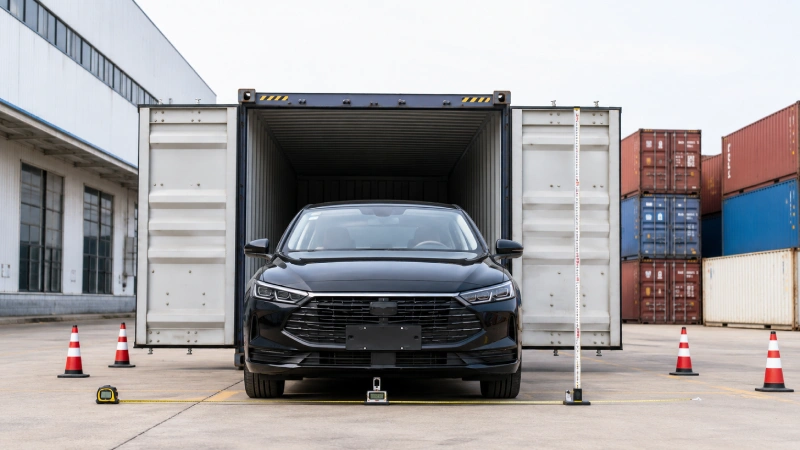
A preliminary vehicle loading plan requires more than the words “sedan,” “SUV” or “pickup.” Every unit should be identified and measured individually.
| Required information | How it affects the loading plan |
|---|---|
| Overall length | Determines combined longitudinal space |
| Front and rear overhang | Affects bumper and ramp clearance |
| Width with mirrors open | Identifies doorway and wall conflicts |
| Width with mirrors folded | Confirms practical loading width |
| Overall height | Affects door, roof and frame clearance |
| Wheelbase | Influences breakover risk |
| Lowest ground clearance | Identifies underbody-contact risk |
| Tyre and wheel-track width | Helps assess wheel restraint and positioning |
| Shipping weight | Affects payload and weight distribution |
| Running condition | Determines loading and unloading method |
| Steering and braking condition | Determines safe movement and positioning |
| Modifications or visible damage | May change dimensions or handling |
| Powertrain type | May trigger carrier or safety checks |
| Vehicle photographs | Confirms the actual configuration |
Catalogue dimensions may refer to another model year or trim level. Physical measurements should include side steps, roof rails, spare-wheel carriers, tow bars, body kits and suspension modifications.
The lowest ground-clearance measurement should cover the front lip, undertray, battery enclosure, exhaust, differential and other low components.
Clear photographs should include front, rear, both sides, three-quarter views, roof accessories, wheel areas and the lowest front and rear points. Winsail can coordinate warehouse or yard receiving in China when available, but the submitted data still needs to match the actual vehicles.
How Vehicle Type Changes Loading Feasibility
Vehicle type helps identify likely constraints, but it does not establish a fixed capacity.
Hatchbacks and Compact Cars
Compact vehicles may leave more longitudinal space than large sedans, but mirror width, bumper design and securing access still need individual review. Similar-looking hatchbacks can also have different wheelbases and overhangs.
Sedans
Sedan length and front or rear overhang often become important constraints. Lower vehicles may also face ramp, sill or underbody-contact risks during entry.
SUVs
SUVs typically add height, width and weight. A 40HQ may improve door-height or roof-clearance feasibility, but higher internal volume does not automatically increase the number of vehicles.
Pickup Trucks
Pickup feasibility varies significantly between single-cab, double-cab, short-bed and long-bed versions. Wheelbase, bed length, rear overhang and vehicle weight must be checked separately.
Vans and Minibuses
High-roof vans can be limited by doorway height and entry geometry even when the container interior appears tall enough. Larger vans may also create unloading and securing-access problems.
Flat-Floor Loading Versus Approved Rack Systems
Flat-floor loading places each vehicle directly on the container floor. The method is relatively easy to visualize, but the layout still needs acceptable spacing, weight distribution, securing access and an unloading sequence.
An approved rack or frame may use vertical space, but it is not standard equipment simply because a similar structure appears in an online photograph. The system must be reviewed for its own weight, structural support, vehicle contact points, centre of gravity, installation method, carrier acceptance and destination unloading requirements.
The IMO/ILO/UNECE Code of Practice for Packing of Cargo Transport Units, commonly called the CTU Code, provides guidance on safe packing and securing. It does not make an improvised vehicle frame or ramp acceptable.
Unsafe practices that should not be presented as standard methods include:
- unsupported vehicle stacking;
- one vehicle resting directly on another;
- improvised welded frames without verified data;
- makeshift timber ramps;
- lifting from unapproved vehicle body points;
- using bumpers or suspension components as structural supports;
- copying a loading arrangement without engineering and operational review.
Door Opening, Loading Angle and Ground-Clearance Risks
The vehicle must pass through the container door along the actual loading path. Static vehicle width and height alone cannot confirm entry.
During loading, the front bumper may contact a ramp, the sill or the ground. A long wheelbase may cause the centre of the underbody to touch, while the rear bumper, exhaust or tow bar may strike as the vehicle enters.
Low-profile vehicles, modified cars and electric vehicles with underfloor battery packs require particularly careful clearance checks. No universal ramp angle should be published without a verified loading system.
A non-running vehicle also changes the plan. The yard must confirm how it will be moved, whether the wheels roll, whether the steering operates and whether the brakes can be controlled.
Where standard-container entry is doubtful, a project logistics review may be more appropriate than forcing an unverified arrangement.
Weight Distribution and Verified Gross Mass
Vehicle capacity is not only a space question. Total cargo weight must include the vehicles, rack or frame, dunnage, protective materials, spare parts and securing equipment.
As of July 2026, the International Convention for the Safety of Life at Sea requires the shipper to provide a Verified Gross Mass before a packed container is loaded aboard a vessel. The International Maritime Organization VGM guidance explains the accepted weighing and calculation methods.
The maximum gross mass and tare should be read from the actual container. Inland road, rail or terminal limits may be lower than the container’s published payload.
Weight must also be distributed reasonably along the container. Engine location, battery position, frame weight and additional cargo can create excessive concentration at one end or on one side.
Vehicle Spacing, Protection and Lashing Points
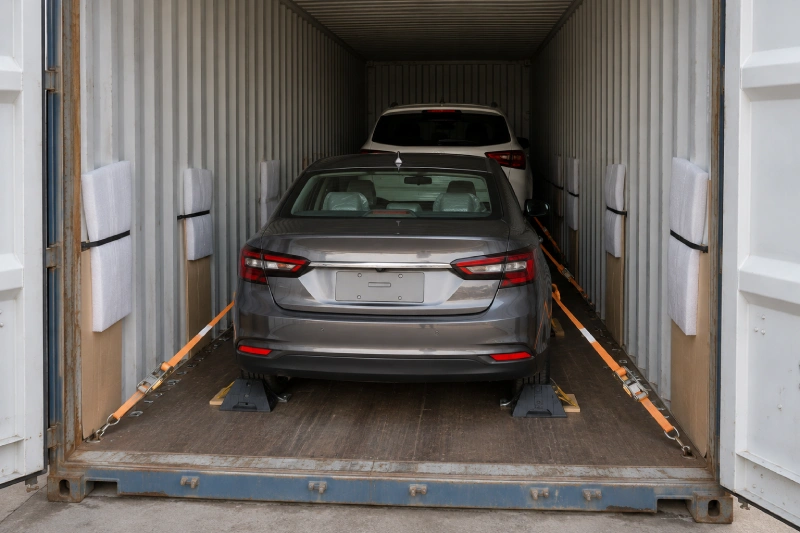
A workable layout must leave access to approved securing locations. If the required points cannot be reached after positioning, the proposal should be revised or rejected.
Protection should prevent contact between vehicles, walls, mirrors, glass, roof accessories and painted panels. Materials placed against the body should be suitable for the surface and should not introduce concentrated pressure.
The securing method must be selected for the actual vehicle, container and loading system. Universal strap quantities, angles, pre-tension values or lashing limits should not be published without verified data.
Can Personal Items or Spare Parts Be Included?
Personal belongings and spare parts are not automatically accepted with vehicles. Approval depends on the ocean carrier, origin procedures, destination customs rules, cargo classification, declaration and securing arrangement.
Additional cargo should be commercially declared where required and included in the packing list, weight calculation and Verified Gross Mass. It must not block access to the vehicles or their securing points.
Batteries, fuel, oils, aerosols, gas cylinders, chemicals and other restricted goods require separate review. Undeclared items can lead to rejection, delays or customs problems.
Winsail can coordinate document review through its customs and cargo-documentation services. The exporter remains responsible for lawful and accurate export information, while the importer is responsible for confirming destination eligibility.
Responsibility Matrix
The responsibilities should be assigned before booking, even when one company performs more than one operational role.
| Party | Main responsibility |
|---|---|
| Seller | Provide the correct vehicle, access and condition information |
| Exporter | Confirm lawful export status and commercial documentation |
| Freight forwarder | Coordinate measurements, booking and logistics parties |
| Loading yard or contractor | Execute the approved loading and securing method |
| Customs broker | Prepare declarations from information supplied by the responsible parties |
| Importer | Confirm import eligibility and destination unloading capability |
| Ocean carrier | Accept the booking and equipment under its conditions |
Winsail does not issue vehicle export licences, determine destination import eligibility or guarantee customs clearance.
Common Reasons a Proposed Loading Plan Fails
A proposal often fails because the actual vehicle or operating conditions differ from the assumptions used during the first calculation.
| Common failure | Operational result |
|---|---|
| Physical vehicle differs from catalogue data | Required clearance disappears |
| Mirrors or accessories were omitted | Doorway or wall conflict |
| Ground clearance was not measured | Bumper or underbody contact |
| Rack or extra-cargo weight was excluded | Payload or distribution problem |
| Securing points cannot be reached | Arrangement cannot be properly secured |
| Vehicle cannot steer, brake or roll | Handling method must change |
| Loading yard lacks suitable equipment | Proposed method cannot be executed |
| Destination cannot unload the arrangement | Plan is operationally unusable |
| Additional goods were not declared | Documentation and weight must be revised |
| Released container differs from reference data | Layout requires reassessment |
Vehicle Loading Assessment Checklist
Before requesting an assessment, confirm that the following information is available:
- Vehicle make, model, model year and quantity
- Physical length, width, height and wheelbase
- Lowest ground-clearance measurement
- Vehicle shipping weight
- Running, steering and braking condition
- Powertrain type
- Modifications, accessories and visible damage
- Front, rear, side, roof and underbody photographs
- Details of spare parts or additional cargo
- Origin, destination and preferred shipping period
- Destination unloading method and capability
Final Loading-Plan Approval Process
A vehicle count should be developed through a controlled review rather than a verbal estimate based only on the container type.
- Collect the vehicle data. Record dimensions, weight, condition, photographs, origin, destination and additional cargo.
- Screen the transport options. Compare 20ft, 40ft, 40HQ and RoRo ocean freight from China.
- Develop a preliminary arrangement. Review flat-floor positioning or an approved frame, together with the loading and unloading sequence.
- Check physical feasibility. Review the doorway, loading angle, ground clearance, protection space, total mass and weight distribution.
- Confirm operational acceptance. Verify carrier equipment, loading-yard capability, securing method and destination unloading arrangements.
- Verify the physical loading. Inspect the released container, recheck critical measurements and photograph the final vehicle positions.
- Complete the shipping record. Confirm vehicle details, container number, seal number, shipping instructions and VGM submission.
A sketch or preliminary calculation is not a final capacity guarantee. Final acceptance remains subject to the actual vehicles, released equipment and approved loading method.
What Winsail Can Coordinate
Winsail Logistics can coordinate vehicle pickup, warehouse or yard receiving, measurements, photographs, container booking, loading, lashing coordination, ocean transport and destination-agent handover, subject to route and supplier availability.
For general Full Container Load planning, buyers can review Winsail’s ocean freight services from China. Importers using United States routes can also consult the China-to-USA shipping guide.
Winsail’s role is logistics coordination. The exporter, importer, customs broker, loading contractor and ocean carrier retain their respective legal and operational responsibilities.
FAQ
How many cars fit in a 20ft shipping container?
There is no universal number. Capacity depends on the exact vehicle dimensions, weight, ground clearance, required spacing and approved loading method. Physical review is required before the quantity can be confirmed.
How many cars fit in a 40ft container?
A 40ft container provides more floor length than a 20ft container, but the final number depends on the vehicle combination, protection space, lashing access, weight distribution and loading system.
Does a 40HQ fit more cars than a standard 40ft container?
Not necessarily. A 40HQ mainly adds internal and door height, while its floor length is generally similar to a standard 40ft container. Extra height helps only when the vehicle profile or an approved frame can use it safely.
Can spare parts be loaded with the vehicles?
Possibly, after the carrier, customs, declaration, packing and securing requirements have been checked. The space and weight of all additional cargo must be included in the loading plan and VGM.
When is RoRo more practical than container shipping?
RoRo may be more practical for large, tall, operable or low-clearance vehicles, or when no approved container arrangement and destination unloading system are available. Route availability and total handling cost should also be compared.
Send Vehicle Dimensions for a Loading Check
Do not request a final vehicle count using model names alone. Send the quantity, make, model, year, exact dimensions, weight, operating condition and clear photographs of every vehicle.
Winsail can prepare a preliminary loading assessment, identify obvious door or ground-clearance risks and compare container and RoRo feasibility where appropriate.
Send Vehicle Dimensions for a Loading Check
Request a Container Loading Plan
Compare Container and RoRo Shipping
