
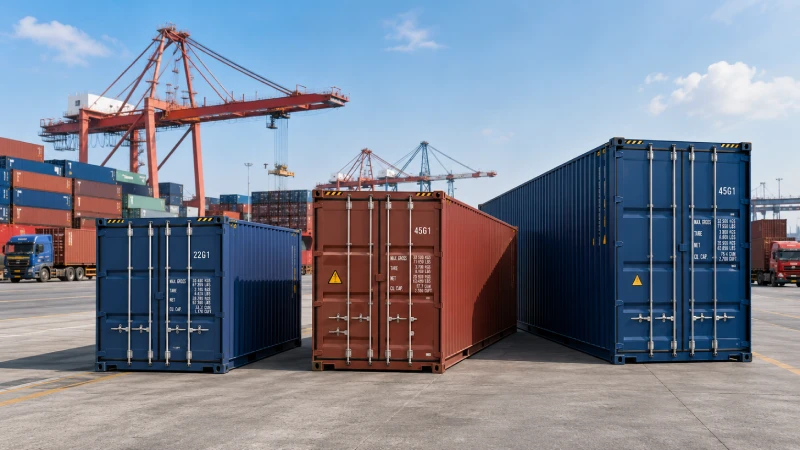
Choosing the right container is one of the most important planning decisions when shipping from China to USA. A container that appears large enough based on total CBM may still be unsuitable because of cargo weight, pallet configuration, carton dimensions, door clearance or U.S. inland transportation limits. For importers, the correct choice is therefore not simply “20ft or 40ft.” It is a decision based on how the cargo will physically fit, how much usable capacity is available and how the container choice affects the total delivered cost.
This guide compares 20GP, 40GP and 40HQ containers and explains how to select the right option before requesting a freight quote.
Quick Container Selector
The following table provides an initial container recommendation based on common cargo profiles.
| Cargo situation | Recommended starting option | Main reason |
|---|---|---|
| Small shipment with low container utilization | LCL | Avoid paying for large amounts of unused space |
| Dense machinery, metal parts or hardware | 20GP | Weight may become limiting before volume |
| General cartons and consumer products | 40GP | Good balance between floor space and cubic capacity |
| Lightweight furniture or bulky products | 40HQ | Additional internal height provides more loading volume |
| Palletized cargo | Calculate individually | Pallet footprint and stacking height reduce usable capacity |
| Oversized or irregular cargo | Special equipment review | Standard container doors or internal dimensions may be insufficient |
This is only a starting point. The final recommendation should consider total gross weight, package dimensions, stackability, loading method and the U.S. delivery route.
20GP vs 40GP vs 40HQ Container Capacity
The three most commonly used dry containers for China–USA shipments are the 20-foot general-purpose container, 40-foot general-purpose container and 40-foot high-cube container.
| Specification | 20GP | 40GP | 40HQ |
|---|---|---|---|
| Approximate internal length | 5.90 m | 12.03 m | 12.03 m |
| Approximate internal width | 2.35 m | 2.35 m | 2.35 m |
| Approximate internal height | 2.39 m | 2.39 m | 2.70 m |
| Published cubic capacity | 33.2 m³ | 67.7 m³ | 76.4 m³ |
| Approximate maximum payload | 28,260 kg | 28,860 kg | 28,660 kg |
| Typical cargo profile | Dense or compact cargo | General commercial cargo | Lightweight and bulky cargo |
These figures are based on typical carrier equipment specifications. Actual dimensions, tare weight and payload can vary slightly by container manufacturer and individual unit. See the MSC dry container equipment guide for a representative carrier specification reference.
What a 20GP Is Best For
A 20GP is often suitable for compact, dense cargo such as:
- Machinery
- Metal components
- Fasteners
- Industrial parts
- Stone products
- Heavy building materials
A 20GP has less than half the cubic capacity of a 40HQ, but its maximum technical payload may be similar. This makes it useful when the shipment is more likely to reach a weight limit than a volume limit.
However, choosing a 20GP does not automatically eliminate overweight risk. The total combination of cargo, container, chassis and tractor must still comply with the applicable road and axle-weight rules.
What a 40GP Is Best For
A 40GP is commonly used for general merchandise, regular export cartons, textiles, household goods and other products with moderate cargo density.
It provides approximately twice the internal floor length of a 20GP. It can therefore accommodate more cartons, longer products or additional pallets without the extra height of a high-cube container.
A 40GP may be preferable to a 40HQ when:
- The cargo does not require extra height
- The cartons cannot be stacked high enough to use the high-cube space
- The cargo is moderately heavy
- The available 40GP rate is commercially attractive
- Warehouse or unloading conditions favor a standard-height container
What a 40HQ Is Best For
A 40HQ has almost the same floor dimensions as a 40GP but approximately 30 centimeters of additional internal height.
That extra height is valuable for:
- Lightweight furniture
- Foam products
- Plastic household goods
- Textiles
- Large retail cartons
- Flat-packed products
- Other bulky, stackable cargo
A 40HQ normally provides better value when the importer can use the additional vertical space. It does not necessarily provide more usable weight capacity than a 40GP.
Published Capacity Is Not Practical Loading Capacity
One of the most common container-planning mistakes is dividing total cargo CBM by the published container capacity and assuming the result confirms the equipment choice.
A 20GP may have a published capacity of approximately 33 CBM, but this does not mean that 33 CBM of packed commercial cargo will always fit.
Usable capacity is reduced by:
- Gaps between cartons
- Mixed carton sizes
- Pallet bases
- Non-stackable products
- Protective packaging
- Wooden crates and skids
- Cargo bracing and securing materials
- Door-access requirements
- Irregular product shapes
- Uneven weight distribution
For preliminary planning, an importer may use conservative working ranges rather than the maximum internal volume.
| Container | Published capacity | Illustrative practical planning range |
|---|---|---|
| 20GP | About 33.2 CBM | About 25–28 CBM |
| 40GP | About 67.7 CBM | About 54–60 CBM |
| 40HQ | About 76.4 CBM | About 63–68 CBM |
These are not guaranteed loading capacities. Regular floor-loaded cartons may achieve high utilization, while pallets, machinery crates or irregular products may use considerably less space.
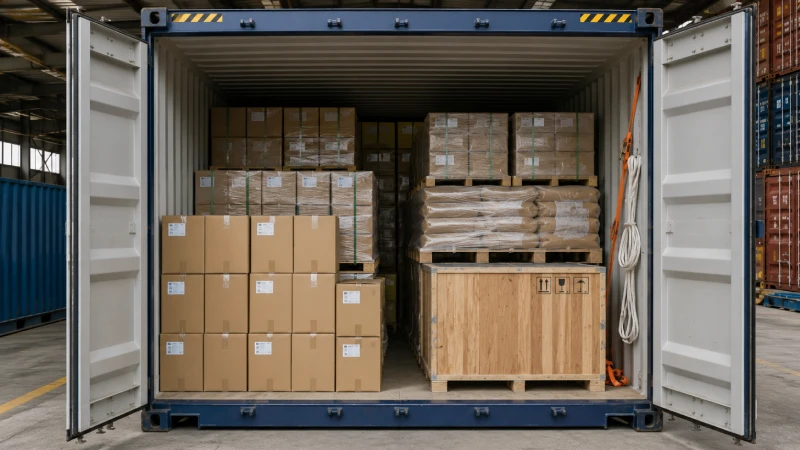
Door Dimensions Can Determine Whether Cargo Fits
Container selection should consider both internal dimensions and door-opening dimensions.
A crate may technically fit inside the container but still be too tall or too wide to pass through the doors. This is particularly important for:
- Industrial machinery
- Large furniture cartons
- Oversized pallets
- Rigid wooden cases
- Equipment loaded by forklift
- Cargo with lifting frames
Package dimensions should therefore be provided individually when any unit is close to the container’s width or height.
If the cargo cannot pass through a standard container door, an open-top container, flat rack or another special solution may be required.
Floor-Loaded vs Palletized Cargo
The loading method has a major effect on usable container capacity.
Floor-Loaded Cartons
Floor loading means placing cartons directly inside the container without pallets.
Its main advantages are:
- Higher cubic utilization
- More cartons per container
- Less space lost to pallet bases
- Greater flexibility in carton arrangement
However, floor loading may require more labor at origin and destination. The receiving warehouse must also be prepared to unload cartons individually.
Palletized Cargo
Palletized cargo is easier to move with forklifts and can simplify warehouse receiving. It may also reduce handling damage.
The disadvantage is lower space utilization. Pallets create unused areas around their bases, and cargo height may be limited by pallet stability or warehouse requirements.
When requesting a quote, provide:
- Pallet length and width
- Loaded pallet height
- Gross weight per pallet
- Total pallet quantity
- Whether pallets can be stacked
Do not calculate container requirements using loose-carton CBM if the shipment will actually be palletized.
Is Your Shipment Volume-Limited or Weight-Limited?
The correct container depends on which restriction is reached first.
Volume-Limited Cargo
Volume-limited cargo fills the available space before reaching the practical weight limit.
Typical examples include:
- Furniture
- Foam products
- Plastic goods
- Light fixtures
- Empty packaging
- Lightweight consumer products
For these shipments, a 40HQ may provide better value than a 40GP because the additional height allows more units to be loaded.
Packaging design can also affect container utilization. Reducing unnecessary carton height or redesigning carton dimensions may allow significantly more products to fit in each container.
Weight-Limited Cargo
Weight-limited cargo reaches an acceptable transport weight while a large amount of container space remains unused.
Typical examples include:
- Steel parts
- Machinery
- Fasteners
- Stone products
- Metal tools
- Dense industrial materials
A 20GP is often the logical starting point for these shipments. Using a 40GP or 40HQ may provide little additional value if road-weight limits are reached before the extra space can be used.
The container’s published payload is not the same as the amount that can always be delivered legally by truck in the United States. Federal Interstate standards generally include an 80,000-pound gross vehicle weight limit, together with single-axle, tandem-axle and Bridge Formula requirements. State, local and off-Interstate restrictions may also apply. The Federal Highway Administration freight weight overview provides additional regulatory context.
Heavy shipments should therefore be reviewed against the actual port, chassis arrangement, delivery ZIP code and route.
Practical Cargo-Loading Scenarios
Dense Machinery or Metal Products
Suppose an importer has 18 CBM of machinery packed in wooden cases with a total gross weight of 23,000 kg.
The cargo volume appears suitable for a 20GP, but the freight forwarder must still check:
- Individual case dimensions
- Door clearance
- Weight per case
- Floor loading concentration
- Weight distribution
- U.S. drayage restrictions
The shipment may fit physically but still require an overweight review for inland delivery.
Lightweight Furniture
A furniture shipment may total 62 CBM but weigh only 8,000 kg.
A 40HQ is likely to be the preferred option because the shipment is volume-limited. The additional height may allow more cartons to be stacked than in a 40GP.
However, the loading plan must confirm that the carton dimensions can actually use the added height. Non-stackable furniture or irregular packages may still leave substantial empty space.
Regular Consumer-Product Cartons
For uniform cartons, total CBM is a useful starting point, but carton arrangement provides a more accurate result.
The loading estimate should consider:
- Cartons per row
- Number of rows
- Number of vertical layers
- Whether cartons can be rotated
- Maximum safe stacking height
- Space required near the doors
A shipment calculated at 58 CBM may fit comfortably in one 40GP if the cartons load efficiently, while a shipment with the same CBM but mixed carton sizes may require a 40HQ.
Palletized Cargo
For palletized cargo, container selection should start with the pallet footprint rather than loose-product volume.
For example, 20 pallets may not fit simply because their combined CBM is below the container capacity. The number that fits depends on the pallet dimensions, orientation and whether double stacking is permitted.
How to Calculate Container Utilization
A basic utilization formula is:
Container utilization = Total cargo CBM ÷ Practical usable container capacity × 100
For example, if the shipment is 52 CBM and the selected working capacity of a 40GP is 58 CBM:
52 ÷ 58 × 100 = approximately 90% utilization
This indicates strong utilization, but it does not prove that the cargo will fit. The calculation does not account for carton orientation, pallets, door dimensions, stackability or weight distribution.
For regular cartons, calculate the CBM of each carton:
Carton length × width × height × quantity = Total CBM
Use meters for all dimensions. A carton measuring 0.60 × 0.40 × 0.35 meters has a volume of 0.084 CBM.
For a reliable container recommendation, provide the package-level dimensions rather than only the final total CBM.
How Container Shipping Costs Are Built
The cost to ship a container from China to the USA is not limited to the carrier’s ocean freight rate.
A full quote may contain three groups of expenses.
China Origin Costs
- Factory pickup
- Export customs clearance
- Container loading
- Origin terminal handling
- Documentation
- Supplier coordination
- Special loading or equipment charges
Ocean Freight Costs
- Base ocean freight
- Carrier surcharges
- Equipment-related charges
- Seasonal adjustments
- Capacity or congestion-related charges
U.S. Destination Costs
- Destination terminal charges
- Customs-related handling
- Chassis charges
- Port drayage
- Final delivery
- Waiting time
- Demurrage or detention
- Overweight permits or special routing
Importers seeking a broader comparison of freight expenses can refer to shipping cost from China to USA, while this page should be used specifically to evaluate container size and utilization.
Is a 40ft Container Twice the Cost of a 20ft Container?
Usually, container rates do not increase in direct proportion to internal capacity.
A 40GP or 40HQ provides considerably more loading space, but some documentation, booking, customs and port charges are applied per container. As a result, a well-utilized 40ft container may achieve a lower cost per CBM or per product unit than a 20GP.
However, there is no fixed 20ft-to-40ft price ratio. The difference changes according to:
- China and U.S. port pair
- Carrier
- Equipment availability
- Sailing schedule
- Market demand
- Peak-season conditions
- Final inland destination
Rate examples should always show the quote date, validity period, included charges and excluded charges.
Port Pair and Inland Delivery Effects
A container shipped from Shanghai to Los Angeles will not have the same cost structure as one shipped from Shenzhen to New York.
The total rate is affected by:
- Distance from the Chinese supplier to the export port
- Direct sailing or transshipment service
- U.S. discharge port
- Port congestion
- Chassis availability
- Distance to the final ZIP code
- Cargo weight
- Warehouse receiving conditions
The selected route can also affect delivery planning. Importers comparing sailing schedules and delivery windows should review shipping time from China to USA separately rather than selecting a container based only on the fastest quoted service.
When LCL May Still Be More Economical
FCL is not automatically the best option just because the cargo can fit inside a container.
LCL may remain more economical when:
- The cargo occupies only a small portion of a container
- The importer does not want to wait for more inventory
- The shipment is a trial order
- Warehouse space is limited
- Cash flow favors smaller and more frequent shipments
- Products from different suppliers are not ready at the same time
The comparison should include more than the LCL rate per CBM. Origin consolidation, destination deconsolidation, minimum charges, handling risks and inland delivery must also be considered.
There is no universal CBM point at which FCL becomes cheaper. Once the shipment approaches meaningful container utilization, request both LCL and FCL quotations based on the same route and cargo details. For a broader explanation of ocean transport options, refer to sea freight from China to USA.
Container Quote Preparation Checklist
To receive an accurate recommendation, provide the following information.
Cargo Information
- Product description
- Total cartons, crates or pallets
- Dimensions of each package type
- Total CBM
- Total gross weight
- Gross weight per pallet or crate
- Stackable or non-stackable status
- Floor-loaded or palletized preference
- Hazardous cargo status
- Oversized or special-handling requirements
Route Information
- Factory or pickup location in China
- Preferred China port, if known
- U.S. destination city and ZIP code
- Commercial or residential delivery
- Loading dock or forklift availability
- Incoterm
- Expected cargo-ready date
A packing list, product photos or machinery drawings can help the freight forwarder check container fit and identify potential loading or overweight issues.
Importers requesting a complete delivered solution should also clearly confirm whether the quote is port-to-port, door-to-door or DDP shipping from China to USA.
Get the Right Container Recommendation Before Booking
Do not select a 20GP, 40GP or 40HQ using total CBM alone.
Send Winsail Logistics your:
- Cargo type
- Total cartons or pallets
- Total gross weight
- Total CBM
- Carton or pallet dimensions
- China pickup location
- U.S. destination city or ZIP code
- Preferred container type, if known
- Expected shipping date
Winsail can compare container fit, practical loading capacity, route cost, LCL alternatives and U.S. inland-weight considerations before the shipment is booked.
FAQ
How much does it cost to ship a 20ft container from China to the USA?
The price depends on the origin port, U.S. destination, carrier, shipping date, surcharges, pickup location and inland delivery requirements. Request a dated quotation with clearly stated inclusions and exclusions.
How many CBM fit in a 20ft container?
A 20GP has a published capacity of approximately 33 CBM. Practical loading capacity is normally lower because of packaging, pallets, gaps and cargo-securing requirements.
How many CBM fit in a 40HQ container?
A 40HQ has a published capacity of approximately 76 CBM. A conservative practical planning range may be around 63–68 CBM, depending on carton dimensions and loading method.
Is a 40ft container twice the price of a 20ft container?
Not necessarily. Many charges apply per container rather than according to cubic capacity. The actual price difference depends on the route, carrier and current market conditions.
Is a 20ft container better for heavy cargo?
It is often preferable for dense cargo because weight may become limiting before volume. The final decision must consider container payload, axle distribution and U.S. inland transportation rules.
Does a 40HQ carry more weight than a 40GP?
Its main benefit is additional internal height and volume. It does not automatically provide significantly more usable cargo weight.
When should I choose LCL instead of FCL?
LCL may be more economical when the shipment uses only a small part of a container or when smaller, more frequent shipments support inventory and cash-flow needs.
Do I need to select a container before requesting a quote?
No. Provide the packing details, gross weight, package dimensions, pickup location and final destination. The freight forwarder can compare 20GP, 40GP, 40HQ and LCL options for you.
