
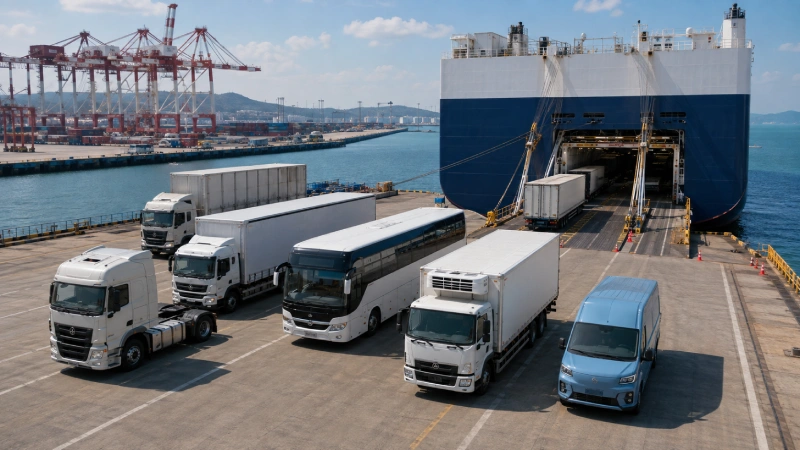
Commercial vehicles can be exported from China by RoRo/PCTC, dry container, flat rack, open top, Mafi, roll trailer or breakbulk shipping. The most suitable method depends on the vehicle’s actual shipping dimensions, weight, running condition, propulsion system and destination. Operational trucks and buses often suit RoRo; small vans or dismantled units may fit containers; oversized or non-running units usually require special handling.
Before booking, confirm China export eligibility, carrier acceptance and destination import rules. For the broader vehicle-shipping framework, read Vehicle Shipping from China.
What Counts as a Commercial Vehicle?
“Commercial vehicle” is a market term rather than one customs classification. This guide covers cargo and panel vans, pickup trucks, minibuses, city and school buses, coaches, light-duty and rigid trucks, tractor heads, dump trucks, refrigerated trucks, tanker trucks, concrete mixers, garbage trucks, tow trucks, fire engines, mobile workshops, trailers, semi-trailers, and electric trucks, vans and buses.
Passenger cars should normally be handled through a general vehicle-shipping guide. Excavators, loaders and bulldozers are non-road construction machinery and need a heavy-equipment logistics plan. Agricultural tractors may fall under HS heading 8701, but their buyer requirements and handling are closer to agricultural machinery. CKD and SKD sets can use several of the methods below, although factory assembly is outside this guide.
Commercial Vehicle Types and Their Shipping Challenges
| Vehicle type | Main shipping challenge |
|---|---|
| Van or pickup | Container-door clearance, body design and HS classification |
| Rigid truck | Height, length, actual weight and deck-space requirements |
| Tractor head | Running condition, wheelbase, axle load and lashing points |
| Bus or coach | Long body, low ground clearance and turning radius |
| Trailer or semi-trailer | Towing, support legs, axle loading and internal cargo |
| Special-purpose truck | High centre of gravity, mounted equipment and loose accessories |
| Electric truck or bus | UN classification, battery condition, SOC policy and carrier approval |
The model name alone cannot determine the transport method. Vehicles from the same product family may have different wheelbases, bodies, axle layouts, roof equipment or mounted systems.
Information Needed Before Requesting a Quote
A reliable quotation starts with a commercial vehicle shipping data sheet containing:
- Make, model, quantity, manufacturing year and new or used status
- VIN or chassis number
- Shipping dimensions: length × width × height
- Actual shipping weight
- Gross vehicle weight rating, or GVWR
- Individual axle weights and wheelbase
- Ground clearance and turning radius
- Running or non-running condition
- Steering and braking condition
- Fuel type or battery chemistry
- Battery capacity and state of charge
- Available lashing, towing and lifting points
- Clear photographs from all sides
- Detachable accessories and mounted equipment
- Cargo loaded in the cab, body or trailer
- Pickup location, destination port, final city and required shipping date
Actual shipping weight is the weight presented for transport. GVWR is the maximum permitted loaded road weight. Confusing them can cause an incorrect freight quote, deck allocation, lifting plan, axle-load assessment or inland road permit. Without verified dimensions and actual weight, a forwarder cannot accurately confirm space or cost.
Shipping Methods for Commercial Vehicles from China
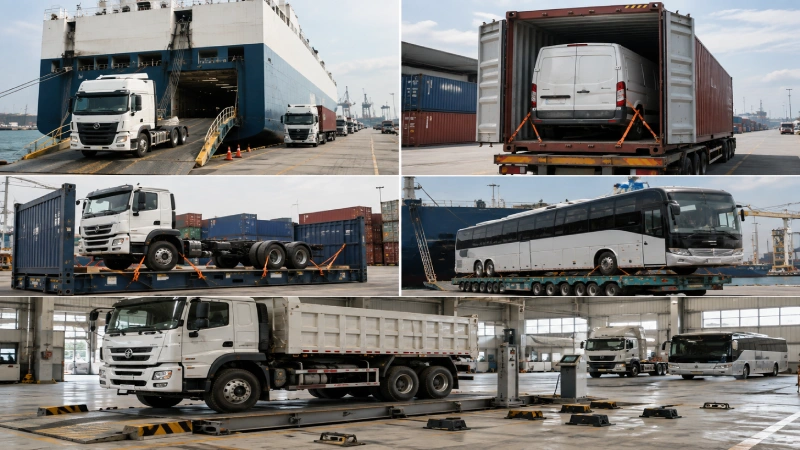
RoRo/PCTC Shipping
RoRo is often the first option for operational trucks, tractor heads, buses, trailers, semi-trailers and fleets of new commercial vehicles. The vehicle is driven or towed through the vessel ramp and secured on a vehicle deck, reducing the need for crane lifting.
Acceptance still depends on the route, ramp angle, entrance dimensions, deck height, deck strength, turning space and vehicle condition. Carriers commonly require working steering and brakes, inflated tyres, no leakage, no broken glass or dangerous sharp edges, usable lashing points, keys, limited fuel and complete vehicle data.
Höegh’s published truck, bus and trailer requirements state that vehicles normally need to be operational. Non-running or towable units are accepted only in limited circumstances and with advance agreement. A non-running truck should therefore never be delivered to a RoRo terminal without written approval.
For a broader explanation of this method, see RoRo Car Shipping from China.
Standard Container Shipping
Dry containers can suit compact cargo vans, pickups, vehicle cabs, chassis, CKD/SKD sets and light commercial vehicles that can be safely dismantled. Container shipping can provide enclosed handling and broader liner schedules, but the unit must pass through the container door and be secured without damaging the vehicle or container.
Check the external and internal dimensions, door clearance, entry angle, ground clearance, weight distribution, access to lashing points and destination unloading capability. The dangerous-goods treatment must reflect the powertrain and the actual container arrangement.
See Container Car Shipping from China for container loading and securing considerations.
Flat Rack or Open Top
Flat racks and open-top containers may suit unitised vehicles, chassis, cabs and special bodies that exceed standard container width or height. They can be useful when a unit remains liftable and securable but cannot enter a dry container.
A flat rack’s nominal payload does not guarantee acceptance. The carrier and terminals still assess axle point loads, concentrated weight, overwidth, overheight, lifting points, lashing arrangements, slot availability and OOG operational limits. Maersk also identifies trucks as a typical special-cargo category requiring case-specific review.
Breakbulk, Mafi or Roll Trailer
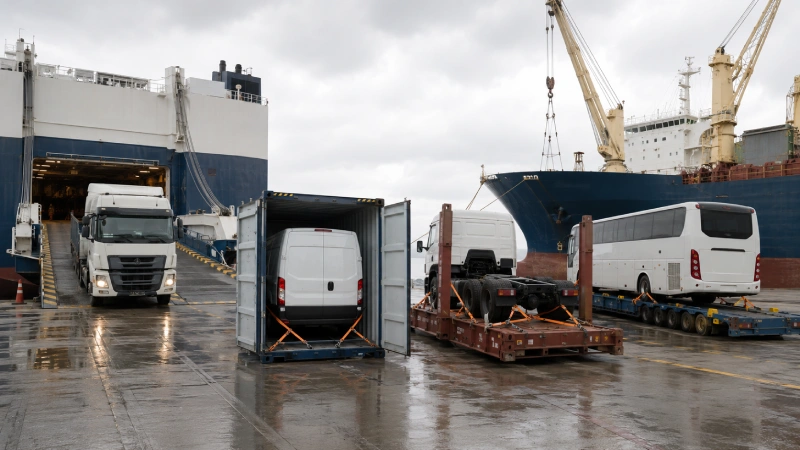
Very large, heavy or non-running fire engines, concrete mixers, coaches, mobile workshops and project fleets may require breakbulk shipping or specialised rolling equipment. A Mafi or roll trailer can allow a non-running unit to be moved aboard a RoRo or multipurpose vessel without relying on its own drive system.
These solutions need an engineering review, suitable terminal equipment and an approved lifting, towing and securing plan. Availability varies by vessel, port and route.
How to Choose the Right Shipping Method
| Vehicle condition | Likely starting option |
|---|---|
| Operational and within PCTC limits | RoRo/PCTC |
| Small enough for safe container loading | Dry container |
| OOG but unitisable and liftable | Flat rack or open top |
| Non-running or very large | Mafi, roll trailer or breakbulk |
| CKD/SKD shipment | Container |
| Damaged or unstable traction battery | Stop and obtain specialist approval |
A starting option is not final acceptance. The actual carrier, vessel, loading terminal and discharge terminal must approve the submitted vehicle data.
Electric and Hybrid Commercial Vehicle Shipping
2026 UN Classification
Under IMDG Code Amendment 42-24, which became mandatory on January 1, 2026, lithium-ion battery-powered trucks, buses and vans are classified as UN3556, Class 9. Lithium-metal battery vehicles use UN3557, while sodium-ion battery vehicles use UN3558.
Hybrid and plug-in hybrid commercial vehicles are not automatically UN3556. Because they combine a battery with an internal-combustion engine or another fuel system, they normally require assessment under the relevant UN3166 entry and applicable special provisions. Conventional diesel or petrol commercial vehicles also require a UN3166 and SP961/SP962 review.
“All new-energy commercial vehicles are UN3556” is therefore incorrect.
RoRo Versus Container Treatment
A vehicle carried in an approved RoRo vehicle space may meet the conditions of SP961. The same treatment cannot automatically be applied to a vehicle packed inside an ordinary freight container. Containerised units may require additional dangerous-goods declarations, marks, labels and carrier approval.
There is also no single IMO SOC percentage that applies to every vessel and route. Carriers may impose stricter SOC, vehicle-age, inspection, battery-record or testing requirements. Correct IMDG classification does not guarantee cargo acceptance.
Used or Damaged Batteries
Disclose collision damage, fire or flood exposure, overheating, deformation, leakage, warning faults, battery repairs and recalls. A damaged, defective or potentially unstable traction battery may require a specialist assessment and can make the vehicle unacceptable for standard sea transport.
For further classification guidance, read UN3556 Electric Vehicle Shipping Guide.
China Export and Destination Compliance
China Export Eligibility
China’s 2026 export licence catalogue continues to cover automobiles, complete vehicle sets and automobile chassis. The qualified exporter or export principal must complete the applicable licence procedure. A freight forwarder can coordinate document flow and customs-booking connections, but it cannot issue an automobile export licence.
New vehicles, used vehicles, modified vehicles and CKD/SKD cargo may require different supporting records. From January 1, 2026, a used vehicle registered for 180 days or less requires an After-Sales Maintenance Service Confirmation issued through the applicable process. Modified vehicles also require evidence proving the authenticity of the modification.
HS Classification
The following headings provide a preliminary reference:
| HS heading | Typical scope |
|---|---|
| 8701 | Tractor heads and certain tractors |
| 8702 | Motor vehicles for carrying ten or more persons |
| 8704 | Motor vehicles for transporting goods |
| 8705 | Special-purpose motor vehicles |
| 8706 | Motor vehicle chassis fitted with engines |
| 8716 | Trailers and semi-trailers |
These headings are not a final classification decision. “Pickup,” “crew van,” “service truck” and “commercial vehicle” are marketing descriptions. Classification may depend on construction, principal use, seating, GVW, axle configuration, propulsion and mounted equipment. The China declaration party and the destination customs broker should verify the final code.
Destination Import Eligibility
Before paying a supplier or booking freight, verify:
- Vehicle age limits
- Left-hand-drive or right-hand-drive requirements
- Emissions and energy-efficiency rules
- GVW and axle-load limits
- Seat count and passenger-vehicle standards
- Type approval or conformity certification
- Pre-export roadworthiness inspection
- Commercial operating licences
- Rules for modified bodies and mounted equipment
- Restrictions on accident, flood, fire or salvage vehicles
Country requirements are not interchangeable. Saudi Arabia applies different conditions to light vehicles, buses, heavy trucks, trailers and semi-trailers. Kenya generally applies age, right-hand-drive and pre-export inspection requirements to used vehicles. The UAE restricts several categories of seriously damaged imported vehicles.
Avoid relying on a generic “Africa import requirement.” Each destination country and intended commercial use must be checked separately.
Step-by-Step Commercial Vehicle Shipping Process
- Confirm that the vehicle is eligible for import, registration and commercial operation in the destination country.
- Verify the China exporter, vehicle status, likely HS heading and export-licence requirements.
- Collect the dimensions, actual weight, axle data, photographs, condition and propulsion information.
- Compare RoRo, container, flat rack, open top, Mafi and breakbulk options.
- Select the China port and destination route based on acceptance, handling and total landed logistics cost.
- Submit the unit to the actual carrier and terminals for cargo acceptance.
- Arrange domestic pickup, vehicle inspection, condition records and port preparation.
- Complete customs, transport and dangerous-goods documentation.
- Deliver the vehicle to the terminal for gate inspection, loading and lashing.
- Coordinate destination clearance, unloading and inland delivery.
A freight quote, booking confirmation, carrier cargo acceptance and final loading approval are different stages. A quoted rate does not mean the vessel has accepted the vehicle.
Vehicle Preparation Checklist
- Test the engine or drive system, steering, brakes, tyres and parking brake
- Repair leaks, broken glass, sharp edges and loose body parts
- Keep lashing and towing points accessible
- Remove personal items and undeclared goods
- Secure spare tyres, tools, detachable accessories and mounted equipment
- Follow the carrier’s fuel-level and SOC instructions
- Provide working keys and operating instructions
- Record the VIN, mileage, warning lights and exterior condition
- Photograph all sides, roof, underbody and battery enclosure
- Confirm whether cargo inside the cab, body or trailer has been approved
- Do not disconnect or alter a high-voltage system without authorised instructions
Can Cargo Be Loaded Inside a Truck or Trailer?
Internal cargo is neither universally prohibited nor automatically allowed. Some RoRo carriers may accept declared goods inside an enclosed truck body or trailer, but each item must be listed, packaged and secured. Doors must remain accessible for inspection, and the load must not make the vehicle unsafe to drive, exceed axle limits or create an unstable centre of gravity.
Do not load personal effects, undeclared goods, loose parts or unapproved dangerous cargo. Do not rely on lightweight side rails as the primary securing points. Obtain written carrier approval before delivering the vehicle to the port.
Documents Required
Commercial and Vehicle Documents
- Commercial invoice
- Packing list
- Sales contract
- VIN or chassis list
- Vehicle certificate or manufacturer data sheet
- Certificate of origin, where required
- Registration or title documents for used vehicles
- Export licence
- Customs declaration
- Destination import permit or conformity certificate
Shipping and Technical Documents
- Booking confirmation
- Bill of Lading
- Vehicle dimensions and actual-weight declaration
- Photographs and condition records
- Loading or lashing plan
- Survey report, when required
- Dangerous Goods Declaration, where applicable
- Battery data, SDS or UN38.3 information requested by the carrier
The exact document set depends on the vehicle, shipping method, carrier, ports and destination regulations.
Main Export Ports and Destination Routes
Chinese departure areas commonly reviewed for commercial vehicle shipments include:
- Shanghai and Taicang
- Lianyungang
- Tianjin
- Qingdao and Yantai
- Guangzhou Nansha
- Shenzhen Xiaomo
- Xiamen
- Qinzhou
- Zhangjiagang and Changshu
Middle East gateways may include Jebel Ali, Jeddah, Dammam and Aqaba. African gateways may include Durban, Mombasa, Dar es Salaam, Djibouti, Lagos, Tema, Abidjan and Kribi.
The lowest ocean freight should not be the only selection criterion. Compare inland collection, vehicle-terminal capability, carrier acceptance, sailing frequency, destination corridor, unloading resources and the final delivery city.
Commercial Vehicle Shipping Costs
There is no reliable long-term fixed “price per truck.”
Total cost = China pickup + port preparation + ocean freight + special handling + documentation + insurance + destination charges + inland delivery
The main cost variables are:
- Vehicle length, width, height and actual weight
- RoRo measurement or occupied deck space
- Special-height deck requirements
- Flat-rack overwidth and overheight
- Mafi or roll-trailer equipment
- Crane lifting, towing and lashing
- Dangerous-goods documentation and surcharges
- Origin and destination ports
- Direct or transshipment service
- Single-unit or fleet volume
- Destination unloading and storage
- OOG inland-transport permits
- Fuel surcharges and current carrier space
A lower sea-freight rate does not always produce a lower landed cost. Difficult unloading, a long inland corridor or special road permits can outweigh the apparent freight saving.
Transit Time and Booking Lead Time
Total lead time includes carrier approval, export documents, domestic pickup, port preparation, waiting for the sailing, sea transit, transshipment, destination clearance and inland delivery.
RoRo can simplify loading and discharge, but PCTC sailings may be less frequent than container services. Plan around the complete logistics cycle rather than sea transit alone.
Main Risks and How to Avoid Them
Major risks include incorrect shipping dimensions, reporting GVWR instead of actual weight, carrier rejection of a non-running unit, inadequate lashing points, loose mounted equipment, undeclared internal cargo, incorrect battery classification, destination age or steering restrictions, missing unloading equipment, absent road permits, insufficient insurance and port storage caused by project delays.
The safest decision sequence is:
Vehicle data sheet → transport method matrix → carrier acceptance → export compliance → destination eligibility → total landed logistics cost
How Winsail Supports Commercial Vehicle Shipments
Winsail can coordinate China pickup, vehicle-data collection, shipping-method comparison, carrier enquiries, booking, port delivery, container or project loading, document flow, dangerous-goods information coordination, destination-agent communication and inland-delivery planning.
Winsail does not issue export licences, make the final HS-code decision, approve dangerous-goods acceptance, or guarantee vessel space, customs clearance or vehicle registration.
FAQ
What commercial vehicles can be shipped from China?
Cargo vans, pickups, buses, trucks, tractor heads, trailers, semi-trailers and many special-purpose vehicles can be shipped, subject to China export eligibility, carrier acceptance and destination approval.
Is RoRo or container shipping better for commercial vehicles?
RoRo often suits operational large vehicles, while containers may suit small vans, cabs, chassis and CKD/SKD units. The correct choice depends on dimensions, condition, route and total landed cost.
Can a non-running truck or bus be shipped from China?
Sometimes, but only after advance approval. The vehicle may require towing, a Mafi, roll trailer, flat rack, lifting plan or breakbulk service.
Can cargo be loaded inside a truck or trailer?
Only with written carrier approval. All goods must be declared, packaged, secured, inspectable and compliant with customs, dangerous-goods and destination rules.
How are electric trucks and buses classified for sea shipping?
Lithium-ion battery vehicles generally use UN3556, lithium-metal battery vehicles use UN3557 and sodium-ion vehicles use UN3558. HEVs and PHEVs require separate assessment and are not automatically UN3556.
What information is needed to quote truck shipping from China?
Provide the make, model, quantity, VIN, dimensions, actual weight, GVWR, axle weights, running condition, powertrain details, photographs, pickup location and destination.
How much does commercial vehicle shipping from China cost?
Cost depends on vehicle size, actual weight, shipping method, route, special handling, dangerous-goods treatment, destination charges and inland delivery. A global fixed price is not reliable.
Which Chinese ports ship trucks and buses to Africa and the Middle East?
Common options include Shanghai or Taicang, Lianyungang, Tianjin, Qingdao or Yantai, Nansha, Xiaomo, Xiamen, Qinzhou and Changshu. The final port depends on the carrier, vessel and destination corridor.
